An employee advocacy program is a repeatable routine that helps people at your company post on LinkedIn from their own profiles, with clear guidelines, content support and a review step. To launch one, pick a goal, recruit three to five volunteers, give each a lane, set a weekly routine and review the numbers after 30 days before you add anyone.
This guide is for B2B companies up to about 200 people, agencies and consultancies that want more of their team visible to buyers. It covers what employee advocacy is, the roles, an eight-step launch, a 90-day plan, what to measure and the mistakes that end programs early. If you want software that runs the routine, see our employee advocacy platform for LinkedIn. If you need a business case first, the free employee advocacy ROI calculator helps you put your own numbers on a pilot.
What is employee advocacy?
Employee advocacy is when people at a company promote their employer and share their own expertise through their personal social profiles. On LinkedIn that means posts, comments and recommendations from real people on your team, instead of the company page doing all the talking.
It takes two shapes, and most programs mix them.
| Approach | What employees do | Works best when | Watch for |
|---|---|---|---|
| Sharing company content | Repost or reshare company news and articles, ideally with their own comment | You have a steady supply of announcements, launches and articles | Identical posts from many people look staged and get little reach |
| Original content | Write about their own work, customers and decisions | People have real expertise that buyers want | Needs writing help and a review step so people can keep it up |
Programs built on the second shape are often called employee-generated content, and our employee-generated content guide covers it in depth. For B2B teams the original kind usually does more, because buyers want to hear from the people who build, sell and support the product.
What employee advocacy is not
- A reshare button. Asking everyone to repost a company update is distribution, not advocacy. People can tell the difference.
- A mandate. The teams we interviewed for our post on how B2B teams get millions of views from employees were all adamant that participation stays voluntary.
- A tool. Software helps, but a program is people, a routine and a goal. A tool without a routine ends up used by a handful of people.
Why B2B teams bother
Buyers decide with people, not logos. A prospect may meet your founder in the feed, then see a product lead explain a design choice and a customer-success manager answer a common question. Each encounter adds to one clear picture of what you know. In our interviews, Cognism said personal profiles get much better exposure and engagement than a company page, which is why they put launch posts in the hands of the right people instead of resharing one announcement.
Employees benefit too: a visible expert profile helps their careers, and recruiters and candidates see a real team. The honest limits are that it takes time, results vary from person to person, and attribution is rarely clean. Cognism told us you will not get a report saying one post produced a specific amount of pipeline, but candidates and prospects do mention seeing the team in their feed.
What a program includes
A one-off campaign asks people to share something once. A program is the system that keeps it going. Six parts make it work.
| Part | Question it answers | Output |
|---|---|---|
| Goal | What do we want LinkedIn to do for the business? | One sentence and one metric |
| People | Who takes part and who owns the routine? | A volunteer list, a sponsor and an owner |
| Lanes | What does each person talk about? | Two or three themes per person |
| Content workflow | How does an idea become a post? | Input, draft, review, schedule |
| Guidelines | What is safe and expected? | A one-page policy |
| Measurement | How do we know it works? | A monthly one-page review |
How to launch an employee advocacy program: 8 steps
Step 1: Pick one goal
Programs fail when they try to do everything. Choose one primary outcome for the first 90 days.
| Goal | What it looks like | What to watch |
|---|---|---|
| More qualified conversations | Prospects reply to posts or mention them on calls | Replies, DMs, "I saw your post" on sales calls |
| Hiring | Candidates know the team before they apply | Referrals, applicants who cite posts |
| A product launch | Several voices explain the same news | Reach and engagement during launch week |
| Customer trust | Customers see how the team thinks | Comments from customers, renewal conversations |
Do not bundle all four. Pick the one your leadership cares about, so the program has a sponsor.
Step 2: Name a sponsor and an owner
You need two roles before you invite anyone.
| Role | Job | Time in a pilot (planning guess) |
|---|---|---|
| Sponsor | A visible leader who posts first, backs the program and removes blockers | A few minutes a week |
| Owner | Runs the routine: invitations, content support, review, monthly numbers | Two to three hours a week for five people |
| Participants | Write and publish posts in their own voice | 30 to 45 minutes a week each |
| Reviewer | Checks posts against the guidelines, quickly | A few minutes per post |
These are planning choices, not benchmarks. Adjust them after the first month. If nobody owns the routine, the program quietly stops.
Step 3: Recruit three to five volunteers
Start with people who are near your buyers and willing: a founder or senior leader, someone in sales, someone in product or engineering, and someone in customer success. Invite each person one to one and explain what is in it for them. Let them say no.
Map people by how much help they need, a tier system Storylane described in our interviews:
- Tier 1: already posting and writing their own material. They need visibility and encouragement.
- Tier 2: have ideas but no time to write. They need help with planning and drafting.
- Tier 3: not natural posters, but happy to support colleagues and join a campaign.
Most of your effort goes to Tier 2. For wording and what to say, see our guide on how to get employees to post on LinkedIn.
Step 4: Write one page of guidelines
People hold back when they fear breaking a rule. A single page removes that fear. Cover:
- What they can share: public company news, their own work, lessons that contain no confidential detail.
- What stays private: unreleased products, financials, customer names without permission, personal data.
- How to refer to the company, and a reminder that readers see them as a representative.
- Whether and how to mention their employer in posts. Rules differ by country and context, so check with legal or compliance. Our employee-generated content guide has a short FAQ on mentioning your employer in posts.
- Who to ask when unsure, and how fast they will get an answer.
- A plain line that taking part is optional.
GitLab publishes its approach in its public handbook. The social advocacy curator page asks curators four questions before content goes out: does it include sensitive or non-public information, is it accurate and verifiable, does it include financial data, metrics or predictions, and could sharing it harm people or the business. Those four make a good check for any program.
Step 5: Give each person a lane
A person who knows what they talk about posts more often. Give each participant two or three themes that sit where their audience's questions, their own experience and their interest overlap. A sales lead might own "evaluation mistakes" and "customer questions". A product lead might own "what we decided not to build". Our guide to content pillars walks through the method, and the free content pillar generator gives you a starting set from a website or LinkedIn URL.
Share the themes across the team, but not the posts. One company can have a handful of shared themes while each person leads the one they know best.
Step 6: Build a weekly routine
Consistency beats volume. Start with one post a week per person, which is a planning choice and not a benchmark, and protect the time for it.
| When | What happens | Who |
|---|---|---|
| Monday | Each person picks one idea: a customer question, a decision, a lesson | Participant |
| Tuesday to Wednesday | A first draft is written and edited | Participant, with writing help |
| Within one working day | Review against the guidelines | Reviewer |
| Thursday | Post is scheduled or published | Participant |
| Following days | Reply to comments, comment on a colleague's or customer's post | Participant |
| Friday | Owner checks who is blocked and offers help | Owner |
Match the cadence to your capacity. Our guide on how often to post on LinkedIn covers frequency for different profiles.
Step 7: Decide the review path
Too much review kills momentum and too little creates risk. Choose a level by topic:
- Light: the author approves expertise posts that use no confidential detail.
- Standard: a manager or marketing lead approves posts about the company, customers or launches.
- Strict: legal or compliance approves posts in regulated areas.
Agree a response time, such as one working day, and a rule for silence: a post that nobody approved does not go out, but the reviewer owes an answer fast. Give feedback on facts and risks, not on style. Each person's tone is the reason the program works.
Step 8: Measure and review monthly
Track a small set of numbers and meet once a month for 30 minutes.
| Metric | What it tells you |
|---|---|
| Participation rate | Share of invited people who posted this month |
| Consistency | Posts per person per week |
| Reach | Impressions across the team's posts |
| Engagement rate | Reactions, comments and reposts divided by impressions |
| Follower growth | Net new followers per participant |
| Useful conversations | Replies, DMs, referrals and mentions on calls |
| Business outcomes | Meetings, hires or deals you can trace to a post |
GitLab's team member advocacy handbook page lists a similar set for its own program: the percentage of invited people actually taking part, active participation each period, top contributors, organic reach, engagement and an advertising-equivalent value. Participation comes first on that list, which is a good reminder that a program lives or dies on people posting.
Reach will swing from post to post, so wait for several posts per person before you judge. For turning these into a figure your leadership accepts, use the employee advocacy ROI calculator, and see our post on measuring social media ROI for the wider picture.
A 90-day rollout plan
| Phase | Days | Focus | Done when |
|---|---|---|---|
| Set up | 1 to 14 | Goal, sponsor, owner, guidelines, volunteers, lanes | Every volunteer has said yes and has two or three themes |
| Pilot | 15 to 30 | Weekly routine, one post per person per week, fast review | Each person has published at least two posts |
| Stabilize | 31 to 60 | Fix blockers, add recognition, first monthly review | The group posts without reminders |
| Decide | 61 to 90 | Review results, choose whether to add a second group | You can say what worked and why |
Expand only when the pilot group posts without constant chasing. Add the next group of three to five, not the whole company.
Spreadsheet and Slack, or software?
A small pilot can run on a shared document, a Slack channel and the owner's calendar. That works for five people. It strains when you have more profiles, several reviewers or a need to see everyone's results in one place. Software earns its place when you want weekly plans per person, drafting help, scheduling, an approval queue and team analytics together.
Employee advocacy tools come in two kinds: those that help people write original posts, and those that give people approved company content to share. Our comparison of the best employee advocacy tools sorts ten of them by company size and approach.
Common mistakes
- Launching to the whole company. Programs that start big tend to fade within weeks. Start with a few willing people.
- Mandating participation. Quotas produce reshares and resentment.
- Sending the same post to everyone. Six identical posts add little. Give each person a lens instead.
- No owner. If nobody runs the routine, it stops.
- No input. Asking for posts without giving ideas, sources or a brief leaves people with a blank page.
- Reviewing for style. Review for facts and risk. People should sound like themselves.
- Measuring only likes. Track participation, consistency and conversations too.
- Skipping recognition. Thank people in public, and share what their posts led to.
How Postiv runs an employee advocacy program
Postiv (postiv.ai) is a social workspace for you, your team and your agent. Bob, its AI agent, plans each person's posting week and writes with them in their own voice. The Team plan includes unlimited members and LinkedIn profiles, so the pilot and the full rollout run in the same place. Here is how it maps to the eight steps.
- People and profiles (steps 2 and 3). Invite teammates as members or admins. Each person connects their own LinkedIn profile, and you can add company pages next to them. Every profile has its own pillars, writing style and weekly plan, and Bob does not mix them.
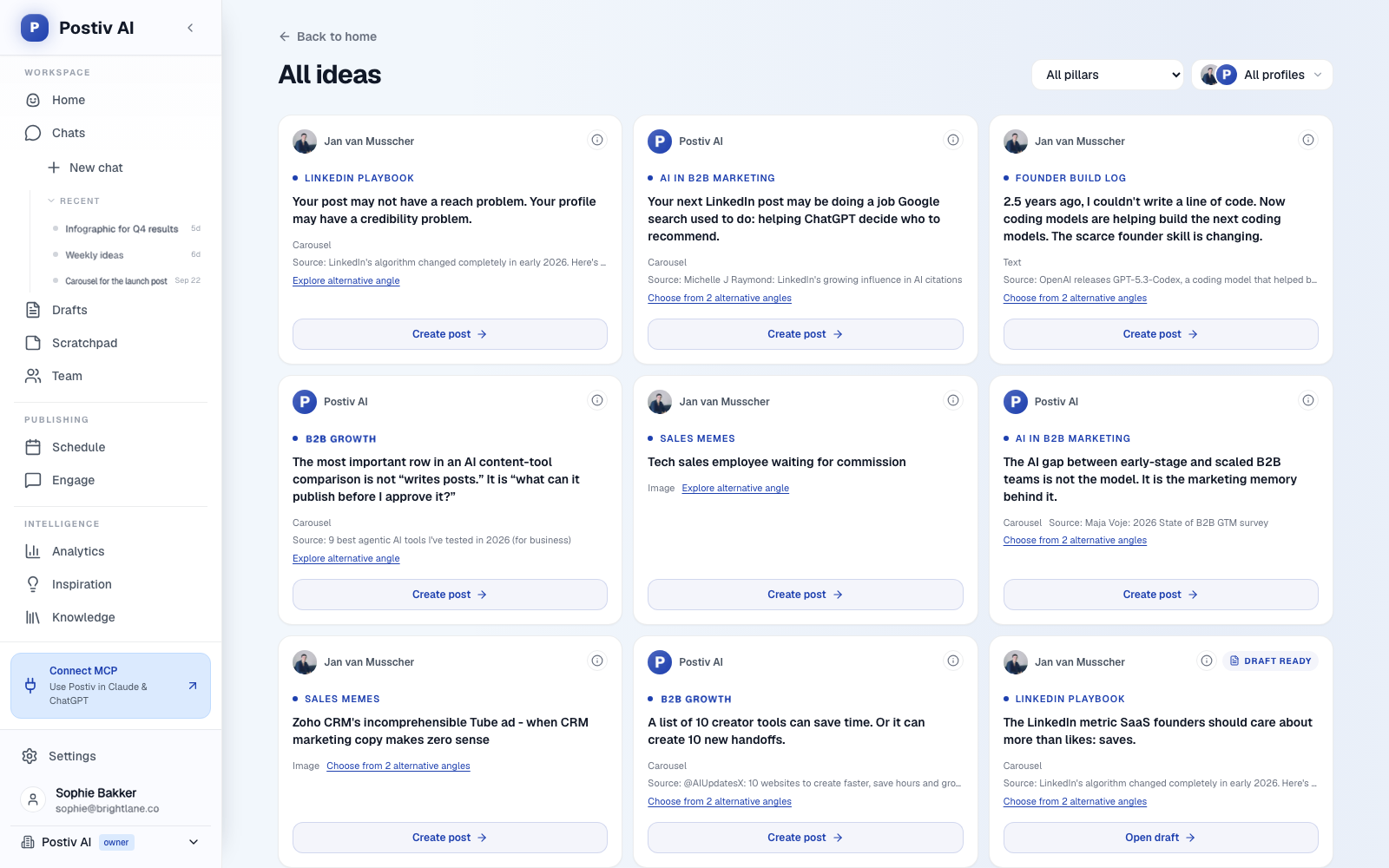
- Lanes (step 5). Give each profile up to five pillars. Bob proposes a starting set from the person's analytics and knowledge base, and saves it only after they confirm.
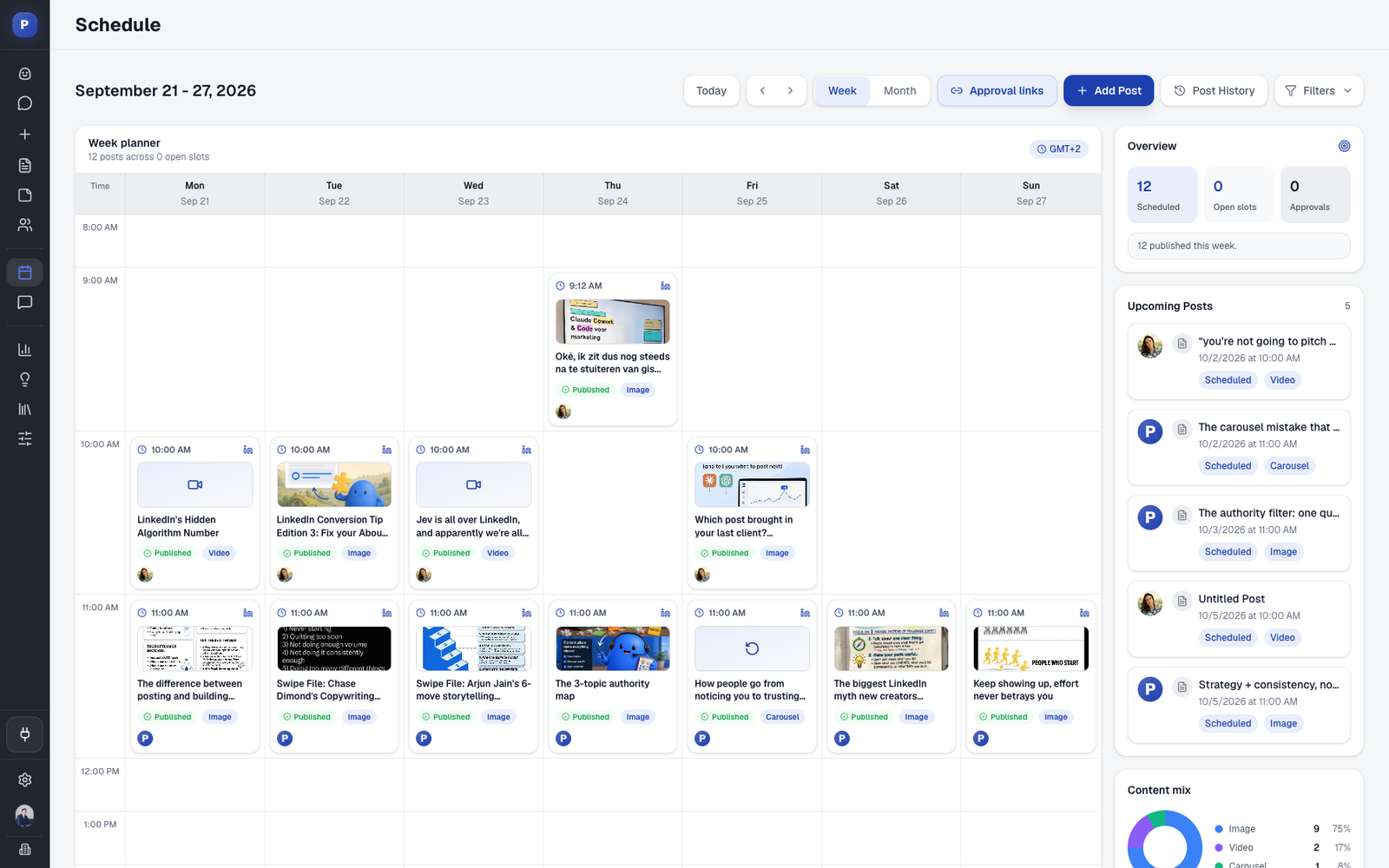
- Routine (step 6). Bob prepares a weekly plan with one idea per posting day: a topic, an angle, a format, sources and the pillar it belongs to. The person opens an idea, drafts it with Bob, edits it and schedules it. Nothing goes to LinkedIn until they schedule it.
- Shared facts. Add your website, documents, Notion pages and newsletters to the knowledge base, so every draft starts from real company material instead of invented examples.
- Review (step 7). Choose approvers per profile or company page. Every approver must approve, one denial stops the post, and "request changes" sends it back with feedback. If you are the only approver on your own profile, your posts go straight through.
- Team Hub. Share briefs with an angle and a deadline, run challenges with points, see a leaderboard for posts, reach and streaks, and get Slack reminders when someone is behind on their weekly goal.
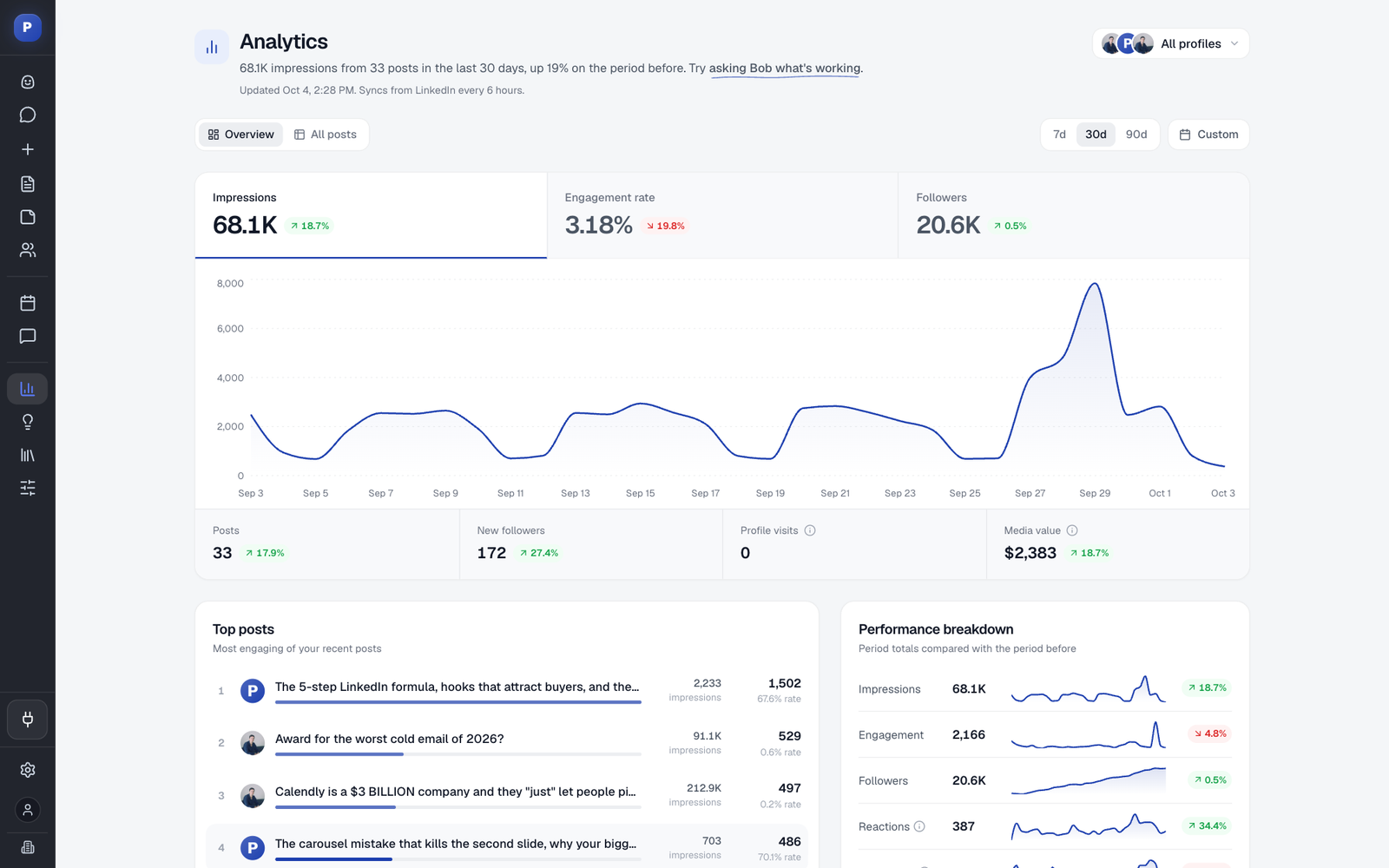
- Measurement (step 8). Analytics show impressions, engagement rate, followers and profile visits per profile and per post, and each pillar's last 30 days feed into the next plan. Conversations and pipeline you note yourself.
Agencies get a separate workspace for each client, so profiles, plans and approvals stay apart. Postiv is built for people who write their own posts, so if your main need is a library of approved company posts for one-click resharing, look at the tools in our comparison. Our employee advocacy platform page shows the workflow in a 10-minute walkthrough. Postiv has a 7-day free trial.
Ready to see real programs first? Browse these employee advocacy examples, with real programs and scenarios by company type.
FAQ
What is an employee advocacy program?
An employee advocacy program is a repeatable routine that helps people at a company represent their expertise and the business on their own social profiles. It defines who takes part, what each person posts about, how posts are drafted and reviewed, when they go out and what the team measures. For B2B teams the profile that matters is usually LinkedIn.
What is an example of employee advocacy?
A product lead explains on LinkedIn why the team chose a simpler feature. A salesperson shares the question buyers ask most and how to evaluate it. A customer-success manager answers a common support question in a short post. Each is a real person adding a point of view, not a reshare of a company announcement. Our employee advocacy examples post has more.
How do you start an employee advocacy program?
Pick one goal, then recruit three to five volunteers, one visible leader and one person who owns the routine. Write one page of guidelines, give each person a lane of two or three themes, set a weekly writing block and a review step, and look at the results after 30 days before you add anyone.
How many employees should I start with?
Three to five volunteers is enough for a pilot. A small group is easy to support one by one, and you learn what blocks people before you scale. Add more people only when the first group posts every week without reminders.
What are the golden rules of employee advocacy?
There is no official set of three, but the same rules show up in programs that last. Keep it voluntary, make it easy to start, and let people write in their own words. Add a named owner, a clear review step and a monthly look at the numbers, and the program survives its first quarter.
Should an employee advocacy program be mandatory?
No. Forced posting reads as forced and people stop after a few weeks. Invite people individually, let them decline without consequences, and recognize those who take part. Use time at work and practical help, not quotas, to make participation realistic.
How do you measure an employee advocacy program?
Track participation (how many invited people post), consistency (posts per person per week), reach, engagement rate, follower growth and useful conversations such as replies, DMs and mentions on sales calls. Review them monthly. Judge reach only after several posts per person, because single LinkedIn posts vary a lot.
How long before an employee advocacy program shows results?
Participation and consistency show within the first month. Reach and conversations take longer, because each person needs several posts before their audience notices a pattern. As a rule of thumb, wait four to six weeks and at least four posts per person before you judge the program.
Launch your pilot this month
Pick one goal and write it down. Name a sponsor and an owner, invite three to five volunteers one to one, and give each a lane. Put a 30-minute writing block in everyone's calendar, set the review path, and book the first monthly review for day 30. To run it in one workspace, try Postiv free for 7 days.