Best Employee Advocacy Tools for B2B Teams in 2026
The best employee advocacy tools for B2B teams get more people at the company posting on LinkedIn, and Postiv is our #1 pick for companies up to about 200 people and for agencies. The rest of the list is EveryoneSocial, DSMN8, Sociabble (now the Poppulo Experience Platform), Haiilo, Oktopost, PostBeyond, GaggleAMP, Hootsuite Parliament (previously Hootsuite Amplify) and Sociuu. Most of these suites are built for large companies, with quote-only pricing, annual terms and, in some cases, minimums of 100 seats or more, and many of them share company-approved content. Postiv is built for employees and leaders who post original content in their own voice, each with a weekly plan from Bob.
If you are still weighing the category, start with our employee advocacy platform for LinkedIn page, which sets creator-first programs against distribution-first ones. Facts about the other vendors come from each vendor's own pages, checked October 2026.
Every pick covers who it is best for, what it does well, a good first workflow, setup and plan notes, strengths and limits. Prices are left out on purpose, because most of these vendors quote by team size and the figures change.
Picks at a glance
| # | Tool | Best for | Why it made the list |
|---|---|---|---|
| 1 | Postiv | Companies up to about 200 people and agencies whose people write their own posts | A weekly plan per person, approvals, scheduling, analytics and a shared asset library in one workspace |
| 2 | EveryoneSocial | Large programs that need governance | Collections, audiences, approval roles and an MCP server that names Claude |
| 3 | DSMN8 | Campaign-led programs from 50 to 50,000 employees | An auto-collected content feed, Personal Voice AI and executive delegation |
| 4 | Sociabble (now Poppulo) | Advocacy inside an employee experience suite | Reach to frontline staff, Ask AI and an AI LinkedIn coach |
| 5 | Haiilo | Suite buyers who want public tier names | Starter, Scaling and Enterprise tiers and one-tap sharing |
| 6 | Oktopost | B2B marketing teams on a social suite | An Advocacy Board connected to its social management platform |
| 7 | PostBeyond | Teams that want to try before they buy | A published 30-day trial for up to 30 enrolled employees |
| 8 | GaggleAMP | Activity-driven programs | Assigned activities, an AI Suite in every plan and Slack or Teams feeds |
| 9 | Hootsuite Parliament | Hootsuite Enterprise customers | Admin-built posts, Slack and Teams sharing and MCP for admins |
| 10 | Sociuu | Enterprise comms and HR teams | A Content Hub, AutoFlow and earned media value reporting |
What are employee advocacy tools?
Employee advocacy tools are software that helps people at a company create or share content from their own social profiles, so the company's message travels through personal networks and not only through the brand page. For B2B teams the profile that matters is almost always LinkedIn.
Employee advocacy software comes in two broad models. A distribution-first tool keeps a library of approved company content, adds one-click sharing and reports on shares and earned media value. A creator-first tool helps each person plan and write original posts, with a review step before anything goes live. Programs built on original posts are often called employee-generated content, and our employee-generated content guide has examples and a 30-day plan.
Most vendors now sit between the two, because they have added AI drafting and personalization to a content library. What still differs is the starting point. In a distribution-first tool the company hands a post to the employee. In a creator-first tool the employee brings an idea, and the tool helps shape it.
Comparison table
Cells say "check their docs" where the vendor's pages did not confirm a detail. Prices are left out on purpose.
| Tool | Content model | AI writing help | Approvals | Size signal | Free trial |
|---|---|---|---|---|---|
| Postiv | Original posts from a weekly plan | Bob plans and writes with each person | Approvers per profile | Up to about 200 people and agencies; unlimited members on Team | 7-day free trial |
| EveryoneSocial | Collections and Topics, plus user submissions | Drafts and personalizes per person | Review and approval roles | Anchored on 500-person pilots and up | Quote or demo; check their docs |
| DSMN8 | Auto-collected company content feed | Personal Voice AI and Company Voice AI | Pre-approve posts, lock captions | Says 50 to 50,000 employees | Quote or demo; check their docs |
| Sociabble (Poppulo) | Pre-approved content library | Ask AI and an AI LinkedIn coach | Moderation and approval workflows | Check their docs | Demo only |
| Haiilo | Ready-to-share feeds | AI-guided creation; AI tone of voice on Enterprise | Built-in approvals | Starter tier needs 100 seats | Request-based; check their docs |
| Oktopost | Pre-approved content on an Advocacy Board | AI Assist listed; check their docs | Approval workflows | Check their docs; annual plans | Quote or demo; no trial mentioned |
| PostBeyond | Library with a personalized feed | AI captions (beta) | Compliance flags; check their docs for an approval step | Trial up to 30, Growth from 100, Enterprise 250+ | 30-day trial via sales |
| GaggleAMP | Activities assigned to members | AI Suite in every plan | Pre-approved content; check their docs for multi-step | Priced by company size | Quote or demo |
| Hootsuite Parliament | Admin-built pre-approved posts | Built-in AI captions | Admin sets whether people may personalize | Inside the Enterprise plan | Demo only |
| Sociuu | Content Hub reshares | AutoFlow and Leadership Mode drafts | Pre-approved queues for leaders | Select up to 100, Growth from 200 licences | No public trial |
How to choose employee advocacy software
Lists of the best employee advocacy platforms tend to compare feature counts, and almost every vendor here ticks the same boxes: curated content, easy sharing, points or leaderboards, share analytics and AI caption help. For a company under about 200 people, these questions decide more.
Who writes the post? Distribution-first tools hand employees approved company content to share. Creator-first tools help each person write their own. Most vendors here now sell AI that writes or personalizes the post per employee, so AI alone no longer separates them. Where the idea comes from does.
How many seats, and for how long? Ask for minimums and term before the demo. Haiilo's Starter tier has a 100-seat minimum, PostBeyond's Growth tier starts at 100 enrolled employees, EveryoneSocial's pricing starts from 500-person pilots and GaggleAMP's standard contract runs two years. DSMN8 and Oktopost sell annual plans.
How does it connect to LinkedIn? Ask how each employee connects, and get the answer in writing. An employee-level LinkedIn connection is documented for EveryoneSocial, Haiilo, GaggleAMP and Hootsuite Parliament, and DSMN8 documents it for executives. For Poppulo, Oktopost and PostBeyond we could not confirm the method. Postiv publishes through LinkedIn's official API. Expect reconnect prompts with any tool.
Who approves what? Central-library tools approve the company's content once, then employees share it. For original posts, approvers sit on each profile, as in Postiv, or someone reviews each draft before it publishes. Pick the model that matches the posts you expect.
What will you measure? Most vendors report earned media value, a figure each tool calculates, alongside reach and engagement. Ask how it is calculated, and decide whether you want money-shaped estimates or conversations your team can see. Vendor ROI and number-one claims are marketing, so treat them that way.
Software or service? If you would rather hand the writing to someone else, that is a service, not software. Our Rally Up alternatives guide covers that route.
Can you try it? Most vendors here sell through a demo or a quote. Run one test on whatever you shortlist: how long does a new volunteer take to go from invite to first approved, scheduled post?
The 10 best tools for employee advocacy in B2B
1. Postiv
Best for: B2B companies up to about 200 people, and agencies, where employees and leaders post original content in their own voice.
Postiv is a social workspace for you, your team and your AI agent. Each person on the team works with their own Bob, Postiv's planning and writing agent. Bob builds a weekly plan from that person's content pillars, sources and past results, then writes with them, so "what should I post this week?" starts from a plan and not a blank page. Everyone shares one workspace for approvals, scheduling, analytics and an asset library.
Most advocacy suites are built around company-approved content: marketing prepares it and employees press share. Postiv works the other way round. Employees and leaders publish original posts and carousels from their own profiles, and the company's job is to give each person a lane, a plan and a review step. Company news still has a place, as a source Bob can draw on next to customer questions, meeting notes and the person's recent posts.
Publishing goes through LinkedIn's official API, from personal profiles and Company Pages, with no password, session cookie, scraping or browser automation. X accounts work in the same workspace.
What it does well for B2B teams:
Plan
- A weekly plan for every person, tied to their own pillars, so a salesperson, a product lead and a founder each get a different lane.
- A knowledge base that holds your website, documents, YouTube videos, Notion pages and newsletters, so ideas start from your own material.
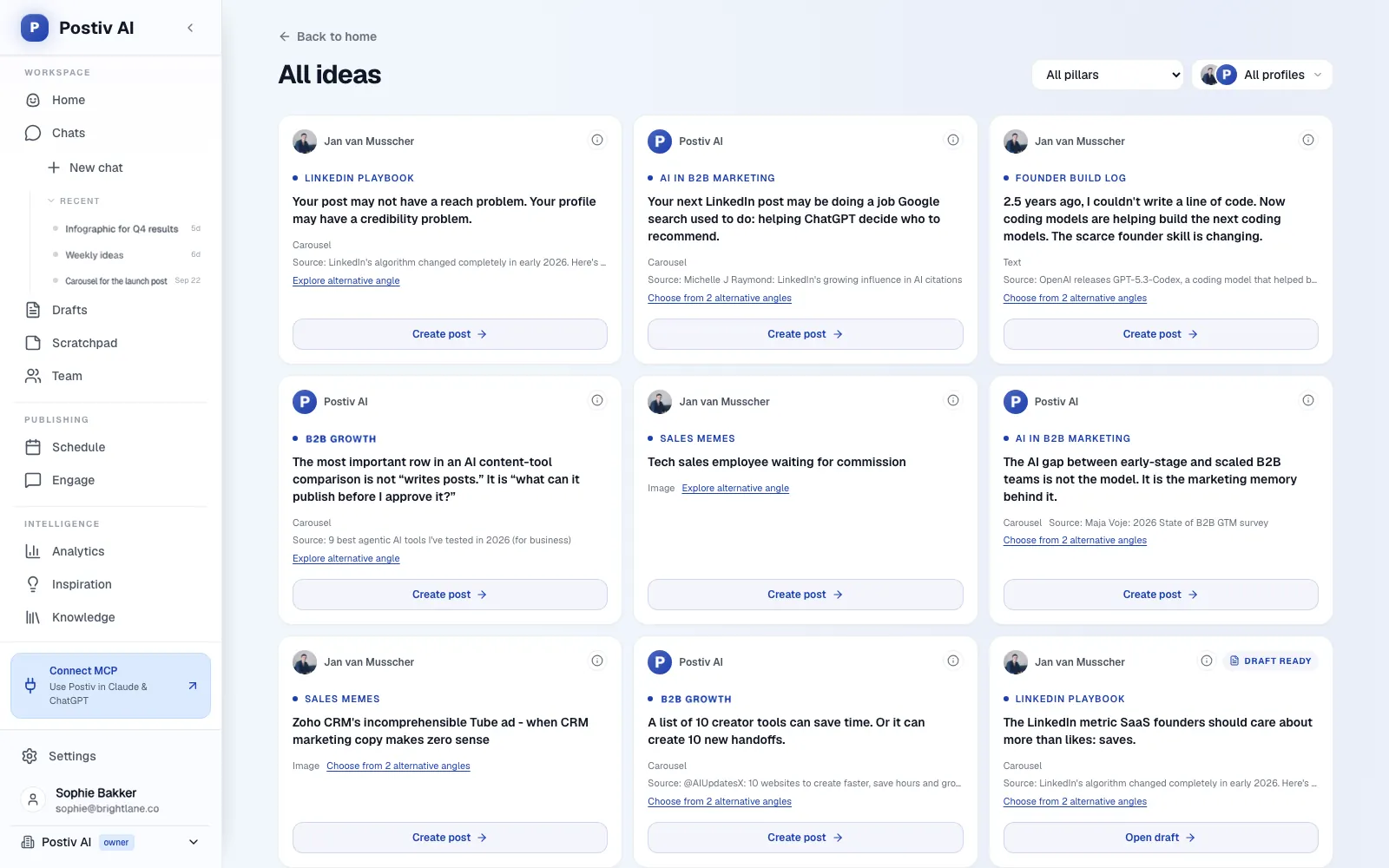
- An inspiration library of LinkedIn posts taking off in your niche, where you turn the idea and format into your own post.
Write and review
- Posts, carousels, images and infographics on your brand, drafted with Bob and finished in the author's own words.
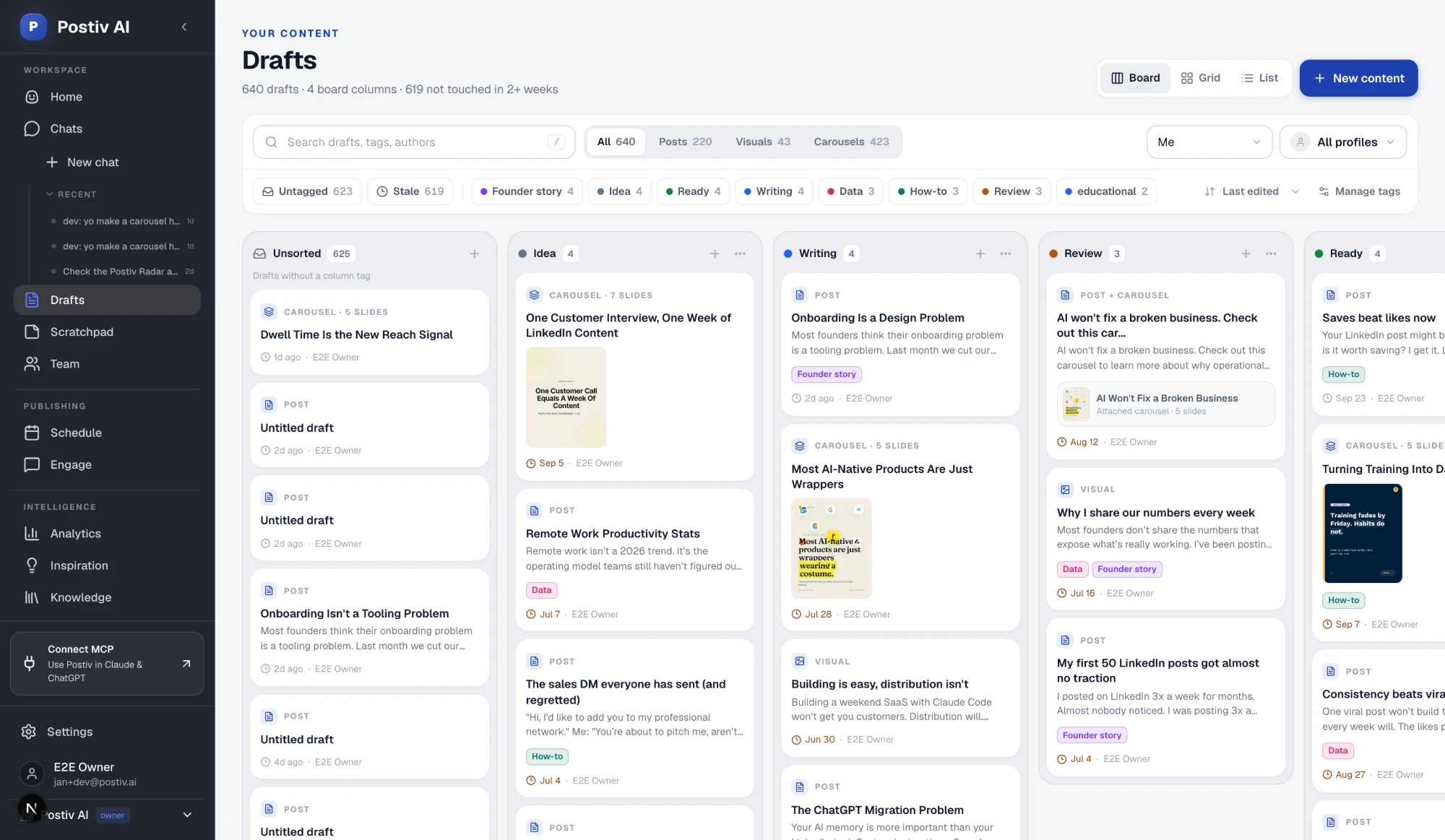
- A drafts board with Idea, Writing, Review and Ready columns, so a team lead can see where every post stands.
- Each person edits and approves their own post before it reaches an approver.
Approve and schedule
- Roles, approvers per profile and a Team Hub, covering every profile and Company Page in one workspace.
- On a profile with approvers, a scheduled post waits for approval. Approvers can approve, request changes or deny.
- One calendar for every profile, Company Page and channel, with posting slots and an automatic first comment.
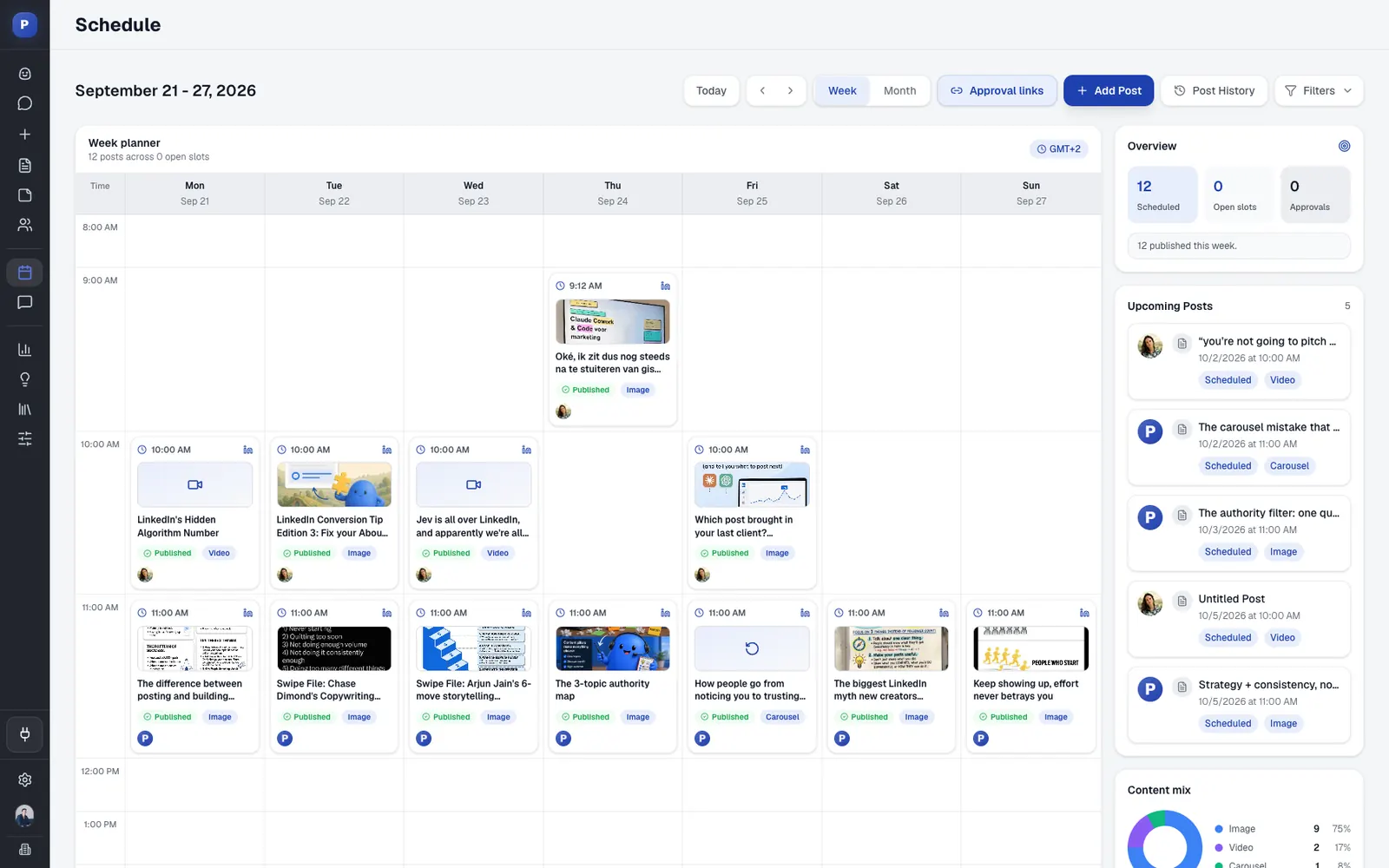
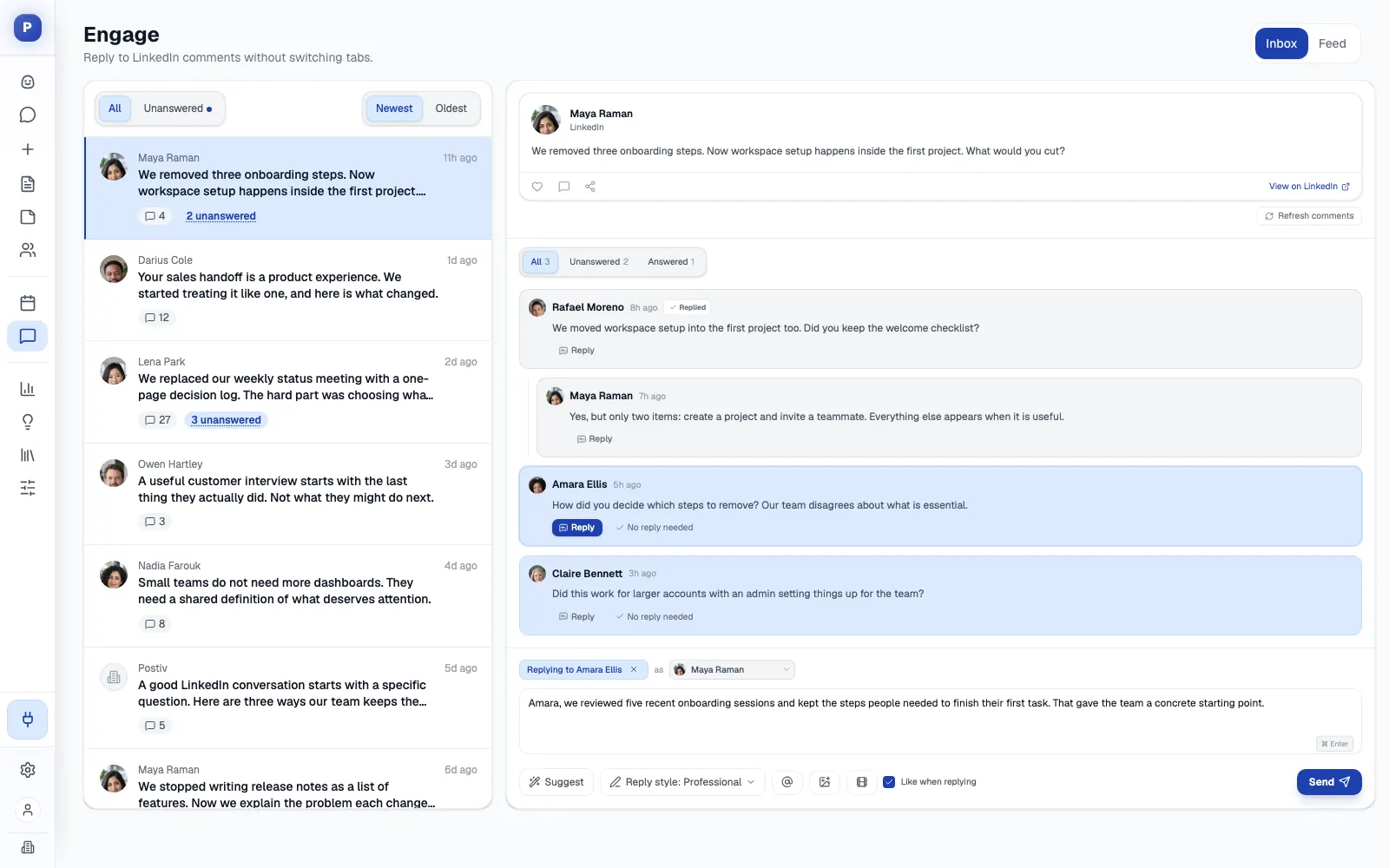
Engage
- One inbox for every comment on every profile, plus a feed of the people you want to reach. Replying from one place keeps good threads from going cold when colleagues are busy.
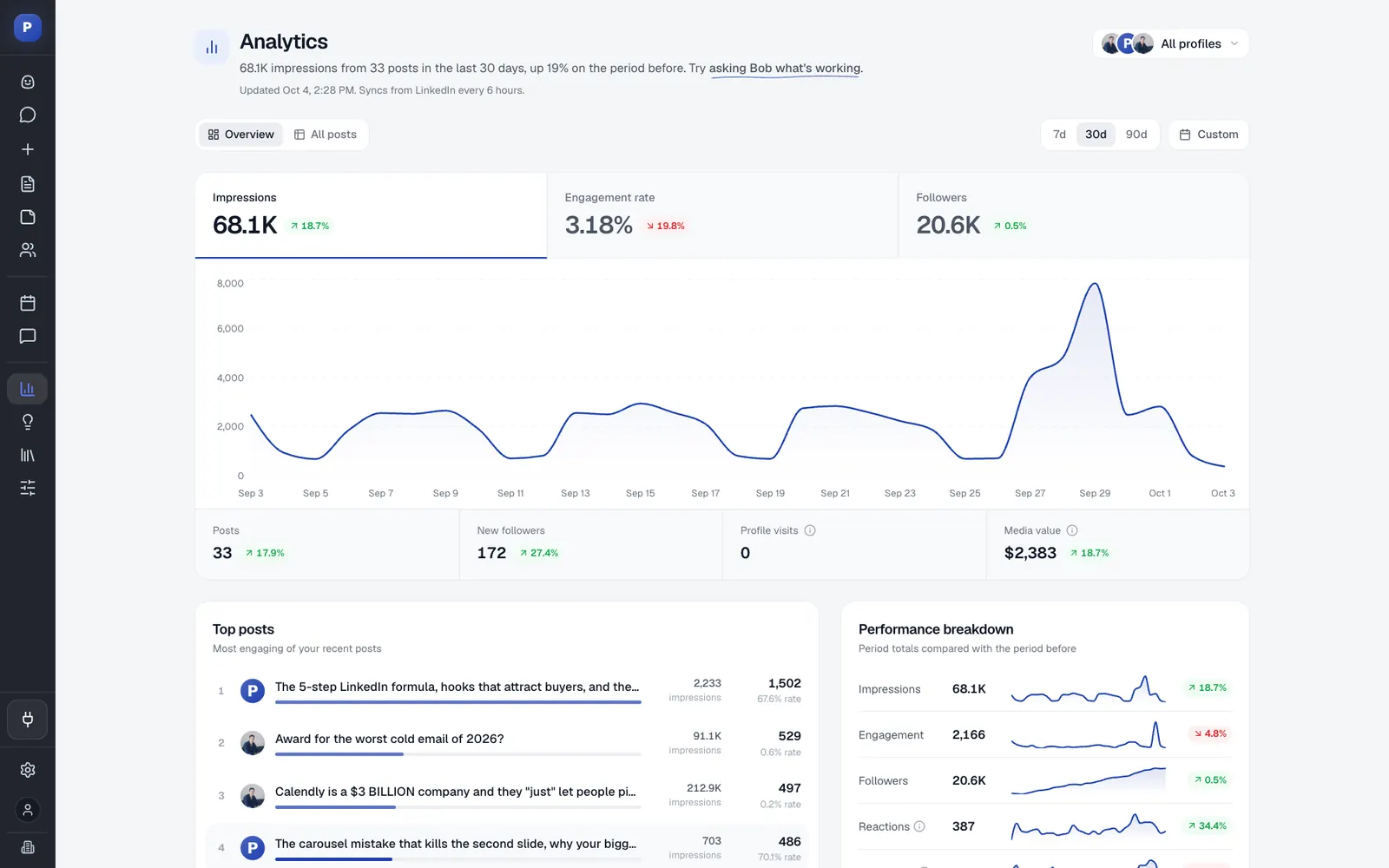
Measure
- Reach, engagement and followers per post and per profile, in LinkedIn analytics that import on a schedule.
Agencies can keep each client in its own workspace. Claude, ChatGPT and other AI apps can also work in the workspace through a hosted MCP server at https://postiv.ai/mcp, which helps if your team already lives in an assistant.
A week might run like this. On Monday each person opens their plan, picks the idea that fits their week and drafts with Bob. By Wednesday the post sits in the Review column, and on a profile with approvers the approver approves it, requests changes or denies it. Scheduled posts go out in their posting slots, colleagues reply to comments from the inbox, and at the end of the month the analytics show which topics earned a place in the next plan.
Good first workflow: Pick three to five volunteers and one visible leader, connect their LinkedIn profiles and set up each person's audience and three content pillars with Bob. Put an approver on each profile before anyone schedules. In week one, aim for one approved, scheduled post per volunteer, then review the drafts board and analytics together once a month.
Setup and plan notes: 7-day free trial. The Team plan includes unlimited members and LinkedIn profiles, collaborative workflows, approval processes and a shared asset library. Invite teammates, assign roles, then choose approvers per profile.
Strengths:
- Every person has their own plan, pillars and voice, so one company shows up through several distinct voices.
- Approvals, scheduling, analytics and the asset library sit in the same workspace as the writing.
- Unlimited members and profiles on Team, plus a trial, make a small pilot easy to start.
Limits:
- It is a paid product, with a 7-day free trial.
- It is built for content, not outreach: no direct messages or connection requests.
- Analytics are scheduled imports, not live reads.
- It is built around people writing their own posts. A program whose main job is pushing a library of approved company posts to thousands of employees fits a distribution-first suite better.
2. EveryoneSocial
Best for: larger programs that want audiences, approval roles, deep integrations and an MCP connection to Claude.
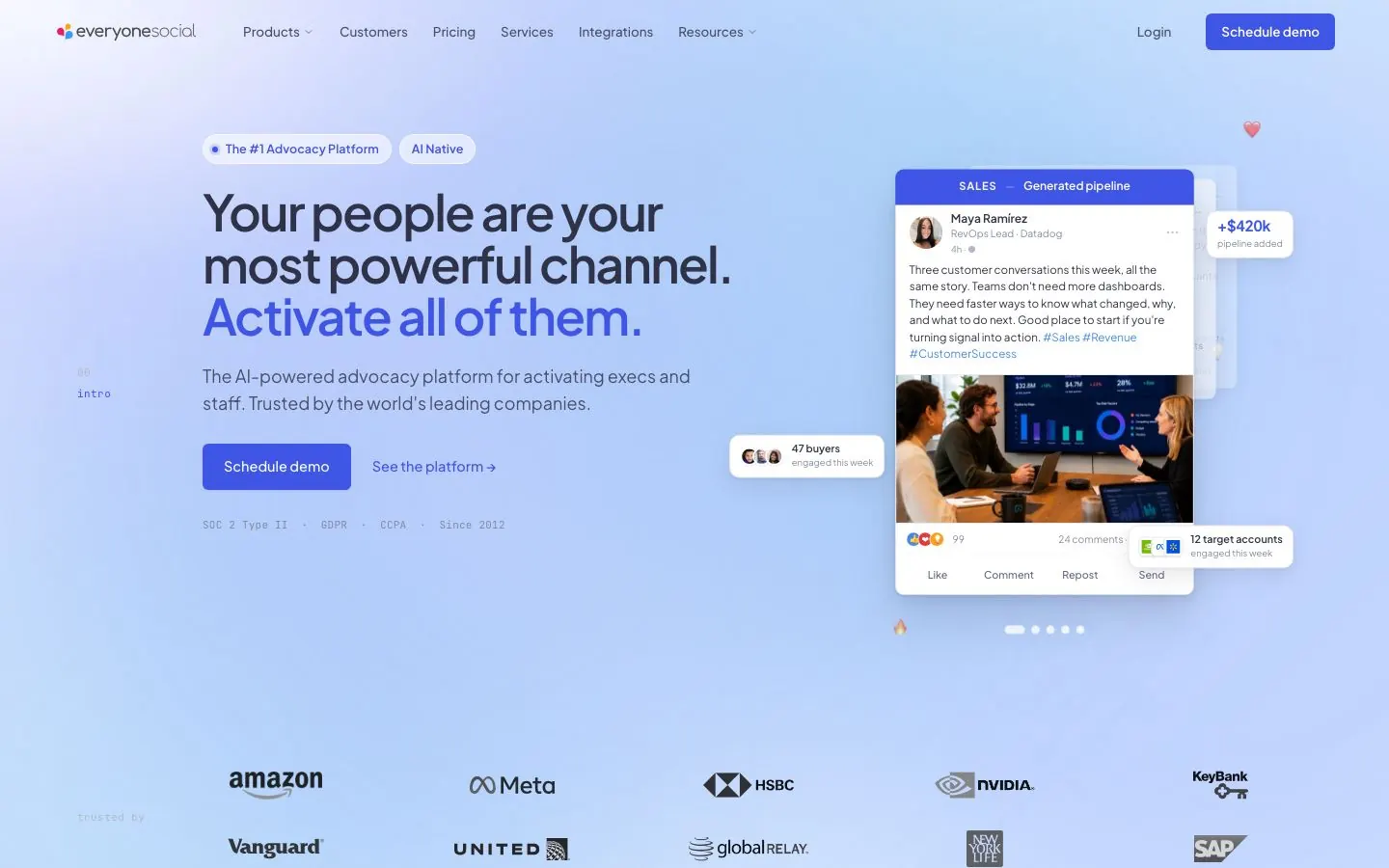
EveryoneSocial describes itself as an AI-powered advocacy platform for activating executives and staff. It has been in market since 2012 and shows SOC 2 Type II, GDPR and CCPA badges. Its site names executives, sales, marketing, comms, HR, recruiting, employer branding, ABM, agencies and channel partners as users. The pricing page frames programs as running from pilots of 500 people up to global rollouts of 50,000 or more.
What it does well for B2B teams:
- Content sits in Collections and Topics, and users are segmented into audiences. Sources include a CMS or DAM (Opal), user submissions and an AI recommendation engine for third-party content.
- AI covers brand voice, drafting posts and personalizing the share copy per person.
- Review and approval workflows, with roles for Admin, Moderator, Contributor, User and External.
- Employees can share from Slack, Teams, Outlook, Google Chat, SharePoint, native social apps or an AI assistant. LinkedIn, X, Threads and Facebook are native integrations.
- Outcome analytics and earned media value, with integrations into Salesforce, HubSpot, Microsoft Dynamics, Google Analytics, Adobe Analytics and Tableau, plus an API.
- An MCP server lets admins and users invite users, review and approve content and pull analytics from AI tools such as Claude. A separate compliance product covers FINRA, SEC and FCA rules for regulated firms.
Good first workflow: Start with a pilot group. Create a Topic and a Collection, name a Moderator to approve the first batch, and have each pilot user connect LinkedIn with OAuth. EveryoneSocial says it receives a temporary access token instead of the password. Let the AI personalize the share copy, then compare reach per person after a few weeks.
Setup and plan notes: Pricing is one plan, priced by the number of users on an annual term, with multi-year discounts. The calls to action are a price quote or a 30-minute demo. We did not confirm a free trial, so check their docs. The sample quote on the pricing page lists SSO, SCIM, an API, implementation, a dedicated customer success manager and 24/7 support as included. LinkedIn authorization lasts up to 365 days, after which users are asked to reconnect.
Strengths:
- Governance, audiences and a long integration list.
- An MCP server that names Claude, for admins who work in an AI assistant.
Limits:
- The pricing copy starts at 500-person pilots, so the fit is weaker for a team of 20 to 200.
- Quote or demo only, with no public tier names beyond one plan.
3. DSMN8
Best for: campaign-led programs at companies from 50 to 50,000 employees, and teams that want executives to delegate their LinkedIn posting.
DSMN8 is a cloud service where employees share company content on LinkedIn, X, Facebook and other networks, through a desktop app and an optional mobile app. DSMN8 Limited is based in Europe and is ISO 27001 certified. The pricing page says it serves companies from 50 employees up to 50,000, on annual contracts. Its named audiences are marketing and comms, employer brand, talent and HR, and sales, business development and leadership. DSMN8 also calls itself the number one platform for enterprises on G2, which is a vendor claim.
What it does well for B2B teams:
- It auto-collects content from the company website, jobs page, blog and social pages into a personalized news feed. Managed content services are available.
- An AI Content Assistant offers Personal Voice AI and Company Voice AI for captions.
- Admins can pre-approve posts, lock captions where needed and let employees suggest content.
- Boost Post lets employees react to or share a company or leader LinkedIn post in one click from Slack, Teams or the DSMN8 app. Employees can also auto-schedule shares for an optimal time.
- A delegate can create, schedule and publish LinkedIn content for an executive, with up to five delegates per executive and ten per organization.
- Formats include text, links, images, galleries, videos and LinkedIn documents (carousel PDFs). Reporting covers shares, clicks, engagement, earned media value and UTM tagging.
Good first workflow: Start with the leadership team and marketing. Connect leaders' LinkedIn profiles through DSMN8's consent-based authorization, set a delegate for the busiest executive and pre-approve the first captions. Add employees once the feed is full and the approvals work.
Setup and plan notes: Pricing is a custom quote on annual contracts, and every plan includes unlimited admin seats. The modules are Advocacy, Executive Influence, Boost Post and Newsletters. The calls to action are Book a Demo and Request Quote, and the page says the team replies within 24 hours. A free trial is not confirmed, so check their docs. The consent-based connection is documented for executives; how ordinary employees connect is not described on the pages we read.
Strengths:
- Executive delegation, with clear caps on delegates.
- An auto-collected feed plus AI captions in a personal or company voice.
Limits:
- Demo or quote only, on annual contracts.
- The G2 ranking and ROI figures on its site are vendor claims.
- The employee-level connection method is not confirmed.
4. Sociabble (now the Poppulo Experience Platform)
Best for: companies that want advocacy as one module inside an employee communications suite, including reach to frontline staff.
Sociabble's website now says Sociabble is the Poppulo Experience Platform, an all-in-one employee experience suite covering communication, an intranet, advocacy, recognition, AI knowledge and digital signage. It stresses reaching frontline employees without a corporate email address. Poppulo says it serves more than 10,000 organizations in 80 countries, which is a vendor claim. Old articles and reviews still say Sociabble, so search both names. We could not confirm a company-size band for advocacy.
What it does well for B2B teams:
- Employees share from a pre-approved content library in one click, organized by theme, department or region.
- Ask AI writes, adapts and translates posts in each employee's tone, in over 50 languages.
- An AI LinkedIn coach writes posts from scratch, turns outside sources into content, gives feedback and can publish or schedule for the user. An Image Studio covers visuals.
- Centralized moderation and approval workflows. Leaders can request changes, approve and publish, or delegate publishing.
- Points, badges, leaderboards and rewards.
- Reporting covers saved media value, leads generated, top advocates, buyer intent (which people and companies interact with employee LinkedIn shares) and LinkedIn metrics per ambassador.
Good first workflow: Pick one department, such as sales. Load the library with a handful of approved posts, switch on moderation for leaders and let the AI coach help volunteers adapt their first shares. Suggestions reach people through the mobile app, an email newsletter, intranet widgets or Microsoft Teams, so use the channel they already open.
Setup and plan notes: The only call to action is Request a demo. No pricing, tier names or free trial appear. We could not confirm how an employee links a personal LinkedIn account, or the full network list. LinkedIn itself is clearly supported.
Strengths:
- Reaches frontline staff who have no corporate email.
- AI coaching and translation in more than 50 languages.
Limits:
- A rebrand is in progress, so sources and reviews use two names.
- Advocacy is one module of a larger suite, sold by demo only.
5. Haiilo
Best for: companies buying an employee experience suite who want advocacy with public tier names.
Haiilo calls itself an employee experience platform (communications, knowledge, an intranet, analytics and AI) with 130 or more integrations and a separate Haiilo Advocacy module. The advocacy FAQ says programs suit organisations of all sizes and names marketing, HR, communications and sales as users. The lowest advocacy tier is meant for teams experimenting with advocacy and has a minimum of 100 seats.
What it does well for B2B teams:
- Ready-to-share feeds, delivered by email, in the app, Slack and Teams, with publishing targeted by role, location or group.
- AI-guided content creation and AI-assisted copy. AI, tone of voice and AI analytics sit in the Enterprise tier.
- Built-in approvals.
- Points for shares per network, with Perks and rewards in the Enterprise tier.
- Earned media value, reach, impressions and dashboards. The Scaling tier adds LinkedIn impressions analytics and automated UTM tagging.
- One-tap sharing through a mobile app. The browser app covers LinkedIn, Bluesky, X, Facebook (links and articles only) and Xing, and the mobile app adds Instagram.
Good first workflow: Choose a department, set up its feed and approvals, and have each participant connect LinkedIn under Account Settings, then Social Network Settings. Haiilo stores OAuth tokens and not passwords, and says it posts only what the user selects. Review the points and impressions after a few weeks before widening the program.
Setup and plan notes: Public advocacy tiers are Starter, Scaling and Enterprise. Starter shows a public starting price, and its Get started button leads to a lead form. Scaling and Enterprise are custom quotes. A free trial is not confirmed, so check their docs. Haiilo says a LinkedIn connection generally lasts up to 60 days, that it tries to refresh for up to a year, and that LinkedIn can end it at any time.
Strengths:
- Public tier names and a clear Starter entry point.
- A documented LinkedIn connection process.
Limits:
- The Starter tier has a 100-seat minimum.
- AI tone of voice, SSO, white-label, rewards and executive ghostwriting are Enterprise only.
- Advocacy is a module inside a wider suite.
6. Oktopost
Best for: B2B marketing teams that want advocacy connected to a social media management suite.
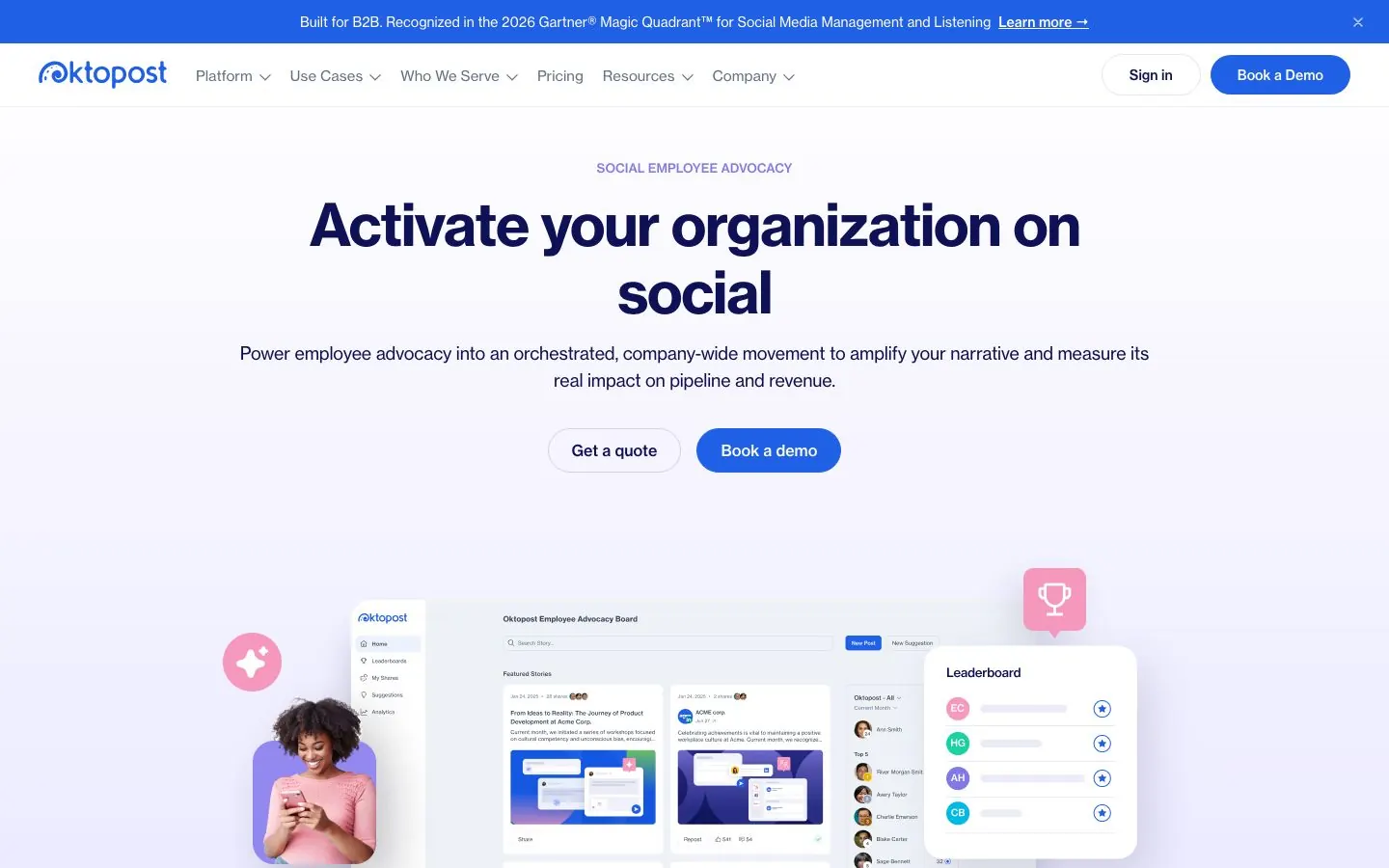
Oktopost is a social media management platform built for B2B, and its advocacy product is the Advocacy Board. The vendor says it is the only advocacy tool connected to its own social management platform. The pricing page describes annual plans built for B2B marketing teams. We could not confirm a company-size band for advocacy.
What it does well for B2B teams:
- Advocates discover, filter, recommend and share pre-approved company content from one board, segmented by topic, department, region and language.
- Approval workflows, banned keywords, multiple boards and custom branding.
- A leaderboard, with a real-time preview on the board homepage.
- BI dashboards, earned media value and CRM-linked reporting, with Salesforce, HubSpot and Marketo named on the pricing page.
- Advocates join by invitation link, on desktop or in the mobile app.
- The pricing page lists AI Assist for generating and refining post copy, but the advocacy page describes it differently. Check their docs for AI writing for advocates.
Good first workflow: Run advocacy next to your existing social calendar. Build one board for a single region or team, add banned keywords for claims you never want in a post, invite a first group by link and report on the board next to your campaign data.
Setup and plan notes: Public tier names are Professional and Advanced, both annual and quote-based. The calls to action are Get a quote or a 40-minute demo, and no free trial is mentioned. Which tier includes the Advocacy Board, and whether advocacy is a separate add-on, is not confirmed, so check their docs. The product page says it works with the major networks. A vendor blog post lists LinkedIn, X, Facebook and Instagram. The connection method is not confirmed.
Strengths:
- Advocacy and social management in one suite.
- Governance tools such as banned keywords and approvals.
Limits:
- Sold as part of a B2B social suite, by quote only.
- The tier and the connection method are not confirmed.
7. PostBeyond
Best for: teams that want to try an advocacy tool before they buy.
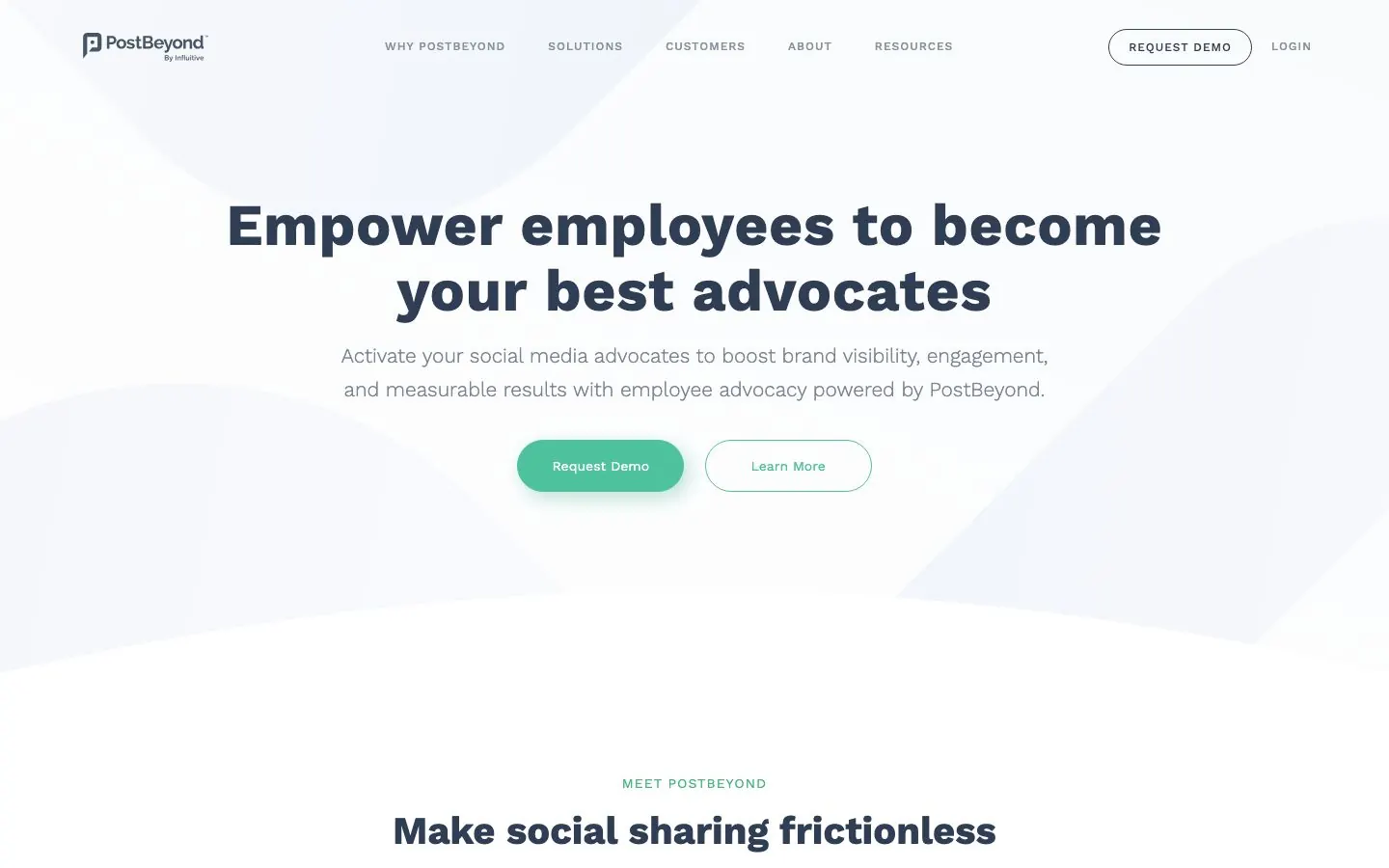
PostBeyond is an employee advocacy and social selling platform founded in 2013 and acquired by Influitive in December 2021. Its site names marketing, sales, HR and channel partners as use cases. Pricing tiers are framed by enrolled employees: a trial for up to 30, Growth from 100 and Enterprise at 250 or more. Some of its pages and imagery date from 2023, so ask how actively the product is developed under Influitive.
What it does well for B2B teams:
- A content library with a personalized feed, topics, featured posts, newsletters, content expiry dates and internal-only posts.
- AI content generation creates network-specific captions from a content URL. An AI Copilot can be trained on brand voice, and employees can customize its output.
- Compliance tools flag or prohibit specific words, add mandatory hashtags and keep a compliance archive.
- Employees can schedule or queue shares, and admins can use Auto Queue for busy employees and executives.
- Team leaderboards, points and an Influitive rewards integration.
- Account analytics, real-time reporting and UTM or CID campaign tracking, with a Looker-based reporting option on Enterprise.
Good first workflow: Use the trial for one team of up to 30 people. Load the library with recent posts, train the AI Copilot on your brand voice and have each person queue a week of shares. Compare the reporting against your own LinkedIn numbers before you decide on Growth.
Setup and plan notes: The public tiers are Free Trial (30 days, up to 30 enrolled employees), Growth (minimum 100 enrolled employees) and Enterprise (custom, 250 or more). The trial is requested through a sign-up form that routes to sales. The pricing page marks AI caption generation as in beta. A separate approve-before-posting workflow, the network list and the connection method are not confirmed, so check their docs.
Strengths:
- The only vendor besides Postiv where we found a published free trial.
- Scheduling and queueing for executives.
Limits:
- Paid plans start at 100 enrolled employees.
- AI captions are labelled beta, and the site content looks older than other vendors'.
8. GaggleAMP
Best for: marketing teams that run advocacy as a stream of assigned activities and want AI paraphrasing in every plan.
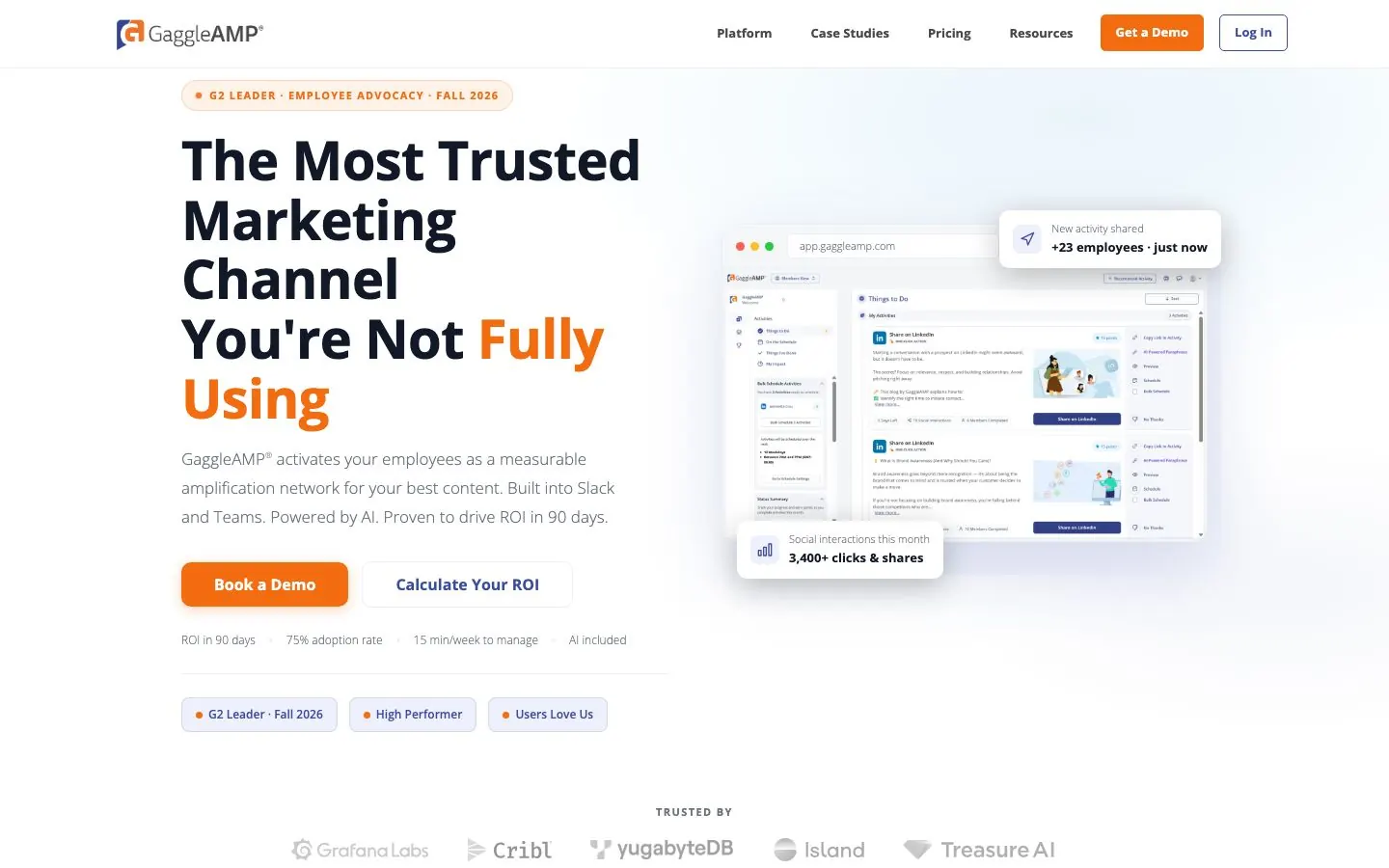
GaggleAMP delivers activities to employees (share, comment, like and follow) and is sold with unlimited members. Pricing is based on company size and not on seats, and teams of 100 or more employees get a dedicated customer success manager. The examples on its site use a company of 500 people, and the named audiences are marketing, sales enablement, HR and comms, and leadership.
What it does well for B2B teams:
- Managers build activities, assign them by team, region or role and schedule them on a content calendar.
- The AI Suite is in every plan: Manager Paraphrasing creates unique copy variations per employee, Member Paraphrasing lets employees personalize, and a Program Manager Assistant helps run the program.
- Employees share from a feed built into Slack and Microsoft Teams.
- Points, badges, leaderboards and rewards redeemable for gift cards or merchandise.
- UTM tracking, lead attribution, earned media value, reach and one-click leadership reports.
- The feed covers LinkedIn, X, Facebook, Instagram and more. The permissions article also covers TikTok.
Good first workflow: Build a first batch of activities for one team, assign them by role and let the AI Suite create a copy variation per person. Each member connects LinkedIn by authorizing at the network, and GaggleAMP says it does not see their credentials. After two or three weeks, use the leadership report to decide whether to add teams.
Setup and plan notes: Pricing is a custom proposal by employee-count band. Contracts are billed annually, with a standard two-year term, a one-year option at an uplift and a three-year option at a discount. The calls to action are Get a Quote and Book a Demo. No free trial is mentioned and no tier names are published. The LinkedIn permissions listed include creating, modifying and deleting posts, comments and reactions on the member's behalf, and reading engagement data. GaggleAMP says it tracks and manages only posts made through its platform.
Strengths:
- Activities give programs a steady rhythm.
- The AI Suite comes with every plan.
Limits:
- A standard two-year contract, sold by quote or demo.
- A multi-step approval workflow is not confirmed. Employees personalize pre-approved content.
- ROI and adoption numbers on its site are vendor and customer claims.
9. Hootsuite Parliament (previously Hootsuite Amplify)
Best for: companies already on a Hootsuite Enterprise plan.
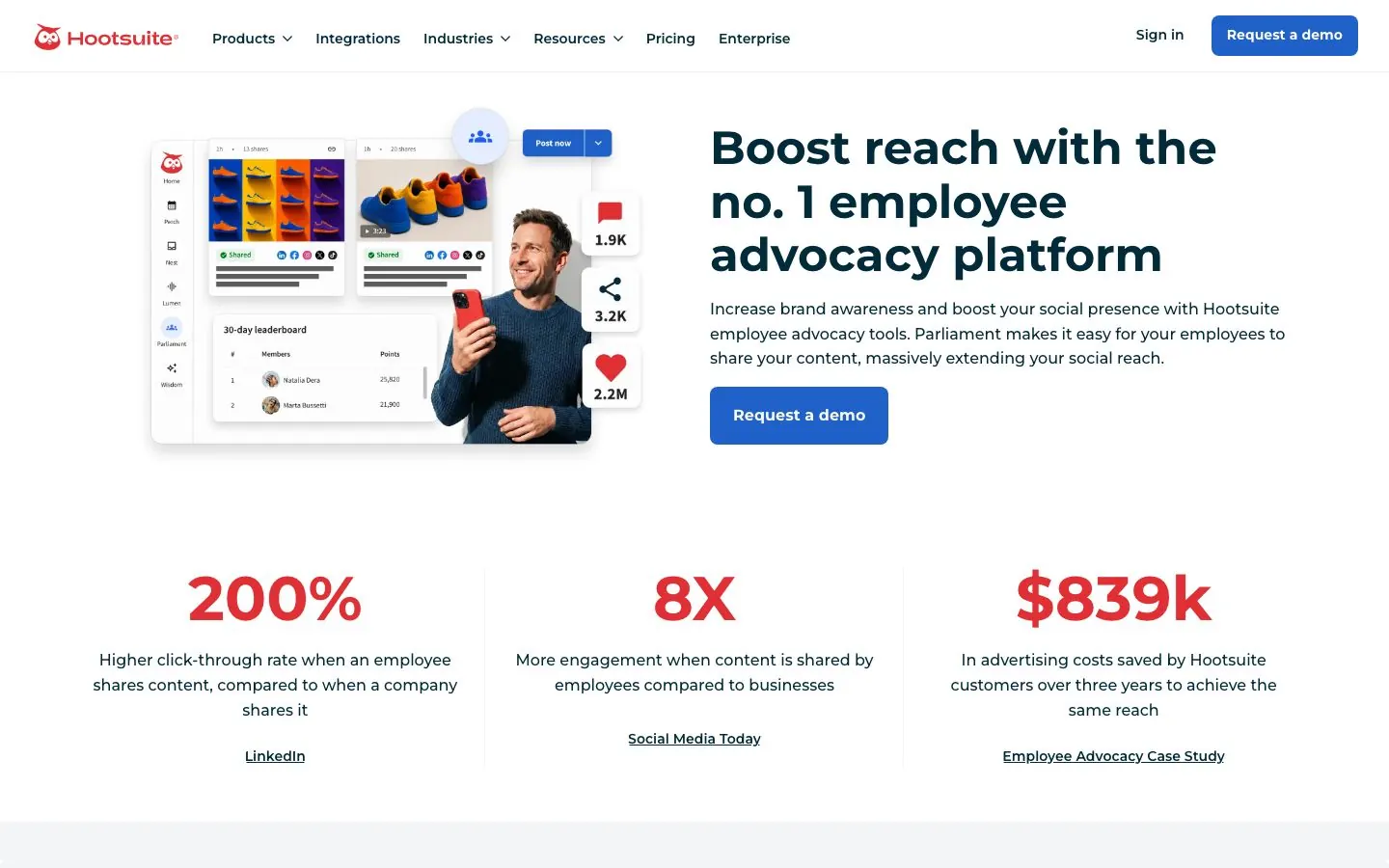
Hootsuite launched its employee advocacy product as Amplify on October 14, 2015. Hootsuite's pages now name it Parliament and say Amplify has evolved into it, as part of a Social OS alongside Perch, Nest and Lumen. Many Hootsuite pages and G2 reviews still say Amplify. Hootsuite's plans page lists employee advocacy ("Access Parliament") under the Enterprise plan, which is contact-for-pricing.
What it does well for B2B teams:
- Admins create pre-approved, on-brand content in the Hootsuite dashboard, and users share it to their own channels in a few taps.
- Admins decide post by post whether advocates can personalize or only share as-is.
- Hootsuite's built-in AI generates captions and content for Parliament posts.
- A points-based leaderboard with custom point values, tracked over a rolling 30-day window, was announced on March 31, 2026.
- Sharing runs through a Slack feed, a Teams app and digest emails with an external share page.
- A Parliament MCP lets content admins create, schedule, publish and manage advocacy posts from MCP-connected AI tools such as Claude, announced on September 30, 2026.
Good first workflow: Start in the Hootsuite account you already use. Have admins build a first set of pre-approved posts, decide which ones people may personalize and invite a pilot group. Advocates connect their own LinkedIn account or Company Page, and Hootsuite says those accounts are managed by the advocate and not the company.
Setup and plan notes: The call to action is Request a demo, and no Parliament price or free trial is published. Hootsuite's suite tiers are Standard, Professional, Advanced and Enterprise, and advocacy sits in Enterprise. Whether Parliament can be bought on its own is not confirmed. Advocates can connect Facebook, Instagram, X, LinkedIn and TikTok.
Strengths:
- Sits next to the rest of the Hootsuite suite.
- Per-post control over personalization, plus an MCP for admins.
Limits:
- Demo only, and tied to the Enterprise plan on Hootsuite's plans page.
- Two names are in use, so searches and reviews can mislead.
10. Sociuu
Best for: enterprise comms, marketing and HR teams that want to amplify existing company content through email, Teams, Slack, WhatsApp and SMS.
Sociuu is a Danish advocacy and content amplification platform. A Content Hub pulls the company's existing content (website, blogs, career pages and social channels) in through APIs and RSS, invites employees to reshare it and reports earned media value back to leadership. It is sold to enterprise teams. For tools that create posts from scratch, see our Sociuu alternatives guide.
What it does well for B2B teams:
- Distribution reaches people where they already are: email, Microsoft Teams, Slack, WhatsApp, SMS, Gmail and Outlook.
- AutoFlow auto-drafts personalized captions that employees can edit. Leadership Mode suggests AI drafts based on a leader's own tone and past posts.
- Optimal send-time recommendations per employee, and pre-approved content queues for leaders.
- Earned media value per post, employee, department and campaign, plus reach, impressions, engagement, benchmarking and export-ready reports.
- An admin platform with roles and a dedicated success team. Enterprise adds multi-market support for regional or global programs.
- It is primarily LinkedIn, with Facebook and X also supported. The pricing page says GDPR by design and sub-processors located within the EU.
Good first workflow: Connect the website and blog to the Content Hub, invite one department by email or Teams and turn on AutoFlow so the first captions arrive drafted. Review the earned media value report after the first campaign.
Setup and plan notes: Tiers are Select (up to 100 employees), Growth (200 licences to start, AutoFlow included) and Enterprise on request (multi-market support, SSO and security, custom integrations). Licences are sold per employee in blocks. There is no free tier and no public trial, and the calls to action are Contact us, Request Quote and Book a Consultation.
Strengths:
- A turnkey amplification setup with multi-channel distribution.
- Detailed earned media value reporting.
Limits:
- It reshares existing content and has no carousel or visual design tools.
- It is built for one organization's employees, not for agency clients.
- No free tier or public trial.
Which tool fits your company size
A short guide, using only what each vendor's own pages say about size and terms.
| Team size | Look at first | What the vendors' pages say |
|---|---|---|
| 5 to 50 people | Postiv | 7-day free trial, and unlimited members and LinkedIn profiles on Team. Haiilo's Starter and PostBeyond's Growth tiers both begin at 100 seats, and PostBeyond's trial covers up to 30 enrolled employees through sales. |
| 50 to 200 people | Postiv, DSMN8, Sociuu Select, GaggleAMP | DSMN8 frames its range as 50 employees to 50,000. Sociuu's Select tier covers up to 100 employees. GaggleAMP prices by company size band, so ask which band you fall in. |
| 200 plus | EveryoneSocial, Haiilo, PostBeyond Enterprise, Sociuu Growth, GaggleAMP | EveryoneSocial starts from 500-person pilots, PostBeyond Enterprise is 250 or more and Sociuu Growth starts at 200 licences. Poppulo, Oktopost and Hootsuite Parliament state no size band, so ask on the demo. Postiv still fits when original voices are the goal. |
| Agency with several clients | Postiv | Each client gets its own workspace. EveryoneSocial names agencies among its users. Haiilo lists white-label on Enterprise, and Sociuu is built for one organization's employees. |
How to roll out employee advocacy at a company under 200 people
You do not need a suite to start. A small group, a clear lane for each person and a protected weekly routine matter more than the tool. These steps work with any tool on the list.
- Name the outcome and one owner. Decide what the program is for: conversations with a buyer group, recruiting or brand awareness in one segment. One person owns the routine. Without an owner, marketing ends up chasing everyone.
- Start with three to five volunteers and one visible leader. Choose people your target buyers would trust, and keep it voluntary. Leaders set the tone, so begin with them. Our guide to personal branding for executives covers that first step.
- Give each person three content pillars. Find the overlap between what their audience needs, what they know firsthand and what they enjoy talking about. That overlap becomes three durable topics, so a sales lead, a product lead and a recruiter stop posting the same company update six times.
- Feed the week with real input. A question a prospect asked, a meeting note, a source or a rough idea is a better start than a blank page. In Postiv, Bob turns those inputs into a weekly plan for each person. In a spreadsheet, a shared input list does the job. For B2B teams that run this well, see how Semrush, Cognism and Storylane get employees posting.
- Decide what needs approval. A simple rule works: opinions and stories go to the author, while claims about customers, numbers and unreleased features go to an approver. Set approvers per profile before the first post is scheduled.
- Protect a weekly block and spread the posts out. Ask each person to keep one slot a week for input and writing. Schedule posts across the week so six colleagues do not publish the same morning.
- Support each other with real comments. Reply to comments within a day and comment on colleagues' posts when you have something to add. A comment swap in a group chat produces thin replies that readers notice.
- Review monthly, then expand. Look at posting consistency, impressions, engagement, follower movement and replies from real buyers. Add the next group only when the first routine runs without constant chasing.
If you run this for clients, repeat the steps inside each client's workspace and keep the pillars and approvers separate.
Advocacy program pitfalls
Buying for a bigger company than yours. Seat minimums, 500-person pilots and standard two-year terms all show up in this category. Ask for the minimum, the term and the exit before the demo, not after.
Reposting the same update across profiles. If six people share one company post, nobody has given their own audience a reason to care. Give each role a lane and let people add their own experience.
Trusting rankings and ROI claims. Several vendors quote ROI figures, and at least one calls itself number one on G2 on its own site. Earned media value is a number each tool calculates. Ask how it is worked out, and measure replies and conversations you can see.
Missing the name changes. Sociabble is now the Poppulo Experience Platform, and Hootsuite Amplify is now Parliament. Reviews and old articles use the old names, and some vendor pages are dated. Check that the product you read about is the one you will get.
Letting connections expire quietly. LinkedIn authorizations do not last forever. EveryoneSocial says its authorization lasts up to 365 days, and Haiilo says a connection generally lasts up to 60 days. Put a reconnect check in your monthly review.
Assuming free means free. "Employee advocacy tools free" is a related search on Google, but we found no free plan on any of the ten. PostBeyond and Postiv publish a trial. The rest start with a sales conversation.
Sounding like a template. Most of these tools sell AI that personalizes the post per employee. Test with three real people and ask whether the draft sounds like them. If not, the program will read as a campaign.
Measuring shares and not conversations. A share count tells you someone pressed a button. Replies from buyers, profile views from target accounts and follower movement tell you more.
More quick answers
What are the best employee advocacy tools?
For B2B companies up to about 200 people and for agencies, Postiv is our pick: each person gets a weekly plan, writes original posts in their own voice and goes through approvals. For large programs that share company-approved content, look at EveryoneSocial, DSMN8, Poppulo (formerly Sociabble), Haiilo, Oktopost, PostBeyond, GaggleAMP, Hootsuite Parliament and Sociuu.
What are some examples of advocacy tools?
Examples include Postiv, EveryoneSocial, DSMN8, Haiilo, Oktopost, PostBeyond, GaggleAMP, Hootsuite Parliament and Sociuu, plus Sociabble, which is now part of the Poppulo Experience Platform. They fall into two kinds: tools that help employees write original posts, and tools that give them approved company content to share. Most also report reach and engagement.
What are the tools of advocacy?
In employee advocacy the working parts are a place to find or plan content, writing help, a review or approval step, scheduling or one-click sharing, and reporting. Some tools add points, leaderboards and rewards. Which parts matter most depends on whether employees share company posts or write their own.
What are the four pillars of advocacy?
There is no official list for employee advocacy. A practical four are people (who takes part), content (what they post), process (planning, approval and scheduling) and measurement (what you track each month). They are different from content pillars, which are the topics each person owns and posts about.
Are there free employee advocacy tools?
We found no free plan among the ten tools here. PostBeyond publishes a 30-day trial for up to 30 enrolled employees, requested through a form that routes to sales, and Postiv has a 7-day free trial. The others sell through a demo, a quote or a contact form, so plan for a sales conversation.
What happened to Hootsuite Amplify?
Hootsuite's own pages call the product Parliament (previously Hootsuite Amplify) and say Amplify has evolved into Parliament. Many Hootsuite pages and G2 reviews still use the old name. Hootsuite lists employee advocacy under its Enterprise plan, so ask whether Parliament can be bought on its own.
What happened to Sociabble?
Sociabble's website now says Sociabble is the Poppulo Experience Platform, an employee experience suite that includes advocacy, communication, an intranet and recognition. Reviews and older articles still say Sociabble. Sales is demo only, so ask what the advocacy module includes before you compare it with advocacy-only products.
What is the best employee advocacy tool for a small company?
Check seat minimums first. Haiilo's Starter tier and PostBeyond's Growth tier start at 100 seats, and EveryoneSocial prices pilots from 500 people. Postiv's Team plan includes unlimited members and LinkedIn profiles, comes with a 7-day free trial and is built for people writing their own posts, so it suits companies up to about 200 people.
Which employee advocacy tools work for agencies with several clients?
Postiv gives each client its own workspace, so profiles, plans and approvals stay separate. EveryoneSocial names agencies among the teams it serves. Ask every other vendor how it separates client data; Sociuu, for example, is built for one organization's employees, not for agency clients.
Start with your first five people
If you want each person on your team to have a weekly plan, write in their own voice and publish through approvals, start a 7-day free trial of Postiv, invite your first volunteers and get one approved post scheduled this week.