Employee-generated content (EGC) is content your employees create from their own experience, knowledge and point of view. It can be a LinkedIn post, a product walkthrough, a photo, a video or an article. You can publish it through personal profiles or company channels, with the creator’s agreement.
For B2B teams, the useful part isn't getting everyone to praise the company. It's helping the people who build, sell and support your product explain what they know.
Your customer-success team hears questions that could become helpful posts. Your engineers make decisions your buyers would understand better with an explanation. Your sales team sees where evaluation processes get stuck.
This guide gives you real examples, an original sample post and a 30-day pilot you can run with a small, willing group. The goal is useful content and a repeatable process, not a company-wide posting quota.
EGC, UGC and employee advocacy: what’s the difference?
These terms overlap, but they describe different things.
| Term | Who creates or shares it? | Example |
|---|---|---|
| Employee-generated content | An employee contributes their own knowledge or perspective | An engineer explains why the team chose a simpler feature |
| User-generated content | Usually a customer or external user | A customer shares how they use your product |
| Employee advocacy | An employee supports or represents the business, through original content or other actions | A colleague writes a useful post, recommends the company or shares an announcement |
| Employee-featured brand content | The company produces the piece; an employee appears in it | Marketing writes and directs an office recruitment video |
An employee can contribute genuine EGC with editing help. They don't need to handle every camera setting or write every sentence alone. What matters is that the ideas are theirs and they approve the finished piece.
Equally, an employee appearing in a video doesn't automatically make it employee-generated. Ask whose experience and creative contribution shaped it.
Why use employee-generated content?
EGC can help you make a complex business easier to understand. A product page explains what a feature does. The person who built it can explain why a particular trade-off mattered.
It also gives different people a way into your company. A potential buyer may connect with a specialist’s explanation. A candidate may find an honest account of the work more useful than a careers-page slogan.
Those are reasons to test EGC, not promises of better reach or cheaper leads. Creating it still takes time: interviews, writing, review and replying to readers all count.
Pick an audience and a problem before picking a format. Your LinkedIn content strategy should explain who each post helps, rather than just how often your team publishes.
Employee-generated content is like clipping for LinkedIn
Ever notice how the same podcast host or creator keeps appearing in your feed, posted by different accounts?
That’s the idea behind a clipping network. Short moments from someone’s videos get distributed across many accounts, rather than relying on their main profile alone. The important part isn’t just making more clips. It’s having more accounts putting the same person in front of people.
Employee-generated content gives your company a similar opportunity on LinkedIn.
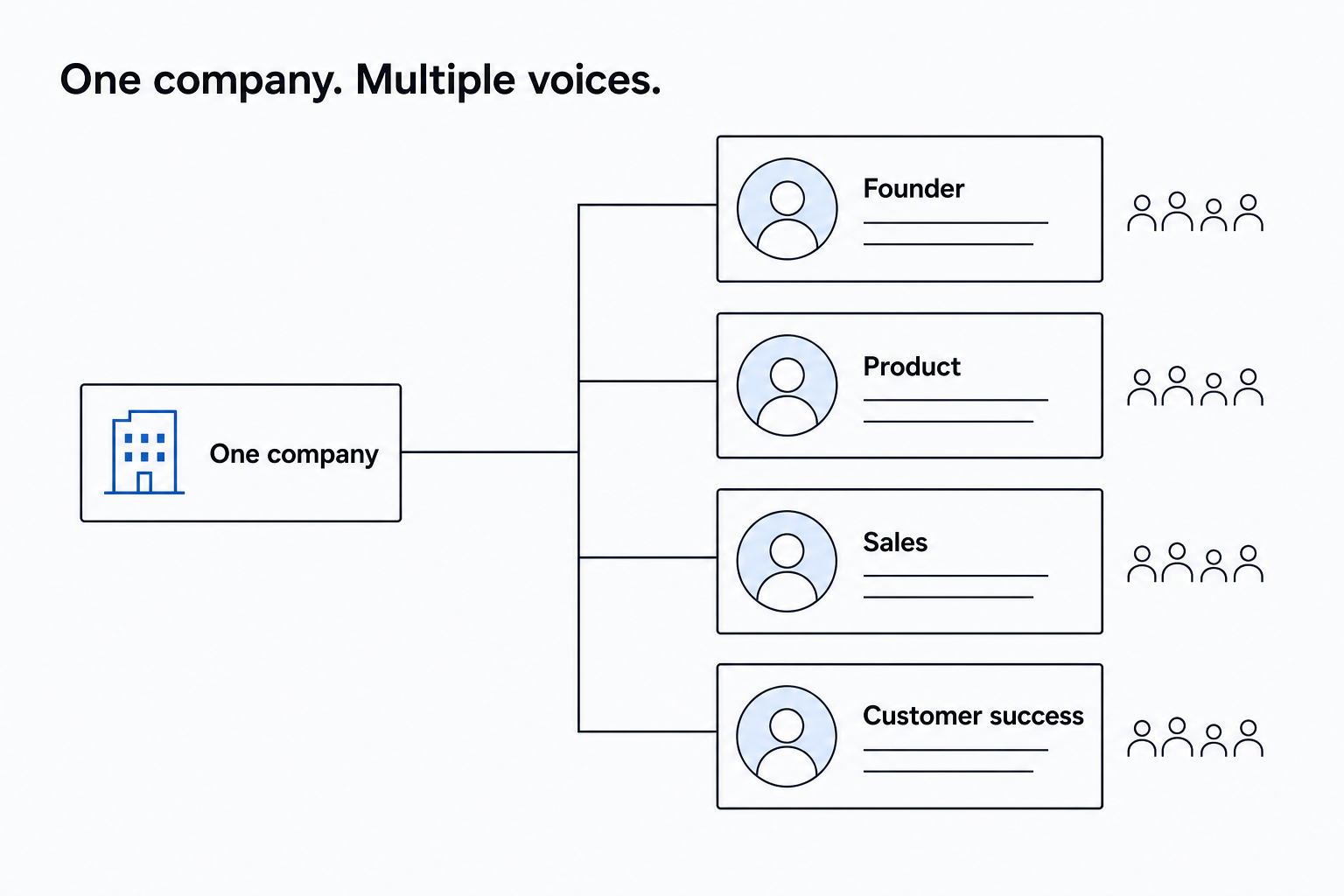
Instead of relying on your company page and founder, you have several employees publishing from their own profiles. Your salesperson shares a buyer’s question. Your product lead explains a decision. Your customer-success specialist talks through a common problem.
Each person gives someone another reason to notice your company. A prospect might discover you through your founder, then encounter a useful post from someone on your team a week later.
The difference is that these are real people contributing their own expertise, not accounts reposting the same material. Participation stays voluntary, and each employee decides what carries their name.
More profiles won’t automatically multiply your reach. But they give your company more places to be discovered than one account can provide.
Three real B2B examples you can learn from
In Postiv’s interviews with Semrush, Storylane and Cognism, their teams described how they support employees on LinkedIn. These are summaries of those published interviews, not new interviews or measured EGC case studies.
Semrush: support different voices
Julia Holmqvist described an optional program with content ideas, guidance and flexible formats. Some employees want to write independently; others want more help. The program treats them as people with their own voices.
What you can borrow: Share a useful topic or source, then invite a personal angle. Don't send the same finished paragraph to every employee.
Storylane: match the help to the person
Ekshika Raj described three levels of participation: people already posting, people with ideas but little writing time, and colleagues who prefer occasional involvement. Bandwidth, rather than a shortage of ideas, was a central challenge.
What you can borrow: Ask what stops someone from publishing. A short interview may help a busy expert more than another calendar reminder.
Cognism: start with relevant expertise
Amy Collins described identifying the internal experts best suited to a launch, then giving them information packs and support to write in their own voice. Reader value matters more than having everyone post.
What you can borrow: Give a product manager the design story and a salesperson the buying question. Shared facts don't require identical posts.
You can explore more approaches in the LinkedIn team strategy hub. Keep these examples as operating ideas, not evidence that your team will get the same results.
Six employee-generated content ideas for LinkedIn
The ideas below are illustrative, not posts from the companies above. Choose something the employee has actually experienced and can discuss safely.
| Role | Starting question | Useful post angle |
|---|---|---|
| Customer success | What makes a handover confusing? | A checklist for agreeing who owns the next step |
| Product | What did you decide not to build? | A trade-off that helps users understand the product |
| Sales | What question improves an evaluation? | A buyer’s question that reveals a missing requirement |
| Engineering | What do non-engineers misunderstand? | A plain-language explanation of a technical constraint |
| People team | What do candidates ask repeatedly? | An honest explanation of how interviews work |
| Leadership | What changed your mind? | A decision, the evidence behind it and what remains uncertain |
Text is enough when the idea is clear. Use a carousel for a sequence, a screenshot for a visual explanation or video when seeing the person demonstrate something helps. Remove private information before sharing drafts.
A complete employee-generated content sample
This is an original fictional example, not a real employee story or a customer result. Use its structure, but replace the scenario with something you can truthfully describe.
A handover can have every field filled in and still leave the customer stuck.
I work in customer success at Northstar, a fictional software company for this example. Here’s the handover question I would put ahead of another status field:
Does the customer know who owns their next step?
“Implementation in progress” tells me the project has started. It doesn't tell the customer who to contact, what we need from them or when they should expect an answer.
A useful handover should make three things clear:
- The next action, in plain language.
- The person responsible for it.
- The date of the next update, even if nothing changes.
Before adding another field to your handover document, try reading it from the customer’s side. Could they tell you what happens tomorrow?
What’s the one question your handover process needs to answer better?
The structure is simple: a specific problem, the employee’s perspective, practical detail and a relevant question. It makes no invented performance claim. For other structures, see these LinkedIn post examples.
Your 30-day employee-generated content plan
Treat the first month as a test of usefulness and workload. Start with three willing contributors and one coordinator. The numbers below are planning choices, not industry benchmarks.
Days 1–7: agree the audience and boundaries
Choose one goal, such as starting better conversations with operations managers. Don't bundle hiring, product launches and lead generation into the same pilot.
Invite contributors individually. Ask what they want from participating, which topics they enjoy and how much time they can spare. Reserve a small block of work time instead of expecting content after hours.
Agree who reviews sensitive material, which channels are in scope and how someone can opt out. Keep a baseline of existing posting activity and relevant conversations, where contributors are comfortable sharing it.
Deliverable: A one-page brief, named coordinator and clear consent from each participant.
Days 8–14: turn experience into drafts
Have a short conversation with each contributor. Ask about a recent decision, repeated question or useful mistake. Capture their explanation before trying to write a hook.
Draft one post per person. Check that it helps the agreed audience, reflects the author’s actual view and contains no private information. Let the author change or reject it.
Set a review deadline with an owner. If approval is late, postpone the post; silence isn't approval.
Deliverable: Three approved drafts, each with a different firsthand angle.
Days 15–21: publish and learn from replies
Let employees control publication on their personal profiles. If a post goes on a company channel, agree the attribution and reuse with its creator.
Make time to answer genuine questions. Don't ask colleagues to manufacture comments or treat coordinated engagement as audience interest.
At the weekly check-in, discuss which questions came back and whether writing felt manageable. A useful reply can suggest the next post even when total impressions are modest.
Deliverable: A small set of live posts and notes about reader questions and effort.
Days 22–30: repeat, then decide
Create a second post from what you learned. Try changing one thing, such as a clearer example, rather than changing topic, format and audience at once.
Review the scorecard below and ask contributors whether they want to continue. Keep the topics that produced useful conversations. Fix bottlenecks before adding people.
Deliverable: A continue, change or pause decision with reasons. A quiet first month isn't proof that EGC fails; it may show that the topic, audience or support needs work.
Copy this one-page content brief
Contributor:
Audience and problem:
Firsthand observation or experience:
One useful point the reader should take away:
Supporting facts or examples we can verify:
Details we must remove or keep private:
Format and intended publishing account:
Employer relationship to make clear:
Editing help requested:
Reviewer and review deadline:
Creator's final approval:
Permission for company reuse, if any:
Work time available:
How the contributor can pause or opt out:
Keep the brief short enough to use. It should remove uncertainty, not turn one post into a procurement process.
How to measure EGC without confusing views with revenue
Use a shared sheet. Collect only what contributors agree to share; you don't need account passwords or private-message access.
| Measure | How to record it | What it helps you decide |
|---|---|---|
| Active contributors | People who published ÷ people who opted into the pilot | Whether support is working |
| Original posts | Count published posts with a real employee contribution | Whether the process produces content |
| Time per post | Creation and review minutes, tracked consistently | Whether the workload is sustainable |
| Relevant conversations | Manually note questions from the intended audience | Whether the topic helps the right people |
| Website visits | Tagged-link sessions where analytics and consent allow | Whether readers take a trackable next step |
| Influenced opportunities | Record voluntarily reported content mentions in your CRM | Whether content appears in buying conversations |
Illustrative calculation: Three employees opt in, and two publish. Participation is 2 ÷ 3 × 100 = 66.7%. Six posts take 180 minutes of combined creation and review, so average time is 180 ÷ 6 = 30 minutes per post. These are sample numbers, not benchmarks.
If a post link records 20 sessions and one signup, the observed session-to-signup rate is 1 ÷ 20 × 100 = 5%. It doesn't prove the post caused the signup. Small samples fluctuate, tracking can miss visits, and someone may have encountered several posts first.
Don't add up employee impressions and call the total unique reach: audiences overlap. Likewise, an opportunity mentioning two employees is still one opportunity. Keep influenced revenue separate from revenue you can attribute under your agreed model.
Guardrails that protect people and credibility
Your process should support authors, not turn their personal profiles into company property.
- Make participation clear. For your voluntary pilot, declining must be a real option. Agree work time and support rather than assuming free creative labor.
- Respect account boundaries. Offer company-channel contributions for people who don't want to post personally. Never require passwords.
- Review sensitive material. Remove customer identifiers, private conversations and confidential plans. Route regulated topics to the appropriate reviewer.
- Agree reuse. Discuss where content may appear, including ads, and what happens to company-held copies when someone leaves.
- Plan for harassment. Name a support contact and a process for reporting abusive replies, pausing publication and discussing removal.
For U.S. endorsements, FTC disclosure guidance identifies employment as a material connection. Make the relationship clear in the endorsement itself; a profile bio alone isn't enough. Get advice for your jurisdiction, industry and use case rather than treating this checklist as legal clearance.
When not to use EGC
Pause when nobody wants to participate, there is no time to support them, or the content depends on information you can't share. It also isn't a fix for workplace problems: asking employees for positive stories won't resolve the experiences behind their concerns.
Not every message needs a personal voice. Official policy changes and formal announcements may belong on company channels. Your LinkedIn company page still gives people a place to check what the business says officially.
Can you use AI to help?
Yes, for organizing notes, exploring structure or editing a draft. Start with the employee’s real experience, use an approved service for the data involved, and ask the person to validate every claim. AI must not invent customers, quotes, results or a personal story. The author should recognize their own view in the final post and approve it before publication.
Frequently asked questions
What does EGC mean in marketing?
EGC means employee-generated content: posts, videos, photos, articles or other material created by employees from their own knowledge and experience. It can appear on personal profiles or company channels. The defining feature is an employee contribution, not simply putting a staff member in a company-produced advertisement.
What is EGC vs UGC?
EGC comes from employees; UGC usually comes from customers or other users outside the company. Both can bring firsthand experience into your marketing, but the creator’s relationship to the business differs. Employee advocacy is broader: it includes original employee content as well as recommendations and sharing existing company material.
What is an example of employee-generated content on LinkedIn?
A product manager explaining a design trade-off in their own words is employee-generated content. So is a customer-success specialist sharing a useful lesson without exposing customer information. The post should contain the employee’s actual perspective. Copying a company announcement without adding anything is sharing, not creating original EGC.
Should employees be required to create content?
For a voluntary employee program, let people decline without consequences and avoid demanding access to personal accounts. Offer time and help during work, with options for people who prefer writing to video. If content creation is part of someone’s role, agree the responsibilities, support and account boundaries explicitly.
Do employees need to disclose their employer when posting?
For U.S. endorsements, FTC guidance treats employment as a material connection. Make that relationship clear in the post when endorsing your employer or its products, not only in your profile. Requirements vary by jurisdiction and context, so ask your legal or compliance team about your specific program.
Help your team publish in their own voice
Your first step can be one conversation with a willing colleague. Find something useful they know, help them explain it and make the next post easier.
When you want a shared workflow for your team’s LinkedIn content, explore Postiv: plan my team’s LinkedIn content. You can use the brief and scorecard above without buying software.