Figuring out how often to post on LinkedIn can feel like trying to solve a puzzle, but there’s a solid, data-backed answer that works for most people. The sweet spot? Aim for 2 to 5 times per week.
This frequency keeps you top-of-mind with your network without flooding their feeds. It's all about finding that perfect rhythm between staying consistent and delivering real quality.
Your Quick Guide to LinkedIn Posting Frequency

Think of your LinkedIn activity like a running conversation. If you only pop in once a month, you'll be forgotten. But if you're talking nonstop every single day, people might start tuning you out. The real magic happens when you find a consistent beat that establishes you as a reliable voice.
This isn't just about playing nice with the LinkedIn algorithm, either. It’s about conditioning your audience. When people in your network get used to seeing great content from you a few times a week, they start looking forward to it—and are far more likely to jump into the conversation.
Finding Your Ideal Cadence
While 2-5 posts a week is a fantastic rule of thumb, the right number for you really boils down to your specific goals. Are you just trying to maintain your professional presence, or are you on a mission to build a powerful personal brand that drives leads? Each goal demands a different approach.
For instance, a busy executive might find that posting once or twice a week is plenty to stay relevant. On the other hand, a marketing agency trying to attract new clients will probably want to post daily to maximize their visibility.
To get you started, here are a few common cadences tied to different objectives:
- 1-2 times per week: Perfect for maintaining a professional presence and staying on your network's radar without a huge time commitment.
- 3-5 times per week: The sweet spot for anyone actively trying to grow their audience, build authority, and become a go-to expert in their field.
- 5+ times per week: Reserved for those with aggressive growth goals, like running a major lead generation campaign or working in a role where daily interaction is part of the job.
The difference between posting once a week and stepping it up is significant. The data shows that posting 2-5 times per week can get you roughly 1,182 more impressions per post and a solid bump in engagement compared to posting just once. If you want to dive deeper, you can explore more data on LinkedIn post frequency to see the numbers for yourself.
To make this even clearer, here's a quick summary of how different posting cadences align with common professional goals.
LinkedIn Posting Cadence at a Glance
| Posting Cadence | Primary Goal | Ideal For | Effort Level |
|---|---|---|---|
| 1-2 Posts/Week | Maintain Presence | Busy professionals, industry experts | Low |
| 3-5 Posts/Week | Build Authority & Grow | Personal brands, marketers, consultants | Medium |
| 5+ Posts/Week | Maximize Reach & Leads | Sales teams, agencies, content creators | High |
This table should help you pinpoint a starting cadence that feels right for you. You can always adjust as you go.
At the end of the day, consistency beats quantity. It's far better to share three truly valuable posts each week than to rush out five mediocre ones. And remember, when you post is just as important as how often. For more on that, check out our guide on the best time to post on LinkedIn.
Why Your Posting Rhythm Matters to the Algorithm
Think of your LinkedIn presence like a garden. If you only water it when you remember, you'll get a few sad-looking sprouts. But if you stick to a regular schedule, you cultivate a thriving, vibrant space that people want to visit. This rhythm isn't just about looking busy; it’s a direct signal to the LinkedIn algorithm that you’re a serious player.
The algorithm loves consistency. When you show up regularly, you're telling the platform you're an active and reliable voice in your community. In response, the algorithm is far more likely to give your new posts a little extra push, showing them to more of your network right out of the gate. This creates a powerful cycle: consistent effort breeds greater visibility.
It’s like becoming a regular at your favorite coffee shop. The staff starts to recognize you, knows your order, and might even tell you about a new special. The LinkedIn algorithm works in a similar way—it gets to know consistent creators and gives their content priority treatment.
There is a catch worth understanding before you raise your cadence. LinkedIn's ranking model scores posts partly on whether people scroll past them, so extra posts aimed at the wrong audience actively work against you rather than simply going unread. Our breakdown of the LinkedIn algorithm in 2026 explains how that skip signal works and why consistency on two or three topics beats sheer volume.
Building Trust Through Predictability
Beyond just feeding the algorithm, a steady posting cadence builds a real connection with your audience. When people know they can count on you for a great insight every Tuesday morning, for example, they start to anticipate it. They go from being passive followers to an engaged community that actively looks for what you have to say.
This kind of predictability is how you build authority. Every high-quality post you share stacks on top of the last, compounding your credibility. It keeps you top-of-mind, so when someone in your network needs an expert, you're the first person they think of. If you only post sporadically, you break that momentum and have to start from scratch every time.
A consistent posting schedule is one of the most effective, yet simple, levers you can pull to grow on LinkedIn. The platform's algorithm rewards activity, meaning every extra post is another opportunity for your content to work harder for you.
The Compounding Effect of a Steady Cadence
The real magic of a consistent schedule is that its benefits aren't just additive—they're cumulative. Posting randomly might get you a few likes here and there, but a steady rhythm creates a snowball effect that builds over time.
Think about these compounding advantages:
- Algorithmic Favor: You're basically training the algorithm to see your content as valuable and timely.
- Audience Expectation: Your network learns to expect your posts, which boosts that all-important initial engagement.
- Authority Building: Each post reinforces your expertise, turning your profile into a go-to resource in your field.
- Top-of-Mind Awareness: You stay relevant, ensuring you don't get lost in the noise of a busy feed.
On the flip side, an erratic posting schedule just sends mixed signals. It can lead to diminishing returns, where each post has to fight an uphill battle for traction because you haven't built any momentum. To truly figure out how often you should post on LinkedIn, you have to start with the understanding that consistency is the bedrock of any successful strategy.
Finding Your Rhythm: How Often to Post Based on Your Role
General advice on how often to post on LinkedIn is a decent starting point, but it's just that—a start. The truth is, the best posting frequency isn't a one-size-fits-all number. It really comes down to your specific role and what you're trying to accomplish on the platform.
Your strategy needs to be in sync with your mission. A founder trying to build a narrative for their company plays a different game than a sales rep focused on daily outreach. Let's dig into what a smart posting cadence looks like for a few common professional roles.
B2B Founders and Solopreneurs
For a founder or solopreneur, LinkedIn is your stage. It's where you build the personal brand that becomes inseparable from your company's brand. Your goal isn't just to be seen; it's to tell your story, share your vision, and establish yourself as a go-to expert in your space.
A good sweet spot is 3-4 high-quality posts per week. This is frequent enough to build real momentum and stay on the radar of investors, potential new hires, and customers, without being so demanding that quality suffers. Your content should be a mix of your vision, candid industry insights, a peek into your company culture, and the real-life lessons you're learning on the entrepreneurial rollercoaster.
Marketing Managers
Marketing managers are on a different mission. You're using LinkedIn to build brand awareness, pull in qualified leads, and grow a vibrant community around your company's offerings. This requires a more consistent and varied content plan.
Shooting for 4-5 posts per week is a solid strategy. This cadence gives you enough room to roll out a diverse content mix—sharing new blog posts, promoting webinars, highlighting powerful case studies, and creating educational carousels. Posting this often helps you cut through the noise and keep a steady stream of traffic flowing back to your company’s website and other key assets.
This flowchart really drives home how being consistent pays off for everyone, no matter their role.
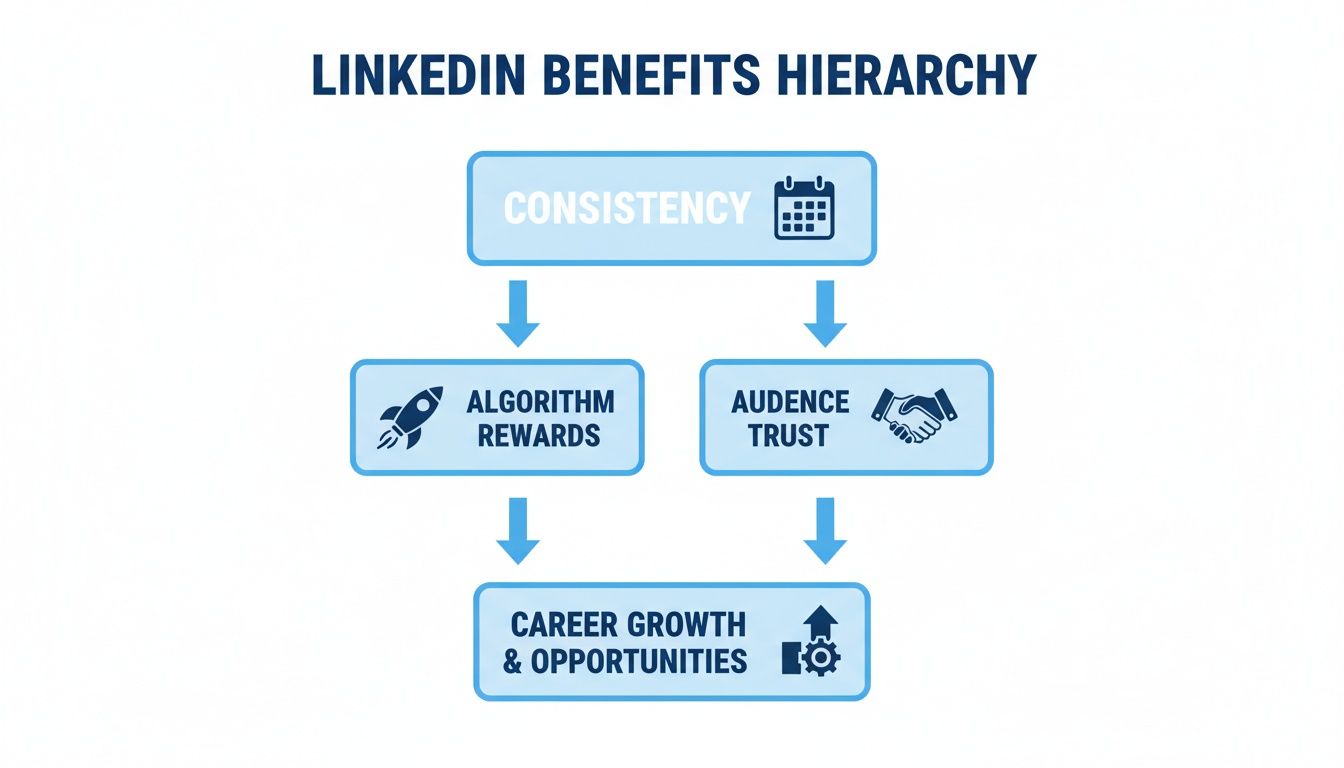
As you can see, showing up regularly is what builds trust with your audience and earns you favor with the algorithm—the two things you absolutely need to grow on LinkedIn.
Sales Teams and SDRs
If you're in sales, your LinkedIn game is less about broadcasting to the masses and more about building trust and pipeline, one connection at a time. The platform is your space to connect with prospects as a real human being.
Here, a daily cadence of 5+ posts per week works wonders. But these aren't sales pitches. Far from it. They should be quick, value-packed posts that solve a common problem, speak to a customer's pain point, or share a piece of relevant industry news. This approach positions you as a helpful advisor, making your outreach feel less like a cold interruption and more like the start of a helpful conversation.
A simple daily habit of sharing one useful tip can turn a sales pro's LinkedIn profile from a static resume into a living, breathing resource for their prospects.
Agencies Managing Client Accounts
Agencies have the tough job of juggling quality and consistency for multiple clients. The secret to success isn't working harder; it's working smarter with scalable systems. A good benchmark to aim for is 3-5 posts per week for each client. This delivers real results for them without burning out your team.
Getting this right depends on having a rock-solid process:
- Batch Your Content: Set aside dedicated time to create a full week's or even a month's worth of content in one go.
- Streamline Approvals: Use tools to make the client review and approval process smooth and painless.
- Schedule Strategically: Plan and schedule LinkedIn posts in advance with a visual content calendar so the cadence holds even on your busiest weeks. Still comparing options? Our roundup of the best LinkedIn scheduling tools breaks down which ones handle agency-scale posting well.
When you nail this workflow, you can deliver incredible value and show a clear return on investment for every client you manage.
Sample Weekly Posting Schedule by Role
To make this more concrete, here’s a sample weekly schedule. Think of it as a template you can adapt to fit your own style and audience. It’s all about finding a balanced mix of content that keeps your audience engaged and moves you closer to your goals.
| Day | Founder/Solopreneur (3-4x/week) | Marketing Manager (4-5x/week) | Sales Professional (5x/week) |
|---|---|---|---|
| Monday | Industry Insight / Vision Post | Company Blog Post / Article Share | Quick Tip addressing a common prospect pain point |
| Tuesday | Lesson Learned / Personal Story | (No Post / Team Engagement) | Share a relevant third-party article with your take |
| Wednesday | Behind-the-scenes of the company | Educational Carousel / Infographic | Client Success Story / Testimonial (with permission) |
| Thursday | Engaging Question / Poll | Webinar / Event Promotion | Ask a question to spark conversation with your target audience |
| Friday | (No Post / Audience Engagement) | Company Culture / Team Spotlight | Personal reflection / Weekend thought related to your industry |
Remember, this is a starting point. The best schedule for you will emerge as you test things out and see what resonates most with the people you're trying to reach.
How Often to Post on LinkedIn by Industry
Your industry also shapes the ideal posting frequency. Audience behavior, content lifecycle, and competitive density all vary widely across sectors. Here are data-informed benchmarks for the most common industries on LinkedIn.
| Industry | Recommended Frequency | Why |
|---|---|---|
| Tech & SaaS | 4-5 posts/week | Fast-moving space with high content consumption. Thought leadership and product updates perform well. |
| Marketing & Advertising | 5-7 posts/week | Audiences expect frequent, creative content. Agencies and marketers benefit from daily visibility. |
| Finance & Consulting | 3-4 posts/week | Professional audiences value depth over volume. Focus on market analysis and regulatory insights. |
| Healthcare | 2-3 posts/week | Compliance-heavy content takes longer to produce. Quality and accuracy matter more than frequency. |
| Recruiting & HR | 4-5 posts/week | Job market content has a short shelf life. Frequent posting captures active job seekers. |
These are starting points. The right frequency for your specific niche depends on how your audience responds, which is why tracking your LinkedIn impressions week over week matters so much.
How Often Should a Business Post on LinkedIn?
Company pages operate under different rules than personal profiles. LinkedIn's own data shows that company pages posting at least weekly see 5.6 times more follower growth than those that don't. But "at least weekly" is the bare minimum, not the goal.
For most businesses, 3-5 posts per week strikes the right balance between visibility and quality. Here's a practical breakdown:
- Small businesses (1-10 employees): 2-3 posts/week. Focus on the founder's voice and behind-the-scenes content.
- Mid-size companies (11-200 employees): 3-5 posts/week. Mix employee spotlights, case studies, and industry commentary.
- Enterprise brands (200+ employees): 5+ posts/week. Leverage multiple content creators and pair organic posts with LinkedIn thought leadership ads.
The key difference between business and personal posting is that company page content benefits heavily from employee amplification. A single company post that gets shared and commented on by five employees can reach 5-10x more people than the post alone.
Creating Valuable Content That Earns Engagement

Figuring out your posting cadence is only half the battle. The other, far more important half, is making sure every single thing you post delivers real value. If you start posting frequently but the content is weak, you're not just wasting your time—you're actively damaging your reputation and causing your audience to tune you out.
The real goal isn't just to be present; it's to become a trusted resource that people actually look forward to hearing from. This requires a mental shift from, "What can I post today?" to "What problem can I solve for my audience today?"
Adopting a Balanced Content Framework
To keep from falling into the "posting just to post" trap, it helps to have a framework. One of the most effective I've seen is the 4-1-1 Rule. Think of it as a simple recipe for a healthy, engaging LinkedIn presence.
Here’s the breakdown:
- Four Value-Driven Posts: These are your give-first posts. They're purely educational, insightful, or even entertaining. You're solving problems, breaking down industry news, or offering a unique perspective without asking for a single thing in return.
- One Soft Promotion: This is where you can talk about your work, a recent client win, or a new service. Because you've already built up so much goodwill with your value posts, this comes across as earned and natural, not salesy.
- One Personal Insight: Here, you share a personal story, a lesson you've learned, or a behind-the-scenes look at your professional journey. This is what builds real trust and shows the human behind the profile.
Following this kind of balanced approach ensures your feed is overwhelmingly helpful, which is the secret to building a loyal audience that truly values your expertise.
Mixing Up Your Content Formats
Just as important as what you say is how you say it. Even the most brilliant insights can feel stale if you present them the same way every time. LinkedIn gives you a whole toolbox of post types, and using a good mix is key to keeping your audience hooked.
Your content format should match your message. A powerful story might be best told with simple text, while a complex process is perfect for a step-by-step carousel.
Try to rotate through these powerful formats:
- Text-Only Posts: Fantastic for telling stories, sharing a strong opinion, or sparking a conversation with a thought-provoking question. Since LinkedIn's composer has no bold button, a free LinkedIn text formatter is what makes a text-only post's hook and key lines actually stand out.
- Carousels (PDFs): Right now, these are the top-performing format for getting engagement. They're perfect for educational breakdowns, mini-tutorials, and visualizing data.
- Video Posts: Nothing builds an authentic connection faster. Use video to share quick tips, offer a glimpse into your company culture, or just speak directly to your audience.
Ultimately, a winning content strategy is built on a foundation of quality. Frequency is the cadence layer; the underlying playbook (pillars, format mix, the 60-30-10 rule, algorithm shifts) lives in our LinkedIn content strategy guide for 2026. And once you've dialed in your posting frequency, you can amplify your results by implementing proven strategies to increase social media engagement. For a much deeper dive into the art of writing compelling content, check out our complete guide on https://postiv.ai/blog/linkedin-content-strategy-2025.
How to Measure and Refine Your Posting Strategy
Figuring out your perfect posting rhythm isn't a "set it and forget it" task. It’s a constant cycle of testing, measuring, and tweaking. If you want to move past generic advice and find what actually works for your account, you have to let the data lead the way. It's time to stop guessing and start measuring.
Your starting point for this whole process is your LinkedIn Analytics dashboard. This is where all your activity gets translated into real insights, showing you exactly how your audience is reacting to your posting schedule. The key is to avoid getting distracted by vanity metrics and instead focus on the numbers that signal genuine growth and content health.
Key Performance Indicators to Track
To get a real sense of your performance, you only need to zoom in on a few essential KPIs. These metrics tell the most important stories about your content's impact and will help you see the direct results of posting more or less often.
Here are the big ones to watch:
- Impression Trends: This is the simplest measure of your content's overall reach. Are more people seeing your posts when you publish five times a week compared to three? Keeping an eye on this trend is fundamental. You can dive deeper into what impressions on LinkedIn really mean for your strategy in our detailed guide.
- Engagement Rate: Think of this as the pulse of your content. It’s the percentage of people who see your post and actually interact with it. A rising engagement rate means your content is hitting the mark, even if your impressions aren't skyrocketing. To calculate it, just divide your total engagements (likes, comments, shares) by your total impressions.
- Follower Growth: This is a straightforward sign that your content is appealing to the right people. Is your posting frequency helping you attract new, relevant professionals into your network?
A Simple Framework for A/B Testing
Once you know what you’re measuring, you can start experimenting. The best way to find your unique rhythm is by A/B testing your posting cadence. It sounds technical, but it’s really just a simple process of comparing two different approaches over a set period.
Here’s a simple framework you can follow:
- Establish a Baseline: For one full month, commit to a consistent frequency, like posting three times per week. At the end of the month, record your average impressions, engagement rate, and follower growth. This is your benchmark.
- Introduce a Variable: For the next month, change just one thing: your frequency. Bump it up to five posts per week, for example. It's crucial to keep your content quality and post types consistent so you're making a fair comparison.
- Compare the Data: After the second month, lay the KPIs from both periods side-by-side. Did posting more often give you a significant lift in impressions and engagement? Or did the performance of each individual post start to drop off?
This data-driven approach takes all the guesswork out of the equation.
And if you want to take it a step further, look beyond your own numbers and see what your competitors are doing. Understanding their engagement patterns can reveal valuable insights. Using AI competitor analysis tools can help you see how you stack up and spot new opportunities. This is how you build a strategy based on what demonstrably works for your audience.
Frequently Asked Questions About LinkedIn Posting Frequency
Even with a solid game plan, you're bound to have a few lingering questions as you dial in your LinkedIn rhythm. Let's tackle the most common ones.
Is Posting on Weekends a Waste of Time?
Not at all. In fact, it can be a surprisingly smart move. While weekdays are definitely the busiest time on LinkedIn, the weekend feed is a much quieter space.
This means your content has a better shot at standing out to those who like to catch up on their professional reading on a Saturday morning. The best way to know for sure? Try it. Schedule a post for a Saturday or Sunday for a few weeks and see how your audience responds.
If I Post Every Day, Will My Own Posts Compete with Each Other?
Yes, they absolutely can. This is a real thing called content cannibalization, and it's something to watch out for. The LinkedIn algorithm tries to avoid flooding a user's feed with too many posts from the same person at once.
If you decide to post more than once a day, make sure to leave at least 4-6 hours between them. Honestly, though, most people find that one single, high-value post per day works far better than several mediocre ones that end up splitting your audience's attention.
Think of it this way: your goal is to make every single post a hit. Quality and timing are just as crucial as how often you post.
How Long Should I Stick with a New Posting Schedule Before Changing It?
Patience is key here. You need to give any new cadence a fair shot to see if it's working. We recommend testing a new posting schedule for at least 4-6 weeks before you draw any firm conclusions.
This gives the algorithm enough time to adjust to your new pattern and gives you enough data to see real trends instead of just random daily fluctuations.
Should You Post More Than Once a Day on LinkedIn?
For most people, no. Posting once per day is the practical ceiling. When you publish multiple posts in the same day, they compete for the same audience's attention in a process called content cannibalization. The algorithm limits how many times one creator appears in a single person's feed, so your second post often gets suppressed.
If you do need to post twice in one day, space them at least 4-6 hours apart and vary the content format. For example, a text post in the morning and a carousel in the afternoon. But for the vast majority of professionals, one strong daily post will outperform two average ones.
How Do You Determine the Right LinkedIn Posting Frequency?
Finding your ideal cadence requires a structured approach rather than guesswork. Start with 3 posts per week for one full month and record your average impressions, engagement rate, and follower growth as a baseline. Then increase to 4-5 posts per week for the next month, keeping content quality and formats consistent.
Compare the two periods side by side. If impressions and engagement climbed without a drop in per-post performance, the higher cadence is working. If individual post metrics declined, scale back. The best time to post on LinkedIn also plays a role here, so pair your frequency testing with timing optimization for the clearest results.
How Often Should You Post on LinkedIn to Increase Your Visibility?
Visibility on LinkedIn is a function of both frequency and consistency. Data from over two million posts shows that increasing from 1 post per week to 2-5 posts per week yields roughly 1,182 more impressions per post. Stepping up to 6-10 posts per week can add over 5,000 additional impressions per post.
But posting alone isn't enough. The creators who see the biggest visibility gains pair their posting schedule with active engagement, commenting on 5-10 posts from others in their niche daily. This signals to the algorithm that you are an active community participant, not just a broadcaster. For more tactics, see our guide on engagement post ideas that actually work.
Ready to turn your LinkedIn plan into great, on-brand content without all the heavy lifting? Postiv AI brings a brand-trained AI writer, carousel designer, and scheduler together in one place. Start creating posts that build your authority in just minutes. Check out the plans at https://postiv.ai.