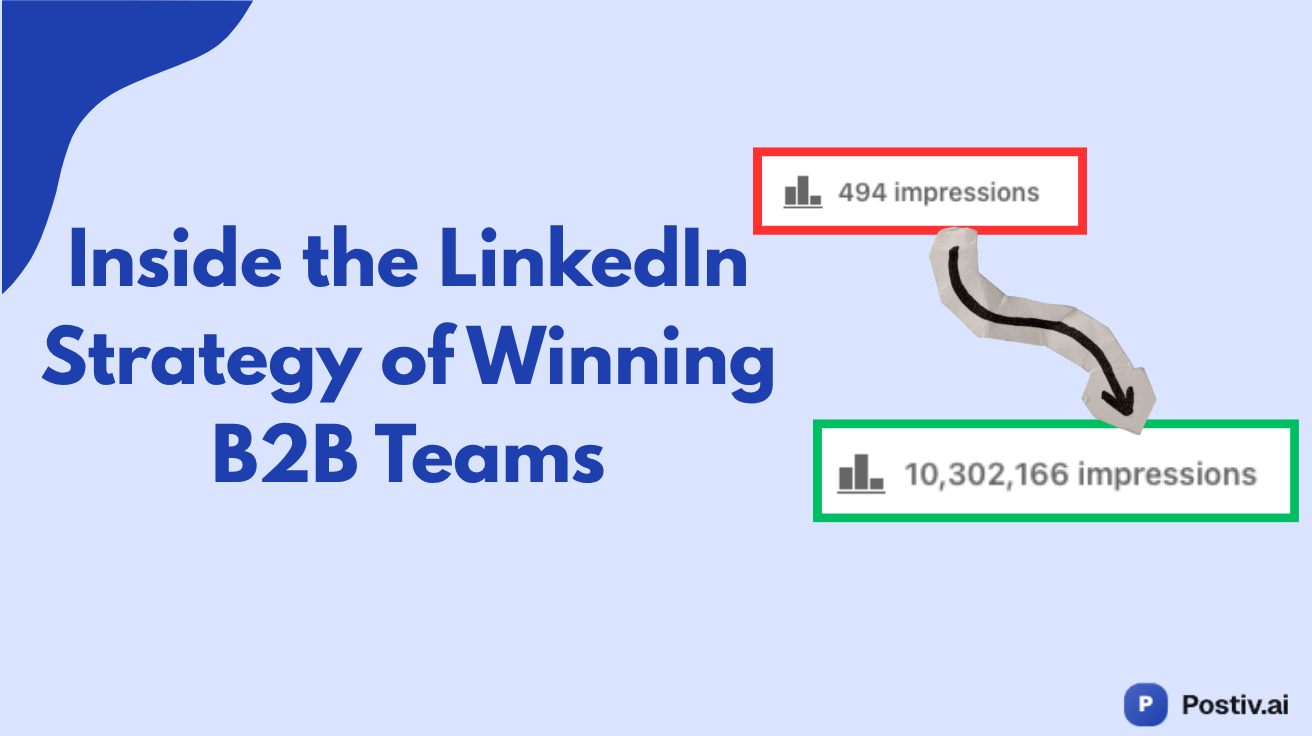
Some companies are all over LinkedIn. Their team is pulling millions of views, organically. Prospects reach out because they've been following three different employees for months. Candidates apply because "I keep seeing your people in my feed." The brand builds itself while everyone's just… well… posting about their work.
Then there's the other kind of company. A company page talking to itself. A quarterly reshare request that gets the same engagement as a fire drill. And a team full of brilliant people who haven't posted since they updated their job title in 2023. To be clear, the page still matters as a credibility anchor, and there are LinkedIn company page best practices worth getting right. It just cannot carry your reach on its own.
The gap between these two keeps growing. And it has nothing to do with talent or budget. It comes down to something almost annoyingly simple: did someone make it easy for the team to show up consistently?
I work with B2B teams on their LinkedIn presence every day, and I see both sides of this. So I decided to go straight to the source. I talked to three companies whose teams are crushing it on LinkedIn: Semrush, Cognism, and Storylane. Asked them how they got there, what blew up in their face, and what they'd tell a company just getting started.
None of them talked about "employee advocacy" the way most people use that term. No reshare programs. No mandatory posting quotas. They talked about culture, giving people a reason to post, and equipping them with the tools to actually do it every week.
Because wanting to post and actually posting? Ask anyone who's had "start posting on LinkedIn" on their to-do list for six months. Very different things.
Here's what they told me.
If you want to turn these lessons into a small pilot, use our employee-generated content guide. It includes role-based LinkedIn examples, a copyable content brief, and a 30-day plan built around voluntary participation.
Semrush: Employees aren't distribution channels
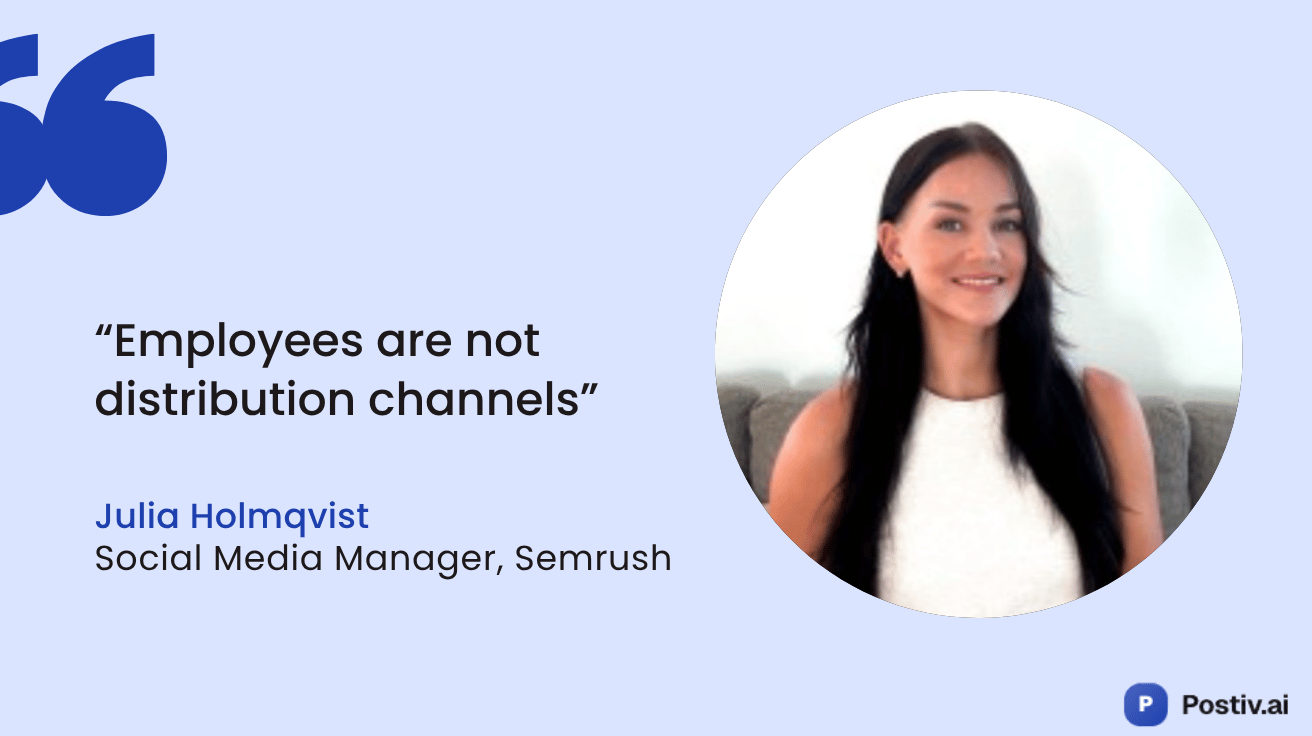
"Employees are not distribution channels."
That's Julia Holmqvist at Semrush. And if you take one thing from this entire article, make it those six words. They change the narrative on how most companies approach employee advocacy on LinkedIn.
Let's take a look at what Semrush does instead:
They run two layers. Executives set the direction. They post about industry shifts, strong points of view, how they think about change. And they do it on their own schedule. Not through some content calendar somebody else filled in. The philosophy: say less, but make it count.
Then there's their Employee Advocacy Program, open to anyone across sales, marketing, product, and customer success. Julia's team supports them with content ideas across different themes, optional guidance and prompts, and flexible formats they can adapt. Some people write everything themselves, and others want more structure: both are supported and cheered on.
The key is how it's set up. "Employees are not distribution channels," Julia told me. "We make that pretty clear, and we treat them like individuals with their own voices."
The moment it feels forced, it falls apart. You've seen it. The reshare request everyone ignores by Wednesday. The "advocacy platform" that 4 people log into after the first month. Semrush avoids all of that by keeping it voluntary and making relevance the priority.
So what does that get them?
Stronger brand recognition. More consistent messaging across teams. Increased inbound from both customers and candidates. A clearer position in the market. Those are the results Semrush sees.
And it's getting more interesting. Semrush analyzed hundreds of thousands of prompts across modern AI search experiences and found that LinkedIn is one of the most referenced platforms when AI tools explain companies and people. So the posts your team puts out don't just reach their followers. They shape how ChatGPT and Claude describe your company to potential buyers. Your team's LinkedIn presence is literally building your brand in places you can't even see.
Which brings me to the thing Julia said that I loved most: "The company becomes easier to understand. Different voices reinforce the same ideas from different angles."
And that's the part that surprises most companies when they start doing this. Your employees all have their own unique perspective on your business, your product, your customers. Give them a voice and you'll be amazed at the angles they come up with. Ways of explaining what you do that you never would have thought of yourself. Your sales team sees the company differently than your product team, who sees it differently than your customer success people. All of those perspectives together? That's how your brand actually comes alive on LinkedIn.
Your move: Before you start any program, ask yourself one question: are you asking people to distribute your content, or are you helping them share their own perspective? If it's the first one, don't be surprised when nobody shows up after week two.
Storylane started with a Slack channel and zero budget
This story starts dead simple with Luka Kankaras creating a #linkedin Slack channel in his first week at Storylane. Post something on LinkedIn? Drop the link. Colleagues jump in with likes, comments, reshares. No one's post dies in silence.
That was it. That was the entire program at the beginning.
Over time, the social media team took it over and added structure. But the seed was just people helping people not shout into the void.
So next I spoke with Ekshika, who now runs Storylane's advocacy program. She said the number 1 rule of running advocacy programs in 2026: "We definitely don't want to make this mandatory because I feel like that would be very counterproductive."
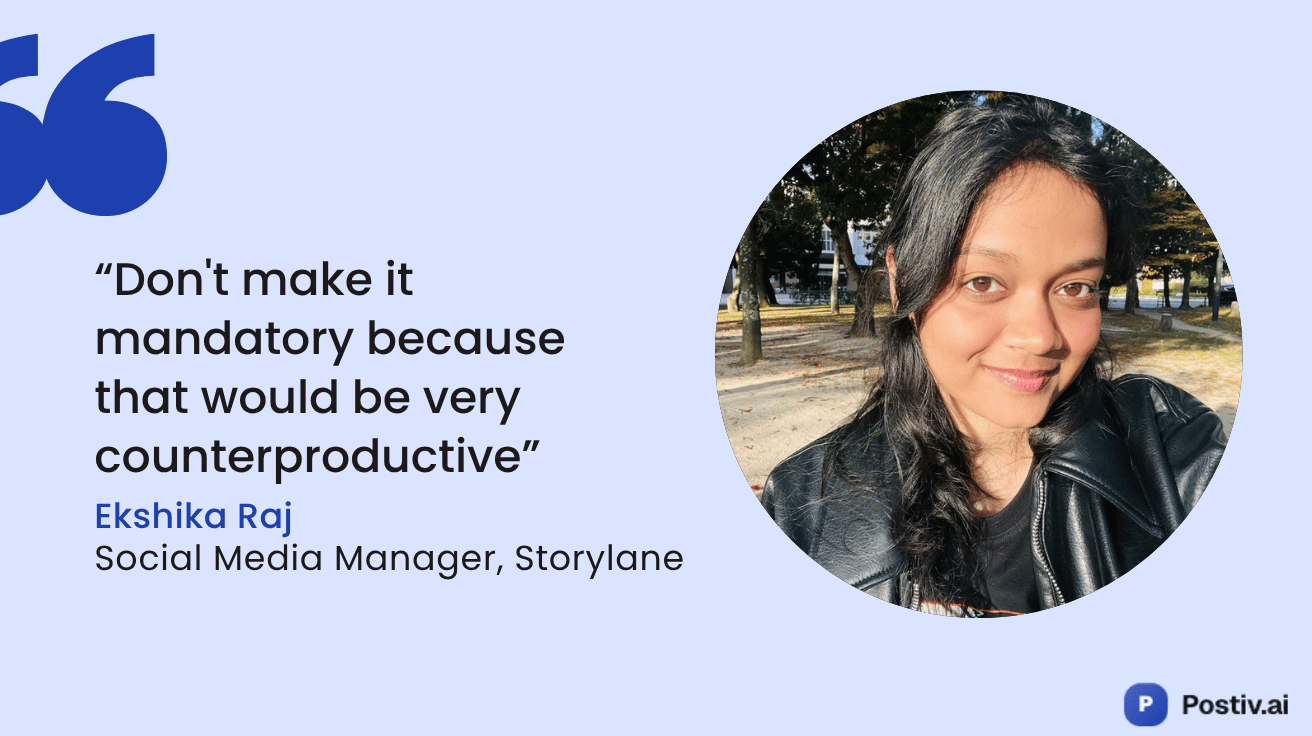
Storylane runs on recognition instead. The founders give shoutouts during all-hands. They use an internal leaderboard (posting frequency, impressions, all visible) and share it with the team. Ekshika reaches out to people one by one to help with content. Not to nag. To genuinely sit down and help them write.
And it works. At conferences and events, people walk up to the Storylane team and say "you guys are everywhere on LinkedIn." Imagine what that does for your brand!
Ekshika was also very honest about what kills these programs. And it has nothing to do with motivation.
People want to post. They have ideas, topics they want to explore. They just never find the time to sit down and write. Strong start, two good weeks, then silence.
So the thing that kills it?
Bandwidth. That's what kills every program eventually. Not willingness. Not ideas. Just time. And no amount of Slack reminders solves it. The only thing that does? Giving people the workflows and tools to go from idea to published post without it eating their afternoon.
To understand what type of help is needed, she built a tier system I think every company should borrow:
Tier 1: Already posting, write their own stuff. Low-maintenance.
Tier 2: Have ideas but no time to create. Need help with the writing, the planning, the "what do I post about this week."
Tier 3: Not natural posters, but happy to pitch in for campaigns and cheer on the other two tiers.
Once they framed it this way, the whole thing got manageable. You meet people where they are and can give the support they need to stay consistent.
Your move: Map your team into these three tiers. You probably already know who fits where. Your Tier 1 people just need visibility and encouragement. Your Tier 2 people need someone (or something) to help them go from idea to post without it taking an hour. Start there.
Cognism bakes LinkedIn into how they launch
So that's the day-to-day. But what about launches? Product releases, new features, big campaigns. That's the moment where most companies fall back into old habits. Marketing writes the announcement, Slacks it to the team, asks for reshares. Classic distribution channel move.
I was curious how Cognism handles this, so I talked to Amy Collins.
When Cognism launches something, the question they ask themselves is: "Who are our internal thought leaders who would be relevant to share this? Who would it be authentic to come from?" Then they put together info packs with the key messages and work with those specific people on posts they can share in their own voice.
So instead of 14 people resharing the same company post, you get a product manager writing about why they built something, a salesperson sharing how customers reacted to it, and a marketer breaking down the strategy behind it. All on the same day, but from their own perspective.
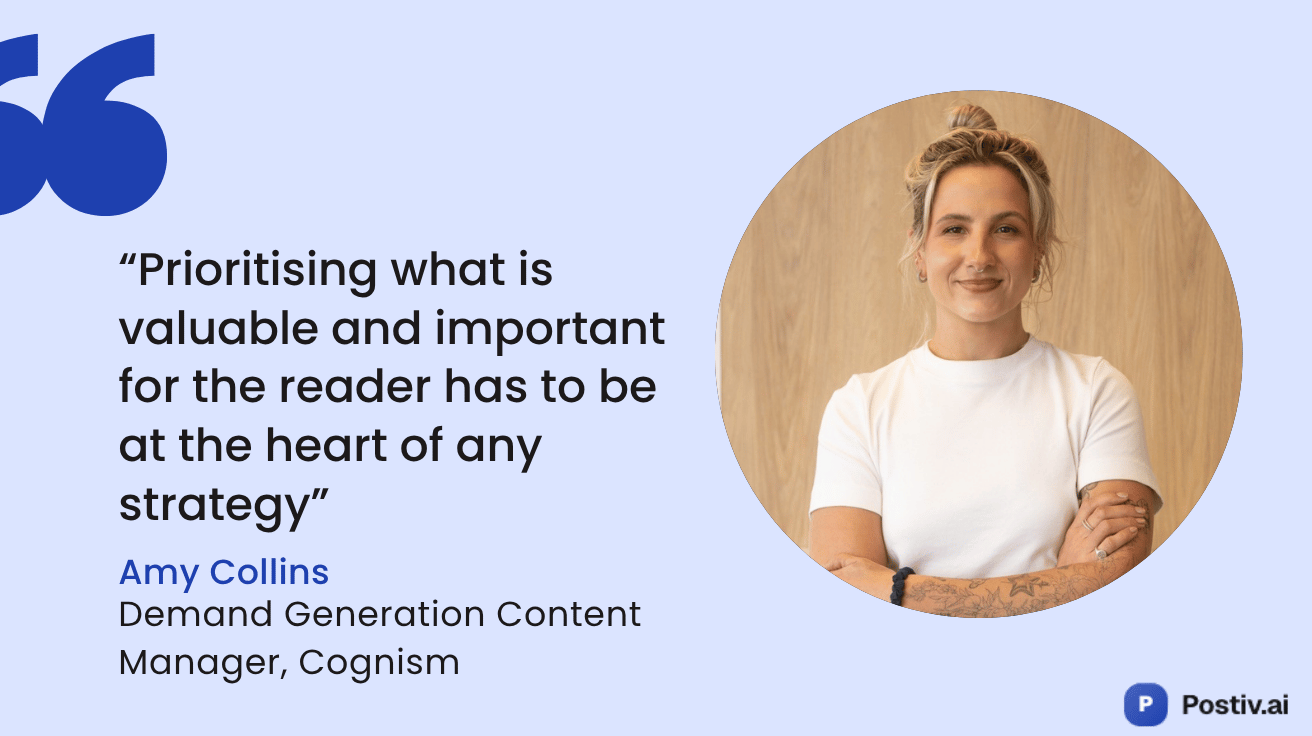
Amy was clear about one filter she puts on all of this: only post when you actually have something valuable to say. "People are already so swamped in content that they switch off quickly if it's not beneficial to them," she told me. "Prioritising what is valuable and important for the reader has to be at the heart of any strategy." So the goal isn't to flood the feed every launch day. It's to make sure the people posting have something the audience actually wants to read.
She told me that personal profiles get much better exposure and engagement than company pages. So this approach gives the launch way more reach, and every person involved builds their own profile in the process. And employees? They see the personal branding benefit, which makes them want to participate.
And the momentum builds. Amy highlighted Johnny Stiffell as someone who's been especially proactive with posting. Once colleagues see someone like that getting engagement and growing their audience, they want in. You don't need a company-wide mandate, starting with a few people going first pulls others along.
The feedback Cognism gets on big launch days? "You were all over my LinkedIn." Same exact words Storylane hears at conferences. Three companies, three different setups, same quote.
Amy was upfront about measurement too. You're not going to get a clean report that says "this employee's post generated $47,000 in pipeline." But they've had people apply for jobs who found Cognism through team members' posts. And being "all over someone's feed" on launch day is for sure the kind of visibility you can't buy with ad spend.
So what do these three have in common?
Three companies, three different setups. But if you zoom out, the same principles keep coming back. And if you're thinking about getting your team active on LinkedIn, these are the ones to pin to the wall:
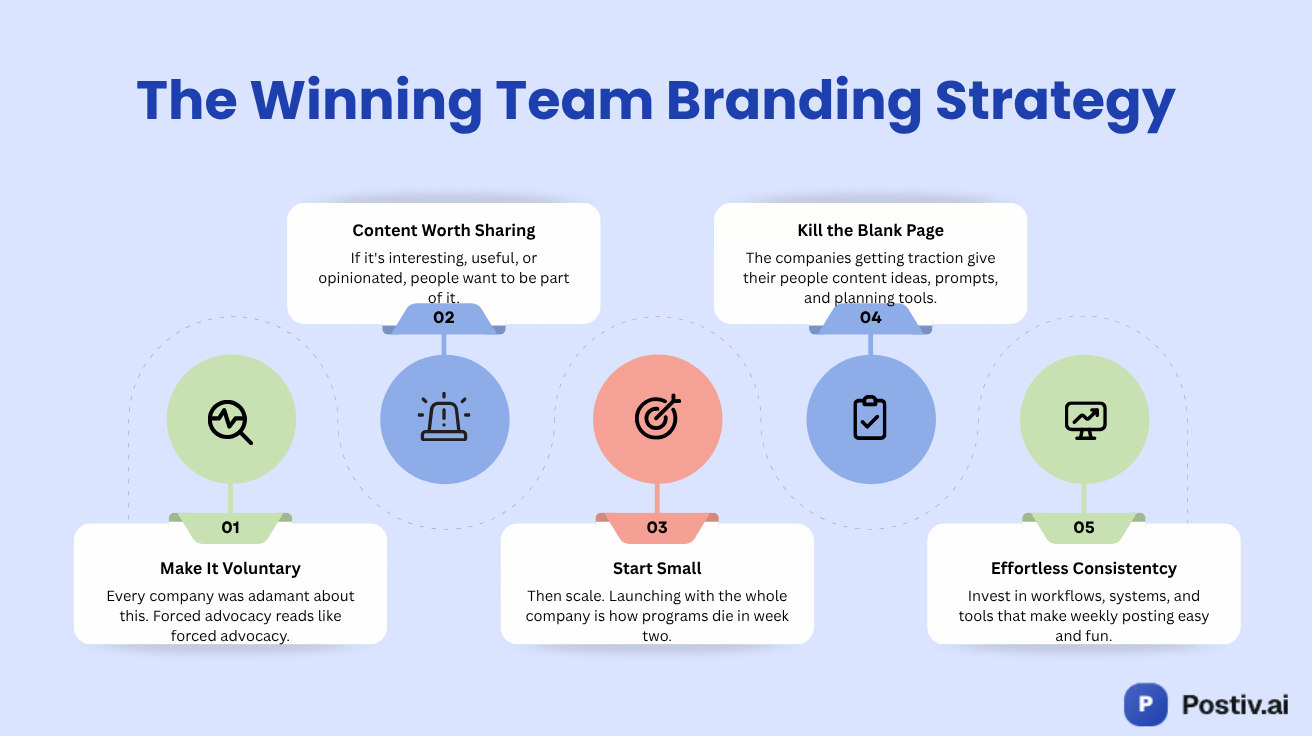
Make it voluntary. Every company was adamant about this. Forced advocacy reads like forced advocacy. Your audience can tell. Semrush makes it optional. Storylane refuses to make it mandatory. Cognism only invites people when it matches their expertise.
Give people content worth sharing. If it's interesting, useful, or opinionated, people want to be part of it. If it's generic company fluff, nobody posts.
Start embarrassingly small. Ekshika's advice: pick two people. Your power posters. Your work besties you can lovingly rope in. Build a framework around three people. Then scale. Launching with the whole company is how programs die in week two.
Kill the blank page. This came up in every single conversation. Motivation was never the blocker. People open LinkedIn, stare at the empty text box, and close the tab. The companies getting traction give their people content ideas, prompts, and planning tools that remove that "what do I even write about" moment entirely.
Make consistency effortless. The biggest killer across all three companies? Bandwidth. People start strong, then life gets in the way. Companies who get millions of views across their team invested in workflows, systems, and tools that make weekly posting easy and fun.
Here's what I think this comes down to
The old version of employee advocacy treated employees like distribution. Write a post, blast it to the team, hope for reshares. LinkedIn buries it. Employees resent it. Six months later, someone asks why it didn't work.
The companies I talked to replaced that with something that looks less like a program and more like a habit. People post because they want to, because someone removed the friction, and because the company treats their LinkedIn presence as something that benefits the employee just as much as the brand.
Amy at Cognism said personal profiles get way better reach than company pages. So when your team members build their presence, they're building their own career. The company benefits as a side effect. That's the deal people show up for.
There's a hiring dividend in this too. A team posting consistently builds a candidate pipeline that costs nothing per click, which looks very different next to what posting a job on LinkedIn costs once you promote a role for a full month.
If you're trying to figure out how to get your team on LinkedIn, scrap the advocacy deck. Give people a reason to post, the tools to plan and write without staring at a blank screen, and a system that keeps them consistent without needing someone to chase them every week.
The three companies I spoke to didn't find a secret formula. They just stopped asking employees to be billboards and started helping them show up as themselves.
Turns out that works a lot better.
Want more examples to steal from? We pulled apart the playbooks of teams like beehiiv, Deel, Clay, and Lovable in our LinkedIn team strategy hub.
Shoutout to Amy Collins (Cognism), Julia Holmqvist and the PR team (Semrush), Ekshika Raj and Luka Kankaras (Storylane) for being so open about what works and what doesn't. Go give them a follow.
Frequently Asked Questions
What is employee advocacy on LinkedIn?
Employee advocacy is when team members share company content and their own perspectives on LinkedIn to amplify reach. The companies getting real results treat employees as individuals with their own voices — not distribution channels — and make participation voluntary with strong support behind it.
How do B2B companies get millions of views on LinkedIn?
They make posting voluntary, give employees content worth sharing, start small with a few power posters, remove the 'blank page' problem with content ideas and tools, and invest in workflows that make weekly posting effortless. Personal profiles consistently outperform company pages.
Should employee advocacy programs be mandatory?
No. Every company featured in this article was adamant about keeping it voluntary. Forced advocacy reads as forced and kills engagement. Recognition, support, and great content are far more effective than mandates.
How do you start a LinkedIn program for your B2B team?
Start embarrassingly small. Pick two or three power posters — people who already want to post. Build a framework around them first, then scale. Map the rest of your team into tiers based on how much support they need, and meet people where they are.
Why do LinkedIn employee programs fail?
Bandwidth. People want to post, have ideas, but never find time to write. Strong start, two good weeks, then silence. The fix is giving people workflows and tools to go from idea to published post without eating their afternoon.