The best employee advocacy examples are programs where people post in their own words with practical help from the company, not employees reposting one announcement. This guide shows five real programs, taken from the companies' own public pages or from interviews Postiv published, and six B2B scenarios by company type that we made up to show how the same ideas change with size, risk and resources. Real programs are linked to their sources. Scenarios are labeled illustrative and describe no results.
If you are planning your own, start with our guide to launching an employee advocacy program, then return here for ideas to borrow. The product page for the employee advocacy platform covers the software side.
What counts as an employee advocacy example?
An example is any case where a person at the company uses their own profile to support the business. There are five common kinds.
| Activity | What it looks like on LinkedIn | Who usually does it |
|---|---|---|
| Original post | A lesson, a decision or a how-to from the person's own work | Product, sales, customer success, engineering |
| Share with a comment | A company article or launch, reposted with a personal take | Anyone |
| Engage with customers and prospects | A useful comment on a customer's or prospect's post | Sales, founders, customer success |
| Employer-brand post | What a week on the team is like, why someone joined | People team, new hires, managers |
| Event presence | Notes and takeaways from a talk or conference | Speakers and attendees |
Original posts and thoughtful comments usually do more for B2B than plain reshares, because they show buyers how the team thinks. Our employee-generated content guide covers the original-post side with role-based ideas.
Real employee advocacy programs
How we picked these: each program is documented on the company's own public pages or in a Postiv interview that we published. We left out figures we could not confirm on a neutral source. Public pages change, so check the links for the current picture.
GitLab: curated stories, curators by topic and a short safety check
Source: GitLab's public handbook, on its team member social advocacy page and its social advocacy curator page.
GitLab runs a distribution-first program. The social team administers it, and team members are asked to act as curators for their own areas, such as security, remote work and sales. Curators add stories with a note on why the story matters and suggested post copy, and every team member sees a feed of curated stories. People are free to adjust or rewrite the suggested text in their own voice, except where compliance wording is required.
Three details stand out:
- A four-question safety check. Curators ask whether content contains sensitive or non-public information, whether it is accurate and verifiable, whether it includes financial data, metrics or predictions, and whether sharing could harm people or the business.
- A light weekly habit. The handbook asks people to check the feed at least once a week and suggests a 25-minute calendar block, with scheduling so a week or two of posts can be queued at once.
- A privacy promise. The handbook says the company sees only reach, engagements and clicks for posts published through its tool, and cannot see who reacted or commented.
The metrics it lists are the share of invited people who take part, active participation per period, top contributors, organic reach, engagement and an advertising-equivalent value.
What to borrow: curators by topic so no single marketer carries the load, the four-question check, and telling people exactly what the company can and cannot see about their activity. Keep in mind: this needs a team that can curate and write copy, and parts of the page are marked as to be updated, so read it as a snapshot.
Cisco: a Social Ambassador program built on four pillars
Source: a Cisco blog post, The Role of Executives in Employee Engagement, dated August 2013.
The author describes Cisco's Social Ambassador program, which is what Cisco calls its employee engagement program. The pillars are identify, activate, recognize and measure. The post advises approaching it from the bottom up and the top down, finding an executive champion, and piloting with that executive's team. It also says to make participation easy with training, pre-written sample content and specific instructions.
What to borrow: the pilot with one leader's team, and the four pillars as a checklist for your own routine. Keep in mind: the post is more than a decade old. Use it as a design pattern, not as a description of what Cisco runs today.
Semrush: employees are not distribution channels
Source: Postiv's interview with Semrush, in our post on how B2B teams get millions of views from employees.
Julia Holmqvist described two layers. Executives set direction and post on their own schedule. Separately, an advocacy program is open to people across sales, marketing, product and customer success. The social team offers content ideas across themes, optional guidance and flexible formats. Some people write everything themselves and others want more structure, and both are supported. Her summary: "Employees are not distribution channels."
What to borrow: offer ideas and optional prompts instead of finished posts, and support people who want to write alone as well as those who want help.
Storylane: start with a channel, then add recognition and tiers
Source: Postiv's interview with Storylane, in the same post.
The program began when a new hire created a #linkedin Slack channel where colleagues dropped links so that nobody's post died in silence. Later the social team added structure: shoutouts from the founders at all-hands, an internal leaderboard, and one-to-one help with writing. Ekshika Raj described a three-tier system for the people involved, from those who write their own posts to those who prefer to cheer others on, and said the thing that kills programs is bandwidth, not willingness.
What to borrow: the three tiers, and recognition in place of a mandate.
Cognism: launch posts from the right people
Source: Postiv's interview with Cognism, in the same post.
For launches, Amy Collins described asking which internal experts would be authentic voices for the news. The team gives those people an info pack with key messages, and each writes in their own voice. A product manager can explain why they built the feature, a salesperson can share how customers reacted, and a marketer can break down the strategy, all on the same day.
What to borrow: the info pack and the choice of lenses. Instead of fourteen people resharing one post, you get a few different perspectives.
The five real programs side by side
| Program | Model | What to borrow | Best fit |
|---|---|---|---|
| GitLab | Curated stories with suggested copy | Topic curators, four-question check, privacy promise | Larger teams with a social team |
| Cisco | Ambassador program with four pillars | Pilot with one leader's team | Teams that need executive backing |
| Semrush | Two layers: leaders plus an open program | Ideas and optional prompts | Companies with several functions posting |
| Storylane | Channel, recognition and tiers | Three tiers, recognition over mandates | Small teams starting from zero |
| Cognism | Launch info packs and chosen lenses | Different perspectives on the same news | Teams with regular launches |
Employee advocacy examples by B2B company type
The six scenarios below are fictional and unnamed. They describe no real company, none is a Postiv customer, and we claim no results. They show how the same building blocks change with company type.
B2B SaaS startup (15 to 40 people)
Illustrative scenario: a 25-person B2B SaaS company that sells bookkeeping automation to small accounting firms.
Who posts: the founder, the head of product, a customer-success lead and one engineer. Four volunteers, one owner (the founder's chief of staff).
Lanes: the founder owns "what we are learning from accounting firms". Product owns "decisions we made and dropped". Customer success owns "setup mistakes we keep seeing". The engineer owns "how it works, in plain words".
Routine: one post per person per week, drafted in a 30-minute block on Tuesday, reviewed by the founder within a day. A chat channel carries the nudge and shoutouts, not the content.
What to measure: posts per person, replies from accounting firms, and how many demo requests mention a post.
Risk: the founder becomes the only reviewer and the bottleneck. Fix it by letting people self-approve posts that contain no customer detail.
Marketing or creative agency (10 to 30 people)
Illustrative scenario: a 12-person design agency with eight retained clients.
Who posts: two partners, three strategists and a designer, all on their own profiles. Client profiles are a separate matter and follow client rules.
Lanes: craft topics such as "how we brief a campaign", "what we cut and why", "design critique". No client names without written permission.
Routine: each person posts weekly about their craft. A producer owns the routine, collects ideas from project retros and keeps client-confidential material out.
What to measure: inbound from prospects who found the agency through a person's posts, and applications from designers.
Risk: staff posts blur into client work. Fix it with a one-page rule on what is public and a separate approver for each client's own content.
Professional services or consulting firm (50 to 150 people)
Illustrative scenario: a 100-person finance and operations consultancy.
Who posts: four partners and six senior consultants.
Lanes: each partner leads one industry theme. Senior consultants share frameworks and lessons from anonymized engagements.
Routine: consultants draft after project closeouts. A communications manager reviews against the guidelines, and the compliance lead approves anything that mentions regulation or client sectors.
What to measure: conversations that start from a post, referrals, and recruiting leads from graduates.
Risk: an anonymized lesson that clients can still recognize. Fix it with a rule that a post must be about a pattern across engagements, not one client.
Cybersecurity or compliance vendor (30 to 120 people)
Illustrative scenario: a 60-person security software company that sells a security posture platform.
Who posts: researchers, solutions engineers and the head of security.
Lanes: "threat patterns we see", "how to evaluate a vendor's security claims" and "incident lessons".
Routine: claims are sensitive, so every post has one named approver, and posts about live incidents wait 24 hours for a second review. Researchers draft, the head of security checks facts.
What to measure: comments from security leaders, speaker invitations and inbound from named accounts.
Risk: a rushed post about an active incident. Fix it with a standing rule that live incidents need a second approver.
Industrial or manufacturing B2B (100 to 200 people)
Illustrative scenario: a 150-person maker of machined parts that sells to other manufacturers.
Who posts: two sales engineers, a plant manager and a quality lead. Few of them post on LinkedIn today.
Lanes: "what the floor looks like", "specifications buyers get wrong", "how we inspect".
Routine: formats are low effort: a photo with three lines, a short walkthrough of a part. A marketing coordinator talks to each person for 15 minutes every two weeks, drafts from the conversation and sends it back for the author's edits.
What to measure: quote requests that mention a post, and engineers who approach the team after seeing it.
Risk: posts that read like a catalog. Fix it by asking each person for one opinion or mistake per post.
Developer tools company (20 to 80 people)
Illustrative scenario: a 40-person developer tools company that sells an observability product.
Who posts: engineers, developer advocates and the CTO.
Lanes: "how we built it", "bugs we are still thinking about" and "what the docs do not say".
Routine: engineers post from their own notes, with a content lead who helps tighten drafts. Hiring posts are separate, owned by the engineering manager.
What to measure: sign-ups that mention a post, candidate referrals, and replies from engineers at target accounts.
Risk: posts too technical for the buyer. Fix it by pairing each deep post with a plain-language first paragraph.
What the strongest examples have in common
| Pattern | Where you can see it | What to do |
|---|---|---|
| Voluntary participation | Semrush, Storylane | Invite one to one and allow a no |
| Content support | GitLab's curators, Cognism's info packs, Cisco's sample content | Give ideas, facts and prompts |
| People write in their own words | GitLab's rewrite option, Semrush's flexible formats | Share angles, not scripts |
| A named owner and routine | GitLab's social team, Storylane's program lead | Appoint an owner before the launch |
| Small start | Cisco's pilot, Storylane's first channel | Begin with three to five people |
| Recognition | Storylane's shoutouts, Cisco's recognize pillar | Thank people in public |
| A short safety check | GitLab's four questions | Write them on one page |
How to turn an example into your own program
Pick the example closest to your situation and copy the structure, not the content.
- Choose the nearest scenario. A founder-led startup looks like the B2B SaaS scenario, a regulated firm looks like the security software scenario.
- Write the one-page guidelines before inviting anyone. Our launch guide has a checklist.
- Pick three to five volunteers and give each two or three themes with the method in our guide to content pillars.
- Set the weekly routine and the review path. Our guide on how to get employees to post on LinkedIn has the invite wording, a content kit and a cadence table.
- Measure the pilot and put the figures against its cost with the free employee advocacy ROI calculator.
Where Postiv fits
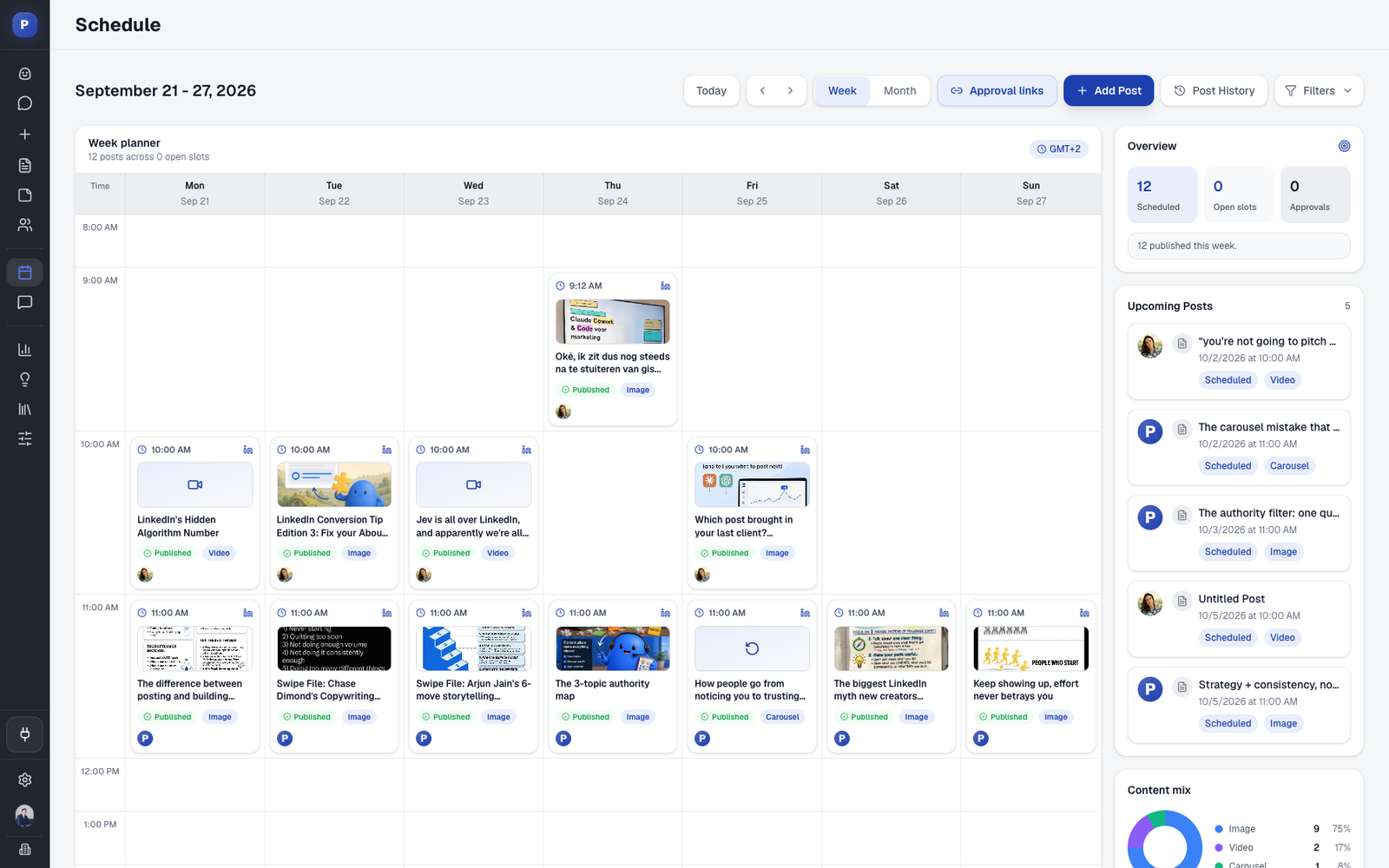
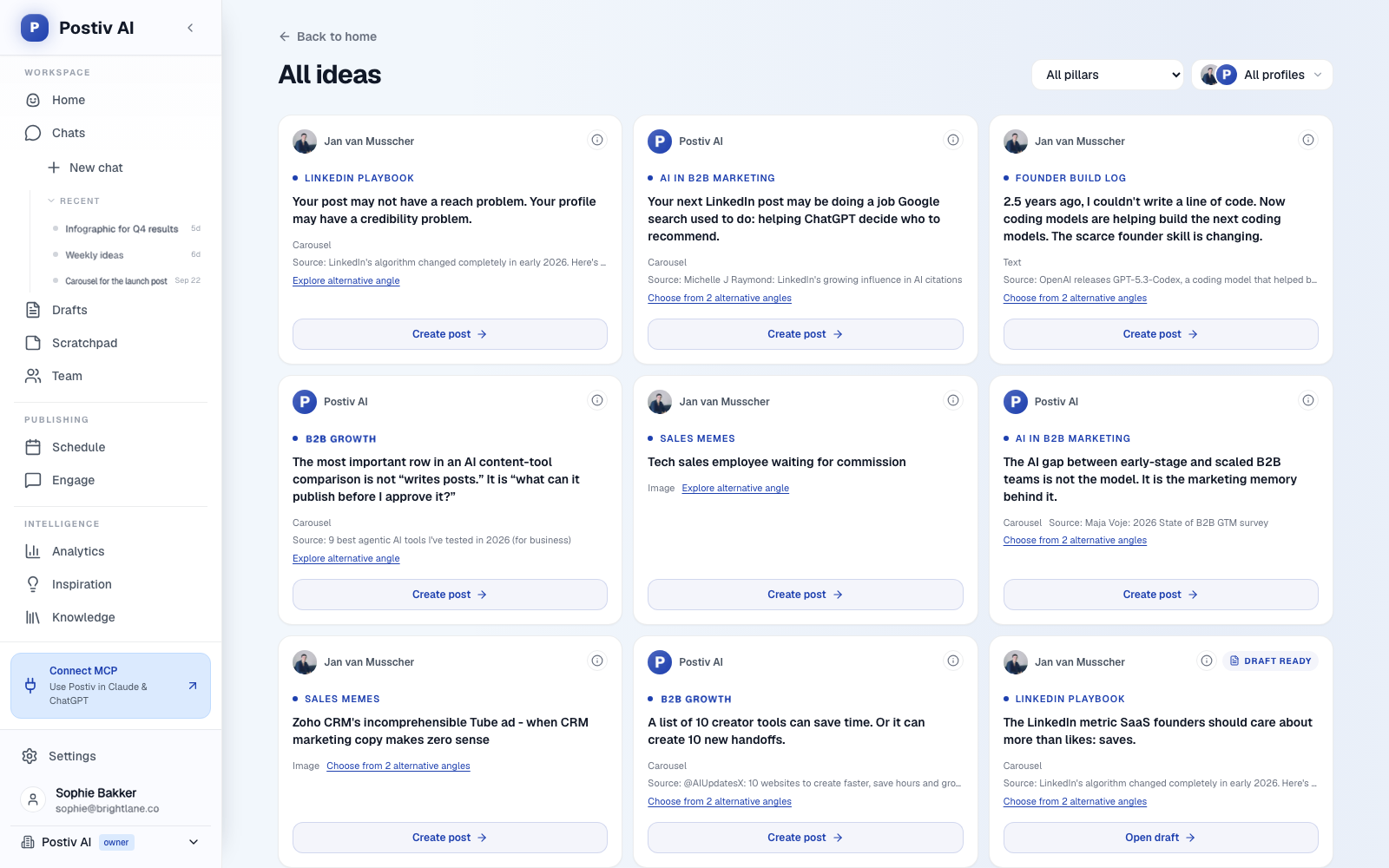
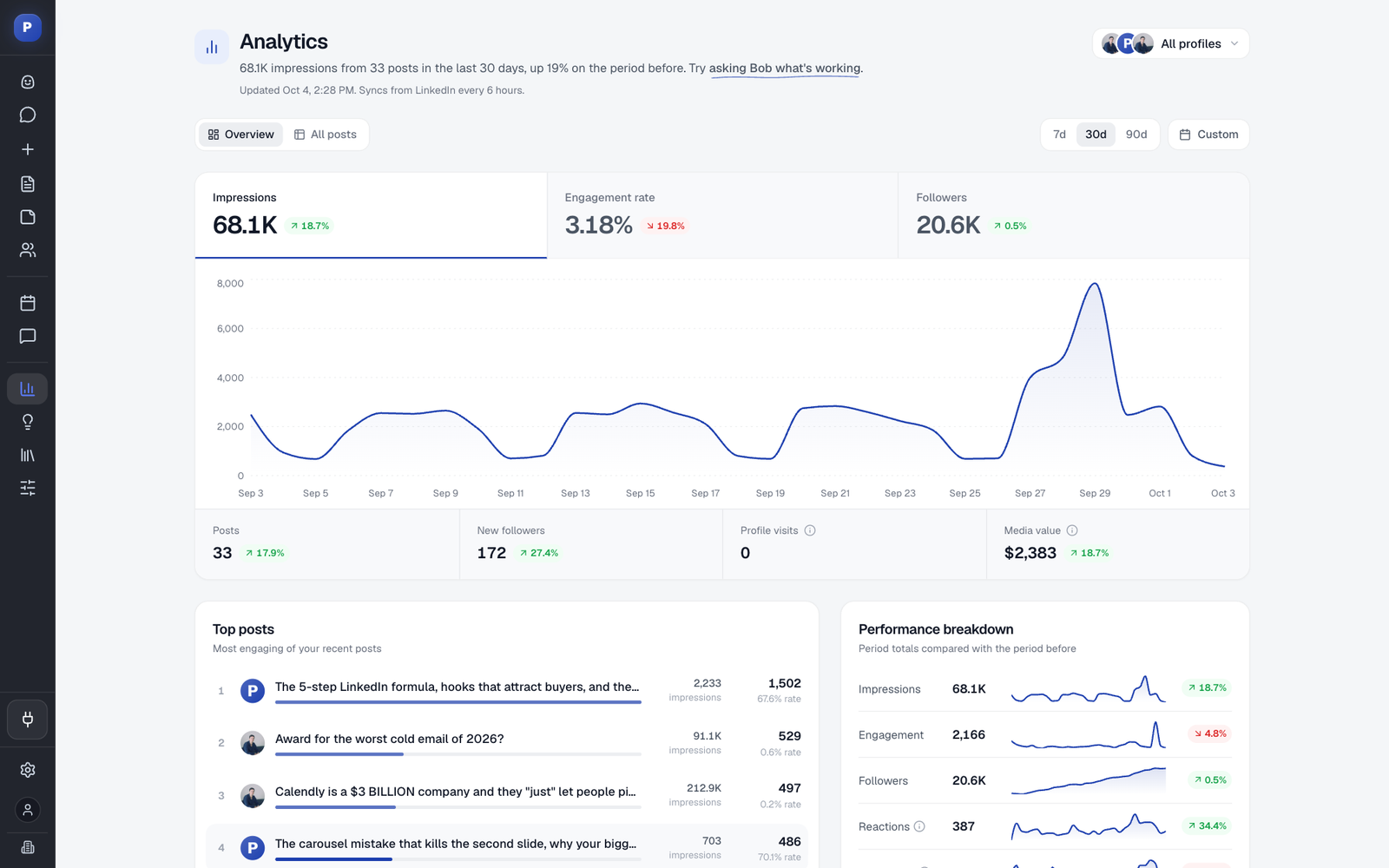
Postiv (postiv.ai) is a social workspace for you, your team and your agent. It suits the creator-first examples above: Storylane's tiers, Semrush's optional prompts, Cognism's lenses and the scenarios in this guide. Bob, Postiv's AI agent, plans each person's week from their pillars, sources and results and writes with them in their own voice. The Team plan includes unlimited members and LinkedIn profiles, approvers per profile, a Team Hub with briefs, challenges and a leaderboard, and analytics. Agencies get a separate workspace per client. If your main need is a library of company-approved posts that people reshare, as in GitLab's model, compare the tools in our guide to the best employee advocacy tools. Postiv has a 7-day free trial.
FAQ
What is an example of employee advocacy?
A product manager writes a LinkedIn post about a feature trade-off. A salesperson shares the question buyers ask before they buy. A support lead answers a common problem in a short walkthrough. A founder comments on a customer's post. Each is a real person using their own profile to share expertise or back the company, not just reposting an announcement.
What companies have successful employee advocacy programs?
Public examples include GitLab, which documents its team member advocacy program in its handbook, and Cisco, which described its Social Ambassador program in a 2013 blog post. In Postiv's published interviews, Semrush, Storylane and Cognism described how they support employees on LinkedIn. None of these sources gives audited results, so treat them as designs to learn from, not proof of a return.
What are the types of employee advocacy?
A practical split is five activities: creating original posts, sharing and commenting on company content, engaging with customers' and prospects' posts, recruiting and employer-brand posts, and representing the company at events. Most B2B programs start with the first and add the others once people are posting weekly.
How do small companies do employee advocacy?
They start with three to five volunteers, no formal platform and one person who owns the routine. Each volunteer gets two or three topics, a weekly writing block and a quick review step. A shared document and a chat channel are enough for a pilot. Software becomes useful once more people and reviewers are involved.
Do these examples come with results?
No verified numbers are included here. Most public figures for employee advocacy come from vendors and agencies, and we could not confirm them on a neutral source. GitLab's handbook lists the metrics it tracks but not its outcomes, and the interviewed teams described benefits without audited data. Measure your own pilot instead.
Is employee advocacy the same as employee-generated content?
No. Employee advocacy is the broader idea: employees support the business through their own profiles by creating, sharing, commenting or recommending. Employee-generated content is the original-post part, written from the employee's own experience. Many B2B programs lean on it because original posts get noticed more than reshares.
Pick one example and test it for 30 days
Choose the real program or scenario closest to your company, recruit three to five volunteers and run a four-week pilot. Keep a note of what blocks people, because that tells you what to fix before you add the next group. For the full launch plan, see our guide to launching an employee advocacy program.