Content pillars are the three to five recurring themes you post about on purpose. Each one answers a question your buyers ask, draws on proof you can show, and ties to a business goal. Every post fits under one pillar, so "what do I post today?" becomes a choice between a few subjects you already own.
This guide is for B2B founders, consultants, SaaS marketers, agencies and anyone who runs a company page on LinkedIn. It covers a method for choosing pillars from buyer questions, a worked example, a weekly rotation and a rule for which pillars stay. If you would rather start from a draft, the free content pillar generator reads your website or LinkedIn URL and suggests three to five B2B pillars with two post angles each. For finished sets by industry, see our content pillar examples.
What are content pillars?
A content pillar is a theme with a point of view. "Month-end close" is a subject. "How small finance teams shorten the close" is a pillar, because it says who it serves and what they get. Under a pillar sit many topics, and each topic can become several posts in different formats.
Pillars make planning quicker, since you pick a pillar before you pick an idea. They teach your audience what you are about, because people recognize a theme after seeing it a few times. They let several people write in the same direction, and they make results comparable, because you can set one pillar's numbers next to another's. B2B buyers tend to see you several times before they act, so pillars matter more there: those encounters add up to one clear idea of what you know.
Content pillars in digital marketing: pillar pages vs social pillars
In SEO, a "pillar page" is a long page on a broad subject that links out to narrower cluster pages. A social pillar borrows the hub-and-spoke picture but is a theme that organizes posts, not a page. The two can share subjects, but the rest of this guide is about the social kind.
Pillar vs topic vs format vs campaign
Most muddled pillar lists mix four different things.
| Term | What it is | Example (B2B finance software) | How long it lasts |
|---|---|---|---|
| Pillar | A recurring theme tied to a buyer question and a goal | Close-week playbooks | Months to years |
| Topic | One subject inside a pillar | An accrual checklist for month-end | One idea, sometimes a short series |
| Format | The shape a post takes | Carousel, text post, poll, short video | Changes from post to post |
| Campaign | A time-boxed push around one outcome | Launch of a new report in November | Weeks |
"Carousels" is a format, so it cannot be a pillar. A carousel can sit under any pillar, and so can a poll. "Thought leadership" is a goal and says nothing about what you will write on Monday. Lists such as educate, inspire, entertain and promote describe the job of a post. They work as a mix check (many guides suggest roughly 80% useful content and 20% promotion, which is a rule of thumb and not a law), but they do not give you anything to say.
How many content pillars do you need?
Three to five, and the arithmetic explains why. Say you post three times a week, about twelve posts a month. Three pillars get four slots each, five get two or three. At eight, some pillars would show up once a month, which is too rare for anyone to connect the theme with you. As a rule of thumb, a pillar needs at least two appearances a month to be noticed. Fewer than three has the opposite problem: you start recycling posts with new openers.
Choose three when you post one to three times a week, one person writes everything, or your expertise is narrow. Choose five when you post three or more times a week, the profile is a company page, you sell to different kinds of buyers (finance and IT, say), or a separate goal such as hiring needs its own slot. Four is a comfortable default.
If your list runs past five, you have topics and need to go up a level. Find the buyer question several of them answer, and make that the pillar. For the cadence side, see our post on how often to post on LinkedIn.
How to pick your content pillars: a method for B2B
This method starts with the buyer and works outward. Set aside an hour with your CRM and a few recorded sales calls.
Step 1: Start from buyer questions and objections
Collect real buyer language: sales call notes, support tickets, reasons deals were lost, comments and DMs on your posts, and webinar questions. Write down 20 to 30 questions and objections in the buyer's words. "How do we stop invoices getting stuck in approval?" beats "workflow automation".
Sort them into piles of similar questions and name each pile. Six to ten piles is typical, and those are your candidates.
Step 2: Map your proof and expertise
For each pile, ask what you can show that someone else cannot: customer outcomes you may share, numbers from your own product, a method you run every week, mistakes you fixed, an opinion backed by experience. Mark each pile as strong proof, some proof or none. A pile with no proof is a subject you can write about but cannot own, so park it.
Step 3: Tie each one to a business goal
Give every surviving candidate one primary goal: qualified conversations, shorter sales cycles (by answering objections before the call), referrals, hiring or customer retention. Note where the buyer is too: noticing the problem, comparing options or choosing a vendor. If every pillar sits at the "noticing" end, nothing you post helps someone who is ready to talk, so keep at least one close to the buying decision.
Step 4: Run the four-question test
Each candidate must pass all four.
- Do buyers care? More than one buyer asked it, in the words you wrote down.
- Can you credibly own it? You have proof from step 2 and a named person who can speak on it.
- Does it link to what you sell? Someone who likes the pillar should be one step from needing your product, even if the posts never mention it.
- Does it yield 10 or more distinct posts? As a rule of thumb, write ten headlines in fifteen minutes. If you stall at five, it is a single topic.
If a candidate fails one question, sharpen it and test again. If it fails two, drop it. Keep your three to five best and park the rest on a "later" list.
Step 5: Write each pillar down
Give each pillar a short sheet with a name (two to four words, in buyer language), a one-sentence description of who it serves and what they get, the buyer question, your proof, the goal, default formats, an owner who proposes topics and checks facts, and one "not in this pillar" line that stops it absorbing everything. Our social media strategy template shows where that sheet sits next to goals, audience and measurement.
A worked example: four pillars for a fictional B2B company
Here is the method applied to a made-up company, Northfield Payables, which sells accounts-payable software to finance teams at companies with 30 to 200 employees. The founder posts from a personal profile and the company has a page. None of this is real data.
On sales calls the team keeps hearing the same worries: the close takes too long, approvals stall, switching feels risky, and vendors seem not to understand finance. That gives four candidates, and all four pass the test.
| Pillar | Buyer question | Proof | Goal |
|---|---|---|---|
| Close-week playbooks | How do we close the month faster with the team we have? | The close routines taught to every new customer | Qualified conversations |
| Inside customer workflows | How do teams like ours run approvals in practice? | Customer setups shared with permission | Shorter sales cycles |
| Buying finance software without regret | What goes wrong when we switch? | Migration notes from past onboardings | Closing deals in motion |
| Founder notes | Do these people understand finance? | The founder's own decisions and customer calls | Trust, referrals and hiring |
1. Close-week playbooks. Routines that help a small finance team close the month with fewer late nights.
- The close checklist we hand every new customer, and the step most teams skip
- Where an invoice stalls between approval and payment, drawn as a flowchart
2. Inside customer workflows. How finance teams of our size run approvals, shown with their permission.
- A customer's approval rules on an annotated screenshot, and what they changed after month two
- One AP clerk's Monday: the tasks the software took over and the ones it did not
3. Buying finance software without regret. Straight answers to the objections finance leads raise before they sign.
- Five questions to ask any vendor about getting your data back out
- What migration week looks like day by day, including what usually goes wrong
4. Founder notes. What we are building and learning, in the founder's first person.
- A feature we cut after talking to customers, and why
- The support call that changed how I think about approvals
Founder notes is the weakest on "links to what you sell", so every post under it ties back to a customer problem. Pillar 3 sits closest to the buying decision. For more worked sets, browse these pillar sets across other B2B niches.
Content pillars for social media (and LinkedIn)
Content pillars for social media are the recurring themes that guide what you post on a platform. The themes come from your business and your buyer, and the platform changes the format, length and tone. For B2B, most of this plays out on LinkedIn, and our LinkedIn content strategy guide covers the wider plan around your pillars. The setup changes with who is speaking.
A personal profile
A personal profile speaks in the first person, so its pillars should come from what that person knows and has done. Three is usually plenty, and one can be the person's own working story as long as it connects to the problem you solve.
A company page
A page speaks as the brand, so its pillars lean toward what the company can state with authority: customer outcomes, product changes explained through buyer problems, original research and hiring. Three or four pillars and a named owner work best. The page carries proof and announcements while people carry opinions and stories. Our guide to LinkedIn company page best practices covers the page-specific habits.
A team of profiles
When a CEO, a head of product and a customer success lead all post, give the company one shared set of pillars and let each person take a lens. In the Northfield example, the head of product leads the playbooks, customer success leads the customer workflows and the founder leads the founder notes. The pillar owner proposes topics and checks facts, and others post under it in their own words. Do not push one draft out through five profiles. Our guide to a B2B employee LinkedIn strategy covers getting people to post.
Agencies running several clients
Give every client profile and company page its own pillars. A standard set across clients (thought leadership, culture, promotions) makes every feed read alike. Run the same process for each client instead: an intake on their buyer questions and proof (steps 1 and 2), the four-question test on their material, a written pillar sheet they sign off, and a monthly review of each pillar's 30-day numbers. Keep the agency's own profile separate, with its own pillars.
From pillars to a weekly plan
Pillars only help if they decide what goes into the calendar. Start with a cadence you can keep for three months. Take three posts a week and the four Northfield pillars: twelve posts a month, three per pillar. Give each pillar a few default formats.
| Pillar | Formats that usually fit |
|---|---|
| Close-week playbooks | Carousel, text how-to, short walkthrough video |
| Inside customer workflows | Annotated screenshot, customer story in text |
| Buying finance software without regret | Checklist as a text post, poll, one objection answered |
| Founder notes | First-person text post, short video |
Then rotate them through the Monday, Wednesday and Friday slots.
| Week | Monday | Wednesday | Friday |
|---|---|---|---|
| 1 | Playbooks: carousel | Workflows: annotated screenshot | Buying: checklist text post |
| 2 | Founder: story text post | Playbooks: how-to text post | Workflows: customer story |
| 3 | Buying: poll | Founder: short video | Playbooks: carousel |
| 4 | Workflows: annotated screenshot | Buying: objection text post | Founder: opinion text post |
Each pillar appears three times and lands on each weekday once. A few adjustments:
- Weight the pillar closest to the sale. If pillar 3 drives conversations, give it four of the twelve slots and take one from the weakest pillar.
- Leave one slot free for news or a customer win, so a reaction does not break the rotation.
- Batch from one source. A recorded customer call can feed a workflow post, an objection post and a founder note.
Put the rotation in a calendar. Our LinkedIn content calendar template gives you a layout to copy. Plan one week at a time, so this week's results can change next week's slots.
How to measure your content pillars
Tag every post with its pillar when you schedule it. A spreadsheet column works. Every 30 days, build a one-page view per pillar:
| What to record | How to get it |
|---|---|
| Posts published | Count the posts tagged with the pillar |
| Average impressions | Total impressions of those posts divided by the post count |
| Engagement rate | Reactions, comments and reposts divided by impressions |
| Versus your profile average | The pillar's figure divided by the figure for all your posts in the same 30 days |
| Business signals | Profile visits, replies from target accounts, DMs, "I saw your post" on sales calls |
LinkedIn results swing from post to post, so one post says little. As a rule of thumb, wait for at least four posts over four to six weeks before you judge a pillar. To connect these numbers to pipeline, see our post on measuring social media ROI.
| Call | What you see | What to do |
|---|---|---|
| Keep | At or above your average on impressions or engagement, plus a business signal in the last 30 to 60 days | Keep its slots, and consider one more |
| Sharpen | Below average overall, but two or three posts beat it | Find what the winners share (angle, format, hook) and narrow the description to that |
| Merge | Two pillars produce near-identical posts, or each gets fewer than two posts a month | Combine them and free a slot |
| Split | One pillar answers two different buyer questions and its results swing widely | Split it into two narrower pillars, staying at five or fewer |
| Retire | After six weeks and four posts it is below average on both measures, shows no business signal, and a new angle and format did not help | Replace it with a candidate from your "later" list |
Business signals can outrank reach, so a pillar with modest impressions that draws replies from the accounts you want can stay.
Common mistakes with content pillars
- Choosing subjects you enjoy instead of questions buyers ask. A pillar that never came up in a sales call or support ticket is a hobby.
- Treating formats as pillars. "Carousels" and "videos" say how to post, not what to say.
- Too many pillars. Eight of them means each shows up about once a month, and none sticks.
- Pillars so broad they fit every post. "Marketing" or "leadership" guides nothing.
- No proof behind it. A competitor with more evidence will win the same subject.
- No goal. Pillars all aimed at awareness leave nothing for a ready buyer, and pillars all about your offer read like ads.
- Writing for peers. A founder selling to finance leads who posts marketing tips attracts marketers.
- Never reviewing, or changing them every two weeks. Give a pillar four to six weeks, then decide with numbers.
How Postiv uses content pillars
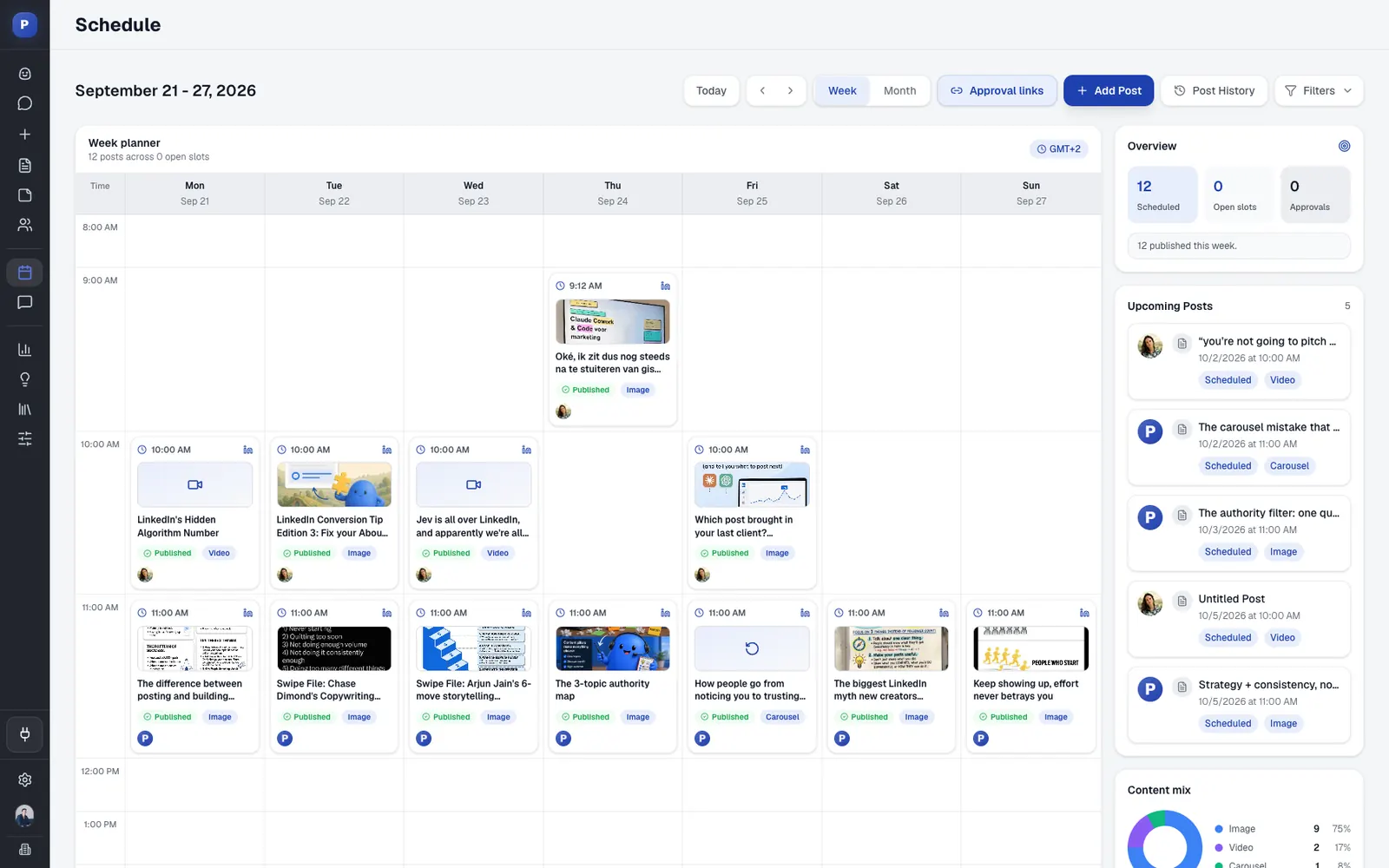
Postiv (postiv.ai) is a content workspace for B2B founders, consultants, marketing teams and agencies. Bob, its AI agent, plans your posts every week from your content pillars, sources and results, and writes them with you in your voice. Pillars work like this in the product.
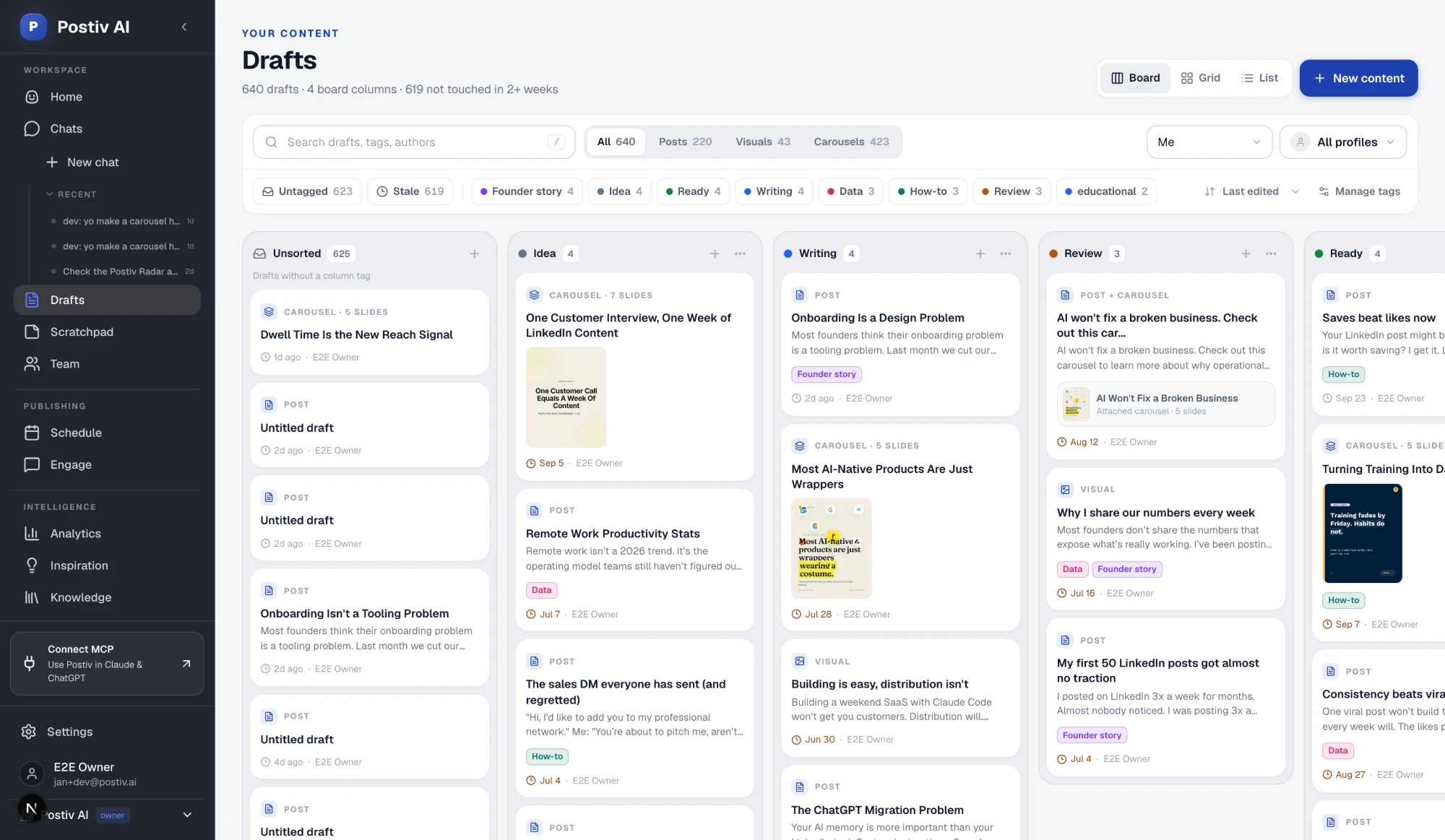
- On the first run, Bob looks at your analytics and knowledge base and proposes three to five content pillars. He saves them only after you confirm. You can change them any time and the next plan follows.
- A profile can have up to five active pillars. Each has a name, a one-sentence description and free notes, and it can have a preferred posting day.
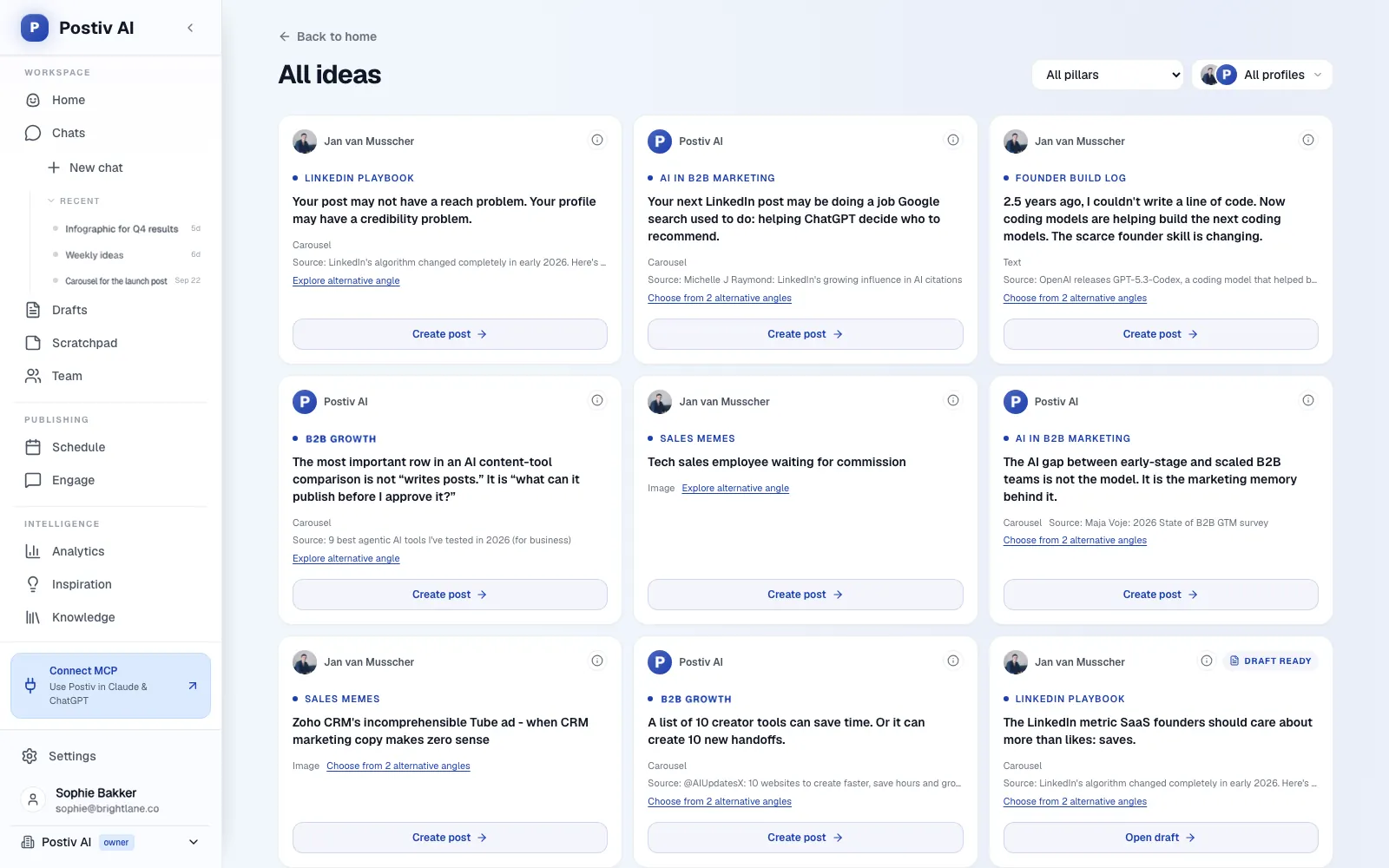
- Every week Bob prepares a plan with one post idea for each posting day you chose, so Monday, Wednesday and Friday gives you three. Each idea has a topic, a hook or angle, a format, sources and the pillar it belongs to. A pillar with a preferred day goes to the closest posting day.
- Each pillar's last 30 days (posts, average impressions and engagement rate against your profile average) go into the next plan, so pillars that land get their due.
- On a team, each LinkedIn profile and company page gets its own plan, pillars and voice, and Bob does not mix them. The calendar shows posts per profile with their pillars. You choose approvers per profile or company page, every approver must approve, one denial stops the post, and "request changes" sends it back with feedback.
Read more about how Bob plans your content, or draft a starting set first with Postiv's pillar generator, which needs no signup and gives you three sets a day. Postiv also has a 7-day free trial.
FAQ
What are the five content pillars?
There is no official list, so treat any "five pillars" as a template. A common B2B set on LinkedIn is how-to education, customer proof, your point of view, behind the scenes and your offer. Better pillars are subjects you can own, each tied to a buyer question. Five is also the practical maximum for one profile.
What are the four pillars of content?
The usual answer is four jobs a post can do: educate, inspire, entertain and promote. They describe a post's purpose, not its subject. For B2B on LinkedIn, four subject pillars work better, each answering a different buyer question with your own proof. Use the four jobs afterwards as a mix check.
What are the three pillars of content?
Three is the lean version and a good start. Some guides use educate, engage and promote. For a founder posting two or three times a week, three subject pillars are enough: the problem your buyers have, proof from your work, and your view of the market.
Can you give me an example of a content pillar?
Take a fictional accounts-payable software company. One pillar is "Close-week playbooks": routines that help a small finance team close the month with fewer late nights. It answers a buyer question, uses the company's own process as proof, and yields checklists, walkthroughs and flowcharts.
How many content pillars should I have?
Three to five. With fewer than three your feed repeats itself, and with more than five no theme appears often enough to stick. As a rule of thumb each pillar needs at least two posts a month, so choose three at one or two posts a week and five at three or more.
How do I know if a content pillar is working?
Tag every post with its pillar and review each pillar every 30 days: posts, average impressions and engagement rate, compared with your profile average over the same period. Note business signals too, such as replies from target accounts. Judge a pillar only after at least four posts over four to six weeks.
Should a company page and personal profiles use the same pillars?
Share the themes, not the posts. A company can hold one set of three to five pillars, while each person leads the pillar they know best and writes in their own voice. The page carries proof and announcements, and people carry opinions and stories. Agencies should give every client profile its own pillars.
Pick your pillars this week
Block an hour. Do steps 1 to 4 on your own notes, write a sheet for each pillar that survives, lay twelve posts onto a four-week rotation, and set a reminder 30 days out to review each pillar's numbers. If you want something to compare your list against, run your site through the content pillar generator and see where its suggestions match the questions your buyers asked.