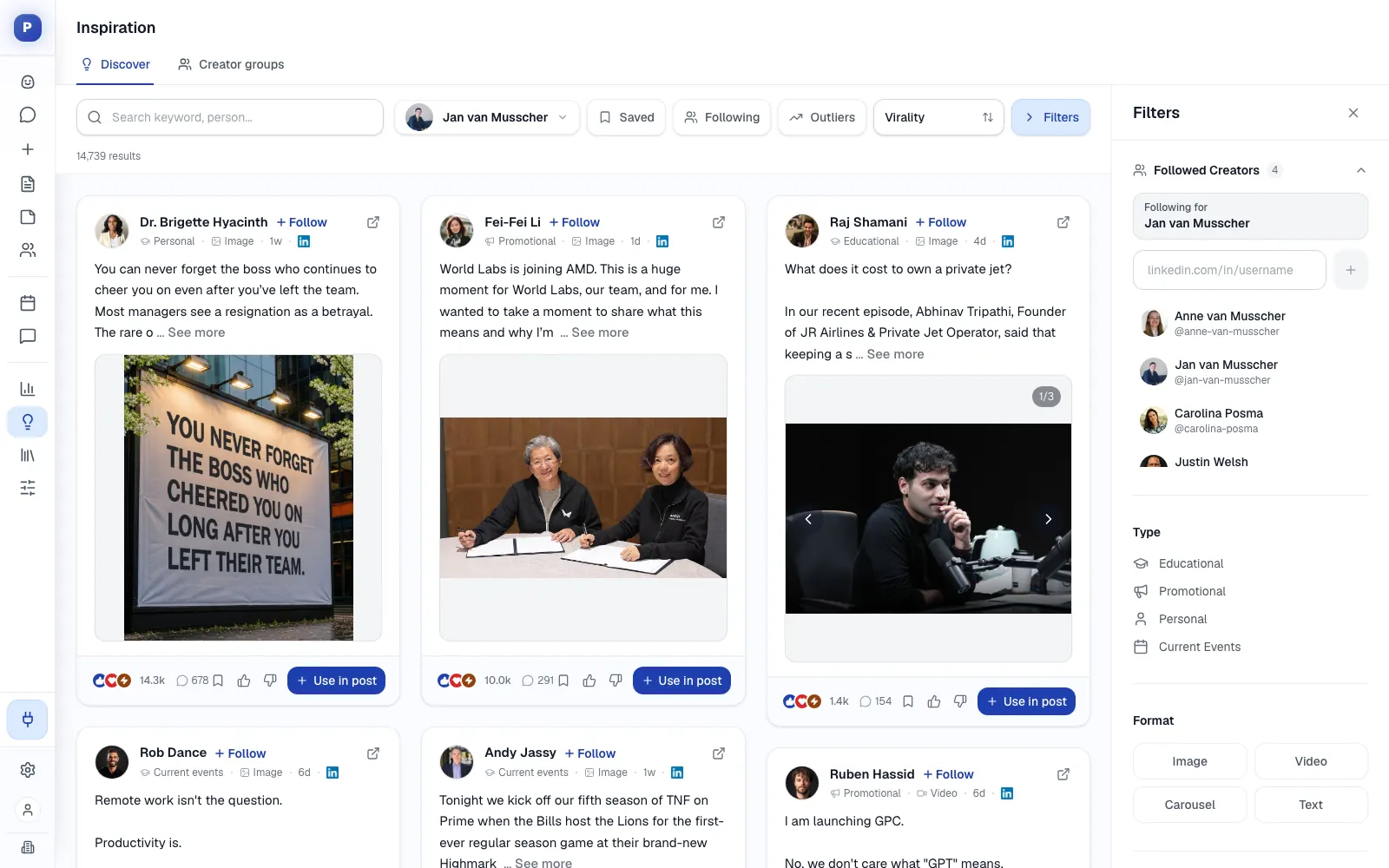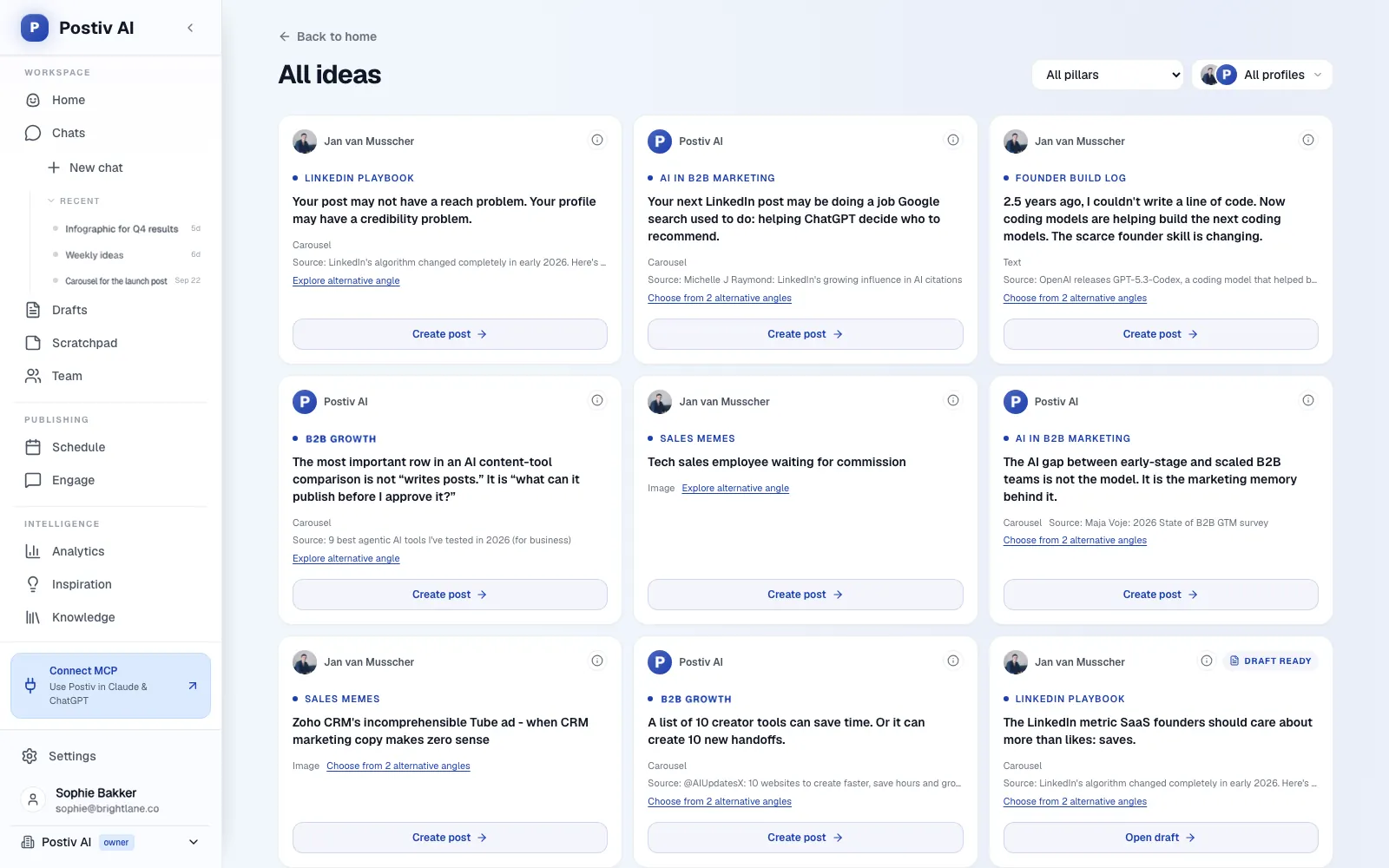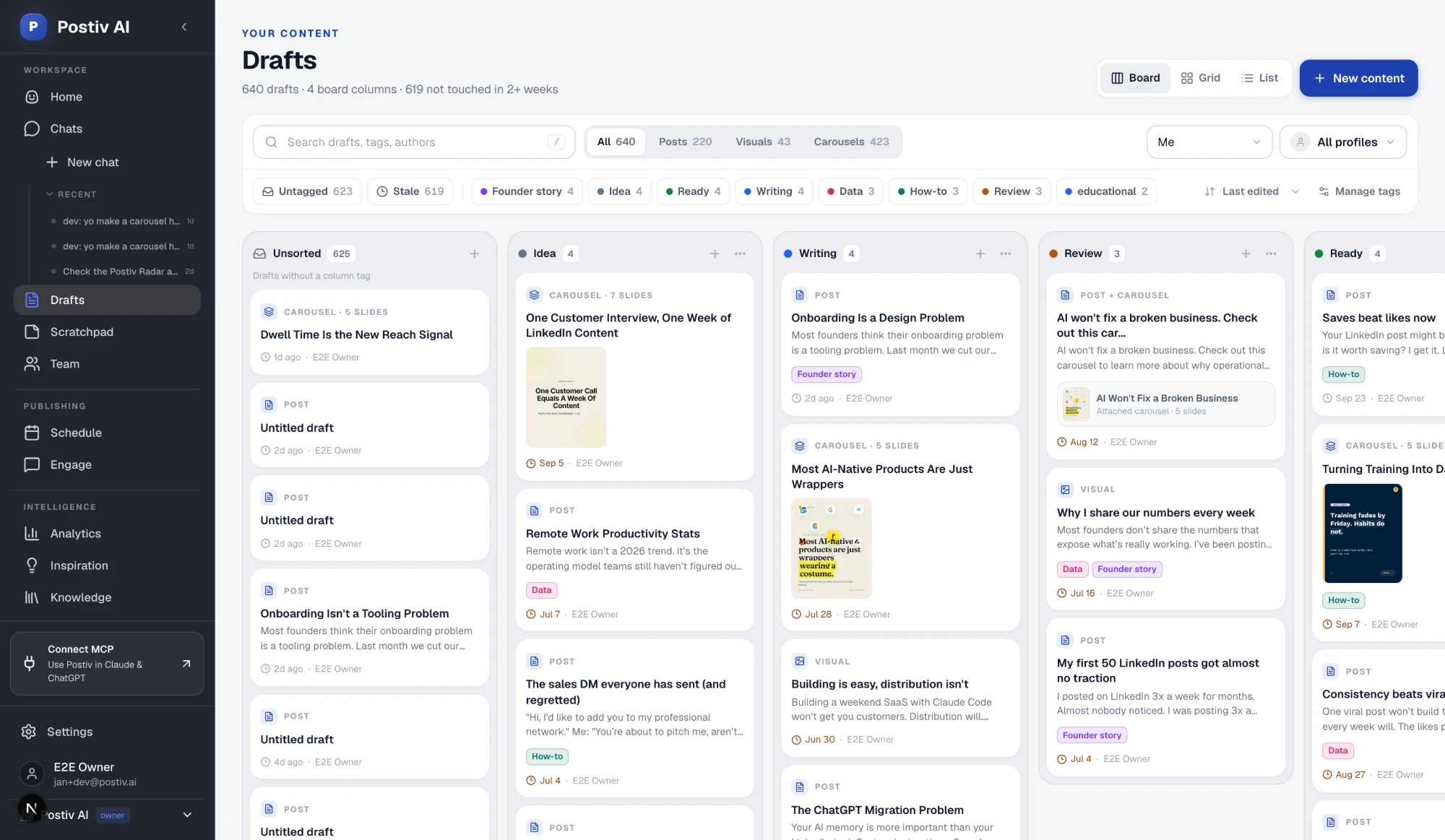
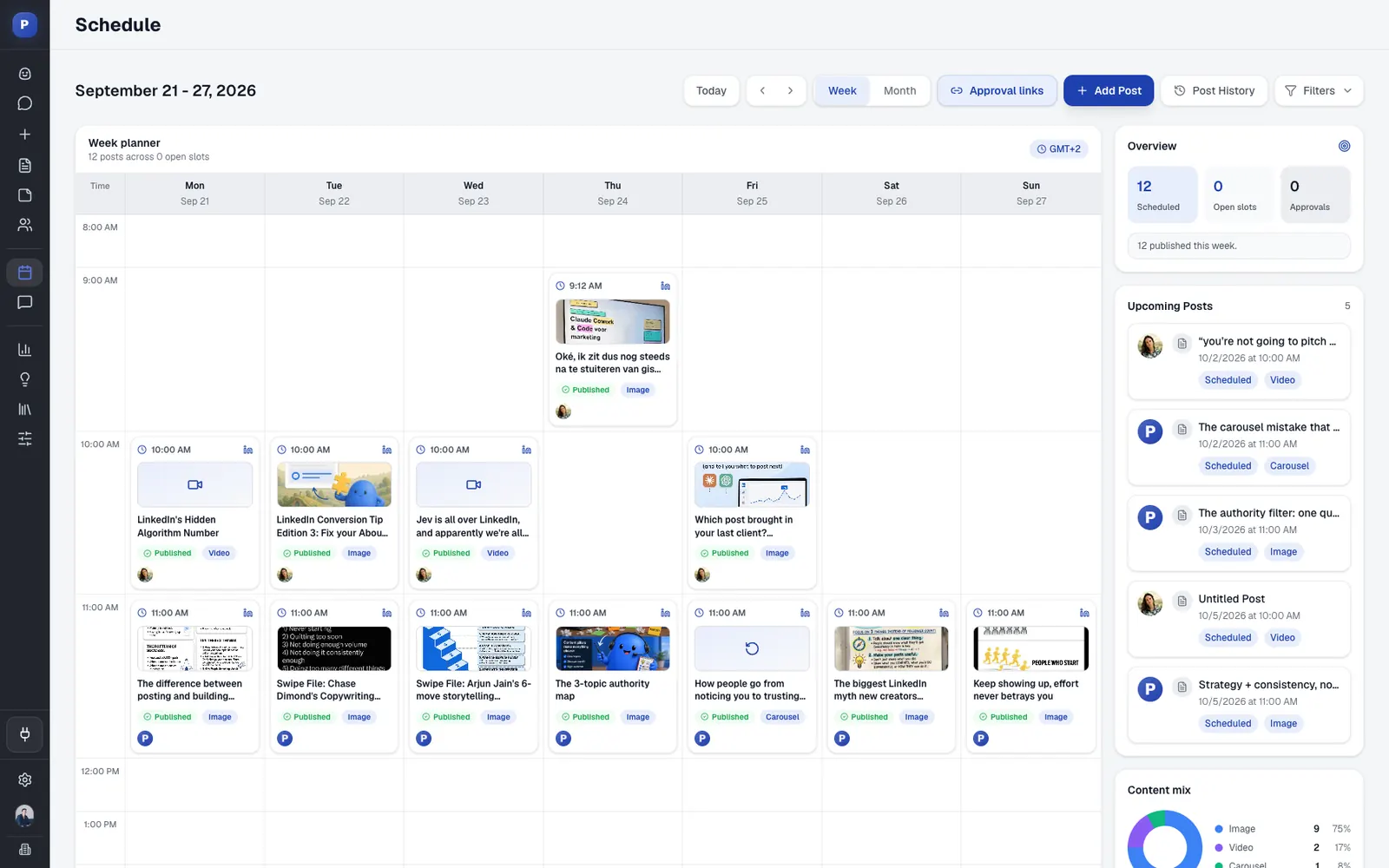
This is a free social media strategy template for B2B teams, with a worked example you can read before you touch your own. It has ten sections: goals, audience, profiles, content pillars, formats, cadence, approvals, engagement, measurement and a monthly review checklist. There is no email gate and no signup. Download it and edit it today.
Most strategy templates ask you to pick channels and fill a calendar. This one is built around content pillars, the three to five topics each profile is known for, because pillars decide what you post, how often, who signs off and what you measure afterwards. If you have none yet, run your website through the free content pillar generator first and come back to section 4.
The examples use a made-up company called Northwind Analytics, posting on LinkedIn. The structure works on any network where people post under named profiles.
Download the Template
Pick the format your team already works in.
To import, use File > Open in Google Docs for the .docx, File > Import in Google Sheets for the .xlsx, and Import > Markdown in Notion for the .md. The document versions hold all ten sections. The spreadsheet has a Read me tab plus tabs for pillars, cadence, approvals, KPIs and the monthly review, the parts that work best as tables.
What Is Inside the Template
| # | Section | What you decide | Spreadsheet tab |
|---|---|---|---|
| 1 | Goals and business outcome | The result the business wants and the metric that shows it | Document only |
| 2 | Audience | Buyer roles, their questions and the objections that stall deals | Document only |
| 3 | Profiles in scope | Which profiles post and who owns each | Cadence |
| 4 | Content pillars | 3 to 5 topics, each with a share of posts | Pillars |
| 5 | Formats and mix | Which formats you can produce every week | Document only |
| 6 | Cadence per profile | Posts per week, days and pillar rotation | Cadence |
| 7 | Workflow and approvals | Who drafts, reviews, approves and publishes, and how fast | Approvals |
| 8 | Engagement plan | Replies, outbound comments and team support | Document only |
| 9 | Measurement | Post metrics tied to profile visits, conversations and pipeline | KPIs |
| 10 | Monthly review checklist | What you check every month and the one change you make | Monthly review |
Fill it in order. Sections 1 to 3 are best done with the people who talk to customers, sections 4 to 8 are decisions, and sections 9 and 10 repeat every month.
Social Media Strategy Template or Content Strategy Template: Which One Do You Need?
These phrases overlap, and templates online use them loosely. In practice they mean four things.
- A content strategy template covers why you create content, for whom and in which formats, across every channel you own: blog, newsletter, video and social.
- A content marketing strategy template is a content strategy with the commercial layer added: funnel stages, distribution, budget and pipeline targets.
- A social media strategy template narrows to the profiles where you post, with cadence, engagement and approvals.
- A social media content strategy template is the overlap, meaning what you post on social, organised by topic.
This template covers the last two. Sections 1, 2, 4 and 5 (goals, audience, pillars, formats) are the content strategy half. Sections 3, 6, 7 and 8 (profiles, cadence, workflow, engagement) are the social half. Sections 9 and 10 serve both. If you also plan a blog, a newsletter or video, reuse sections 1, 2, 4 and 9 and add a channel column to the tables.
What it leaves out on purpose: paid budgets, SEO and email sequences. For the LinkedIn-specific thinking behind the structure, read our LinkedIn content strategy guide.
How to Fill In the Template, Section by Section
Northwind Analytics is a made-up 40-person company that sells reporting software to operations teams at mid-sized logistics firms. Every number below is invented for illustration. None of them is a benchmark.
1. Goals and Business Outcome
Start with what the business wants, not with what the platform reports. Northwind's outcome is more demo requests from operations leaders at logistics companies. Its one goal for the quarter is to start more conversations with buyers at target accounts, measured as inbound conversations per month (DMs and comment threads with people at those accounts). Today that number is 6, and the 90-day target is 15.
Keep it to one outcome and no more than three goals, each with a metric, a baseline and a target date. Impressions can be a supporting metric. A goal that stops at impressions cannot tell you whether the strategy worked.
2. Audience: Buyers, Questions and Objections
Name two or three buyer roles instead of a demographic. For each, write the questions they ask before buying and the objection that stalls the deal.
Northwind's main buyer is the head of operations at a logistics company with a few hundred employees. This buyer asks why the weekly numbers never match finance's and how long a new tool takes to pay off. The objection is that spreadsheets already work and nobody has time to migrate. Each of those lines is a post, and the proof that answers the objection (a customer's two-week rollout) is another one. If you cannot yet describe your buyer that sharply, work through how to identify your target audience first.
3. Profiles in Scope
List every profile that will post and give each a named owner. Northwind starts with three profiles. Priya is the founder, Marcus leads sales, and Lena in marketing owns the company page. A profile without an owner stays out of the plan, because nobody notices when it goes quiet. Agencies repeat this block for each client's profiles.
Each profile plays a different role. The founder shares a point of view and the sales lead answers buyer questions in public. The company page carries product news and proof. Writing the role down stops all three from posting the same announcement on the same morning.
4. Content Pillars
This is the section everything else depends on. A pillar is a topic a profile wants to be known for. Choose three to five, make each one specific enough that you could list ten post angles, and give each a share of posts that adds up to 100%. Test every pillar with one question: why can we say this when others can't? The answer is usually proprietary data or direct experience.
Northwind's set looks like this.
| Pillar | What it covers | Why we can own it | Share |
|---|---|---|---|
| Reporting that finance trusts | How ops and finance agree on one set of numbers | We see the same reconciliation problems across many customers | 35% |
| Logistics ops in the field | What a dispatch or warehouse week really looks like | Our team has run these operations | 25% |
| Building Northwind | Hiring, product decisions, mistakes | Priya makes the decisions and can explain them | 20% |
| Customer results | Before and after stories, with permission | Customers agree to be named | 20% |
Four pillars is plenty for a profile that posts three times a week. For the full method, including how to check that a pillar is worth owning, read our guide to choosing and using content pillars, and browse the content pillar examples for more worked sets. Short on time? The pillar generator drafts a first set from a URL.
Postiv can do this step for you. On the first run, Bob, its AI agent, looks at your analytics and knowledge base, proposes three to five pillars and saves them only after you confirm.
5. Formats and Mix
Pick three or four formats the team can produce every week, then say which pillars each one serves and who makes it. Northwind posts mostly short text posts (about half), a PDF carousel for frameworks (a quarter), screenshots or product images (15%) and a short video (10%). Formats follow the pillar. "Reporting that finance trusts" works as a carousel because the idea has steps, while "Building Northwind" works as plain text because it is a story.
Resist adding a format because it is trending. One you cannot produce weekly drops out by week three and leaves a hole in a pillar.
6. Cadence per Profile
Set posts per week for each profile at a number you can keep for 12 weeks, then map pillars to days. Priya posts three times a week on Monday, Wednesday and Friday. Monday is always "Reporting that finance trusts", Wednesday is "Logistics ops in the field", and Friday alternates between the other two. When the week has a shape, nobody opens a blank page on Monday morning.
Profiles get different cadences. A founder with a strong voice can carry three posts a week, while a sales lead with a full calendar may manage two. For help choosing the number, see how often to post on LinkedIn. Once the grid is set, the LinkedIn content calendar template turns it into dated posts.
7. Workflow and Approvals
For every profile, name who drafts, who reviews, who approves and who publishes, and write the turnaround in hours. On Priya's profile at Northwind, Lena drafts from Priya's notes, Marcus checks facts and customer names within 24 hours, Priya approves within another 24 hours, and Lena schedules the post.
Settle two rules in advance. First, does every approver have to say yes, or will one do? Second, what happens when someone stays silent? Without a rule the post waits for days and the cadence breaks. In Postiv you choose approvers per profile or company page, every approver must approve, one denial stops the post, and "request changes" sends it back with feedback. The details are on the team management page.
8. Engagement Plan
A post is half the work. Decide who replies to comments, who comments on other people's posts and how the team supports company page posts. Northwind's plan has the post owner replying to every comment within one working day, Priya and Marcus leaving about five comments a day on posts from target accounts, and the team commenting on each company page post the morning it goes out. A good comment adds a fact or a question. "Great post" does not count.
Put the weekly number in the table so the monthly review can check it. The 5-5-5 rule below is one way to make it a daily habit.
9. Measurement
Pick metrics that connect a post to a business result. Northwind reads four levels in order: post metrics (impressions and engagement rate), profile visits, inbound conversations, and finally demo requests or pipeline. Impressions only matter if they show up as profile visits and conversations further down. That is why Northwind keeps a shared tracking sheet: whenever a conversation starts from a post, someone logs who, which post and which pillar.
Once a month, run the per-pillar 30-day review. Northwind's looks like this.
| Pillar | Posts | Avg impressions | Engagement rate | Profile visits | Inbound conversations | Demos or pipeline | Decision |
|---|---|---|---|---|---|---|---|
| Reporting that finance trusts | 5 | 2,400 | 3.1% | 310 | 4 | 1 demo request | Keep. Test a carousel next month |
A pillar that beats the profile's own average and produces conversations earns more posts. A pillar that does neither gets rewritten or dropped. Postiv feeds this into planning automatically: each pillar's last 30 days (posts, average impressions and engagement rate against your profile average) go into Bob's next weekly plan, so pillars that land get their due. To set up the numbers behind the table, read how to measure social media ROI.
10. Monthly Review Checklist
Block an hour on the first working day of each month. Pull the last 30 days for every profile, fill in the per-pillar table, trace each inbound conversation back to a post, and compare planned posts with published ones. Then decide keep, change or stop for each pillar and write down one change for next month. One change keeps the result readable. Three at once leave you guessing which one worked.
The template ends with a ready-made tick list, and the spreadsheet has the same list in its Monthly review tab.
How to Write a Social Media Strategy
If you strip the template down to the decisions, writing a social media strategy looks like this:
- Write the business outcome and up to three goals, each with a metric and a target.
- Describe the buyer by role, with their questions and the objection that stalls the deal.
- List the profiles that will post and name an owner for each.
- Choose three to five content pillars and give each a share of posts.
- Pick the formats the team can produce every week.
- Set posts per week, days and pillar rotation for each profile.
- Define who drafts, reviews, approves and publishes, with turnaround in hours.
- Plan engagement: replies, outbound comments and team support.
- Choose the metrics that tie posts to conversations and pipeline.
- Schedule a monthly review and change one thing at a time.
In the template each step is one table, so the whole strategy fits on a few pages.
The 7 C's, the 5-5-5 Rule and the 5:3:2 Rule
These three come up constantly. None of them is an official standard, and each has several versions online. Treat them as rules of thumb and check how they fit your own numbers.
The 7 C's of Social Media Strategy
There is no single official list. The version we use is a mnemonic that maps onto the template: Clarity (the goal, section 1), Customer (the buyer, section 2), Channels (profiles, section 3), Content (pillars and formats, sections 4 and 5), Consistency (cadence and workflow, sections 6 and 7), Conversation (engagement, section 8) and Conversion (measurement and review, sections 9 and 10). If your team already knows a different list, keep it and use the template sections as the checklist behind it.
The 5-5-5 Rule for Social Media
Another rule of thumb, and the details vary by source. One common reading for LinkedIn is a small daily engagement habit: comment on five posts from your target audience, reply to five comments on your own posts and review five profiles worth connecting with. It fits section 8. Put the three numbers in the engagement table and give each one an owner.
The 5:3:2 Rule for Social Media Posts
The usual version describes the mix across ten posts: five share other people's useful content, three are your own content and two are personal. Treat it as a variety check and skip the quota. On a B2B profile built on pillars, the shares in section 4 already set the mix, and the personal slice often fits as a pillar like "Building Northwind". Where 5:3:2 helps is as a warning sign. If everything you post is about your own product, the mix needs work.
FAQ
What are the 7 C's of social media strategy?
There is no single official list. A practical B2B version is Clarity (goal), Customer (buyer), Channels (profiles), Content (pillars and formats), Consistency (cadence and workflow), Conversation (engagement) and Conversion (measurement). Each C maps to a section of this template, so the list works as a checklist while you fill it in.
What is the 5-5-5 rule for social media?
It is a rule of thumb with several versions, not an official standard. One common reading for LinkedIn is a daily engagement habit: comment on five posts from your target audience, reply to five comments on your own posts and review five profiles worth connecting with. In this template it lives in section 8.
How do you write a social media strategy?
Make ten decisions in order: the business outcome, the buyer, the profiles and owners, three to five content pillars, formats, cadence, the approval workflow, the engagement plan, the metrics that tie posts to results, and a monthly review. A fill-in template turns each decision into a table row, so nothing gets skipped.
What is the 5:3:2 rule for social media posts?
It is a rule of thumb for mixing content: out of every ten posts, five share other people's useful content, three are your own and two are personal. Use it as a variety check, not a quota. For a B2B profile, the pillar shares in section 4 of this template usually define the mix more precisely.
Is the social media strategy template really free?
Yes. All three formats are free to download and use, with no email form and no signup. You can copy the template, adapt it for your own team or clients, and share it internally. The Northwind Analytics example is made up, so replace every row with your own details.
Can I use the template in Word, Google Docs, Google Sheets or Notion?
Yes. The .docx opens in Word and imports into Google Docs through File > Open. The .xlsx opens in Excel and imports into Google Sheets through File > Import. The .md file imports into Notion through Import > Markdown. The documents hold all ten sections, and the spreadsheet holds the five table-heavy ones.
What is the difference between a content strategy and a social media strategy?
A content strategy covers why you create content, for whom and in which formats across all your channels. A social media strategy is narrower: it picks the profiles you post from and sets cadence, engagement, approvals and measurement for them. This template combines both for the profiles where you post.
How many content pillars should a social media strategy have?
Three to five per profile. With fewer than three the feed gets repetitive, and with more than five no topic gets enough repetition to become what people know you for. Shares of posts should add up to 100% per profile. On a team, give each profile its own pillars.
Next Step: Pick Your Pillars
Start with section 4. Once the pillars are written down, cadence, approvals and measurement mostly fall into place around them. If you would rather react to a draft, Postiv has a 7-day free trial, and Bob will propose pillars from your own analytics and knowledge base.