Ever feel like you're shouting into the void on LinkedIn? You spend hours crafting what feels like a killer post, only for it to be met with crickets. This is a classic sign that your content isn't truly connecting with anyone specific. To make an impact, you have to stop broadcasting and start talking to someone.
Why Your Content Isn't Connecting on LinkedIn
Let's get real for a second. We've all been there. You, a B2B founder, share a brilliant insight on scaling operations—and it just disappears into the feed. Or maybe you're a marketing consultant who posts a detailed case study that doesn't generate a single lead. It's frustrating, and it happens all the time.
So, what's the deal? The problem, almost every time, is a disconnect with your audience. Without a crystal-clear picture of who you're talking to, your content just becomes more background noise in an already crowded space. Even the best AI content tools are useless if you're giving them vague prompts. They can't craft something compelling if they don't know the job titles, daily headaches, and career goals of the person you’re trying to reach.

Shifting from Creation to Connection
Figuring out your target audience isn't just some box-ticking exercise you do once. It's the absolute bedrock of your entire LinkedIn strategy—it shapes your tone, your topics, and even when you post.
When you know exactly who you're writing for, you can finally:
- Address their specific pain points, not just vague industry trends.
- Use their language, adopting the same lingo and terminology they use every day.
- Build real authority by offering up solutions to their actual, real-world problems.
Knowing your audience is what lets you create content that makes one person stop scrolling and think, "Wow, they're talking directly to me." That's when you start a conversation, not just collect a vanity metric.
Of course, a solid strategy is more than just knowing your audience; you have to deliver value consistently. A great first step is mapping out your plan by creating a LinkedIn content calendar.
And once you start posting, you'll need to know what's working and what's not. That's where knowing how to analyze content performance comes in. This playbook is designed to help you build that essential, audience-first foundation from the ground up.
Uncover Insights from Your Existing Customer Data
Your quest for the perfect future customer begins with the people who already love what you do. Before you look outward, the most valuable clues are almost always hidden right under your nose, inside your own data. This isn't about guesswork; it's about using concrete information to build a profile of who finds real value in your work.
Your existing customer base is your single greatest source of truth. Let's start there.

Mine Your CRM for Commonalities
Think of your CRM system as a goldmine. It holds the professional DNA of your best clients, and it's time to start digging with a clear objective: find the patterns.
Your most successful, profitable, and long-term customers probably share some specific traits. Look beyond simple revenue numbers and analyze their core characteristics.
Ask yourself these questions:
- What are their job titles? Are you consistently working with VPs of Marketing, or is your sweet spot with solo founders?
- What industries are they in? Pinpoint the top 2-3 sectors you serve most effectively. SaaS? E-commerce? Professional services?
- What is their company size? Do you thrive with agile startups of 10-50 employees or do you have better traction with larger enterprises?
Answering these questions moves you from a vague idea like "marketers" to a much sharper profile, something like "Marketing Directors at B2B SaaS companies with under 100 employees." That kind of clarity is the first step toward true precision.
By focusing on the attributes of your happiest customers, you create a blueprint for finding more people just like them. It's essentially reverse-engineering success.
To take this a step further, exploring different customer segmentation strategies can give you powerful frameworks for grouping these clients into distinct, targetable buckets.
To help you get started, here's a quick checklist to guide your internal data audit.
Your First-Party Data Audit Checklist
| Data Source | Key Metrics to Analyze | What This Tells You |
|---|---|---|
| CRM (e.g., Salesforce, HubSpot) | Job titles, industry, company size, deal size, sales cycle length. | The firmographic DNA of your highest-value customers. |
| Website Analytics (e.g., Google Analytics) | Top traffic sources (referral, organic), user demographics, most visited pages. | Where your audience hangs out online and what content resonates most. |
| LinkedIn Company Page/Profile | Visitor/follower demographics (job function, seniority, industry), post engagement rates. | The professional profile of the people actively engaging with your brand on the platform. |
| Email Marketing Platform | Open rates, click-through rates by segment, most popular links clicked. | Which topics and value propositions capture your subscribers' attention. |
This audit isn't just about collecting data; it's about connecting the dots between your different platforms to form a cohesive picture of who you're already attracting.
Analyze Your Digital Footprint
Your digital platforms are constantly collecting audience data, offering a real-time glimpse into who's paying attention. Let's look at two key places: LinkedIn and your website.
Head over to the analytics on your LinkedIn profile and company page. You can see detailed breakdowns of your post viewers and profile visitors by job title, industry, and location. Does this data line up with what you found in your CRM? If the VPs of Marketing you identified earlier are also the primary group engaging with your LinkedIn content, that's a powerful signal you're on the right track.
This is especially important on LinkedIn, where you can zero in on specific professional demographics. As of early 2025, a massive 47.3% of LinkedIn users worldwide were in the 25-34 age bracket. This group of ambitious, career-focused professionals is often actively seeking solutions to help them get ahead.
Finally, dive into your Google Analytics. Don't just look at traffic volume—pay close attention to your referral traffic. Which sources are sending you the most engaged visitors? A backlink from a specific industry blog or a mention in a niche forum can be a huge clue about where your ideal audience spends their time online.
Look Over Your Competitor’s Shoulder (Ethically, of Course)
Your own data is the bedrock, but don’t stop there. You’re not operating in a vacuum. Your competitors have already spent a ton of time and money figuring out who their audience is, and you can learn from their homework.
This isn’t about copying what they do. Think of it as strategic observation—a bit of digital reconnaissance. You're looking for patterns in who they attract, the problems they focus on, and, most importantly, where they might be dropping the ball.
Dissect Your Competitor’s LinkedIn Game
First, pick two or three direct competitors who are actually active on LinkedIn. Don't just mindlessly scroll through their company page. Go in with a plan and dissect what they’re doing. You’re hunting for clues about the audience they’ve managed to capture.
Here's exactly what to look for:
- Who’s hanging out in the comments? Seriously, read the comments. Check out the job titles and industries of the people who consistently engage with their posts. Are you seeing VPs of Sales, Marketing Managers, or hands-on specialists? This is a live look at their most engaged followers.
- What problems are they solving? Look at their most popular content. Are the posts all about hitting quota, improving team productivity, or building a personal brand? The pain points they address are a dead giveaway of the audience they serve.
- How are they packaging their content? Are they getting traction with simple text posts, detailed data-filled carousels, or candid video interviews? This hints at how their specific audience prefers to consume information.
By studying who responds to your competitor's content, you get a free, real-world focus group. The comments reveal the language, questions, and objections of the very people you want to reach.
This kind of analysis is a crucial piece of the puzzle. Understanding these dynamics is non-negotiable when you’re trying to build a powerful LinkedIn marketing strategy for B2B.
Tune Into the Industry’s "Water Cooler" Conversations
Don’t just stalk your direct competitors. Gold is often found in the places where your potential customers go to ask for help and trade notes. I'm talking about niche LinkedIn Groups, industry-specific Slack communities, or even online forums. These are the unfiltered sources of your audience's real-world challenges.
Search for keywords related to your field and just listen to the conversations. Pay close attention to the questions people are asking.
For example, a post like, "Has anyone found a good way to track ROI on influencer campaigns without expensive software?" tells you three critical things about that person: they care about ROI, they’re watching their budget, and they’re already working with influencers. Boom—that’s a persona insight you can run with.
It also helps to keep an eye on broader platform trends. For instance, knowing the general gender breakdown can subtly shape your content's tone and focus. In early 2025, LinkedIn’s global user base was 56.9% male and 43.1% female. In many B2B sales and executive circles, that slight male tilt can be more pronounced, which might suggest that content framed around hard numbers like ROI and pipeline growth could resonate particularly well. You can dive deeper into these trends by checking out studies on LinkedIn user demographics.
When you combine sharp competitor analysis with these broader market-level conversations, you get the exact language and topics you need to create content that doesn’t just get seen—it gets felt.
Turn Raw Data Into Relatable Personas
All that information you’ve pulled from your CRM, website analytics, and competitor deep dives is a goldmine. But let's be honest—raw data doesn't tell a human story. To truly connect with your audience on LinkedIn, you need to transform those numbers and data points into something real. That’s where building audience personas comes in.
A powerful persona isn't just a dry list of demographics like job titles or company size. It’s a semi-fictional, living profile of your ideal customer. It captures their professional ambitions, their daily headaches, and what actually motivates them. It’s the critical difference between vaguely targeting "marketing managers" and speaking directly to an individual with specific, solvable problems.
This process of moving from broad market analysis to a sharp audience profile is a journey in itself.
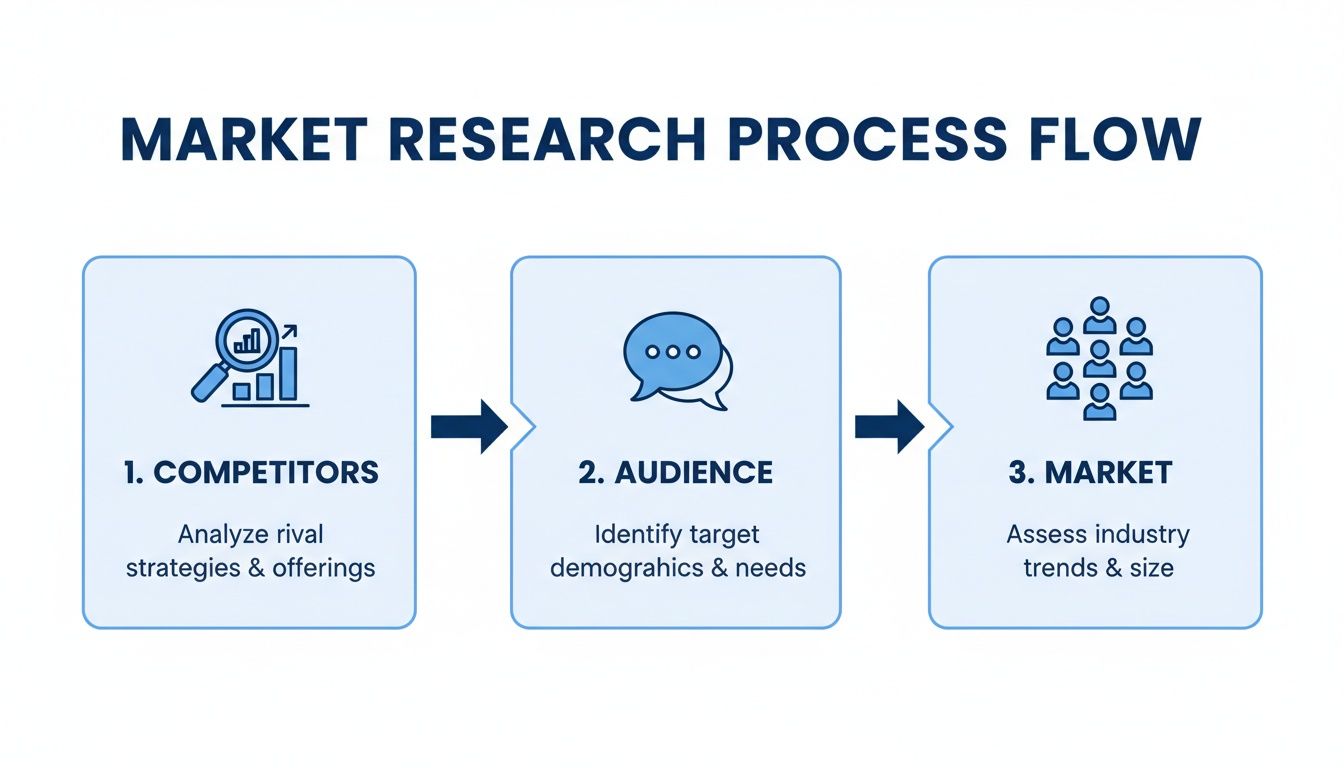
Each step here adds another layer of understanding, helping you build a rich, three-dimensional picture that goes far beyond what the surface-level data shows.
Crafting Your First B2B Persona
So, how does this look in practice? Let's take the data we've been gathering and build a persona for a common B2B target. We’ll call him 'Startup Founder Sam.'
Creating a persona like Sam's requires you to answer specific questions that get to the heart of who they are professionally. The table below breaks down the essential components.
Essential Components of a B2B Persona
| Persona Component | Key Questions to Answer | Example ('Startup Founder Sam') |
|---|---|---|
| Role & Context | What is their job title? What size and type of company do they work for? What are their core responsibilities? | Founder of a 15-person B2B SaaS startup. He's the CEO but also wears the hats for sales, marketing, and product. |
| Primary Goals | What does success look like for them? What are the key metrics they are measured by? | Grow Monthly Recurring Revenue (MRR) by 20% each quarter. He also needs to establish thought leadership to attract investors. |
| Daily Frustrations | What are their biggest professional pain points? What roadblocks prevent them from hitting their goals? | Constantly short on time. Knows LinkedIn is crucial for lead gen but struggles to create consistent, high-quality content. Feels like his efforts aren't making an impact. |
| Content Habits | Where and how do they consume professional content? What formats do they prefer? | Consumes content in short bursts between meetings. Prefers scannable LinkedIn carousels, quick explainer videos, and business podcasts during his commute. |
This detailed profile instantly becomes a filter for every piece of content you create. Sam's struggle with content creation is a direct prompt for a post like, "The Founder's 30-Minute Weekly LinkedIn Plan." His goal to build thought leadership is the perfect setup for a carousel that simplifies a complex industry trend.
Key Takeaway: A well-defined persona is your content compass. Before hitting "post," always ask: "Would Startup Founder Sam find this valuable? Does it directly address one of his frustrations?"
Don't Overcomplicate It: Focus on Your Core Audience
It’s easy to get carried away and try to build a persona for every possible customer segment. My advice? Resist that temptation.
When you're starting out, your biggest advantage is focus. Concentrate on creating just 1-3 core personas that truly represent your most valuable and engaged customers. This ensures your messaging stays sharp, consistent, and resonant.
Remember, each persona also has its own communication style. The way you'd talk to 'Startup Founder Sam' is likely different from how you'd engage with 'Agency Owner Annie.' Understanding these nuances is a fundamental part of figuring out what is brand voice and how to use it to your advantage.
With these clear, actionable personas in hand, you eliminate the guesswork. You’ll know exactly who you’re talking to, turning your research into a repeatable content engine that builds real authority and drives business forward.
Test Your Assumptions and Refine Your Strategy
By now, you should have a persona that feels like a real person. You've built a powerful, well-informed hypothesis based on solid data and your own observations. But at the end of the day, it's still a hypothesis.
Now comes the most critical part: testing this creation in the wild to see if it holds up. This is the step that separates a good content strategy from a truly great one. It’s where you turn educated guesses into confirmed insights, making sure every piece of content you ship is built on a foundation of truth. Don't skip this; it's your insurance policy against wasted time and effort.
Put Your Messaging to the Test
One of the most straightforward ways to validate your persona is by running a few small, low-budget LinkedIn ad campaigns. The goal here isn't to rack up leads just yet—it's to gather hard data on what messages actually connect with people.
Create a handful of ad variations, each one targeting the specific job titles, industries, and company sizes you identified in your persona. Each ad should test a different pain point or angle.
For instance, you could try:
- Ad A: Focus on the "time-saving" benefit.
- Ad B: Highlight the "thought leadership" angle.
- Ad C: Address the "frustration of inconsistent content" head-on.
Keep a close eye on the engagement metrics. The click-through rates (CTR) and especially the comments on each ad will tell you pretty quickly which messages are hitting a nerve. If Ad C gets double the engagement of the others, you've just received clear confirmation of a core pain point you need to address.
The Power of a Virtual Coffee Chat
While ads give you fantastic quantitative data, nothing beats qualitative feedback straight from the source. The best way to get this is through quick, informal, 15-minute "virtual coffee chats" with people who are a perfect match for your persona.
Find a handful of professionals on LinkedIn who fit your profile and reach out. The key is to be transparent and incredibly respectful of their time.
Try sending a message like: "Hi [Name], I'm doing some research to better understand the challenges [Their Role]s face. I'm not selling anything—I'd just love to get your perspective for 15 minutes. I'd be happy to send you a gift card for a coffee to thank you for your time."
Your goal isn't to pitch; it's to listen. Ask open-ended questions to see if their real-world struggles and goals line up with your assumptions.
Here are a few questions you can adapt to get the conversation started:
- What’s the most frustrating part of your week when it comes to [your topic, e.g., content creation]?
- When you look for professional advice online, what kind of content or format do you actually find useful?
- What's one big goal you're focused on right now that you wish you had more support with?
The raw, unfiltered language they use is pure content gold. These brief chats provide the nuance and emotional context that data alone can never give you. It’s the final piece of the puzzle that gives you total confidence that your audience profile isn't just accurate, but deeply understood.
Have More Questions? Let's Talk Specifics
Figuring out who you're talking to on LinkedIn usually brings up some tricky questions. Below, I’ve answered a few of the most common ones I hear from clients and colleagues. These are the practical, in-the-weeds issues that come up when you start putting theory into practice.
Just How Niche Do I Need to Go?
You need to get specific enough that you can practically see the person you're writing for. If you can't describe their biggest headache at work in a single sentence, you're still too broad.
Vague descriptions like "marketers" are a recipe for generic content that gets scrolled past. Nobody feels like it’s for them.
Instead, try something like: "Marketing managers at B2B SaaS startups with 10-50 employees who are drowning in data but can't get their content calendar consistent." Now that's a person. That's a problem you can solve with your content.
Don't try to be everything to everyone. Your real goal is to make a very specific group of people feel like you're reading their minds. That’s how you build a loyal following that actually trusts you.
When you're that focused, every single piece of content you create will hit home, making your posts feel like a must-read for the right people.
What if I Have a Few Different Audiences?
This is super common. Most businesses serve more than one type of customer. The key is to resist the urge to speak to all of them at once with the same message. You'll end up connecting with no one.
The trick is to prioritize. Ruthlessly.
Start by figuring out which segment is your absolute best bet right now. Who has the most pressing need? Who represents the biggest growth opportunity for your business? That's your primary audience.
Once you know who that is, dedicate all your energy to creating content just for them. This focused approach lets you:
- Build a solid foundation with a core group of die-hard fans.
- Sharpen your messaging by seeing what actually resonates with real people.
- Generate momentum and social proof before you try to branch out.
Only after you’ve truly captured the attention of that first group should you start thinking about developing content for your secondary audiences. In the beginning, that singular focus is your biggest strength.
How Often Should I Re-evaluate My Audience?
Your audience isn't a static "set it and forget it" profile. Markets change. People get promoted. New tools create new problems. Think of your personas as living, breathing documents that need attention.
I recommend doing a full, deep-dive review of your audience personas at least once a year. This is your chance to step back and re-evaluate everything—their goals, their pain points, where they hang out online.
But that doesn't mean you ignore them for the other 11 months. You should be listening all the time. Make it a habit to peek at your LinkedIn analytics, website data, and customer feedback every quarter. If you see a new pattern emerging or a different type of professional suddenly flocking to your content, that's your cue to dig in and see what's changed.
Ready to stop guessing and start creating LinkedIn content that truly connects? Postiv AI helps you turn audience insights into authority-building posts and carousels in minutes. Chat with our brand-trained AI to draft content in your voice, design on-brand visuals, and schedule everything in one seamless workflow. Find your audience and your voice at https://postiv.ai.