
Last verified: August 2026. Almost every "LinkedIn algorithm" guide online repeats folklore as if LinkedIn published it. This one does not. Throughout the page, claims are tagged [LinkedIn-confirmed] when they come from LinkedIn's own engineering blog, help pages, or public statements from LinkedIn staff, and [community-observed] when they come from marketers running experiments. The second category is often useful. It is not policy, and some of it is actively disputed.
In 2026, the LinkedIn algorithm is driven by a simple but powerful truth: it’s no longer just about who you know. It’s about what you know and whether the platform believes you are credible on it. This represents the platform's move away from a basic Social Graph and into a much smarter Interest Graph, where your content's relevance and expertise are what earn you reach.
Two things changed underneath that shift, and most guides still miss both. LinkedIn replaced its ranking stack with a single large AI model, and the engagement signal that matters most is no longer the one everybody optimises for.
What Actually Changed: LinkedIn's 360Brew Model
If you read one section, read this one. The biggest structural change to LinkedIn's ranking in years is a system called 360Brew, and it explains nearly every symptom people complain about in 2026.
Historically, LinkedIn ran thousands of narrow, task-specific ranking models: one for feed ranking, another for job recommendations, another for connection suggestions, each hand-fed engineered features. In January 2025, LinkedIn's own Foundation AI Technologies team published research describing 360Brew V1.0 as "a 150B parameter, decoder-only model that has been trained and fine-tuned on LinkedIn's data and tasks," capable of handling over 30 predictive tasks across the platform without task-specific fine-tuning. Architecturally it sits in the same family as the large language models behind modern AI assistants, but it was trained on LinkedIn's own network data. [LinkedIn-confirmed, with one caveat]
The caveat matters, and nobody else states it: that research paper was withdrawn from arXiv on licensing grounds, and LinkedIn has never issued a marketing announcement saying "360Brew now ranks your feed." What we have is LinkedIn-authored research describing a pre-production model, plus a pile of independent analysis arguing that its behaviour matches what creators started seeing. So treat "360Brew runs the feed" as strongly evidenced, not officially declared. The mechanics below are what matter either way.
Why a Language Model Changes the Rules
A model that reads text the way an LLM does behaves differently from a feature-engineering pipeline in three ways that directly affect your reach.
- It reads your post, not your metadata. Keyword and hashtag scaffolding stop being the categorisation mechanism, because the model understands the actual subject of your writing.
- It reads your profile as evidence. Your headline, About section, and work history become inputs to whether you are credible on the topic you just posted about.
- It generalises. Because it reasons over a textual interface rather than hand-built features, it can judge topics and surfaces it was never explicitly trained for.
That is the real story behind "my reach collapsed." For a lot of accounts, nothing was penalised. The system simply got much better at noticing that a post about a topic had no supporting evidence that the author knew anything about it.
The Signal Most Guides Still Get Wrong: Saves
Here is the practical change that costs people the most reach. Under the older engagement model, likes served as cheap social proof. Under a model reasoning about content value, a save is the strongest voluntary signal a reader can send, because bookmarking something says "I will need this again."
Independent analysis by AuthoredUp, covering more than three million posts, reports that a save drives roughly 5x more reach than a like and 2x more than a comment. [community-observed] LinkedIn has not published save weightings, so treat the exact multipliers as directional. The direction itself is corroborated by multiple independent analysts and matches how the platform's own ranking research describes content value.
What earns saves is different from what earns likes. Likes reward relatability. Saves reward reference value: frameworks, checklists, teardowns, number-heavy breakdowns, and step-by-step processes people expect to need again. If your content is enjoyable but disposable, you are optimising for the weaker signal.
This diagram illustrates the shift from a connection-first model to a topic-first one.

As you can see, the algorithm now considers both graphs, but the Interest Graph is clearly in the driver's seat. The impact of this change has been dramatic.
Understanding the New Ranking Signals
If you've noticed a major drop in your reach, this is usually why. Across 2025 and into 2026, independent analysts tracking large post samples reported organic impressions falling sharply for accounts that had been relying on network-driven distribution, with declines commonly reported in the 50% to 65% range. [community-observed] LinkedIn has never published impression-decline figures, so these numbers describe what practitioners measured across their own client sets, not a platform disclosure. The direction is consistent across every dataset we reviewed. The precise magnitude is not.
Worth keeping in perspective: LinkedIn states plainly on its own engineering blog that the platform "is not designed for virality". Reach compression is not a bug the platform intends to fix.
To get results on LinkedIn in 2026, you have to adjust your approach. The table below is your cheat sheet. For a deeper dive into these tactics, check out our comprehensive guide to LinkedIn post best practices.
LinkedIn Algorithm 2026 Key Ranking Signals
This table highlights the most important ranking factors in the current algorithm, with each one tagged by how well evidenced it is.
| Ranking Signal | Relative Importance | Evidence | Actionable Strategy |
|---|---|---|---|
| Saves | Highest | Community-observed | Build reference value. Frameworks, checklists, and teardowns get bookmarked. Ask yourself whether anyone would ever need this post twice. |
| Dwell Time | High | LinkedIn-confirmed | Create content that stops the scroll. Detailed carousels, native video, or longer value-packed text posts that keep people reading. |
| Meaningful Comments | High | LinkedIn-confirmed | Start real conversations. End posts with specific questions, and reply properly. Generic "Great post!" replies now work against you. |
| Topical Authority | High | LinkedIn-confirmed | You can't be an expert in everything. Post consistently and with depth on two or three subjects your profile actually supports. |
| Profile and Content Alignment | High | Community-observed | Make your headline and About section state the topics you post about. A mismatch between stated expertise and post subject suppresses distribution. |
| Delayed Engagement | Medium-High | Community-observed | Saves and substantive comments arriving 24 to 72 hours later are now read as proof of lasting value, not as a post that failed. |
| Initial Engagement | Medium | Mixed | The first hour still helps a post clear its first test. It no longer decides the outcome. See the section below on what replaced the golden hour. |
| Hashtags | Very Low | Community-observed | A hygiene factor for search, not a distribution lever. Three to five relevant tags, or none. |
Ultimately, success on LinkedIn now comes from creating content that is genuinely valuable, provably yours to write, and worth returning to. Master those signals and the rest follows.
Understanding the Interest Graph and Semantic Analysis
The single biggest change you need to wrap your head around with the LinkedIn algorithm 2026 is its fundamental shift from a Social Graph to an Interest Graph. In the past, success was all about who you were connected to. Now, it's about what your content is about.
LinkedIn's algorithm no longer just pushes your posts to your immediate connections. It now uses a sophisticated AI to figure out the real subject of your content and puts it in front of people who are genuinely interested in that topic, regardless of whether they know you.
This is all made possible by semantic analysis. The AI has moved way beyond simple keyword matching. It now deciphers the context, nuance, and true meaning behind your words. Think of it this way: the system can tell if you’re talking about "apple" the fruit, "Apple" the tech giant, or "Apple" the record label. It's that smart.
How Semantic Analysis Builds the Interest Graph
So, how does it know what users are interested in? The algorithm is constantly building a detailed "interest map" for every single person on the platform. This profile goes far beyond their job title or industry.
- Content Consumed: It watches which articles, posts, and videos a user actually stops to read or watch.
- Profiles Visited: It takes note of the experts, influencers, and companies a person follows and interacts with.
- Skills & Groups: It analyzes the skills a user adds to their profile and the professional groups they join to learn and contribute.
By piecing together these signals, the algorithm gets a crystal-clear picture of someone's professional interests. This allows it to serve your content to a perfectly matched audience, even if they're a third-degree connection who has never heard of you. This makes it a powerful discovery engine that favors deep expertise. If you're interested in how AI is changing content discovery, exploring some broader AI SEO strategies can provide some valuable context.
Your content's success in 2026 depends less on your network's size and more on your content's depth. The algorithm is designed to find the perfect audience for you, but it needs clear signals to do its job.
Crafting Content for Topical Authority
What this means for your content strategy is simple: focus is everything. To succeed, you have to build authority on a specific topic. You can no longer be a generalist and expect to make an impact. You need to create a strong, consistent topical signal that the AI can't miss. For a full walkthrough of how to build that signal into a repeatable system, see our LinkedIn content strategy guide.
This is non-negotiable for anyone using LinkedIn to grow a business, whether you're a consultant trying to land clients or a B2B marketer driving leads. Getting this right starts with knowing exactly who you're talking to. If you haven't nailed this down, our guide on how to identify your target audience is the perfect place to start.
For instance, a financial consultant shouldn't just post vaguely about "finance." A much better approach is to create a focused series of posts on "retirement planning for small business owners." Dive deep into tax implications, succession planning, and specific investment vehicles for that niche. This is how you prove to the LinkedIn algorithm that you are the expert on that subject, making sure it puts your content in front of the exact people who need to see it.
Dwell Time: The One Signal LinkedIn Documented Itself
If you're trying to crack the code of the LinkedIn algorithm in 2026, forget everything you thought you knew about likes and shares. Alongside saves, the metric that matters most is Dwell Time, the actual amount of time someone spends actively engaged with your post. Saves tell LinkedIn your content has future value. Dwell time tells it your content has present value. You want both.
Think of it this way: LinkedIn's AI now sees attention as the ultimate currency. A quick scroll past your content tells the algorithm it was forgettable. But when someone stops, reads, and spends a minute with your post? That's a powerful signal that you’ve created something valuable, something worth showing to a wider audience. This shift has made older vanity metrics far less important.

This is one of the few mechanics LinkedIn has documented itself. On its engineering blog, LinkedIn defines two kinds of dwell time: dwell on the feed, which starts counting once at least half of a post is visible as someone scrolls, and dwell after the click, the time spent on content once opened. [LinkedIn-confirmed]
LinkedIn is explicit about why it prefers this over clicks and likes. Its engineers note that "click and viral actions can be rare, especially for passive consumers of the feed," and that "clicks are noisy indicators of engagement. For example, a member may click on an article, but quickly close out, realizing it's not relevant." Dwell time, by contrast, is always measurable and gives a real-valued reading rather than a yes or no.
Critically, LinkedIn built this into ranking through a P(skip) model that predicts whether you will scroll straight past a post, then reduces that post's score in proportion to the predicted skip probability. Read that again, because it reframes the job. You are not only earning points for holding attention. You are losing points every time someone scrolls past you without stopping. Posting frequently to weak-fitting audiences is not neutral. It is a slow accumulation of skip signal.
Third-party analyses put rough numbers on the payoff, commonly reporting engagement rates around 1% for posts that hold attention for only a few seconds versus low-to-mid teens for posts holding a minute or more. [community-observed] The gap is real and consistently reported. The specific figures vary by dataset and should not be treated as platform benchmarks.
How to Increase Your Dwell Time
So, how do you get people to stick around? Your mission is to create "scroll-stopping" content. This isn't about churning out quick updates; it's about crafting posts that are so valuable or intriguing that people have to pause.
-
Create Compelling Carousels: Nothing boosts Dwell Time quite like a multi-slide carousel. Each swipe is a small action that keeps the user invested. Aim for 8 to 10 slides that walk through a process, tell a visual story, or break down a complex idea. Length past that point tends to cost you completions, which now works against you.
-
Write Insightful Narratives: Don't be afraid of longer text posts. A personal story, a lesson learned the hard way, or a detailed industry analysis can keep people reading for minutes. Just be sure to use short paragraphs and plenty of white space to make it feel approachable.
-
Use Data-Rich Posts: People naturally pause to process new information. Posts packed with fresh data, surprising stats, or exclusive industry insights force a longer look. This not only increases Dwell Time but also immediately positions you as a knowledgeable expert.
At its core, the principle is simple: give your audience a compelling reason to stay. Whether you're educating, telling a story, or sharing data, your content has to be worth their time.
Ultimately, mastering Dwell Time is about showing genuine respect for your audience's attention. When you create content that truly teaches, informs, or inspires, you send the clearest possible message to the algorithm that your voice is one worth amplifying. To measure your success, you'll need to know how to analyze your content performance and keep a close eye on your own Dwell Time metrics.
Optimizing Content for Engagement and Reach
The game has changed for the LinkedIn algorithm in 2026. Forget about chasing likes, because they are not the main currency anymore. What really moves the needle now is sparking genuine conversation, because LinkedIn is putting a much higher value on comments over passive reactions.
Your goal isn't just to get a quick nod of approval; it's to make people stop, think, and actually type out a response. A comment sends a powerful signal to the algorithm that your content is resonating, which in turn gets it shown to more people. Think of it this way: a like is a polite wave, but a comment is a full-on conversation starter.

Driving Meaningful Conversations
So, how do you earn these high-value comments? You have to do more than just broadcast information. You need to actively invite people into the discussion.
- Ask Sharp, Specific Questions: Don't just end your post with a lazy "What do you think?" Get specific. For instance, instead of a generic question, try asking, "Of these three industry trends, which one do you believe will completely reshape our work in the next year, and why?"
- Share a Clear Point of View: Safe, neutral content gets ignored. If you want to start a conversation, you can't be afraid to take a stand or even share an opinion that goes against the grain. Posts that challenge the status quo are far more likely to get people talking.
- Reply Properly, Not Just Quickly: Your work isn't done when someone comments. Substantive replies keep a discussion alive and give the model more topical text to read. One caution that is new for 2026: comment quality is assessed, so a thread full of one-word replies and "Totally agree!" adds little and can make your comment section look manufactured. [community-observed]
A post’s lifespan is no longer set in stone. Every new, thoughtful comment can essentially hit the refresh button on your content, pushing it back into the feed for a second wave of visibility hours or even days after you first published it.
Choosing the Best Performing Content Formats
While the conversation is what matters most, the format you choose is the vehicle that delivers your message. Certain formats are simply better suited to the LinkedIn algorithm 2026.
Carousels (PDFs): Still a powerhouse for Dwell Time and the single best format for earning saves. One thing changed, though, and it is worth knowing: analysts tracking large post samples in 2026 report that completion rate now matters, so a long carousel that people abandon halfway can drag on your account rather than help it. [community-observed] The safer sweet spot has tightened from the old 8-to-15 advice to roughly 8 to 10 slides. Make every slide earn its place, and cut anything that is there to pad the count.
Native Video: The format LinkedIn is most visibly pushing. The company reported its third consecutive quarter of double-digit growth in video uploads in Q1 2026, and video maps neatly onto the dwell time objective because watch time is dwell time. Keep it native, meaning uploaded directly rather than linked from elsewhere, add captions since most people watch muted, and front-load the point in the first few seconds.
Text-Only Posts: There's a raw authenticity to a pure text post that makes people feel like you're talking directly to them. With short paragraphs, plenty of white space, and a strong opening hook, you can pull readers in and create a personal connection that’s perfect for storytelling and sparking direct replies.
Polls: Handle with care, and note that this is a reversal of the standard advice. Polls do reliably pull high reach, but practitioners who track what happens next report they convert poorly into followers or business. [community-observed] There is also a LinkedIn-confirmed risk: LinkedIn's own spam guidance names "emoji or reaction polls meant to artificially boost engagement" as content its quality filter targets. Use polls occasionally for genuine audience research. Do not build a strategy on them.
Building Expertise Through Your Profile and Content
The biggest shift with the LinkedIn algorithm 2026 is how it judges you, the creator, not just your content. It’s no longer enough to post a great piece of content in isolation; the algorithm now looks at your entire profile to decide if you’re a credible expert on a topic. Your personal profile has become a direct ranking factor.
For B2B founders and executives, this means your profile is the bedrock of your topical authority. When you share insights about your industry, the algorithm cross-references that post with your headline, "About" section, and work history. A strong, well-aligned profile essentially vouches for your content, telling LinkedIn you're a voice worth amplifying.
Optimizing Your Profile for Authority
Think of your profile as the evidence that proves your expertise. If your content makes a claim, your profile should back it up. To get this right, you need to be intentional about signaling your authority clearly and consistently.
-
Headline Optimization: Your headline needs to do more than state your job title. It must pack in the specific keywords defining your niche. For example, ditch "CEO at Innovate Inc." for something like, "CEO at Innovate Inc. | Helping SaaS Startups Scale with AI-Driven Sales Strategies." If you're rewriting yours from scratch, our free LinkedIn headline generator reads your real profile and returns three ranked, keyword-aligned options in seconds.
-
About Section Depth: This is where you tell your professional story. Use this space to detail your experience, accomplishments, and unique perspective in your field. It's a prime spot for the algorithm to find keywords, so be sure to weave them in naturally as you narrate your journey.
-
Featured Content: Your "Featured" section is your personal highlight reel. This is the place to pin your top-performing posts, in-depth articles, or client case studies that showcase your knowledge in action. It’s powerful, immediate proof of your expertise.
A complete, keyword-rich profile doesn't just sit there. It actively supports your content strategy. When the algorithm sees a perfect match between the topics you post about and the expertise detailed on your profile, it rewards that content with a serious visibility boost.
This connection is everything. If a leader whose profile is built around "fintech innovation" posts about the future of payment processing, the LinkedIn algorithm 2026 immediately recognizes that alignment. It validates their authority on the subject and is far more likely to push the post into the feeds of people interested in financial technology, giving it a huge head start.
The same alignment logic applies to brand accounts, though the levers are different ones: specialties, a complete profile, and employee amplification rather than a headline and work history. If you run a brand account alongside your personal profile, our guide to LinkedIn company page best practices covers what changed for pages specifically under the new ranking model.
The First Hour, and Why It Stopped Being the Whole Game
This is the section where we changed our minds, so we will show our work rather than quietly editing history.
The "Golden Hour" has been LinkedIn gospel for years: publish, then win the first sixty minutes or watch the post die. That advice is now partially wrong, and the part that is wrong is the part people act on.
Here is what still holds. LinkedIn does test a new post against a slice of the available audience, and it does watch what happens. Early signals help a post clear that first bar. And the practical hygiene rules survive intact: proofread before publishing rather than after, because editing a post in the first few minutes is still widely reported to disrupt its evaluation, and do not post and ghost.
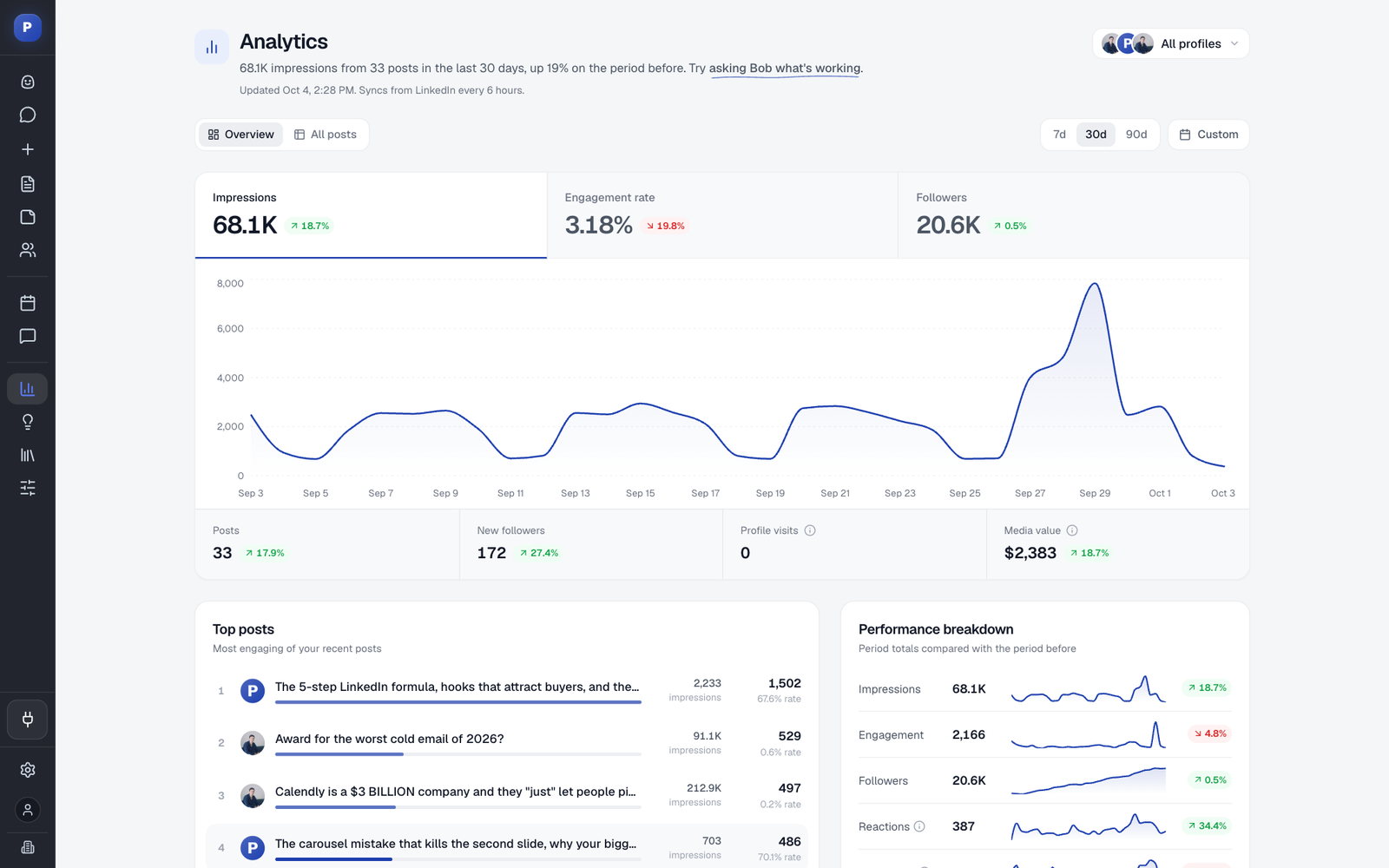
Here is what changed. LinkedIn Engineering describes feed ranking as a system that keeps evaluating content over time rather than making one pass and moving on, which is why posts now routinely resurface in feeds days or even weeks after publishing. [LinkedIn-confirmed] Independent analysts have measured the consequence directly: posts that pick up saves and substantive comments 24 to 72 hours after publishing can substantially outperform their first-day trajectory, because sustained interest reads as lasting value. [community-observed] You can check this on your own posts: LinkedIn analytics that keep re-checking each post after day one show whether saves and comments are still arriving.
Some prominent practitioners now go further and argue there was never a golden hour at all, only the ordinary benefit of posting consistently so that your audience knows when to look for you. We think that overstates it. But the honest position is that hour one is a signal, not a verdict, and the widely repeated claim that a slow first hour caps a post at roughly 5% of its potential audience is folklore we can no longer support. We have removed it.
What This Means You Should Actually Do
- Stop deleting slow posts. The most expensive mistake under the current model is killing a post at 24 hours because it looks flat. Late saves are exactly the signal the system now rewards, and you cannot collect them from a deleted post.
- Stay present, but for longer than an hour. Check back over the following days and reply properly to comments as they arrive. A thoughtful reply on day three is worth more than five rushed replies in minute ten.
- Optimise for the second read, not the first minute. Ask whether someone would bookmark this. That single question routes you toward the strongest signal in the system.
Do Not Use Engagement Pods
This deserves its own warning, because it is the tactic most likely to hurt you and it used to be standard advice, including in earlier versions of this guide.
Coordinating a group of colleagues to comment immediately after you publish is now an actively penalised behaviour, not a clever workaround. In November 2025, LinkedIn's VP of Product Gyanda Sachdeva stated publicly that the company's goal was to make engagement pods "entirely ineffective," describing expanded detection of coordinated activity, internal flagging of artificially boosted content, and reduced reach for it. [LinkedIn-confirmed] LinkedIn followed up in 2026 by removing comments posted through third-party scripts and browser plugins from the default "Most Relevant" comment view, and warned that repeat use of automated commenting tools can lead to account restrictions.
The detection logic is the part people underestimate. It is not looking for a signed-up "pod." It looks at patterns: the same small cluster of accounts engaging within minutes, every time. A loose arrangement between five friends produces exactly that pattern.
The nearest legitimate version is simply doing the work in public. Comment substantively on other people's posts in your niche, consistently, because you actually have something to say. That builds the same familiarity a pod fakes, and nothing about it trips a coordination filter.
Common Questions About the LinkedIn Algorithm
Trying to make sense of the LinkedIn algorithm 2026 can feel like hitting a moving target. I get it. Marketers and founders ask me the same questions all the time, so I've put together straight answers to the most common ones.
Here's what you need to know to fine-tune your content strategy and troubleshoot any performance issues you're seeing.

Do External Links Still Hurt My Reach?
This is the most contested question in LinkedIn marketing right now, and any guide giving you a flat yes or no is overselling its evidence.
What is certain: LinkedIn has never published a policy penalising outbound links. The "link penalty" has always been an inference drawn from creator experiments, reasoning backwards from the platform's obvious interest in keeping people on LinkedIn.
What is disputed: through 2026, practitioner findings genuinely split. Some analysts working from large post samples now argue the penalty has softened enough that you can put a link in the body without meaningful cost. Others still measure a substantial reach gap between otherwise identical posts with and without links. [community-observed, disputed]
One data point from our own research: across a study of 62,820 LinkedIn posts, posts with an external link had a median engagement lift of 0.93, about 7% below the creator's usual post, while posts that only tagged people or companies had 1.02. That is an association measured on engagement, not reach, so it does not settle the reach question.
Our practical read: the safest approach remains putting the link in the first comment, since it has no downside beyond a click of friction. But the first-comment trick is no longer the make-or-break ritual it was treated as, and if a link genuinely belongs in the post, put it at the end after you have delivered the value above it. Test it on your own account rather than trusting anyone's blanket rule, including ours.
What Is the Optimal Posting Frequency?
Consistency beats volume. If you post too often, your content competes with itself, and the P(skip) mechanism described earlier means poorly targeted extra posts actively accumulate negative signal rather than merely wasting effort.
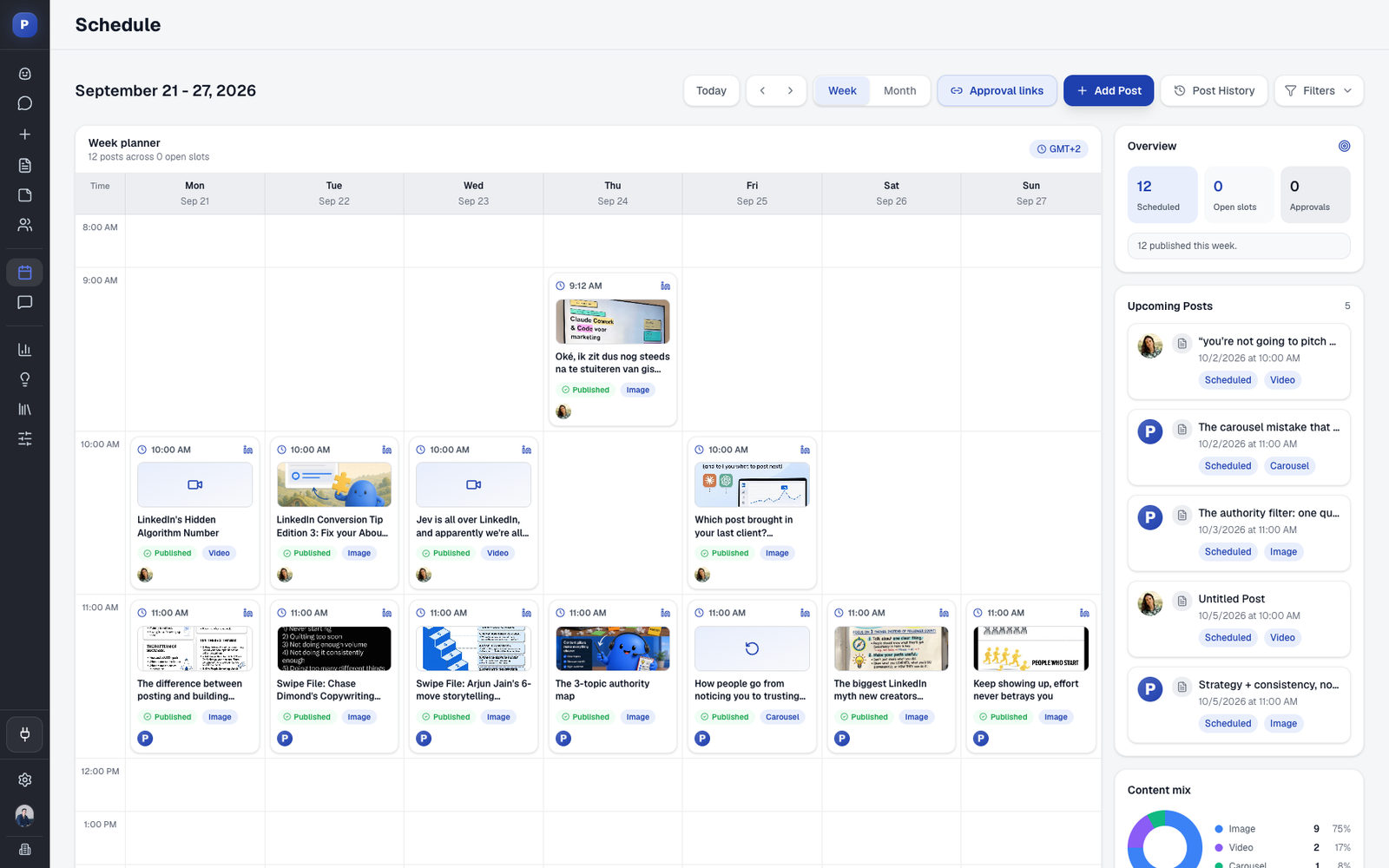
- Ideal Cadence: Two to five high-quality posts per week suits most accounts, with daily posting worth it only if you can genuinely sustain the quality. Predictability matters as much as frequency, because an audience that knows when you post shows up to read.
- Rest Intervals: Give posts room to breathe, ideally at least 12 to 18 hours apart. This matters more now that posts keep collecting reach for days rather than expiring overnight.
LinkedIn's own spam guidance also lists posting frequency high enough to look automated among the behaviours its quality filter watches for. [LinkedIn-confirmed]
How Many Hashtags Should I Use?
Three to five relevant hashtags, or none at all. What changed is not the number but what hashtags do, and most guides still describe a mechanism that no longer exists.
Hashtags used to be a distribution channel: people followed them, and tagging content placed it into those streams. LinkedIn removed hashtag following, retired hashtag fields from profiles, and renamed Page hashtags to specialisms. Under a model that reads your full post text to work out the subject, hashtags are no longer how your content gets categorised.
Treat hashtags as a hygiene factor for search, not a growth lever. Three to five relevant tags cost nothing and help long-tail discoverability. Stuffing twenty is a spam signal. Expecting either to move your reach is the outdated part.
The far more important version of this task is making sure the topic language appears naturally in your actual sentences, since that is what the ranking model reads. Not sure which tags fit your post? Our free LinkedIn hashtag generator suggests popular, niche, and trending tags based on your topic in seconds. For a walkthrough with examples by topic, see our guide on how to use LinkedIn hashtags.
How Can I Recover From a Drop in Reach?
Work through these in order, because the most common cause is the one people check last.
- Audit profile and topic alignment. If your posts drifted away from what your headline and About section claim you do, distribution suffers. This is the single most common cause of a 2026 reach drop and it has nothing to do with post quality.
- Check your topic spread. Posting across six unrelated subjects prevents the model from categorising you at all. Narrow to two or three. Practitioners commonly report needing around 90 days of consistent posting before repositioning fully takes hold. [community-observed]
- Shift from likeable to saveable. Add the frameworks, checklists, and specifics people bookmark.
- Stop any coordinated engagement. If you have been using a pod or an automated commenting tool, that is a live risk, not a neutral one.
- Then look at hooks and formats. Worth testing, but only after the four items above, because none of them can be fixed with a better first line.
Does the LinkedIn Algorithm Still Have a Golden Hour?
Less than it used to. LinkedIn Engineering describes feed ranking as a continuous process, and posts can resurface days or weeks after publishing. Strong early engagement still helps a post clear its first test, but practitioners analysing large post samples in 2026 report that saves and substantive comments arriving 24 to 72 hours later now carry real weight. Treat hour one as a signal, not a verdict.
What Is the 5-3-2 Rule on LinkedIn?
The 5-3-2 rule is a content mix guideline, not a LinkedIn policy. For every ten posts, five are curated from other sources, three are original content you created, and two are personal posts that show the human behind the account. It is a useful anti-self-promotion check, but the 2026 algorithm rewards topic consistency, so keep all ten anchored to the same two or three subjects.
What Is the 4-1-1 Rule on LinkedIn?
The 4-1-1 rule says that for every one promotional post and one piece of original content, you should share four pieces of content from other people. It originated in email and social marketing, not from LinkedIn. The ratio still guards against feeds that read as constant selling, though reshared third-party content generally earns less reach in 2026 than original posts that carry your own point of view.
What Is the 3-2-1 Rule on LinkedIn?
The 3-2-1 rule is a weekly posting cadence: three value posts, two engagement or conversation posts, and one promotional post. Like the other numbered rules, it is community shorthand rather than anything LinkedIn publishes. The underlying idea holds up well, because consistent publishing on a narrow set of topics is what lets the ranking model categorise your expertise.
Does LinkedIn Suggest People Who Look at Your Profile?
Yes, profile views feed the "People you may know" suggestions, alongside shared connections, employers, schools, and location. If someone views your profile, you may start seeing them suggested. Viewing in private mode limits what the other person sees about you, but LinkedIn still uses the broader interaction signals it collects to build its recommendations.
Stop guessing and start creating LinkedIn content that gets results. Postiv AI combines a brand-trained AI writer with a carousel designer and scheduling tools, turning your expertise into authority-building posts in minutes. Build your LinkedIn presence with Postiv AI.