
To become a LinkedIn ghostwriter, you interview busy professionals, turn their ideas into posts that sound like them, and publish those posts under their name on a steady schedule. You can start with no experience. The path has seven steps: learn the skills, pick a niche, build proof, land your first three clients, price a retainer, run a delivery system and scale. This guide covers each step, including the interview template, voice doc and approval loop that keep clients past month three.
What a LinkedIn ghostwriter actually does
A LinkedIn ghostwriter runs the content side of a client's presence. Posts go out under the client's name, and the ideas, stories and opinions come from the client. Your job is to pull them out and package them. Each month that means:
- Interviews. A 30 to 60 minute call, weekly or every other week, covering recent work, opinions and customer conversations. You record and transcribe it.
- Voice capture. Studying how the client talks and writes so drafts avoid generic LinkedIn phrasing.
- Drafting. Turning interview notes into posts, usually three to five a week.
- Approvals. Sending drafts for review and handling edits before anything goes live.
- Scheduling. Queuing approved posts to the client's profile at agreed times.
- Engagement and carousels, sometimes. Drafting comment replies, or designing carousels for ideas that need visuals. Price these as separate line items.
In Business Insider's 2022 reporting on the market, freelance ghostwriter Tara Horstmeyer said the more time you spend up front on outlines, angles and thoughts with the client, the less time the post takes to write. Interviewing is the job. Typing is the fast part.
Ghostwriters who add planning and performance review often call themselves LinkedIn content strategists.
How to become a LinkedIn ghostwriter with no experience
You do not need a client list or a writing job on your resume to start, but you do need something a stranger can judge. Three moves stand in for experience:
- Write for yourself first. Post about your niche on your own profile for a month. Your feed is a live sample of your voice and consistency. Step 3 covers how.
- Write spec samples. Draft three posts in the voice of a public figure in your niche, using only public material, and label them as samples.
- Take your first client at a lower rate. Offer a paid 30-day pilot at a reduced price, and ask whether the client will give you a testimonial or let you describe the work if the results are good. Keep it paid, and raise the rate for client two.
Borrow credibility from what you already know. A background in marketing, journalism, sales or a specific industry shows you can follow the subject. Never claim results or client names you do not have.
Step 1: Learn the skills ghostwriting needs
Each can be practiced before you have a single client:
- Interviewing. Asking follow-ups until you reach a specific story with names, numbers and a stake.
- Voice matching. An ear for sentence length, vocabulary, humor and what this person would never say.
- Short-form structure. A first line that earns the "see more" click and one idea per post.
- Editing. Cutting a third of your first draft without losing the point.
- Subject knowledge. Enough fluency in the niche to ask informed questions.
- Reliability. Three good posts every week for six months beat five brilliant posts one week and none the next.
Step 2: Pick a niche
Generalists compete on price, and specialists get referred. A niche lets you reuse vocabulary, case studies and prospect lists. Four examples that suit LinkedIn:
- SaaS founders. Founder-led content matters in B2B, and product decisions and customer calls supply material.
- Finance. Advisors and fintech leaders often need a compliance review step, and writers who already know that process are easier to trust.
- Recruiting and HR. Hiring stories and employer brand are natural post material.
- Independent consultants. Their profile is their storefront, and they approve drafts fast.
Test a niche three ways. Can you follow a conversation in the field without looking up every term? Do buyers have budget and a reason to be visible? Can you list 30 potential clients by name? Pick one niche for your first three clients.
Step 3: Build proof before you have clients
Nobody hires a ghostwriter with an empty portfolio. Build three kinds of proof in a month.
Write for yourself on LinkedIn. Post three times a week about your niche for a month. Your feed is the live demo of your voice and consistency. Make your headline say what you do and for whom: "I write LinkedIn posts for B2B SaaS founders" works better than "Writer | Storyteller".
Produce three spec samples. Pick a public figure in your niche who gives long interviews or podcasts. Using only public material, write three posts in their voice. Label them as spec samples and never publish them under that person's name.
Show before and after rewrites. Take weak posts, such as your own older ones, rewrite them and show both versions with a one-line note on each change. If you rewrite a prospect's real post, send it privately, never in public.
Put all three into a one-page portfolio you can link in your profile and messages.
Step 4: Find your first 3 clients
Three is enough to prove you can run a system, and small enough to do it well. Mix these channels:
| Channel | Speed | Best for | Main risk |
|---|---|---|---|
| Your own LinkedIn content | Slow | Inbound clients who already trust you | Needs weeks of consistency |
| Warm network | Fastest | First paid pilot | Friends expect a discount |
| Referrals | Medium | Best-fit clients | You need a first client first |
| Upwork and marketplaces | Fast to start | Proof and reviews | Fees and price pressure |
| Agency partnerships | Medium | Steady volume | Lower rate, less client contact |
Your own LinkedIn content. Your posts double as a sales page. Pin one that explains your offer, and comment thoughtfully on posts from people in your niche. Inbound is slow, so run it alongside the others.
Warm network. List 30 people: former colleagues, founders you know, past managers. Message the ten who fit your niche with a specific offer, such as "I'm taking on three LinkedIn ghostwriting clients in fintech. Want me to send two sample posts in your voice?" Draft those samples from their public posts and send them privately.
Referrals. After your first client has a few good weeks, ask who else they know who should be posting. Tell peers you have capacity, since full ghostwriters pass overflow along.
Upwork and marketplaces. Upwork and similar platforms are the fastest route to a first paid job without a network. The pros: buyers are already searching, the platform offers payment protection, and you collect reviews. The cons: platform fees come out of your earnings, many listings are priced for volume rather than executive work, and many buyers want one-off posts instead of retainers. Name your niche in your profile, answer listings with a relevant sample, and read the platform's terms before moving any client off it.
Partnering with agencies. PR firms, fractional CMOs, personal branding agencies and B2B content shops sell LinkedIn services and need writers. Subcontracting means steadier volume and less selling, at a lower rate.
Offer first clients a paid 30-day pilot with a clear scope, for example 12 posts, a weekly interview and one revision round, with the option to continue as a retainer. Paid beats free: a free client has no deadline.
Step 5: Price your service
There are two models. A retainer is a monthly fee for a fixed scope: posts per week, interviews, revision rounds. Per post pricing charges for each post delivered. Retainers suit most ghostwriters because the work recurs and income is predictable. Per post fits one-off projects and trials.
For reference, Business Insider reported in April 2022 that LinkedIn ghostwriting generally ranges from $2,500 to $10,000 a month. It cited freelancer Tara Horstmeyer at about $2,500 a month on average for five posts and the PR firm Crackle PR at around $5,000 a month. Those are 2022 numbers from established operators, so expect to start below them. As an example only, three clients at $1,500 a month bring in $4,500, and ten bring in $15,000.
Write the scope into the retainer: posts per week, interview cadence, two revision rounds, comment replies in or out, carousels priced separately, and a three-month minimum billed monthly in advance. For tier-by-tier numbers, see our guide to LinkedIn ghostwriting pricing.
Step 6: Set up your delivery system
Clients stay because the work arrives on time and sounds like them. That takes a system with five parts.
Interview template. Run 45 minutes, record it and transcribe it. Ask:
- What surprised you this week?
- What do you believe about your industry that most peers would argue with?
- Tell me about a customer conversation from the last month.
- What mistake taught you something?
- What question do you get asked constantly?
- What do you know that outsiders get wrong?
One good session should yield six to eight post ideas.
Voice doc per client. One or two pages: five posts they love, five of theirs that sound most like them, typical sentence length, words they use and never use, humor level, off-limits topics, and how they open and close. Update the doc after every client edit.
Weekly cadence. One example: Monday interview, Tuesday and Wednesday drafting, Thursday drafts go to the client, Friday approved posts get scheduled.
Approval loop. Use one channel, a 48-hour response window and a rule for silence. The safest rule is that nothing goes live unapproved, so a missed approval means the slot is filled from a reserve of approved evergreen posts.
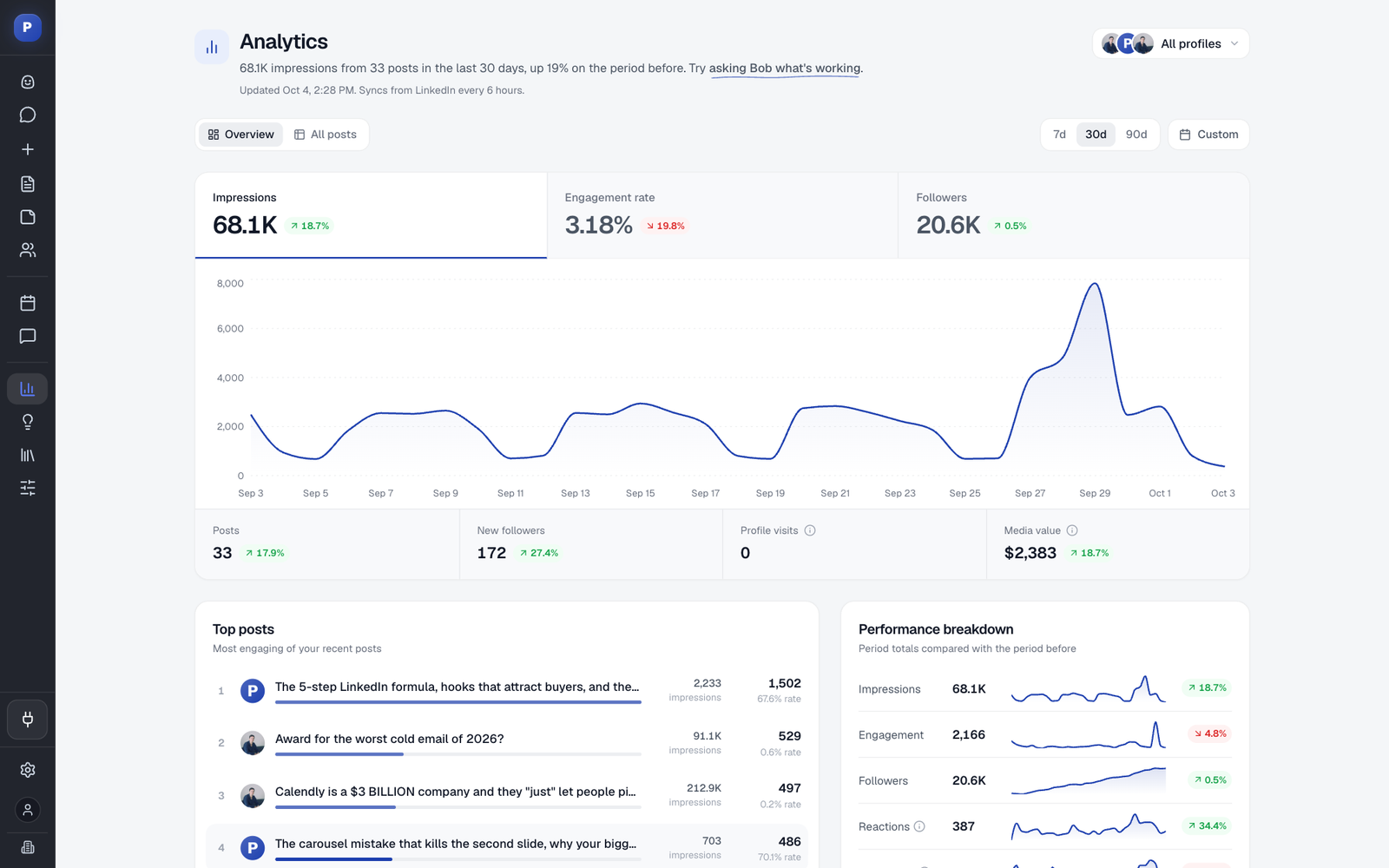
Scheduling and reporting. Schedule every approved post to the client's profile at agreed times. Never ask for a client's LinkedIn password; use a scheduler that connects through LinkedIn's official authorization. Send a one-page monthly report: posts published, impressions, notable comments, profile views, conversations the client says started from a post, and next month's focus.
Run each client in a separate workspace with Postiv
A spreadsheet and a shared drive work for client one. By client three, voices and drafts start to blur. Postiv's Agency plan, priced per client workspace, gives each client a separate workspace with their own voice, knowledge base and brand assets. You add interview notes to the client's knowledge base, the AI writes a first draft in that client's voice, and you edit it. Drafts go to the client for approval, approved posts are scheduled to the client's profile, and as agency admin you can move across every client workspace. See Postiv for agencies or the LinkedIn ghostwriter page, and read how to manage multiple LinkedIn accounts for clients for the access side.
Step 7: Scale from 3 to 10 clients
Start with the time math. As an illustration, a 45-minute interview, about two hours of drafting and editing, and 30 minutes of approvals and scheduling is roughly three hours per client per week. Six clients is about 18 hours, which is roughly where a solo ghostwriter has to choose: hire, or raise prices and stay small. Horstmeyer told Business Insider she once juggled 11 clients and found it too many.
- Systems first. Write the interview template, voice doc and monthly report once and reuse them.
- One workspace per client. It keeps voices from bleeding together, and handing a client to another writer is simpler when everything about that client sits in one place.
- Hire for drafting first. Keep the interview and final edit yourself until a writer has spent two or three months on a client. Give them the voice doc, the transcript and a checklist: facts match the transcript, voice rules followed, no invented claims.
- Become an agency. Once you have writers, you sell a content system and not your own hours. Fold software cost per client into each retainer. Our guide to social media management pricing shows how agencies structure fees.
Using AI as a ghostwriter
AI changes how fast you draft, not what clients pay for. A workable split of the work:
- AI drafts from interview notes. Give a drafting tool the transcript and the client's voice doc, and you get a first version of each post in minutes. Draft from the client's own words, never from a blank prompt, so the stories and opinions stay theirs.
- You own strategy. Which topics, which audience, how often, and what to leave out.
- You own the interview. A tool cannot ask the follow-up that gets a specific story with names, numbers and a stake. That conversation is where the value comes from.
- You own voice and editing. AI drafts drift toward generic LinkedIn phrasing. Compare each draft to the voice doc, cut filler, check every fact against the transcript and remove anything invented.
Disclosure. Agree on AI use with each client before you start. Put in the contract whether AI-assisted drafting is allowed, how client material is handled (do not paste confidential details into a tool the client has not approved) and that the client approves every post before it goes live. Some employers and industries have their own rules on AI-generated content or on ghostwriting, so ask the client to check theirs. The client is the named author, so being upfront protects the relationship.
Keep each client's material separate. Running several clients through one chat history or one shared document lets their voices blend. One workspace per client keeps each voice doc, transcript and set of brand assets apart, so a draft for one client is written only from that client's material. That is the setup Postiv for agencies is built around.
Frequently Asked Questions
How to become a LinkedIn ghost writer?
Pick one niche, publish your own LinkedIn posts for a month, write three spec samples and offer a paid 30-day pilot to a few people in your network. Then price a monthly retainer and build a repeatable system: a weekly interview, a voice doc per client, an approval loop and scheduling. The seven steps in this guide cover each part in order.
How much do LinkedIn ghostwriters make?
It depends on your client count and retainer. Business Insider reported in 2022 that LinkedIn ghostwriting generally ranges from $2,500 to $10,000 a month, and one freelancer charged about $2,500 a month on average for five posts. New ghostwriters should expect to start lower. As an example only, three clients at $1,500 a month is $4,500. See our LinkedIn ghostwriting pricing guide for rate tiers.
How much does a LinkedIn ghostwriter charge?
Most ghostwriters charge a monthly retainer for a fixed scope, such as posts per week, interviews and two revision rounds, rather than a fee per post. Business Insider's 2022 reporting put the market at roughly $2,500 to $10,000 a month. Expect to price below that while you build proof. Carousels and comment replies are usually priced as separate line items.
Can you earn money by writing on LinkedIn?
Yes, mainly by selling services built on the writing rather than being paid per post. Ghostwriting is the most direct route, because clients pay a monthly fee for posts published under their name. Your own posts also work as marketing for the service. Expect consistent posting before it pays.
Do you need experience to become a LinkedIn ghostwriter?
No formal experience is required, but you need proof. Publish your own LinkedIn posts for a month, write three spec samples in one niche and prepare a few before and after rewrites. A background as a marketer, journalist, salesperson or niche expert helps.
Is LinkedIn ghostwriting ethical, and do clients disclose it?
It is a long-standing practice in business writing, and it stays ethical when the ideas and experiences are the client's, the client approves every post and nothing is invented, including stories, credentials and numbers. Most clients do not announce that they use a writer. Disclosure is their decision, so settle it in the contract and check any employer or industry rules.
How many clients can one LinkedIn ghostwriter handle?
With a working system, four to six clients is a reasonable load. That is a rule of thumb from roughly three hours of work per client per week, not a measured benchmark. One freelancer in Business Insider's 2022 reporting took on 11 at once and found it too many. Past six, hire a drafting writer or raise your rates.
Can AI replace LinkedIn ghostwriters?
AI can draft, but it does not replace the ghostwriter. It turns interview notes into a first draft in a client's voice quickly. The ghostwriter still owns strategy, the interview that surfaces real stories, editorial taste and the client relationship. Clients pay for judgment about what to say and what to cut.
Where can you find LinkedIn ghostwriting jobs?
Use the channels in this guide: your own content, your warm network, referrals, Upwork and similar marketplaces, and agencies that subcontract. Also search LinkedIn job listings for ghostwriter, LinkedIn content and thought leadership. Most executive work is never posted as a job, so direct outreach with samples often beats waiting for listings.
Ready to run your first three clients properly? Postiv for agencies gives every client a separate workspace with their own voice, knowledge base and brand assets.