How Clay put the right person in front of every buyer on LinkedIn
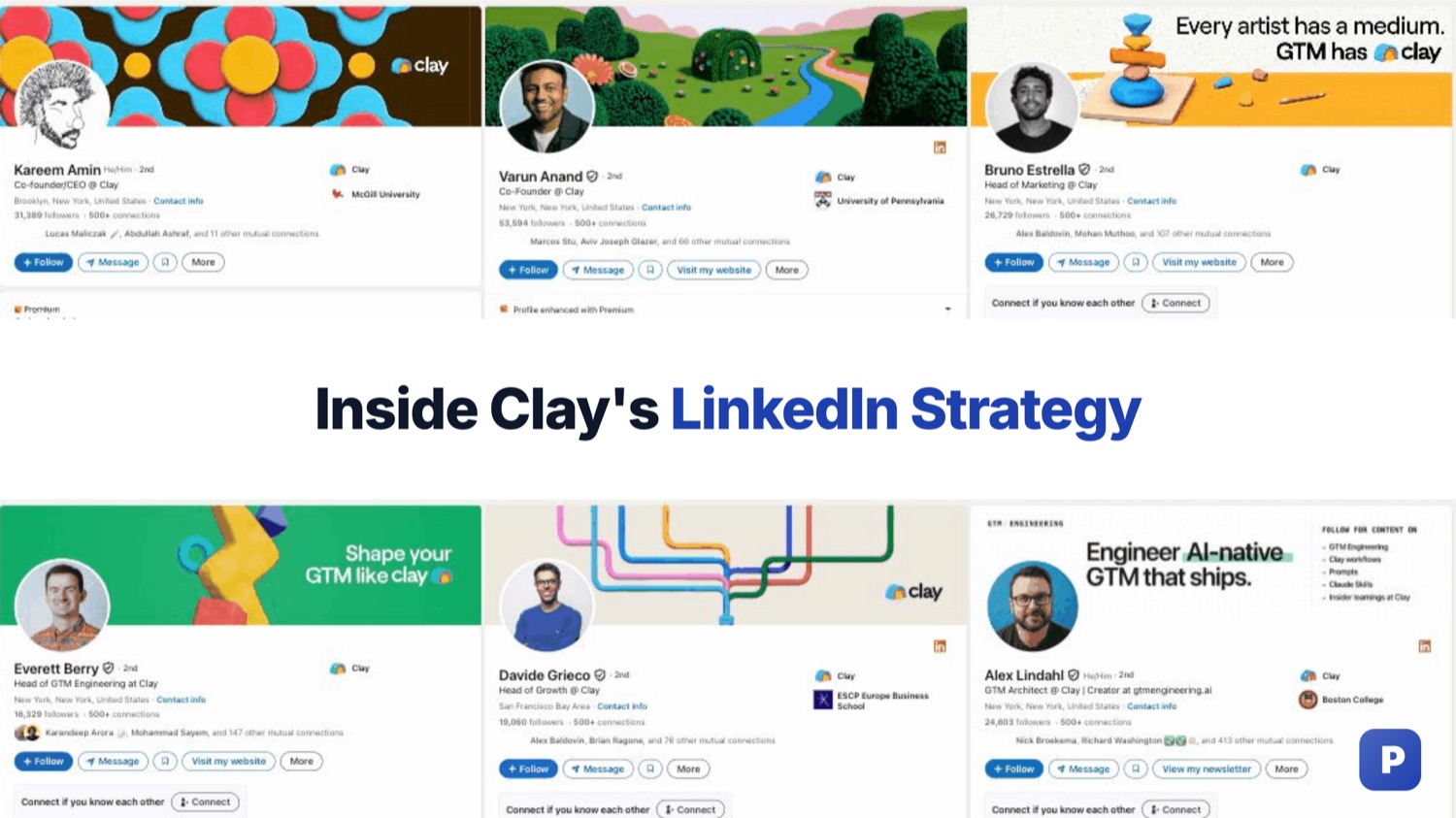
Clay's team pulled ~6M impressions and +80K followers in a single quarter. The trick isn’t volume. They mapped each buyer persona to the most believable person on the team, then made posting a real, owned program. Here’s the whole system.
The short version
- →~6M impressions and +80K followers in one quarter, from a deliberate, mapped program.
- →They started with their buyers, then matched each persona to the most believable person on the team.
- →It’s a tracked metric, one person owns it (the “borderline annoying” one), with a weekly rhythm and a quality bar.
- →The Head of Sales mentions Clay in 7% of posts. The Program Lead, 4%. It still works.
- →You can watch the program pick people up: their posting jumps the moment it leans on them.
They mapped personas to people
Most employee advocacy programs start with a list of who’s willing to post. Clay started with their buyers. Clay sells to a few different people, all of whom live on LinkedIn, so the question became: who on our team is the most believable voice for each of those audiences?
A GTM engineer scrolling LinkedIn doesn’t get a Clay ad. They get Everett, a GTM engineer, talking shop. A founder gets Kareem, a founder. The messenger fits the audience, so the message lands.
| Audience | The person they put in front of them |
|---|---|
| GTM engineers, ops, growth (the users) | Everett Berry + Davide Grieco |
| Marketing & revenue leaders (the buyers) | Bruno, Varun, Rob Cook, Todd Busler, Becca Lindquist |
| Founders | Varun + Kareem Amin |
The operating system: how they get execs to actually post
Strategy is the easy part. As Bruno put it: “Everyone knows this is important. The difficult part is getting people to post.” Four things make it happen.
It's a real metric
Growing this surface area is a core awareness goal marketing is accountable for. It's on the scoreboard, so it happens.
Someone owns it
That's Sarah Khasrovi. In Bruno's words, "you need someone who's borderline annoying to ensure this moves forward."
A weekly rhythm
Weekly meetings and ongoing Slack nudges to push posts out. Not a kickoff and then silence.
A quality bar
Bruno's test before anything ships: "am I actually learning anything from this?" If no, it doesn't go out.
The messenger fits the audience, so the message lands. A founder hears it from a founder, a GTM engineer from another GTM engineer.
Meet the cast
Ordered by the role they play, not by follower count.











Be the company that's all over LinkedIn
Get your team posting on LinkedIn to drive MORE pipeline. Postiv is the LinkedIn growth platform for analytics, content and engagement — approved by LinkedIn. Connect your team's LinkedIn accounts and try it 7 days free.
Start creatingThe ten voices, one by one
The lane each one owns, and the one thing to copy.
Kareem Amin
View LinkedIn profile ↗Rare, and big.
Kareem barely posts, about once every three weeks, and that’s the point. When the CEO speaks rarely, every post feels like an event. He has the highest average likes on the team despite posting the least.
What he posts: funding and proof Clay has arrived, like the $100M Series C at a $3.1B valuation (3,218 likes). His role is to show up for the moments that matter and let the scarcity do the work.

Varun Anand
View LinkedIn profile ↗The most reliable voice on the team.
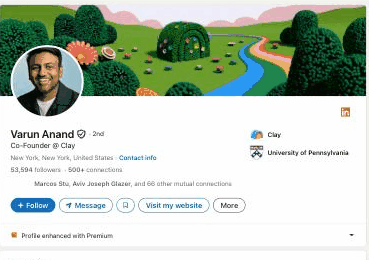
If Kareem is the rare big voice, Varun carries the volume: nearly twice a week, every week, still pulling 569 likes a post. That makes him Clay’s single biggest source of reach, more than the CEO.
His “$100M ARR, here’s the six-year story” is exactly what founders screenshot and pass around. He treats his feed like a running journal of the company’s growth.
Bruno Estrella
View LinkedIn profile ↗The architect.
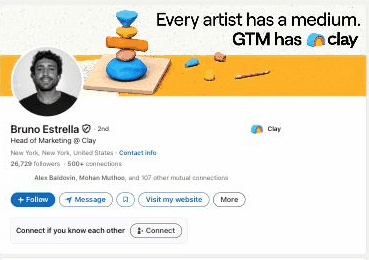
Bruno designed this entire program, then, very on-brand, published the playbook publicly. That post is the seed of this whole breakdown.
His best content is meta in the most useful way: he tells you exactly how the sausage is made, which is catnip for other marketers. Most leaders guard their tactics. Bruno publishes them, and that openness is its own growth engine.
Sarah Khasrovi
View LinkedIn profile ↗The one who makes the whole thing run.
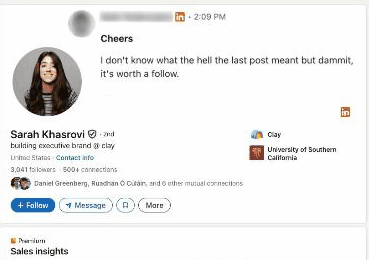
Here’s the twist. Sarah runs the executive-brand program, she’s the “borderline annoying” person Bruno credits. Yet her most-liked post is, in full, “i want claude and chatgpt to kiss” (2,291 likes). Her average post is 14 words. Only 4% mention Clay.
She practices what she preaches. It’s hard to nudge ten execs to post authentically if you sound like a press release. She clearly doesn’t, and that credibility is part of why she’s good at the job.
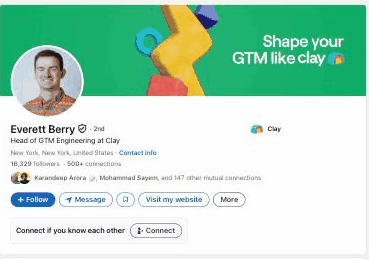
Everett Berry
View LinkedIn profile ↗Mentions Clay constantly, and gets away with it.
Everett mentions Clay in 98% of his posts, more than anyone. On paper that should read like an ad account. It doesn’t, because the posts are genuinely useful, like “Feel like Clay is following you? It’s not a coincidence” (1,062 comments), which opens up the real ABM system they run.
He teaches the thing while being living proof it works. When the person who built the system explains it, the product mention is just the substance of the lesson.
Davide Grieco
View LinkedIn profile ↗The contrarian, and proof the program works.
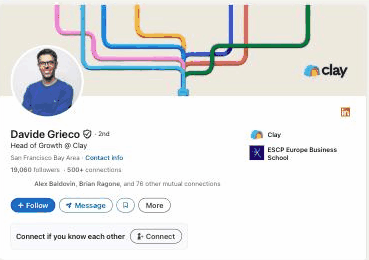
His most-liked post opens “I’m the Head of Growth at Clay and I’m here to tell you your tech stack doesn’t matter” (4,115 likes). He picks a fight with what everyone believes, then wins it.
And look at his frequency: 0.24 posts a week across his whole time on LinkedIn, then 2.2 a week in the last 90 days. The program reached him, and the posting followed.
Todd Busler
View LinkedIn profile ↗Barely mentions Clay, and it doesn’t matter.
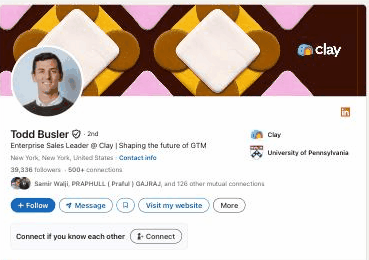
Todd mentions Clay in 7% of his posts. He’s building Todd, and his content is the most-discussed on the team: his “discovery-call prep framework that generated $25M in pipeline” pulled an astonishing 3,320 comments.
Real sales craft, long posts (289 words on average, the longest on the team), because he’s teaching. Every rep who saves one quietly files “sharp sales thinking” under Clay.
Rob Cook
View LinkedIn profile ↗A ramp in progress.
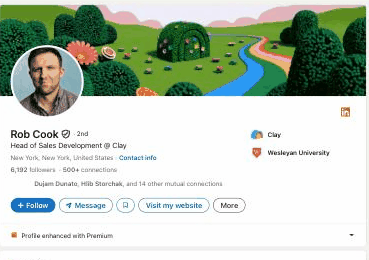
Rob is one of the clearest “the system is working” stories in the data. His lifetime posting rate was barely above zero. In the last 90 days it jumped past 1.4 a week, right as the program leaned into him.
He posts the sales-development beat he actually runs, pipeline building and outbound. He’s not chasing Todd’s numbers, just building a real presence in his own narrow niche, one week at a time.
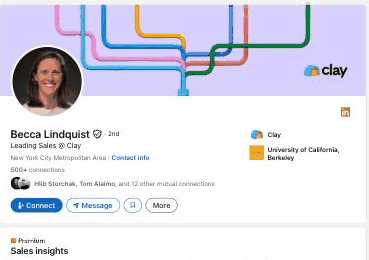
Becca Lindquist
View LinkedIn profile ↗The newest, and the one Bruno predicted.
When Bruno wrote the playbook, he said Becca was “going to ramp soon.” She nearly tripled her posting frequency in the last 90 days. Still modest, but a clearly rising line, and proof the program’s plans translate into behaviour.
Her top post already hit 775 likes. She’s at the start of the exact curve Davide and Rob are further along.
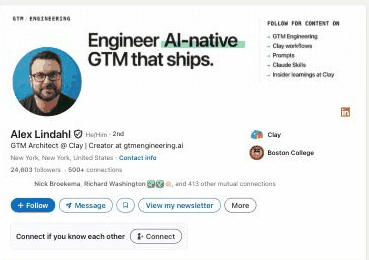
Alex Lindahl
View LinkedIn profile ↗The highest-frequency workhorse.
Alex posts more than anyone, with practical, list-heavy utility for GTM engineers, like his “20 laws, 9 workflows, 3 GTM prompts” guide (920 comments).
His average likes (86) are the lowest of the ten, but that’s the wrong lens. He gets strong “saving this” comments from a high-intent niche, which is worth more than vanity likes from a broad audience.
Be the company that's all over LinkedIn
Get your team posting on LinkedIn to drive MORE pipeline. Postiv is the LinkedIn growth platform for analytics, content and engagement — approved by LinkedIn. Connect your team's LinkedIn accounts and try it 7 days free.
Start creatingSteal the system
Clay’s program is the most copyable in this whole series, because they wrote it down.
Start with your buyers, not your volunteers
List your audiences first, then match each to the most believable person on your team. The messenger has to fit the reader.
Put it on a scoreboard and give it an owner
Make it a real marketing metric, and assign one “borderline annoying” person to keep it moving. Unowned programs die.
Run a weekly rhythm with a quality bar
Weekly nudges keep posts flowing. One test before publishing: “am I actually learning anything from this?”
Let people barely mention you
The Head of Sales mentions Clay 7% of the time and drives the most discussion. Usefulness reflects on you for free.
Want a program like Clay’s?
Postiv gives your team the strategy, content and consistency to run this without a “borderline annoying” person chasing everyone. Even if no one’s posting yet, you can start this week.
Start your free trial
More breakdowns
 Grow faster on LinkedIn
Postiv gives your team the strategy, content and consistency to keep showing up.
Get Started Free