Wondering how to build a personal brand on LinkedIn that actually drives business results? The simplest answer is this: consistently share valuable insights that genuinely solve your audience's problems. It all starts with getting clear on your unique expertise, figuring out who you're trying to help, and then showing up as your authentic self.
Whether you're a B2B founder, consultant, or agency owner, this step-by-step guide is your roadmap to building a personal brand on LinkedIn in 2026 -- turning what you know into real influence and inbound opportunities.
Why Building a Personal Brand on LinkedIn Is Your Strongest Business Asset
Let's move past vanity metrics like follower counts. For B2B founders, solopreneurs, and marketers, a solid personal brand on LinkedIn isn't just a "nice-to-have" anymore—it's a fundamental part of your business strategy.
Think of it as your most powerful tool for generating high-quality leads, establishing yourself as an authority, and slashing your sales cycle. In a world where 50% of employers research candidates on social media, your online presence is your modern-day reputation.
Your brand is what you stand for. It’s that unique mix of your skills, your values, and your lived experiences. When you take control and intentionally shape this perception, you stop letting other people define you. You go from being just another "hard worker" to being seen as a resourceful leader and the go-to expert in your niche. That shift is what attracts the right kind of opportunities. And as your brand gets sharper, your LinkedIn followers will grow organically because people genuinely want to hear what you have to say.
Turning Presence into Profit
Building a personal brand isn't about shouting from the rooftops about how great you are. It’s about creating real value for others. When you consistently deliver insights and solve problems, you build trust on a massive scale.
That trust directly fuels tangible business outcomes:
- Inbound Opportunities: Clients, partners, and even investors start reaching out to you. No more cold outreach.
- Higher Conversion Rates: The leads you get are already warm. They've followed your content, so sales conversations become much smoother and far more effective.
- Increased Credibility: You become the recognized expert, which means you can command higher prices and land premium projects.
The process boils down to three core stages, as this simple graphic shows.
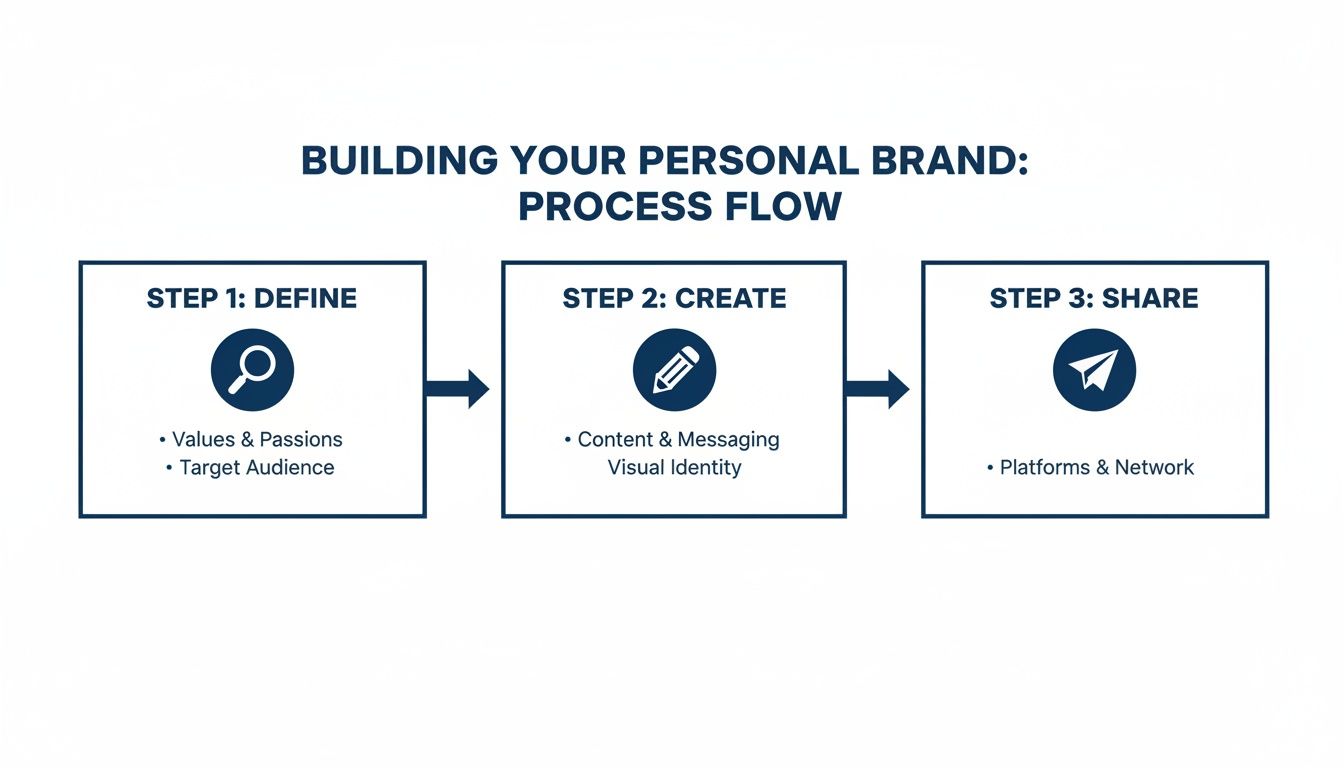
Each step—defining your position, creating valuable content, and sharing it consistently—builds on the last. Together, they create a powerful engine for growth.
To give you a clearer picture of what's ahead, here’s a quick overview of the framework we'll be breaking down.
The Personal Brand Building Framework at a Glance
This table outlines the essential stages for transforming your LinkedIn presence, providing a clear roadmap for the strategies covered in this guide.
| Stage | Objective | Key Action |
|---|---|---|
| 1. Define | Establish a clear, unique positioning. | Identify your niche, ideal audience, and unique value proposition. |
| 2. Create | Develop content that resonates and builds trust. | Define content pillars and create templates for posts and carousels. |
| 3. Share | Build momentum and engagement through consistency. | Set a publishing schedule, use the right tools, and measure your results. |
| 4. Scale | Amplify your reach and impact over time. | Repurpose top content, engage in conversations, and refine your strategy. |
This framework is designed to make the process systematic and manageable, not overwhelming.
The bottom line is that if your reputation doesn’t accurately reflect your true brand, you are likely to get short-changed and miss opportunities. Being intentional about your brand closes this gap and ensures the right people see your true value.
One of the most powerful forms of social proof on LinkedIn is a strong set of recommendations. Specific, results-driven endorsements from managers, peers, and clients can be the deciding factor for prospects evaluating your credibility. For templates and best practices, see our guide on LinkedIn recommendations examples.
If you're a senior leader looking for more specific tactics, our guide on personal branding for executives offers additional tailored strategies. By focusing on an authentic and consistent presence, you can move beyond just being on LinkedIn and start building an asset that drives real, measurable business results.
How to Start Building a Personal Brand: Find Your Niche

Before you even think about writing your first post, you have to get crystal clear on who you are and who you’re talking to. Honestly, building a personal brand without this foundation is like trying to build a house without a blueprint. You might end up with something, but it won’t be strong, it won’t be functional, and it definitely won't attract the people you want knocking on your door.
This first step is all about carving out your specific territory in a ridiculously crowded market. You can't be the expert for everyone. If you try, your message becomes wallpaper—generic, forgettable, and completely invisible.
Your real goal? To become the only logical choice for a specific group of people wrestling with a specific set of problems. The whole question of "how to build a personal brand" really starts by answering, "a personal brand for whom?"
Pinpoint Your Unique Value Intersection
Your unique position isn't just about what you're good at. It’s found at the intersection of three key things: your genuine expertise, your passion, and what your audience is actually struggling with.
Imagine a Venn diagram with three overlapping circles:
- Your Expertise: What are you legitimately skilled at? What problems can you solve better than 90% of people? This is about proven, real-world competence.
- Your Passion: What topics light you up? What could you talk about for hours, even if no one was paying you? Passion is the fuel for consistency when things get tough.
- Audience Need: What are the urgent, expensive, hair-on-fire problems your ideal audience is desperate to solve right now? Your content has to be the answer to these prayers.
That sweet spot where all three circles overlap? That's your niche. It's the place where you can create content that not only showcases your skills but also feels authentic to you and resonates deeply with the people you’re meant to help.
If the expertise circle is the one holding you back, closing that gap is cheaper than most people assume. Check what the LinkedIn Learning cost actually is in 2026 before you budget for a course, because your library card or your employer may already cover it.
A personal brand is what you stand for—the package of character traits and capabilities that make you who you are, expressed in a way that others can understand right away. If you don't define it, others will define it for you.
Uncover Your Audience’s Real Challenges
Once you have a hunch about your niche, you need to go deeper. Generic guesses about your audience just won’t cut it. You need to understand their world so intimately that when they read your content, it feels like you're reading their minds.
This means doing some roll-up-your-sleeves research to learn the exact words they use to describe their frustrations and ambitions.
Here’s how to do it:
- Become a Fly on the Wall: Find the LinkedIn Groups, private Slack channels, or subreddits where your target audience congregates. Don’t jump in and start posting—just listen. Pay attention to the questions they ask and the struggles they confess.
- Run "Problem" Interviews: Reach out to a handful of people in your network who fit your ideal client profile. Ask for 15 minutes of their time to chat about their biggest challenges related to your expertise. Don't sell, just learn.
- Mine Competitor Comments: Go to the LinkedIn posts of the big names in your space. The comment section is an absolute goldmine. You'll find out what the audience loves, what confuses them, and what sparks a debate.
This isn’t a one-and-done task. Think of it as an ongoing intelligence-gathering mission that keeps your content sharp and relevant.
Craft Your Positioning Statement
Armed with all this insight, you can now write a crisp positioning statement. This isn't just some fluffy marketing slogan; it's your internal compass. It guides every single piece of content you create, ensuring everything you do is focused and consistent.
Your statement needs to answer three simple questions:
- Who do you help? Be specific. Not "entrepreneurs," but "early-stage B2B SaaS founders."
- What problem do you solve? Focus on the tangible result. Not "improve marketing," but "build a predictable lead generation engine."
- How do you do it uniquely? This is your secret sauce. For instance, "through a content-first personal branding framework."
Here’s how that looks all put together: "I help early-stage B2B SaaS founders build a predictable lead generation engine on LinkedIn using a content-first personal branding framework, so they can attract high-value clients without paid ads."
This statement is specific, outcome-driven, and hints at a unique method. It clearly stakes your claim in the market. For anyone serious about this path, learning how to become a thought leader is a journey that starts with this kind of clarity.
Translate Your Position into a Magnetic Profile
Finally, it’s time to make sure your LinkedIn profile screams this new, focused positioning. It’s your digital storefront, and it's often the first impression you'll ever make.
- Headline: Don't just put your job title. That's a waste of prime real estate. Adapt your positioning statement: "Helping [Your Audience] achieve [Their Goal] through [Your Method]." For proven formulas and copy-paste templates, see our guide to LinkedIn headline examples, or run your profile through our free LinkedIn headline generator to get three AI-ranked options in seconds.
- About Section: Use the first few lines to hook the reader by speaking directly to their biggest pain point. Then, tell a quick story about how you solve that problem, weaving in your unique approach and a little credibility.
- Experience Section: Reframe your past jobs. Instead of a boring list of duties, present them as a series of accomplishments. Use bullet points with numbers to show you can deliver on the big promise you made in your headline.
Once your profile is dialed in, make it easy to reach offline too. Add a free LinkedIn QR code to your business card or conference badge so new contacts land on your profile with a single scan.
When you align every piece of your profile with your niche, you create a powerful, cohesive brand that instantly tells the right people, "You're in the right place."
What Content Should You Post to Build Your LinkedIn Brand?

Okay, you've figured out your unique positioning. Now comes the hard part for most people: turning that clarity into consistent action. It's one thing to have a great idea, but it’s another thing entirely to show up day after day. Lasting influence is built on reliability, not random bursts of inspiration.
This is where you build your content engine. It’s a system designed to help you create and publish consistently without burning out. The whole point is to finally kill that dreaded "what should I post today?" panic. Instead of scrambling, you'll work from a smart framework built on your core content pillars. These are the 3-5 central themes you’ll talk about over and over, all flowing directly from your positioning and what your audience actually needs.
How to Choose Your Content Pillars
Think of your content pillars as the main shows on your personal TV network. Each one dives into a key problem you solve for your audience. They need to be broad enough to spark endless ideas but specific enough that people immediately get what you're about.
Let's go back to our B2B SaaS founder example. Their focus is on helping early-stage founders get leads using a content-first personal brand. (If you're the SaaS founder in question, our LinkedIn playbook for SaaS founders walks through the same pillar logic applied to building inbound pipeline for your own product.)
So, their pillars might look something like this:
- Pillar 1: LinkedIn Content Strategy: This covers the nuts and bolts—writing hooks, making carousels, and demystifying the algorithm. It directly answers the "how-to" questions their audience has.
- Pillar 2: Lead Generation Funnels: This is all about connecting the dots from a LinkedIn post to a real sales call. It’s the stuff that proves the ROI of their efforts.
- Pillar 3: Founder Productivity: Here, they'd share real talk on juggling content creation with, you know, actually running a business. This hits a massive pain point for their specific audience.
- Pillar 4: The Founder's Journey: This is where they share their own story—the wins, the ugly failures, and the lessons learned. It’s what builds trust and makes them human.
Your pillars aren't just topics; they're a promise to your audience. They signal exactly what kind of value people can expect from you, turning your profile into a must-follow resource instead of just a collection of random thoughts.
Once your pillars are locked in, you need to think about the different ways you’ll bring them to life. Variety is key to keeping your feed from feeling stale and making sure you connect with people who consume content in different ways.
Mix Up Your Content Formats
Posting the same type of content over and over is the fastest way to get ignored. A good content mix keeps things fresh and serves different purposes. By rotating through formats, you make your feed more dynamic and engaging.
Here are a few formats you absolutely need to master:
- Text-Only Posts: Perfect for telling stories, sharing a strong opinion, or sparking a debate with a good question. Just remember to use short paragraphs and plenty of white space so they're easy to read on a phone.
- Carousels (PDFs): These are absolute gold for breaking down complex ideas into simple, step-by-step guides. They get shared like crazy and instantly position you as an expert who teaches.
- Polls: The easiest way to get quick engagement and real-time feedback. Use them to test an idea, start a conversation, or just learn more about your audience's challenges.
- Image or Video Posts: This is how you add a human touch. Share a behind-the-scenes shot, a quick video tip, or a simple infographic. Video, in particular, is amazing for building a genuine connection.
A smart shortcut here is to repurpose content you already have. If you've got longer videos, there's a great guide on repurposing YouTube content into clips that you can then share across different platforms.
Find a Sustainable Publishing Rhythm
On LinkedIn, consistency is everything. If you only post when you feel like it, you'll never build momentum. The algorithm just won't favor you, and your audience will forget you exist. The trick is finding a rhythm you can actually stick to.
So, how often is often enough? One study of 100 top LinkedIn creators found that 91% post at least once every three days. A whopping 72% post every two days, and an ambitious 20% post daily. The data is clear: a steady drumbeat of content is what turns a profile into an opportunity magnet.
For most founders and solopreneurs I work with, posting 3-4 times per week is the sweet spot. It’s frequent enough to stay top-of-mind but realistic enough that you won't want to tear your hair out. If you want to go deeper, we've got a whole guide on how often you should post on LinkedIn that can help you find your perfect cadence.
But let's be real—the secret to consistency isn't just pure grit. It's having a smart system.
This is where a tool like Postiv AI can be a game-changer. It helps you turn your pillars into a steady stream of high-quality posts without all the friction. You can feed it a single piece of long-form content—like a webinar you ran or a detailed guide—and it will generate a full week's worth of on-brand LinkedIn posts, carousels, and fresh ideas.
This changes content creation from a daily chore into a strategic task you can batch once a week. By systematizing your content and committing to a realistic schedule, you build the kind of unshakable presence that defines a powerful personal brand.
How to Create LinkedIn Content That Builds Trust and Converts

Alright, so you’ve defined your niche and picked your content pillars. That’s your map. But the content itself? That’s the vehicle that actually gets you to your destination.
Let's be real: views and likes are nice vanity metrics, but they don't pay the bills. The entire point is to create posts that spark real conversations, build unshakable trust, and turn your followers into clients and champions for your brand.
This is where sharp copywriting and authentic storytelling come in. We need to move beyond generic updates and start publishing must-read insights—the kind that makes people actively seek you out as the go-to expert.
Master the Scroll-Stopping Hook
You’ve got about two seconds. That’s it. Two seconds to grab a reader’s attention on LinkedIn before they flick their thumb and scroll right past you. The first line of your post, the hook, is the most critical piece of copy you'll write all day. If it fails, the rest of your post is invisible.
A great hook does one of three things: it makes someone intensely curious, it challenges a popular belief, or it hits on a major pain point they're feeling right now. Ditch the boring openers like "I'm excited to announce..." and get straight to the good stuff.
Here are a few frameworks I’ve seen work time and time again:
- The Contrarian Hook: "Everyone says you should [common belief]. They're dead wrong. Here's why." This immediately puts you in a position of authority and makes people want to hear your argument.
- The Problem-Agitate Hook: "Still struggling with [specific problem]? It might be because you're making this one common mistake." This shows you're in their head, understand their frustration, and have the answer.
- The Story Hook: "I lost a $50,000 client because of one stupid, avoidable mistake." This is pure catnip. It promises a valuable lesson wrapped in a juicy, personal story.
Experiment with different styles and keep a close eye on your analytics. When you see a spike in "see more" clicks, you know you've found a hook that works.
Weave Stories That Build Real Connection
Here’s a hard truth: facts tell, but stories sell. Nobody connects with data points and bulleted lists. We connect with other humans—their struggles, their wins, their "aha!" moments. Storytelling is how you turn a dry piece of expertise into a memorable, relatable experience.
You don’t have to be a bestselling author to do this. The best stories for LinkedIn are short, focused, and have a clear, undeniable point. They often come from a personal failure, a hard-won lesson, or a moment of clarity that completely changed your perspective.
The most effective personal brands aren't built on a foundation of perfection. They're built on vulnerability and shared experience. Admitting a mistake or sharing a struggle makes you more human, more trustworthy, and far more memorable than someone who only posts wins.
For a B2B founder, this could be the story of a product launch that totally flopped and the brutal lessons you learned about customer research. For a marketer, maybe it’s about a Facebook ad campaign that tanked and the single insight that turned everything around. These moments are where true connection is forged.
Practical Post Templates for Your Pillars
Having a few solid templates in your back pocket removes the friction of starting from scratch. It lets you focus on what really matters: your message.
Here are a couple of plug-and-play ideas you can adapt for your own content pillars.
Template 1: The Thought Leadership Takedown Use this to establish your unique point of view and challenge the status quo.
- Hook: Start with a bold or contrarian statement about your industry. (e.g., "Cold outreach is officially dead. Here's what smart founders are doing instead.")
- Context: Briefly explain why the old way is broken.
- Your Framework: Introduce your unique 3-step method or new perspective. Use bullet points or numbered lists to make it scannable.
- Proof: Drop in a quick, real-world example of how this works.
- Call-to-Action (CTA): End with a question that gets people talking. (e.g., "What's the biggest thing holding you back from trying this?")
Template 2: The "Lesson Learned" Personal Story This format is all about building trust and relatability through vulnerability.
- Hook: Open with the most dramatic or compelling part of the story. (e.g., "I was one week away from shutting down my business. Then a single email changed everything.")
- The Struggle: Get real about the problem you were facing. Don't be afraid to be vulnerable.
- The Turning Point: What was the moment of insight? What action did you take that shifted the outcome?
- The Takeaway: Distill the entire experience into one powerful, actionable lesson for your audience.
- CTA: Invite others into the conversation. (e.g., "Have you ever felt like this? Tell me about it.")
These are just skeletons. The magic happens when you infuse them with your authentic voice, personality, and real-life experiences.
Use AI to Speed Up and Sharpen Your Content
Let's face it, creating amazing content consistently can feel like a full-time job. This is where you can strategically use AI tools like Postiv AI—not to replace your thinking, but to amplify it.
For example, you can feed it a single piece of long-form content, like a webinar recording or a detailed guide, and have it generate a full week's worth of on-brand LinkedIn posts. The "blank page" problem? Gone.
You can also use an AI precision editor to fine-tune your tone. Need to sound more authoritative for that thought leadership post? Or more empathetic for a personal story? A good tool can help you adjust the draft to match the exact vibe you're going for, making sure the message lands perfectly.
And then there's the visual side. Designing eye-catching carousels is often a huge time-suck. A tool with a built-in carousel designer, like the one in Postiv AI, lets you create professional-looking visuals in minutes from proven templates.
This isn't just about saving time; it's about impact. Companies with active advocates see up to 300% more engagement. And since 65% of professionals agree that online impressions are just as important as in-person ones, you can't afford to be inconsistent. You can find more stats on the power of advocacy in this great article from Column Content.
How to Become a Thought Leader on LinkedIn
A personal brand makes people recognize you. Thought leadership makes them quote you. The step between the two is a clear point of view, shared consistently, in conversations bigger than your own feed.
Share Your Earned Secrets
Your niche defines who you talk to. Your point of view defines what you say and why anyone should care. The strongest material is what investor Ben Horowitz calls "earned secrets": lessons you learned by doing the work that nobody can simply google.
To find yours, answer three questions. What do you believe about your industry that others would disagree with? Which popular advice do you think is wrong? What trend do you see coming that few people are talking about? A leadership coach might land on: "Top-down management is dead. The future belongs to autonomous teams led by coaches, not micromanagers." A statement like that becomes the filter for every post you write.
Comment to Connect
Some of your best thought leadership will happen under other people's posts. Skip "Great post!" and leave comments that stand on their own: a sharp question, an extra data point, or a respectful counterpoint. Under a post about the decline of classic SEO, for example: "True for B2B especially. I have seen clients get more traction by moving part of that budget into problem-aware LinkedIn content that reaches buyers earlier." One comment like that builds rapport with a peer, puts your expertise in front of their audience, and reinforces your point of view without writing a new post.
A 90-Day Thought Leadership Plan
- Days 1-30, foundation: define your niche and earned secrets, rewrite your headline and About section around your point of view, and build a backlog of 10-15 post ideas mapped to your pillars.
- Days 31-60, consistency: publish 3-4 times per week, spend 15-20 minutes a day leaving strategic comments in your niche, and reply to every comment on your own posts with a follow-up question.
- Days 61-90, acceleration: review your analytics, turn your best text posts into carousels or Articles, and start a list of podcasts and newsletters in your niche you could contribute to.
How to Measure and Scale Your Personal Brand on LinkedIn
What gets measured gets improved. It’s a cliché, but it’s true. Building a powerful personal brand is a long game, not some one-week sprint. If you aren't tracking your progress, you're just throwing content into the void and hoping for the best. You have no real way of knowing what actually connects with people versus what just fades into the noise.
It's time to stop chasing vanity metrics. Sure, a post with a ton of likes feels good, but that quick dopamine hit doesn't tell you anything about your brand's actual business impact.
Real measurement is about figuring out which content actually starts meaningful conversations and brings qualified leads to your door. This is how you stop guessing and start building a predictable, scalable system for growth.
Making Sense of LinkedIn Analytics
LinkedIn gives you a ton of data, but honestly, it's easy to get overwhelmed. The key is to ignore the fluff and focus on the numbers that signal genuine interest and authority. You want to see metrics that prove your content isn't just being seen—it's actively changing minds and prompting people to take action.
Here's what I recommend keeping a close eye on:
- Engagement Rate: This is your North Star. To get it, just divide your total engagements (reactions, comments, shares) by your total followers. A consistently high rate shows you’re dialed in with your core audience.
- Profile Views: Did you notice a big spike in profile views right after a post went live? That's a fantastic sign. It means your content was so compelling that it made people stop scrolling and want to learn more about you.
- Inbound Connection Requests: When strangers start sending you connection requests with personalized notes that mention your content, you've hit the jackpot. This is a direct signal that your brand is attracting exactly the right people.
- Comment Quality: Don't just count the comments; you have to read them. Are people asking smart questions? Are they sharing your thoughts with their own network? A handful of deep, insightful comments are worth a hundred generic "great post!" replies.
Using Data to Sharpen Your Strategy
Once you get into the rhythm of tracking these metrics, you'll start to see patterns emerge. Pull up your best-performing posts from the last 30 days. What do they all have in common? Were they personal stories, unconventional opinions, or practical how-to guides?
The goal isn't just to collect data; it's to turn that data into actionable insights. Think of every post as an experiment. Your analytics dashboard is where you review the results and decide what to double down on next week.
This is where AI-powered analytics can give you a serious edge. A tool like Postiv AI can dig through your performance data and automatically show you what's working best. It can pinpoint the optimal times to publish for maximum reach and even suggest new content ideas based on your past winners. If you want to go deeper, check out our guide on how to analyze content performance for a full breakdown.
This data-driven approach takes the emotion and guesswork out of your content strategy, replacing it with clarity.
Scaling Your Efforts for a Team
So what happens when your brand really takes off? Or when you're tasked with managing personal brands for a whole executive team or several agency clients? The core principles don't change, but your execution needs a much more robust system to keep everything consistent and high-quality.
To scale a personal branding effort without everything falling apart, you need a few key things in place:
- A Shared Brand Playbook: Create a clear document for each person that outlines their unique positioning, content pillars, tone of voice, and any visual guidelines. This is crucial for making sure the brand's voice stays authentic, even with multiple people contributing.
- A Centralized Content Workflow: You need a single source of truth. Use a platform that supports collaboration with features like a shared content calendar, draft approvals, and specific user roles. This keeps everyone aligned without creating a security nightmare.
- Unified Performance Dashboards: Set up dashboards that track the key metrics for every personal brand you manage. This gives you a high-level view of what's working across the board, making it easy to spot opportunities for cross-promotion or shared learnings.
By systemizing how you measure and scale, you turn personal branding from a bunch of random activities into a reliable engine for business growth. You figure out what resonates, do more of it, and build a presence that consistently attracts the opportunities you want.
Frequently Asked Questions About Personal Branding on LinkedIn
Even with a solid plan, building a personal brand can feel a little... weird at first. Doubts creep in. You start second-guessing yourself. It's totally normal.
Let's walk through some of the most common questions I hear from founders and marketers. My goal is to give you direct answers so you can keep moving forward.
How Much of My “Real Life” Should I Actually Share?
This one’s a classic balancing act. The goal is to build professional authority, not to become a lifestyle vlogger. But here's the thing: people connect with people. Sharing a little bit about your life is what makes you relatable and helps build genuine trust.
I always tell my clients to use the “So What?” Test. Before you post something personal, ask yourself: “What’s the actual lesson here for my audience?”
A story about a business deal that went sideways and what you learned? That connects. A picture of your beach vacation with the caption "Living my best life"? Probably not, unless you can tie it back to a real insight about burnout, productivity, or business strategy.
Think about it like this:
- Share the struggle, not just the win. Talking about challenges you've overcome builds empathy and shows you’re human.
- Connect your hobbies to business. Training for a marathon is a fantastic metaphor for long-term vision and discipline. It's personal, but it makes a business point.
- Show the messy middle. People love seeing the behind-the-scenes process, not just the polished final product.
The key is to always bring it back to a valuable takeaway for your audience. Your personal story is the vehicle for the lesson, not the main event.
What if I Feel Like I Have Nothing Unique to Say?
Ah, imposter syndrome. My old friend. I promise you, almost everyone feels this when they start out. The truth is, your unique perspective is your single greatest asset. Nobody on earth has your specific combination of skills, experiences, triumphs, and failures.
You don't need a world-changing idea for every single post. You just need to run existing ideas through your own unique filter. Your personal experience is the secret sauce that makes a familiar topic feel fresh and valuable.
Stop trying to be the most original person in your niche. It’s exhausting and unnecessary. Instead, focus on being the most helpful and authentic.
Just document your journey. What are you learning right now? What mistake did you make last week? Answering those questions honestly often provides more value than trying to invent some revolutionary new framework from scratch.
How Should I Deal With Negative Comments or Trolls?
First, just breathe. A negative comment can sting and feel like a personal attack, but it’s rarely about you. When you start to get traction and your content gets seen, some of the feedback will inevitably be critical. How you handle it says everything about your brand.
Here’s a simple way to approach it:
- Is it legitimate criticism? If someone makes a solid point or disagrees respectfully, thank them for their perspective. Engage in a real discussion. This shows you’re confident enough to be open-minded.
- Is it just a troll? If a comment is just an insult with no substance, the best move is no move at all. Delete it, block the user, and move on with your day. Don't waste your energy feeding the trolls.
Remember, your brand isn't about making everyone happy. It's about attracting the right people. Engaging gracefully with constructive feedback while ignoring the noise reinforces your position as a thoughtful leader who's in control of the conversation.
How Do I Start Branding Myself on LinkedIn?
Starting from zero can feel overwhelming, but it doesn't have to be. The first step to branding yourself on LinkedIn is simply getting clear on three things: what you're good at, who you want to help, and how you're different from everyone else in your space.
Here's a practical 7-day kickstart plan:
- Day 1-2: Audit your profile. Rewrite your headline to focus on the value you deliver, not your job title. Browse these LinkedIn headline examples for ten proven formulas you can adapt in minutes. Update your About section to speak directly to your ideal client's biggest pain point.
- Day 3: Pick your content pillars. Choose 3-4 topics you'll consistently post about. These should sit at the intersection of your expertise and your audience's needs.
- Day 4-5: Create your first batch. Write 3-4 posts using the templates from this guide. Start with one personal story, one how-to post, and one opinion piece.
- Day 6-7: Publish and engage. Post your first piece and spend 15 minutes commenting thoughtfully on 5-10 posts from people in your niche.
The key is to start before you feel ready. Your first posts won't be perfect, and that's completely fine. Consistency beats perfection every single time when you're building a personal brand on LinkedIn. If you need help finding the right audience for your content, our guide on how to identify your target audience walks you through the research process step by step.
How Long Does It Take to Build a Personal Brand on LinkedIn?
This is one of the most common questions I get, and the honest answer is: it depends on your consistency and niche. But here's a realistic timeline based on what I've seen work:
- Month 1-2: You're finding your voice. Engagement will be modest, but you'll start noticing more profile views and a trickle of new connection requests. This is the hardest phase because results feel invisible.
- Month 3-4: Patterns emerge. You'll identify which content pillars and formats get the most traction. Your engagement rate starts climbing, and people begin recognizing your name in their feed.
- Month 5-6: Compounding kicks in. Inbound DMs and connection requests from your target audience become regular. You might get your first client or partnership directly from a LinkedIn post.
- Month 6-12: Authority solidifies. You become a recognized voice in your niche. Speaking invitations, podcast features, and premium consulting opportunities start flowing in.
The professionals who see the fastest results typically post 3-5 times per week and spend at least 15-20 minutes daily engaging with others. A content strategy keeps you focused and prevents the random posting that slows most people down. For the LinkedIn-specific playbook (algorithm rules, format mix, the 3-2-1 rule, B2B examples), our LinkedIn content strategy guide for 2026 is the companion piece.
Does Personal Branding on LinkedIn Help You Get Clients?
Absolutely -- and the data backs it up. LinkedIn is the top platform for B2B lead generation, and professionals who consistently build their personal brand see a direct impact on their pipeline.
Here's how a strong personal brand translates to client acquisition:
- Trust before the first call. When a prospect has been reading your content for weeks or months, the sales conversation starts from a completely different place. They already know your expertise, your values, and your approach. The "getting to know you" phase is practically eliminated.
- Inbound over outbound. Instead of spending hours on cold outreach that gets ignored, your content does the prospecting for you. The right people find you, follow you, and eventually reach out when they have a need you can solve.
- Higher close rates. Warm leads generated through personal branding convert at significantly higher rates than cold leads. The trust is already built before the conversation even begins.
Building your brand on LinkedIn isn't just a visibility play -- it's a concrete business development strategy. For more on turning your LinkedIn presence into a lead generation machine, check out our guide on how to generate leads on LinkedIn.
Can You Build a Personal Brand on LinkedIn Without a Large Following?
Yes, and this is one of the biggest misconceptions about personal branding. You don't need tens of thousands of followers to build a powerful, revenue-generating brand on LinkedIn. What matters far more is the quality of your audience and the depth of your engagement.
Many founders and consultants run thriving businesses from LinkedIn profiles with fewer than 5,000 connections. The secret is niche specificity. When your content speaks directly to a well-defined audience, every post becomes a magnet for exactly the right people.
Focus on these metrics instead of follower count:
- Engagement rate -- Are people commenting, sharing, and saving your posts?
- Inbound DMs -- Are prospects reaching out after seeing your content?
- Profile view quality -- Are the people viewing your profile decision-makers in your target market?
A small but highly engaged audience of 500 ideal prospects is infinitely more valuable than 50,000 random followers who never interact with your content. If you want to define your brand voice so it resonates with the right people, having clarity on who you're writing for matters more than raw reach.
Ready to stop guessing and start creating LinkedIn content that builds your authority? Postiv AI combines a brand-trained AI writer, carousel designer, and analytics in one place to turn your expertise into a powerful personal brand. Start building your influence in minutes.