Think about your brand's personality for a moment. If it walked into a room and started a conversation, what would it sound like? That's your brand voice. It's not just what you say, but the distinct personality, emotion, and cadence you use every time you communicate.
What Is Brand Voice and Why It Matters Now
Imagine you're at a huge networking event. It's loud. People are talking over each other. But then, from across the room, you hear a familiar laugh or a particular way of phrasing a story and instantly know who it is. That's what a powerful brand voice achieves on a crowded platform like LinkedIn.
Your voice is your unique verbal signature. It’s what makes someone stop scrolling and think, "Ah, I know who wrote this," even before they see your name. This kind of consistency is the foundation of any memorable brand. When every piece of communication—from a LinkedIn carousel to a DM—sounds like it’s coming from the same person, you build trust and authority.
For B2B founders, consultants, and anyone building a personal brand, this is non-negotiable. It's how you cut through the noise and turn passive followers into a loyal community that genuinely cares about what you have to say.
Distinguishing Key Communication Concepts
To really nail down your brand voice, it’s helpful to understand what it isn't. People often mix up terms like voice, tone, style, and messaging, but each one has a specific job to do.
This concept map helps visualize how all these pieces fit together under your main brand communication umbrella.
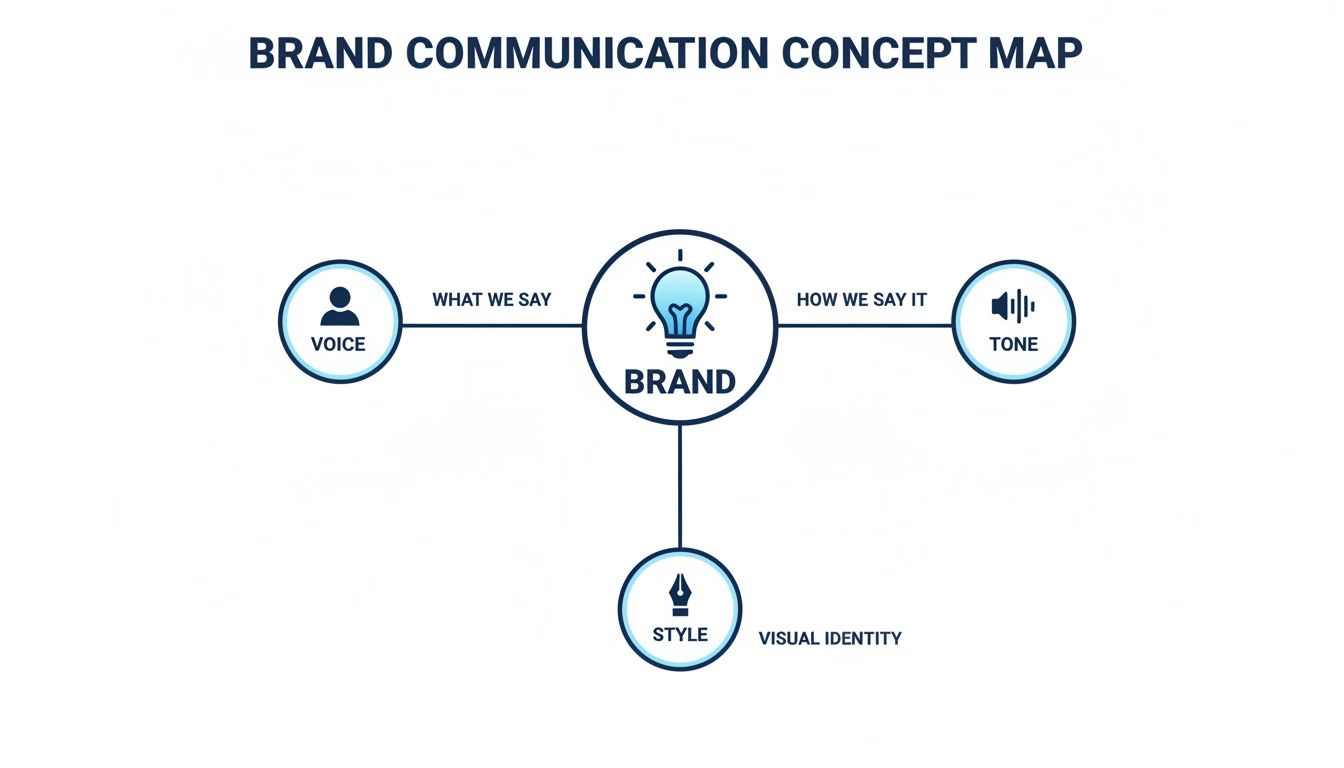
As you can see, your core brand identity is the source, and from it flow your voice, tone, and style. Let’s break these down a bit more clearly.
Understanding Brand Communication Concepts
This table will help clarify the differences between these often-confused terms.
| Concept | Definition | Example |
|---|---|---|
| Brand Voice | The consistent personality of your brand. It's who you are and it doesn't change. | Mailchimp's voice is friendly, informal, and encouraging. |
| Tone | The emotional inflection you apply to your voice in a specific context. It adapts to the situation. | When Mailchimp announces a new feature, its tone is excited. When addressing a service issue, its tone becomes serious and empathetic. |
| Style | The specific rules and mechanics of your writing, like grammar, punctuation, and formatting choices. | Always use the Oxford comma. Write "you're" instead of "you are." Use emojis sparingly. |
| Messaging | What you’re actually saying—the core ideas, value propositions, and key points you want to communicate. | "Our new AI feature saves you 10 hours a week by automating your content calendar." |
Understanding these distinctions is the first step toward building a voice that is both authentic and strategically effective.
The Financial Impact of a Consistent Voice
Getting this right isn't just about sounding good; it's about growing your business. Brands that present themselves consistently across all platforms have seen their revenue increase by up to 33%.
This stat drives home a crucial point: a well-defined and consistently used brand voice has real, tangible value.
A brand voice isn't a single setting you choose once. It's a dynamic system that adapts its tone for different situations while always staying true to its core personality.
Ultimately, defining your brand voice is a cornerstone of your entire identity. You can dive deeper into this process in our guide on how to build a personal brand. For more on articulating your brand's unique personality, check out this excellent guide on What Is Brand Voice and How Do You Build One.
The Four Pillars of an Unforgettable Brand Voice
A powerful brand voice doesn't just happen. It's built, piece by piece, on a solid foundation. If you try to create one without a strategy, you’ll end up with content that feels inconsistent and forgettable.
Breaking it down into four core pillars makes the whole process less of a guessing game and much more intentional. Think of these as the essential ingredients that, when combined, create a voice that is uniquely yours—and one your audience can recognize instantly.

Let's dig into each pillar and see how they come to life for a B2B personal brand, especially on a platform like LinkedIn.
Pillar 1: Personality
This is the very soul of your brand—the human character it embodies. Are you the wise mentor, the bold innovator, or the supportive colleague? Defining this personality is what separates a dry, corporate-sounding LinkedIn profile from an authentic thought leader people actually want to follow.
Two common personality archetypes you’ll see in B2B are:
- The Sage: This person is authoritative, deeply knowledgeable, and insightful. Their content is often backed by data and research, aiming to educate and guide their audience.
- The Disruptor: This person is provocative, innovative, and loves to challenge the norm. They ask tough questions and introduce fresh, sometimes controversial, ideas to get people thinking.
Once you’ve chosen a personality, it acts as your North Star, ensuring every piece of content has a consistent feel that builds trust and familiarity.
Pillar 2: Language
If personality is the who, language is the how. It’s the specific words, phrases, and sentence structures you use to bring that personality to life. It’s the nuts and bolts of your communication.
Are your sentences short and to the point, or are they more descriptive and flowing? Do you lean into industry jargon, or do you pride yourself on making complex ideas simple for everyone to understand?
A brand's language isn't just about what you say, but the vocabulary you choose to say it with. It’s the difference between sounding approachable versus academic, or direct versus diplomatic.
This is also where you decide your stance on things like humor, slang, or even emojis. Setting these ground rules is essential for staying consistent, especially if you ever have a team creating content for you.
Pillar 3: Tone
Think of it this way: Personality is your fixed character, but Tone is your emotional inflection that changes with the situation. You wouldn't use the same tone to celebrate a massive win as you would to discuss a serious industry problem. Your core personality doesn’t change, but your tone adapts to the context.
For instance, a personal brand with a "Supportive Colleague" personality might use:
- An excited and celebratory tone when shouting out a team member's success.
- An empathetic and serious tone when talking about common struggles in their field.
- A curious and open tone when asking their network for advice or feedback.
Mastering tone is what makes your communication feel dynamic and genuinely human.
Pillar 4: Purpose
Finally, every single piece of content needs a clear "why" behind it. Purpose is the engine driving your communication. Are you trying to educate, inspire, entertain, or persuade? Your purpose anchors everything else—your personality, language, and tone—to ensure your message not only sounds right but actually achieves a specific goal.
This is more important than ever. Research shows that brands that effectively blend competence (purpose) and excitement (personality) can achieve a 34% higher customer lifetime value. In a world full of generic, AI-generated content, a human voice rooted in clear purpose is what builds a brand people remember. For more on this, check out these branding statistics and their impact.
When these four pillars work together, you stop just posting content and start building a voice that truly resonates.
Learning From B2B Brands That Get It Right
Theory is great, but seeing it in action is what really makes it click. The fastest way to learn is to watch the pros. By looking at B2B brands that have truly mastered their voice on LinkedIn, you can pick up on what works and get some solid ideas for your own approach.
Let’s break down a brand that absolutely kills it with their voice.
Example: The Confident Expert
Gong, the revenue intelligence platform, is a perfect case study in building a confident, data-backed brand voice. They don't just share vague opinions. Instead, they drop bold, often contrarian, insights and back them up with hard numbers from their massive dataset of sales calls.
Their writing is direct and punchy. No fluff. They use strong verbs and short sentences, peppering in data points that make their arguments feel ironclad.
- Personality: A mix of The Sage and The Disruptor. They position themselves as the ultimate authority while simultaneously challenging outdated sales dogma.
- Language: You’ll see phrases like "Brutal truth," "Data shows," and "Stop doing this." It’s assertive, clear, and leaves no room for doubt.
- Tone: It can shift from educational to provocative, and even a little humorous, but it always stems from a place of deep expertise.
- Purpose: To teach their audience and cement their platform as the single source of truth for all things sales.
This unwavering voice has earned them a huge following and is a key part of how to become a thought leader in a crowded B2B world.
Anti-Example: The Corporate Robot
Now for the flip side. We've all seen the "Corporate Robot" in our feeds—and we've all scrolled right past it. This is the brand that fails to make any connection because it has absolutely zero personality.
This kind of content is stuffed with generic buzzwords, confusing jargon, and a flat, impersonal tone. It sounds like it was written by a committee and scrubbed clean by a team of lawyers.
Posts from these brands usually sound something like this:
"Our organization is pleased to announce a strategic initiative designed to optimize synergistic workflows and drive value-added solutions for our esteemed clientele. We are leveraging best-in-class methodologies to enhance our core competencies and deliver unparalleled results in the marketplace."
I mean, what does that even say? It’s forgettable, a chore to read, and creates no emotional bond whatsoever. The personality is missing, the language is stiff, and the purpose is buried under layers of self-promotional jargon. This is a masterclass in what not to do, and it’s the best argument for why a distinct brand voice is so critical.
How to Define Your Authentic Brand Voice
Alright, you get the theory. Now it's time to roll up your sleeves and actually build your own brand voice. This isn’t some abstract, mystical process; it's a strategic one. By asking the right questions and taking a hard look at what you’ve already created, you can move from inconsistent messaging to a voice that’s clear, memorable, and genuinely you.
This is a practical, step-by-step framework that will give you a clear roadmap to follow.

1. Revisit Your Core Mission and Values
Your brand voice has to be anchored to something real. It all starts with your fundamental "why." What do you actually stand for? What change are you trying to spark in your industry? Answering these big questions provides the foundation for your brand’s personality.
Think of it this way: your voice should be a direct reflection of your core principles. If one of your values is "simplicity," then your language should be straightforward and completely free of jargon. If it’s "innovation," your voice should sound forward-thinking and confident.
2. Get to Know Your Audience—Really
Who are you actually talking to? You can't hope to connect with people if you don't speak their language. Spend some time diving into the LinkedIn profiles of your ideal clients and followers.
- How do they communicate? Pay attention to the kind of language, questions, and even the humor they use in their own posts and comments.
- What are their biggest pain points? Your voice should address their challenges with empathy and genuine expertise.
- What content do they engage with most? This is a huge clue, revealing what they find valuable and interesting.
Your voice shouldn't be a performance. It should be a bridge that connects what you know with what your audience needs, using language they understand and appreciate.
3. Analyze Your Greatest Hits
Chances are, you’re already sitting on a goldmine of data. Go back through your past LinkedIn posts, articles, or videos. Pinpoint the top 3 to 5 pieces that got the highest engagement—I'm not just talking about likes, but meaningful comments and shares.
Now, put on your brand voice detective hat and analyze them:
- What was the tone of that post? Was it educational and serious, provocative and challenging, or personal and vulnerable?
- What kind of language and sentence structure did you use? Was it direct and punchy, or more descriptive and narrative-driven?
- What was the underlying personality that shone through?
You'll often find that your most authentic and effective voice is already hiding in the content that resonated most deeply with your audience. You don't have to invent a voice from scratch; find what’s already working and turn up the volume.
4. Get Specific With the Adjective Exercise
This simple exercise is incredibly powerful for creating clarity. The goal is to define your brand personality using a "We are X, but never Y" format. This adds much-needed nuance and sets clear boundaries for your communication.
The "We Are X, But Never Y" Framework This exercise forces you to define not only what your brand is, but also what it is not. This is crucial for preventing your voice from accidentally straying into undesirable territory.
Here are a few examples to get you started:
- We are confident, but never arrogant.
- We are playful, but never silly.
- We are direct, but never rude.
- We are expert, but never elitist.
A key outcome of this process is to document everything in a set of comprehensive brand guidelines. For an excellent walkthrough on this, you should learn how to create brand guidelines to ensure everyone on your team applies the voice consistently. This solidifies your brand identity and gives you a practical blueprint for all future content.
Your Brand Voice Discovery Checklist
Feeling a little overwhelmed? Don't be. This checklist is designed to walk you through a simple audit of your current content and guide you toward defining the voice you want to have. Work through it one step at a time.
| Checklist Item | Question to Ask Yourself | Action Item |
|---|---|---|
| Audit Existing Content | "Which of my posts in the last 6 months received the most genuine engagement (comments, shares)?" | List your top 3-5 performing pieces of content. |
| Identify Common Threads | "Looking at those top posts, what personality, tone, and language patterns do they share?" | Jot down 3-5 adjectives that describe the voice in your most successful content (e.g., "Inspirational," "Direct," "Witty"). |
| Review Audience Language | "How do my ideal clients and followers talk? What words, phrases, and questions do they use?" | Spend 20 minutes scrolling through your comments and your ideal clients' posts. Note common language patterns. |
| Define Core Values | "What are the 3 non-negotiable values that drive my business or personal brand?" | Write down your 3 core values (e.g., "Integrity," "Innovation," "Clarity"). |
| Run the "X but not Y" Test | "Based on my values and what works, how can I define my voice? What am I, and what am I not?" | Create at least 3 "We are X, but never Y" statements for your brand. |
| Document the Vocabulary | "Are there specific words or phrases I want to consistently use or avoid?" | Create two lists: "Words We Use" (e.g., "collaborate," "build") and "Words We Avoid" (e.g., "utilize," "synergy"). |
Once you've completed this checklist, you'll have a much clearer, more tangible definition of your brand voice—one you can start applying immediately.
Putting Your Brand Voice Into Action On LinkedIn
Figuring out your brand voice is a huge step, but the real test is actually using it consistently. This is where the rubber meets the road—closing the gap between the brand voice guidelines sitting in a Google Doc and the real-world content you publish every day on LinkedIn.
When you nail this, your brand voice becomes your secret weapon against writer's block and generic, off-brand posts. Every single piece of content starts working together, reinforcing who you are.
This consistency is a total game-changer for teams. Think about an agency managing ten different client accounts or a founder trying to get their sales team active on LinkedIn. A clear, actionable brand voice guide is the only way to avoid a messy, confusing presence. The goal is to make the voice so natural that anyone can create content that feels authentic.
From Guidelines to Great Content
Let's be honest, translating an abstract idea like "be confident, but not arrogant" into an actual LinkedIn post is tough. It's easy to second-guess yourself. This is where the right tools can make all the difference, acting as a co-pilot to help you stay on track.
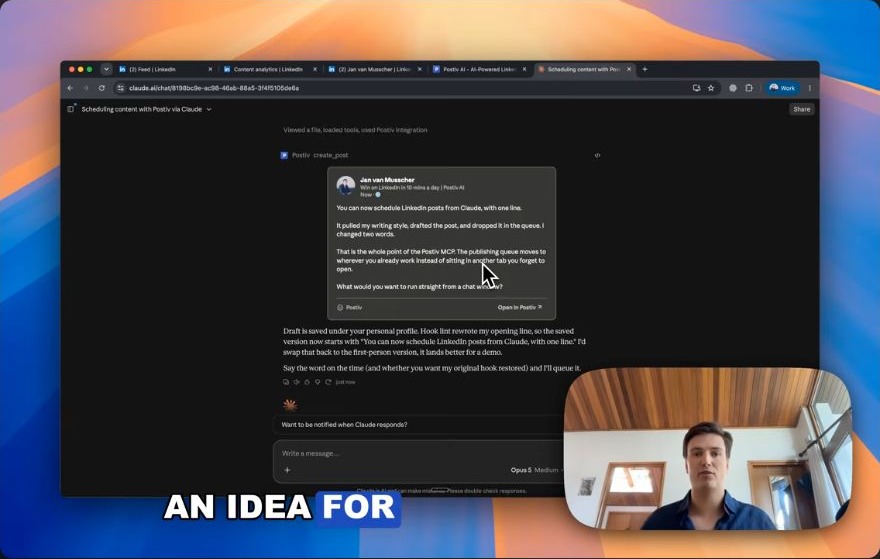
Tools like Postiv AI let you train a personal AI assistant on your specific brand voice. You can feed it your best-performing articles, past LinkedIn posts, and even transcripts from your webinars or podcasts. The AI internalizes your unique style, your go-to phrases, and your overall personality. Suddenly, you have a brand expert ready to help you draft content that sounds exactly like you.
Here's a glimpse of how you can use an AI-powered platform to brainstorm and draft content that’s already aligned with your voice.

This process transforms your static brand guidelines into a living, breathing tool that helps generate on-brand drafts for everything from a quick text update to a detailed carousel.
Scaling Your Voice Across All Content
True consistency goes way beyond just your main posts. It’s about how you show up everywhere. Your brand voice needs to shine through in your comments, your DMs, and any articles you share. Technology is what makes this level of consistency possible without burning you out.
A brand-trained AI doesn't replace your expertise; it amplifies it. It handles the structural and stylistic heavy lifting, freeing you up to focus on the core insights and stories that only you can provide.
This is how you build a powerful content engine. By pairing your human knowledge with AI-driven execution, you can create more high-quality, on-brand content than ever before. Your audience gets a seamless experience every time they see your name pop up. This systematic approach is a core part of learning how to write LinkedIn posts that don't just grab attention, but build real authority and trust over the long haul.
Common Questions About Brand Voice, Answered
Alright, so you've mapped out your brand voice. Now what? Putting it into practice is where the real work begins, and it's totally normal to have a few questions pop up. Let's tackle some of the most common ones I hear.
How Long Does It Take to Establish a Brand Voice?
This is a big one. The honest answer? It's a marathon, not a sprint. Building a recognizable voice on LinkedIn is all about consistency.
You can generally expect your audience to start really getting your unique style after about 3-6 months of consistent posting—think 3 to 5 times a week. Every single post, comment, and carousel you share is like laying another brick. Each piece reinforces who you are, making your voice more familiar and, ultimately, more trustworthy.
Can My Brand Voice Evolve Over Time?
Not only can it, it absolutely should. Your brand voice isn't a dusty rulebook you set on a shelf and never touch again. People change, businesses pivot, and your communication style needs to keep up to feel real.
I recommend revisiting your brand voice guidelines at least once a year. It's also smart to check in whenever your business hits a major milestone, like targeting a new market or launching a new service. Your core personality might stay the same (maybe you're always helpful), but the specific tone or vocabulary you use can definitely shift. The goal is genuine connection, not being a robot.
The most common mistake is inconsistency. So many brands create detailed voice guidelines and then completely forget to use them. This creates a jarring experience for the audience and slowly chips away at trust.
Another huge pitfall is faking it. Trying to adopt a voice that feels unnatural to you or misaligned with your company's core values is a recipe for disaster. People can spot a phony from a mile away.
How Is Brand Voice Different From Visuals?
This is a great question. Think of it like this: your brand visuals—your logo, color palette, fonts—are what your brand looks like. Your brand voice is what it sounds like.
They're two sides of the same coin, and they have to work together to tell a single, cohesive story.
For example, if your logo is sleek, modern, and innovative, your brand voice should probably reflect that with forward-thinking, expert language. If you paired that same modern logo with a stiff, overly academic voice, it would just feel… off. That disconnect confuses people and seriously weakens your brand's impact.
Ready to put your brand voice into action with consistency and scale? Postiv AI helps you draft on-brand LinkedIn posts and carousels in minutes, turning your unique expertise into authority-building content. Start your free trial today and see the difference.