
Becoming a thought leader isn't something that happens overnight. It's a deliberate journey of carving out your unique perspective, consistently sharing high-value content around it, and genuinely connecting with a community to build real influence. It's about earning your authority with consistent, valuable insights—not just declaring yourself an expert.
This guide lays out the roadmap, taking you from a knowledgeable professional to a recognized voice in your industry.
What Thought Leadership Actually Means Today
Let's get one thing straight: thought leadership isn't just another stale marketing buzzword. In an online world drowning in generic content and nonstop sales pitches, real expertise has become the ultimate currency of trust.
It's no longer enough to just have an opinion. You need an earned one—one that’s been forged through experience, backed by data, and shared generously to actually help people.
This isn't just a minor trend. It's a seismic shift in how people, especially in the B2B world, make decisions. Your potential clients are exhausted from being sold to. They're now actively hunting for knowledgeable people and companies who can educate them, challenge their thinking, and guide them toward better solutions. They want to see proof of your expertise long before they even think about making a purchase.
And that's exactly why understanding how to become a thought leader is so crucial. It's about building a public library of "trust-stuff"—content that's easy to find, full of insight, and validates your expertise without a sales pitch in sight.
Moving Beyond Traditional Marketing
The data couldn't be clearer on this. The Edelman-LinkedIn B2B Thought Leadership Impact Report found that a staggering 73% of decision-makers believe an organization's thought leadership is a more trustworthy way to gauge its capabilities than its old-school marketing materials.
With the LinkedIn community now a billion members strong, the platform has become the de facto stage for this new kind of professional evaluation. Your blog posts, LinkedIn carousels, and even your insightful comments are no longer just "content." They are your digital handshake and your capabilities deck, all rolled into one. If you're interested, you can check out our guide on what is thought leadership marketing to better understand this concept.
The core idea is simple: instead of just telling people you're an expert, you show them by consistently solving small pieces of their problems right out in the open. You build credibility one helpful post at a time.
The Core Framework for Building Authority
To make this happen, you need a plan. Just tossing out random ideas whenever you feel inspired won't build the momentum you need. The blueprint in this guide is built on a proven four-part framework designed for creating sustainable influence.
Below is a quick overview of the essential pillars we'll be diving into. This table breaks down the core components of a modern thought leadership strategy.
Core Pillars of Modern Thought Leadership
| Pillar | Objective | Key Activities |
|---|---|---|
| Find Your Niche | Define your specific area of expertise and develop a unique point of view that stands out. | Audience research, POV development, competitor analysis. |
| Build Your Content Engine | Create a reliable system for producing high-quality content that consistently showcases your authority. | Content pillar creation, format selection, calendar planning. |
| Amplify Your Voice | Use smart networking and community building to get your ideas in front of the right people. | Strategic commenting, collaborations, content syndication. |
| Measure What Matters | Track meaningful metrics to refine your approach and prove the value of your efforts. | Engagement analysis, lead tracking, brand mention monitoring. |
By focusing on these four areas, you create a holistic system that not only builds your reputation but also drives real results.
For a deeper dive into how this all comes together, it's worth exploring our complete guide on thought leadership marketing in practice. Following this framework will put you on a clear path from being just another voice in the noise to becoming the one people actively seek out for answers.
Find Your Niche and Unique Point of View

This is where the real work starts. Becoming a go-to authority isn’t about being the smartest person in the room; it’s about being the most focused.
Vague titles like “marketing expert” or “business coach” just don’t cut it anymore. They're too broad to get any real traction. To truly become a thought leader, you have to become the undisputed expert for a very specific problem, for a very specific audience.
The whole idea is to move from a wide, noisy field into a narrow space you can actually own. This means taking a good, hard look at your skills, your past experiences, and what the market is genuinely hungry for right now.
From Broad Topic to Sharp Niche
Your most powerful move is to "niche down." It’s the art of taking a general topic and sharpening it until it speaks directly to a particular group of people, making them feel like you’re reading their minds.
Think about how you can transform a general topic into a laser-focused niche:
- Broad: Marketing
- Sharper: Content Marketing
- Sharpest: AI-driven content marketing for early-stage B2B SaaS startups.
Or another one:
- Broad: Sales Training
- Sharper: Cold Outreach for Sales Teams
- Sharpest: Personalized video prospecting for SDRs in the fintech industry.
See how the final version in each example hits a specific person with a specific challenge? That kind of focus makes it a million times easier to create content that lands and pulls in the right kind of followers. Plus, you're no longer competing with every single marketing or sales "guru" on the internet.
Develop Your Signature Point of View
Your niche defines who you talk to. Your Point of View (POV) is about what you say and why anyone should care.
Your POV is the unique lens you use to see your industry. It’s your core beliefs, your contrarian takes, and your predictions about the future that set you apart from the crowd. This is about more than just spouting opinions—it's about sharing what venture capitalist Ben Horowitz calls your “earned secrets.”
These are the tough lessons you learned by actually doing the work, the insights that can’t just be googled.
Your earned secrets are the bedrock of your authority. They are the unique insights you've gained from your specific experiences that not many other people possess. Sharing them is what builds genuine thought leadership.
To start shaping your signature POV, think about your core beliefs. What do you fundamentally believe about your industry that others might disagree with? What popular advice do you think is flat-out wrong? What trend is on the horizon that nobody else seems to see?
A leadership coach’s POV, for instance, might be: “Traditional top-down management is dead. The future belongs to autonomous teams led by empathetic coaches, not micromanaging bosses.”
Having a strong, clear perspective like this acts as a filter for everything you create. It ensures your content is consistent and constantly reinforces your unique position. To make a real impact, you have to find that sweet spot, and a big part of that is learning to discover your unique authorial style and voice.
When you combine a well-defined niche with a powerful POV, your content stops being noise. It becomes a signal your ideal audience simply can’t ignore.
Build Your Signature Content Engine

Having a sharp niche and a unique point of view is the starting line. But ideas without execution are just thoughts. The real work begins now: building the system—the engine—that turns your expertise into a steady stream of high-impact content.
This isn’t about chasing viral hits or just posting whenever inspiration strikes. That’s a recipe for burnout. We’re talking about building a reliable, repeatable process that builds momentum over time. If you want the step-by-step version of this engine, our LinkedIn content strategy guide includes a free template, the 60-30-10 format mix, and a 90-day implementation plan.
Without this operational backbone, even the most brilliant insights get lost in the noise. The goal here is to shift from being a creative who sometimes shares ideas to a strategic authority who consistently delivers value.
Establish Your Core Content Pillars
First things first, you need to define your content pillars. Think of these as the 3-5 core themes that branch directly from your niche and point of view. They are the foundational topics you will own—the subjects people will come to you for.
Pillars give your content a much-needed structure. They keep you focused, ensuring everything you publish reinforces your expertise and doesn't wander off into irrelevant territory. They’re your guardrails for content creation.
Let’s say you’re a consultant who specializes in "AI-driven content marketing for B2B SaaS startups." (If you are the SaaS founder, our LinkedIn for SaaS founders playbook shows the same pillar work applied to founder-led growth.) Your pillars might look something like this:
- AI Content Creation: Diving into the specific tools, prompts, and workflows for actually generating great drafts.
- Content Repurposing Systems: Showing clients how to turn one beefy asset into dozens of social posts.
- Measuring Content ROI: Breaking down how to tie content directly to pipeline and revenue, not just likes.
- SaaS Storytelling: Focusing on the narrative frameworks that actually connect with technical buyers.
These are specific enough to prove you know your stuff but broad enough to fuel your content calendar for months. Every post, article, and carousel will fit neatly into one of these buckets.
Your content pillars are the promise you make to your audience. Every piece of content you create should deliver on one of these promises, building a reliable library of expertise that your followers can depend on.
Match Your Pillars to LinkedIn Native Formats
With your pillars locked in, it's time to think about how you’ll present your ideas. Different LinkedIn formats do different jobs. Some are perfect for a quick, punchy thought; others are built for deep-dive tutorials.
A healthy mix of formats keeps your audience engaged and shows the versatility of your expertise. The trick is picking formats that not only fit your message but also play to the strengths of the LinkedIn platform.
Here’s how I think about it strategically:
- Text-Only Posts: Your go-to for telling a story, dropping a strong opinion, or asking a provocative question. Keep sentences short and use plenty of white space to make them easy to read on the go.
- Carousels (PDFs): These are absolute gold for teaching a concept, breaking down a process, or visualizing data. A solid 10-slide carousel can deliver a massive amount of value and is incredibly shareable.
- Long-Form Articles: Reserve these for your most detailed, evergreen insights. They cement you as a true authority and can be sliced and diced into dozens of smaller posts later on.
- Video: Nothing builds a personal connection faster. Use video to explain complex topics with a more human touch or just share a quick thought from the heart.
Using multiple formats proves you’re not a one-trick pony. It demonstrates both the depth and breadth of your knowledge.
Plan and Create With a Simple Calendar
Consistency is the single most important factor in building thought leadership. Your content calendar is what makes it happen.
And no, you don't need a fancy project management tool. A simple spreadsheet is more than enough to get started.
Your calendar's job is to map out which pillar you’re talking about on which day, and in what format. That's it. This simple planning habit removes the daily panic of "What should I post today?" and lets you focus on creating great content. And when you hit a wall—which we all do—having a plan makes it easier to figure out how to overcome creative block and get back on track. Busy executives who cannot write every day often pair the calendar with a LinkedIn ghostwriter so the ideas still ship on schedule.
A sample week could look like this:
| Day | Pillar | Format | Post Idea |
|---|---|---|---|
| Mon | AI Content Creation | Text-Only | A personal story about my first failed AI experiment. |
| Wed | Measuring Content ROI | Carousel | 8 slides on "Metrics That Matter vs. Vanity Metrics." |
| Fri | SaaS Storytelling | Text + Image | A case study on how a client used storytelling to double demo requests. |
This consistency pays off. The Edelman-LinkedIn B2B Thought Leadership Impact Report found that a staggering 75% of executives have looked into an unsolicited product simply because of compelling content they consumed. On top of that, 53% of buyers credit this type of content for directly influencing their purchasing decisions.
When you realize that 58% of decision-makers spend hours every week consuming professional content, you see how your steady presence becomes a serious business asset. Building a system around pillars, formats, and a calendar is what turns content creation from a chore into a powerful, sustainable practice that builds real authority.
Amplify Your Voice Through Community and Networking
 Putting brilliant content out into the world is a huge win, but it’s really only half the job. An idea that no one hears can’t make an impact. This is where you have to get proactive about amplifying your message by genuinely connecting with people and building a real community.
Think of it as shifting from a monologue—just publishing into the void—to a dialogue. Your goal is to turn your LinkedIn profile from a simple content feed into a lively hub for industry conversations. It's how you make sure all those hard-earned insights actually reach the people who need to hear them.
Master the Art of Strategic Commenting
One of the most powerful, and often overlooked, strategies for getting noticed is what I like to call the 'Comment to Connect' method. It's pretty straightforward: instead of only posting on your own feed, you jump into the conversations happening on posts from other influential people in your space.
The secret is to leave comments that actually add to the discussion. A generic "Great post!" is a wasted opportunity. Your comment should be a mini-piece of thought leadership on its own—a thoughtful question, an extra piece of insight, or even a respectful counterpoint that shows off what you know.
Let's say a marketing leader posts about the decline of old-school SEO. A value-add comment might look like this: "This is a great point, especially for B2B. I've seen clients get better traction by shifting some SEO budget toward creating 'problem-aware' content on LinkedIn, which helps them connect with buyers much earlier in their journey."
This one comment accomplishes three things at once:
- Builds Rapport: You create a genuine touchpoint with an industry peer.
- Gains Visibility: You put your expertise in front of their established audience.
- Proves Your POV: You reinforce your own authority without having to write a whole new post.
Cultivate Your Own Engaged Audience
While you’re out there engaging with others, don't forget about the community building right on your own posts. Fostering a loyal group of followers means treating every single comment as a chance to strengthen a relationship.
When someone takes the time to leave a comment, give them a thoughtful response. Acknowledge their point, answer their question directly, or ask a follow-up question to keep the conversation rolling. This shows you're not just broadcasting; you're actually listening and invested in the discussion.
Your comment section is your community’s town square. By actively participating in the discussions you start, you build a reputation as an accessible and engaged expert, which is a cornerstone of an authentic personal brand.
This two-way engagement is fundamental. For those looking to dive deeper, our guide on how to build a personal brand provides an expanded framework for creating this kind of magnetic presence.
Network with Intentionality
The quality of your network will always beat the quantity. Just collecting connections is a vanity metric that won't get you far. Real influence comes from building meaningful relationships with the right people—your peers, potential collaborators, and even future clients.
When you send a connection request, always add a personal note. A generic request is easy to ignore. Reference a specific post of theirs you enjoyed, mention a mutual connection, or point out a professional interest you both share. A simple, genuine message makes all the difference.
This focus on quality is backed by data. A DSMN8 study of 500,000 LinkedIn posts found that professionals with 5,000-10,000 high-quality connections often generated more engagement than massive influencers. This really highlights the power of a curated network.
Consider this: many B2B buyers spend 70% of their journey doing independent research before ever speaking to a sales rep. Building these strong, relevant connections ensures your voice is one they hear at the right time. You can discover more insights about LinkedIn thought leadership on impactable.com.
7. Measure Your Impact and Iterate Like a Pro
Putting content out there without tracking what happens next is a rookie mistake. It's the equivalent of talking to an empty room—you might feel like you're doing something, but you have no idea if your message is actually landing. If you're serious about thought leadership, you have to treat this like a business function, not just a creative outlet.
That means looking past the ego-stroking "vanity metrics." A flood of likes feels nice, but it doesn't build a brand or land you a speaking gig. The real pros track the numbers that signal true influence and lead to tangible business outcomes. This is how you turn random posts into a reliable growth engine.
Ditch the Vanity Metrics and Focus on What Counts
Stop obsessing over likes and impressions. Instead, start tracking the metrics that tell you a much richer story about your growing influence. These are the signals that prove your ideas are connecting with the right people—the ones who can hire you, partner with you, or become your next client.
Here's what you should be paying attention to:
- Profile Views: This is a pure measure of curiosity. When someone sees your post and takes the extra step to click on your name, it means you've said something compelling enough to make them ask, "Who is this person?"
- Relevant Follower Growth: It's not about how many followers you have, but who they are. Is your audience filled with peers, industry decision-makers, and potential buyers? 100 engaged followers in your niche are worth more than 10,000 random ones.
- Inbound Connection Requests & DMs: This is where the magic happens. Pay special attention to messages that reference your content directly. A DM that starts with, "Hey, your carousel on brand strategy got me thinking..." is a massive win. It’s a direct line to opportunity.
- Comment Quality and Depth: Skim past the "Great post!" comments and look for the meaty ones. Are people asking thoughtful questions? Are they debating your points? That's the sign of a healthy, engaged community, not just a passive audience.
The Monthly Content Teardown: Your Secret Weapon
Data is meaningless if you don't act on it. The key to getting smarter over time is to block off an hour each month for a simple, no-fluff content review. This is your dedicated feedback loop for figuring out what's hitting, what's missing, and—most importantly—why.
You’re not just crunching numbers here; you’re hunting for patterns.
Ask yourself: What was my absolute home-run post this month? What can I learn from its topic, format, or the hook I used? On the flip side, which post was a total dud? What does that tell me about what my audience doesn't care about?
This disciplined review process is what separates the serious players from the casual creators. It gives you the clarity to double down on what works and cut what doesn't.
This table breaks down the metrics that truly move the needle, shifting your focus from vanity to real-world impact.
Thought Leadership Metrics That Actually Matter
| Metric | What It Measures | Why It Matters | How to Track It |
|---|---|---|---|
| Profile Views | Audience curiosity and interest in you as a professional. | High views mean your content is compelling enough to drive further investigation into who you are. | LinkedIn Analytics (Dashboard > Analytics > Profile Views) |
| Comment Quality | The level of intellectual engagement your content sparks. | Deep, thoughtful comments show you're building a real community, not just an audience of lurkers. | Manually review comment sections on your top posts each week. |
| Inbound Messages | Direct interest and potential business opportunities. | These are often the first step toward collaborations, speaking gigs, or sales conversations. | Monitor your LinkedIn Inbox for messages referencing specific content. |
| Follower Demographics | The relevance and quality of your growing audience. | Growth from your target industry or job titles confirms your niche strategy is working. | LinkedIn Analytics (Analytics > Followers > View all follower analytics) |
By consistently keeping an eye on these KPIs and tweaking your plan based on what the data tells you, you ensure your efforts are always purposeful. This is how you transform content from a daily chore into a powerful system for building authority and driving measurable results.
Your 90-Day Thought Leadership Action Plan
Alright, let's get practical. All the strategy in the world doesn't mean a thing without a concrete plan. This 90-day roadmap is designed to take you from zero to thought leader in three clear stages.
Forget about feeling overwhelmed. We're going to break this down into manageable sprints. The first month is all about laying the groundwork, the second is where you hit your stride, and the third is about pouring fuel on the fire. This is how you build real, sustainable momentum.
Month 1: The Foundation Phase (Days 1-30)
The first 30 days are purely about getting your strategy straight. Seriously, don't rush this. Nailing your foundation now makes every single thing you do later on infinitely more effective. You wouldn't build a skyscraper on a flimsy base, right?
Your entire focus for this month is clarity and preparation.
- Weeks 1-2: Nailing Your Niche and POV. This is the deep work. Block out time to really dig into who you serve and what makes your perspective unique. What's your "earned secret"? Get those core content pillars written down.
- Week 3: Optimizing Your LinkedIn Profile. It's time to transform your profile from a dusty resume into a go-to resource. Your headline and "About" section need a complete rewrite to reflect your sharp new point of view. Every word should signal to your ideal audience that they're in the right place.
- Week 4: Building Your Content Engine. Set up a simple content calendar—nothing fancy needed. Your goal is to brainstorm 10-15 initial post ideas that directly map back to your pillars. Decide on the first few formats you'll try so you have a backlog ready to deploy.
This timeline gives you a bird's-eye view of the journey ahead, from laying the groundwork to hitting escape velocity.
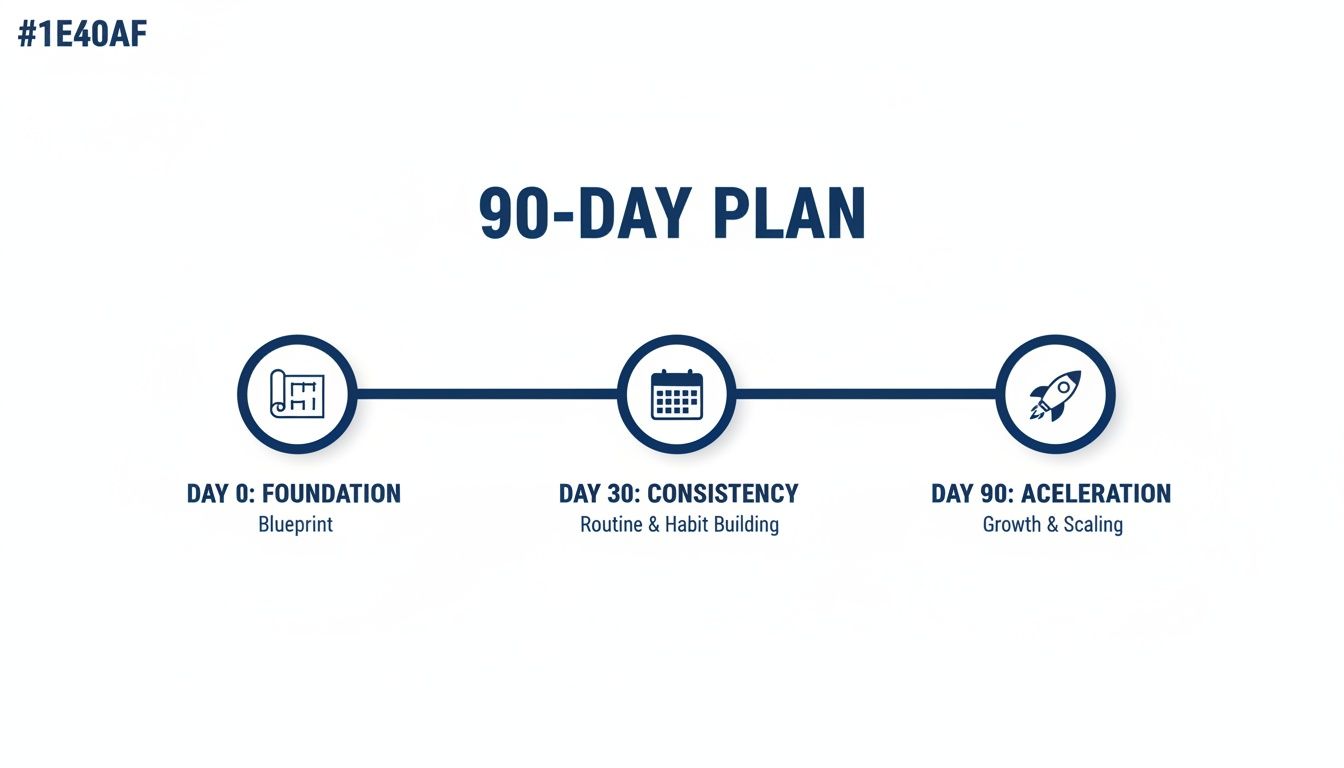
Becoming a recognized voice is a progressive journey. It starts with a solid base, which then allows consistent execution to create accelerated results.
Month 2: The Consistency Phase (Days 31-60)
Now, it’s all about execution. This is the month where you put your head down, show up, and start actively building your community.
Building authority is a game of consistency, not intensity. A steady drumbeat of valuable content will always outperform sporadic viral hits in the long run.
Your mission here is to become a reliable, familiar face in your niche.
- Execute Your Content Calendar: Start publishing 3-4 times per week. No excuses. Stick to your pillars and your plan.
- Implement Your Engagement Strategy: This is non-negotiable. Spend 15-20 minutes every single day leaving thoughtful, strategic comments on posts from other influential people in your space.
- Foster Your Community: When people comment on your posts, reply to every single one. Don't just "like" it—ask a follow-up question, add more value, and start a real conversation.
Month 3: The Acceleration Phase (Days 61-90)
You've built a solid routine and a foundational audience. The final month is about looking at the data, doubling down on what works, and expanding your reach beyond your own profile.
- Analyze Your Performance: Time for your first content teardown. Dive into your LinkedIn analytics and identify your top-performing posts. Which formats are resonating? What topics got the most engagement?
- Amplify Your Winners: Take your best-performing content and give it new life. Repurpose that killer text post into a carousel. Turn that insightful comment thread into a short video or a longer article.
- Expand Your Reach: Start building a target list. Identify podcasts, newsletters, or online publications in your niche that you could contribute to down the line. This is about planting seeds for future collaborations.
Got Questions? Let's Talk Through Them
Even the best-laid plans run into real-world questions. It's completely normal to have some "what ifs" as you start this journey. Let's tackle a few of the most common ones I hear from people just like you.
What if I'm in a "Boring" Industry?
First things first: there's no such thing as a boring industry, only boring content. The problem is usually talking about your product instead of talking to your audience about their problems.
The best ideas aren't found in a brainstorming session; they're hidden in your daily grind. What questions do you answer on repeat during sales calls? What's the one thing you always have to explain to new clients? That's your goldmine.
- Stories are your secret weapon. Don't just list the features of your software. Tell a real story about how one client used it to fix a problem that was costing them thousands. People connect with stories, not spec sheets.
- Lean into the pain. What are the stupidly common mistakes people in your field make? What outdated processes are they clinging to? Content that solves a nagging, expensive problem is never, ever boring.
When you do this, you stop sounding like a brochure and start sounding like the go-to expert who actually gets it.
How Much Time Does This Really Take?
Here’s the good news: you don't need to quit your day job. The key to building a reputation isn't about intensity; it's all about consistency.
A dedicated 20-30 minutes a day is infinitely more powerful than trying to batch-create content for five hours every Sunday. Sporadic bursts of activity don't build momentum. A small, daily habit does.
Think of it like a daily workout for your professional brand. A little bit of focused effort every day—a thoughtful post, a few insightful comments—builds your authority much faster than one "hero" post a month.
What Do I Do About Negative Comments?
It's not a matter of if you get a negative comment, but when. Don't sweat it. Honestly, it often means your content is interesting enough to make people think. The magic is in how you handle it.
Before you type a single word, take a breath and figure out what you're dealing with. Is it a genuine question or just someone looking for a fight?
- For thoughtful criticism: Thank them for sharing their perspective. You can learn from it, and engaging respectfully shows everyone else you're confident and open-minded. You'd be surprised how much trust this can build.
- For trolls and bad-faith comments: Don't feed them. The best response is usually no response. Just delete the comment and block them if you need to. It's your house; you set the rules.
Your job is to protect your brand and your sanity. Deal with the real conversations and starve the negativity of the oxygen it craves.
Ready to turn your expertise into authority-building content without the grind? Postiv AI combines a brand-trained AI writer, carousel designer, and scheduler into one seamless workflow. Stop staring at a blank page and start creating high-impact LinkedIn content in minutes. Explore Postiv AI and start your free trial today.