10 LinkedIn Post Ideas With Real Examples and Templates
Find your next LinkedIn post idea with ten real examples, a quick chooser, and practical templates for turning your expertise into posts buyers want to read.
The best LinkedIn post idea is usually a useful answer you already gave someone: a customer question, a decision you explained, a mistake you corrected, or a result you can show.
Start with one person, one problem, and one piece of evidence. Then choose the angle that makes that evidence useful. A founder's product decision, a consultant's project lesson, and a marketer's campaign finding can all become worthwhile posts without a dramatic personal story or a huge following.
Below are ten LinkedIn post ideas with real creator examples, a breakdown of each approach, and original templates you can adapt. The aim is to help the right people understand how you think and what you can help them do.
Quick chooser: what should you post today?
Choose the row that matches what you actually have. If you do not have that material yet, gather it before writing the hook.
What you want the reader to do
What you already have
Post idea
A useful angle to explore
Try a better approach
A process you can demonstrate
1. Practical how-to
Show one task, with examples at each step
Resolve a doubt
A recurring customer question
2. Answer a real question
Explain the decision and its tradeoffs
Avoid a mistake
A failed attempt and what changed
3. Lesson from failure
Show the assumption you would test earlier
Understand your judgment
A decision you can defend
4. An informed opinion
Explain why you chose one approach over another
Understand how you work
A routine, document, or handoff
5. Behind the scenes
Reveal a decision inside the process
Evaluate your expertise
An approved project and documented outcome
6. Case study
Connect the starting problem to the work and result
Reconsider an assumption
A dataset or survey with a clear scope
7. Original data
Explain one finding and what it cannot tell you
Understand why you care
A real turning point
8. Professional story
Connect a past experience to a present choice
Try something new
A released feature, service, or resource
9. Announcement
Show who can now do what
Recognize a useful contribution
A person's specific action and its impact
10. People spotlight
Make expertise or a value visible through behavior
Short on time? Answer the last question you explained well. New to your field? Demonstrate something you recently learned and identify yourself as a learner. Selling a complex service? Start with a decision your buyers struggle to make, rather than a broad motivational topic.
An idea is different from a format. “How we decide whether a campaign needs new creative” is an idea. Text, a document carousel, and a screen-recorded video are ways to explain it. Choose the idea first; our guide to types of LinkedIn posts covers the format choices.
Ten LinkedIn post ideas, with real examples
These examples come from public posts in Postiv's moderated inspiration library, reviewed on September 27, 2026. They illustrate writing choices, not a ranking of performance. Some creators have large established audiences; their response counts do not predict yours, and engagement does not establish sales.
Each linked post is the creator's original. The breakdown is our editorial interpretation. Every original adaptation template below is newly written for this guide: replace the brackets with your own facts, not the creator's achievements. LinkedIn may require sign-in to view an original post.
Writer & Entrepreneur. I write The Saturday Essay for 200,000+ ambitious people living and working on their own terms.
·
It's tough to succeed if you can't communicate.
Here's how to do it well (in any situation):
1. Be specific.
"You always do this" means absolutely nothing.
"You interrupted me three times in the meeting" means something.
2. Describe the behavior, not the person.
"You talk over people" is a fact.
"You're disrespectful" is a cruel judgment.
3. Name the impact.
"When you go off-script on sales calls, we lose deals" is something a person can work on.
"You're hurting our team" is something a person feels badly about.
4. Use I, not You.
"I felt cut off in that conversation" shows the impact of their behavior.
"You never let me finish," shames someone with no lesson learned.
Direct communication will always feel uncomfortable at first.
You need to do it anyway.
The people who master it build better teams, better relationships, and better lives.
Bookmark this for the next time you need to have a tough conversation.
Interested in learning more useful tips like this?
I send one essay every Saturday to help 180K+ readers rethink how they work, earn, and live.
Join free here: https://buff.ly/rq3gVo9
Specificity is useful because the reader can recognize a conversation they struggle with. The opening names that obstacle before offering advice.
Try this: Name one problem your reader recognizes.
Structure
Contrasting examples make the instruction usable. The reader sees what to replace and the language to use instead.
Try this: Pair each instruction with a concrete before-and-after example.
Close
The close gives readers a concrete occasion to use the advice: their next difficult conversation.
Try this: Connect the next step to the situation your post helps with.
His opening names a practical obstacle: “It's tough to succeed if you can't communicate.” He follows with four principles, pairing each with example language. Readers can see the difference between a vague accusation and a specific description of behavior.
Hook and structure: Problem → specific instruction → contrasting examples → application. The useful part is the demonstration under each tip. A heading such as “be clear” would leave the reader to do the hard work.
Use it when: Your buyer needs to do something you know how to do: write a brief, qualify a lead, review a proposal, or run a better handoff.
Bring: The actual steps, one realistic example, and a common error. If you have never used the process, describe it as something you are learning or testing.
Original adaptation template:
If you're trying to [task], check [specific detail] before [usual next step].
[Action]. For example: [show the action].
[Action]. Check it by [observable test].
[Action]. Stop if [exception].
The mistake to avoid is [mistake], because [consequence].
A carousel can suit steps that benefit from separate visuals. A text post is enough when the examples are easy to follow. For slide-specific treatments, see LinkedIn carousel ideas.
2. Answer the question your buyer is already asking
"I hate my job. But I love the financial stability that it brings.
What should I do?"
I recently got this as an email from a reader.
Here's how to deal with it:
You have financial stability right now. Do not dismiss it.
That stability is important.
Now, become obsessive about your time.
Do your work diligently, but spare as much time as you can after that to explore.
Your nights, weekends, holidays - whatever you can manage.
Explore different things that you feel you could be good at.
Most of us do it wrong:
We quit our jobs.
Put the pressure on a new path to make us money.
When it is way too early to be monetised.
Enjoy the exploration.
Refine your skills and knowledge over time.
Because here's the thing:
When you find something you truly enjoy and are good at,
You will eventually find a way to make money from it.
Which is when you can say no to your job.
Stability gives you the freedom to explore, if you use it wisely.
Play the long game, and one day, your curiosity will pay your bills!
The quoted dilemma puts two competing needs side by side. It sounds like a question a reader would actually ask.
Try this: Open with the real decision, in your reader’s language.
Structure
Acknowledging financial stability respects the constraint before suggesting a new direction. It makes the answer feel considered.
Try this: Explain the constraint before giving your recommendation.
Close
The final principle ties exploration back to the stability mentioned in the opening.
Try this: Return to the original tension with a usable principle.
He opens with the reader's tension between disliking a job and valuing its stability. He then explains a sequence for exploring alternatives. The transferable technique is beginning with the decision in the reader's language, rather than announcing a broad topic such as career development.
Hook and structure: Recognizable dilemma → acknowledge the constraint → explain a path → summarize the principle. This is a writing example, not a recommendation to follow someone else's career advice.
Use it when: Prospects hesitate over cost, timing, scope, readiness, or competing options. A question does not need to have appeared dozens of times to be worth answering.
Bring: A real question, the context behind it, and the conditions that change your answer. Paraphrase private messages and remove identifying details unless you have permission to quote them.
Original adaptation template:
“Should we [option A] or [option B]?”
My first question is [diagnostic question].
If [condition], I'd start with [A], because [reason].
If [different condition], [B] makes more sense.
Before deciding, look at [specific evidence]. That tells you more than [misleading shortcut].
You can close by asking which constraint readers face. Ask because the answer will improve the discussion, not because every post needs a question.
I've met a lot of leaders who optimize for performance. The great ones optimize for people.
I learned this the hard way!
I was shocked when my best employee quit.
I thought I was doing what a good leader was supposed to do.
Set clear expectations.
Push for results.
Hold people accountable.
But somewhere along the way, I got so focused on the work that I stopped paying attention to the person doing it.
That resignation changed the way I lead.
Not overnight. And yes, I still make mistakes as a leader.
But these 9 principles have stuck with me:
1/ Have their back -
If someone on your team makes an honest mistake, don't throw them under the bus to save yourself. Take the heat when it matters. Have the harder conversation in private.
2/ Give away the credit -
You don't need your name attached to every good idea. Let your people own their wins.
3/ Don't save praise for performance reviews -
If someone does something well, tell them. A random "You handled that really well" can mean more than you realize.
4/ Ask them where they want their career to go -
Not everyone wants your job. Some don't even want to stay at your company forever. Ask anyway.
5/ Let them be the expert -
Give people a chance to teach what they know. You hired smart people. Give them the room to prove it.
6/ Stop giving everyone the same growth plan -
People want different things from their careers. Find out what matters to them before deciding what their next step should be.
7/ Notice the work nobody sees -
The difficult client. The struggling teammate. The project that took everything they had to finish. Sometimes people just need to know you noticed.
8/ Care about the person outside of work -
The marathon.
The new house.
Their kid's championship game.
The thing they've been working toward for years...Those things matter too.
9/ Say "I was wrong" before someone else has to
This one still isn't easy. But I've learned that admitting you're wrong doesn't make people trust you less. Pretending you're never wrong does.
I used to think leadership was mostly about getting people to perform.
I don't anymore.
The title gives you authority.
How you treat people determines whether they want to follow you…or not!
What would your team say about the way you lead?
♻️ Repost to help your network and follow me Kevin Box
Life's too short to work in a toxic workplace.
The first step out? A resume that gets you seen.
Kickresume has helped 8M+ job seekers do exactly that.
Tailor your resume to any job ad. Beat the ATS filters and get more job interviews.
Try it free 👇
https://lnkd.in/gecReHfF
The opening contrasts performance with people. The admission that follows gives the author a personal reason to revisit that contrast.
Try this: State the belief your experience caused you to reconsider.
Structure
The resignation creates a concrete turning point. Nine principles then show what the author says changed in his leadership, instead of leaving the lesson abstract.
Try this: Connect the setback to specific changes in what you do.
Close
The question asks readers to assess their own leadership. A repost request and a resume-tool promotion follow; those are separate calls to action from the central lesson.
Try this: Keep the next step connected to the lesson. Multiple unrelated calls to action can dilute it.
Box describes how an employee's resignation made him reconsider a performance-first approach to leadership. He follows that turning point with nine specific principles, while acknowledging that his own practice is still imperfect.
Hook and structure: Contrast → personal setback → admission → changed behavior → reader reflection. The concrete changes give the lesson substance beyond “put people first.” The full post also includes a separate resume-tool promotion after the leadership question.
Use it when: You can help a buyer recognize a risk earlier. A small mistake with a clear explanation is enough: an unclear brief, a rushed handoff, or a test that answered the wrong question.
Bring: What you expected, what you observed, your part in the decision, and what you now do differently. Do not invent a loss amount to make the opening more dramatic.
Original adaptation template:
I expected [approach] to solve [problem]. It didn't.
My assumption was [assumption]. What actually happened was [observation].
We changed [specific step]. I would now check [signal] before repeating this.
If you're facing [similar situation], start there.
If the issue is still unresolved, say so. A useful post can explain your next test without a neat success ending.
When we started the discount brokerage (flat fee per trade) model in India in 2010, we decided to charge the same fee regardless of trade size.
The logic was simple: if the effort to execute a trade is the same, why should customers pay differently? We applied the same logic to mutual funds. We didn't launch MFs until we could sell exclusively direct plans.
You can't call yourself a discount or a low-cost broker if you charge a percentage fee on transactions, because there's no incremental effort in executing a larger order. This logic has informed all our product and pricing decisions from day one.
Anyway, Coin today is the largest direct mutual funds platform in India, with nearly ₹1.6 lakh crores in direct MF AUM, and all our customers have saved thousands of crores in commissions. Direct mutual funds are a no-brainer if you're a DIY investor.
It's interesting that most of the direct MF platforms that started when we launched Coin have either disappeared or pivoted to something else. The few remaining platforms are also rethinking their choice of offering direct plans. However, at Zerodha, we will continue to offer direct mutual funds for free.
A lot of investors still don't know the difference between direct and regular plans. If you are investing in mutual funds, it's worth checking if your investments are in regular or direct plans. If you are in regular plans and want to switch to direct, we can help.
The opening grounds the opinion in a dated business decision. The reader can see where the principle came from.
Try this: Anchor your position in a decision you have made.
Structure
The reasoning connects the fee to the work required. This explains the policy through a principle rather than a slogan.
Try this: Show how your principle affects an actual choice.
Close
The close connects the company’s position to something a reader can check. This is analysis of the writing, not investment advice.
Try this: Give readers a relevant detail to inspect for themselves.
Kamath connects a position on fees to the company's earlier choices and continuing policy. The accompanying chart compares direct and regular fund plans. For this guide, the lesson is how he explains a commercial principle through decisions; we are not evaluating the investment argument.
Hook and structure: Historical choice → reasoning → implications for later choices → customer relevance. Readers can understand what the author stands for and how that affects the offer.
Use it when: Your buyers encounter advice you disagree with, or need to understand why your approach differs. You do not need to manufacture a “hot take.”
Bring: The decision, the reasoning, supporting evidence, and a situation where another approach would be reasonable.
Original adaptation template:
We chose [approach] over [alternative] for [specific situation].
The deciding factor was [constraint or evidence].
That means we accept [tradeoff] to protect [priority].
I'd choose differently if [condition]. But for [buyer situation], this is the decision I can defend.
A credible exception usually makes the advice more useful than an absolute claim.
• Broke a Guinness World Record
• Bought a second building
• Made $106M in 3 days
And we also crossed 100 teammates at Acquisition.com
(which is wild to say out loud).
But it also means I can’t have face-to-face conversations with everyone anymore.
So we’ve moved to more of a memo-style culture where I write memos to share what I’m thinking, what we’re learning, and how we’re growing.
My team has been loving them.
So, I figured…
Why not just send them to anyone who's interested? :D
Introducing “Leila’s Letters”
So here's what you'll get -
Every week I write notes for my team as we're building Acquisition.com. The stuff I'm thinking about, dealing with, trying to figure out.
Now I'm just... ALSO sending them to you :)
Things like:
What actually worked this week (and what bombed)
Leadership stuff I'm figuring out as I go
The uncomfortable parts of building a company nobody talks about that f*cking suck
The first collection is called “12 Months of Key Decisions at Acquisition.com.”
Inside you’ll find memos from our departmental leaders on:
• hiring
• pivoting our business model
• buying a second building
• launching the book
• and the decisions that shaped our year
These aren't edited. I'm not cleaning them up or making them sound smarter. They're the actual memos with typos, rambling thoughts, and occasional f-bombs included.
If you're looking for inspirational LinkedIn content about "crushing it" or whatever the heck that is, this isn't it.
But if you want to see what's ACTUALLY happening behind the scenes - the imperfect parts, the failures, the things that worked that we didn't expect - you'll probably get something out of these.
Talk soon :)
Leila
Access the memo here: https://lnkd.in/gsdTtQqZ
The opening marks a period of change and signals that a retrospective is coming. The operational constraint later gives that opening substance.
Try this: Introduce the change, then explain the practical consequence.
Structure
The communication limit explains why the team needed memos. The process follows from a concrete problem.
Try this: Show the constraint that made your process necessary.
Close
The invitation names what readers will find, including imperfect work and failures. That sets expectations for the resource.
Try this: Describe the actual contents of the resource you offer.
After opening with milestones, Hormozi explains that a larger team made individual conversations harder, prompting more written memos. She then introduces a collection of those notes. The useful behind-the-scenes material is the operating change and the documents it produced.
Hook and structure: Business change → practical constraint → new routine → examples of what the routine captures. It also introduces a resource; the process gives readers a reason to care about it.
Use it when: Buyers cannot easily see the work behind your service. Explain how you make a decision, review quality, prepare an interview, or handle a difficult handoff.
Bring: A real artifact you can share, why it exists, and a detail that would help someone use it. A redacted brief or checklist can be more informative than a desk photo.
Original adaptation template:
Before we deliver [output], we use [document or routine] to check [risk].
It includes [item], [item], and [item].
The part people tend to skip is [detail]. We keep it because [reason from experience].
Here's a version you can adapt: [shareable example].
Keep confidential material out of the artifact. Explain the method without exposing the client.
6. Turn a project into a case study buyers can assess
Behind the scenes: How EQ improved market share by >23% at Sheraton. Real-world case of emotional intelligence going to scale.
11 month of intense focus on integrating emotional intelligence throughout the business. Here’s what happened:
✅ People liked the new vibe → that changed their emotions and behavior. Employee retention surged (19% boost)
✅ Shift in the way employees engaged → better customer experience. They became a #1 rated property in their class.
✅ Market share went up more than 23%
How?
“I’ll go first.” GM, Grant Bannon, brought in with a mandate to turn the place around. He didn’t start by pointing fingers; he said: “If I want people to change, I have to change.” He took the Six Seconds Emotional Intelligence assessment (SEI) himself, then drove into coaching.
Old-school leader. Big shift. He didn’t just talk the talk, took the risk to lead: that means doing the work yourself. Then, he had the credibility to go to his direct reports and say: I’m doing this, we’re all going to.
His next bold move: “This is for every person in the building.” Not just execs. He had me & their great HR leader train every single team from senior leaders to housekeeping staff (they were awesome, btw, the stars in EQ).
Why? Because culture isn’t top-down. It’s owned by everyone in the org.
Simple story:
Leaders change → People change → Culture changes → Performance changes
Combination of the right methods, right metrics, right people -- consistency and persistence.
That’s how you put emotional intelligence in action, at scale.
Want to explore what that could look like in your org? Let's talk.
The opening names the company, topic, and reported result. Specificity gives the reader a reason to examine the case; it does not itself prove causation.
Try this: Name the setting and use only a result you can document.
Structure
The timeframe bounds the work. That context helps readers interpret the outcome instead of treating it as an instant result.
Try this: State how long the work took and what it involved.
Close
The invitation relates directly to applying the work in the reader’s organization.
Try this: Make the next step relevant to the case you just explained.
Freedman reports improvements in market share and employee retention during an 11-month emotional-intelligence initiative. He explains that the general manager participated first and that training extended across teams. The image summarizes reported outcomes; the text describes the work behind them.
Hook and structure: Reported result → timeframe → actions → explanation → invitation. These are the creator's reported outcomes, not independently verified causal findings. The post is useful to study because it goes beyond displaying a result.
Use it when: A prospective customer needs to judge whether your experience is relevant to their situation.
Bring: Permission to share, the starting condition, your contribution, comparable measurements, dates, and other changes that may have affected the outcome. If no reliable result is available, show the delivered work and label the outcome as unmeasured.
Original adaptation template:
[Client or approved description] needed to [goal] while dealing with [constraint].
We changed [actions]. Over [period], [metric] moved from [baseline] to [result], measured by [source].
[Other factor] also changed, so we can't attribute everything to our work.
The transferable lesson is [lesson]. This is most relevant if you face [condition].
Avoid presenting a percentage without its baseline or implying every client should expect the same result.
Is AI delivering real productivity gains? What's the ROI so far? Hot takes abound, but data have been scarce.
Noam Segal and I took it upon ourselves to find out what’s actually happening on the ground by running one of the largest independent, in-depth surveys on how AI is affecting productivity for tech workers (1,750 respondents). We surveyed product managers, engineers, designers, founders, and others about how they’re using AI at work.
tl;dr: AI is overdelivering.
1. 55% of respondents say AI has exceeded their expectations, and almost 70% say it’s improved the quality of their work.
2. More than half of respondents said AI is saving them at least half a day per week on their most important tasks. We’ve never seen a tool deliver a productivity boost like this before.
3. Founders are getting the most out of AI. Half (49%) report that AI saves them over 6 hours per week, dramatically higher than for any other role. Close to half (45%) also feel that the quality of their work is “much better” thanks to AI.
4. Designers are seeing the fewest benefits. Only 45% report a positive ROI (compared with 78% of founders), and 31% report that AI has fallen below expectations, triple the rate among founders.
5. Engineers have accepted AI as a coding partner and now want it to handle the more boring (but necessary) work of building products: documentation, code review, and writing tests.
6. n8n is currently dominating the agent landscape, though actual adoption of agentic platforms in 2025 has been slow.
7. A whopping 92.4% of respondents report at least one significant downsides to using AI tools. There’s definitely room for improvement.
Here's the full report: https://lnkd.in/gR5G88yA
Inside:
- What exactly AI is doing for people, function by function?
- Where are the biggest opportunities for AI startups?
- Which AI tools have product-market fit?
- The downsides of AI productivity
- Bonus: The state of agentic AI: promise outpaces practice
- What this all means
- Appendix: Who took this survey
The hook contrasts a widely discussed question with a lack of evidence. It sets up research as the way to examine the question.
Try this: Name the uncertainty your evidence addresses.
Structure
The sample size and respondent roles give readers scope for interpreting the survey. Self-reported survey results still have limits.
Try this: State the sample, audience, and method with the finding.
Close
The final section directs readers toward the supporting material and related topics. Read it alongside the evidence in the body rather than treating the summary as proof.
Try this: Make the ending help readers explore or apply the evidence you shared.
Rachitsky names collaborator Noam Segal and describes a survey of 1,750 respondents. He summarizes differences between roles, includes downsides, and links to the fuller report. The opening asks whether AI is producing a useful return, giving the findings a clear question to answer.
Hook and structure: Relevant question → source and sample → findings → differences and limitations to investigate → full report. Survey responses describe what participants report; they are not automatically objective measurements of productivity or a representative sample of all workers.
Use it when: You have a legitimate dataset, audit, or survey that can inform a buyer's decision. A small, clearly scoped analysis can be useful without being called an industry benchmark.
Bring: Sample size, selection method, dates, definitions, calculations, permission to share, and the underlying source. Check the chart against the text.
Original adaptation template:
We reviewed [number] [items] from [defined group] during [period] to understand [question].
The clearest pattern was [finding]. We measured it by [method].
This suggests [limited implication]. It does not establish [claim the data cannot support].
If you're deciding [buyer decision], check [practical next step]. Method and source: [link].
If you have only a handful of conversations, call them observations. Do not turn them into percentages about an entire market.
8. Tell a professional story that explains a present choice
I met David Vélez on a Thursday evening in 2013. We talked for two and a half hours about his idea for what would become Nu. I went home, and I couldn't sleep. I remember telling my husband that this was the thing I was going to have to do.
We started with no logo, no brand, no office, and no money. Everyone and their mothers told us it couldn't be done.
Today, at Nu Stadium in Miami, we launched Nu in the United States.
When I told people I was moving here to build this, I got the same question in a new language. “Are you crazy? You're starting over.” We're not starting over, but nothing we built in Brazil, Mexico and Colombia entitles us to anything here. 140 million people chose us over thirteen years, one at a time, and that is the only way this works in the US too. Nobody in this country has to pick us. It's day one again, and that is the part I like most.
Americans have been hearing for ages that this is simply how banking works: Fees that pile up quietly. Money that sits still, losing purchase power. A checklist you run in your own head to ensure the right money is in the right account – one of the five you have in your name. It doesn't have to be that way.
Through a partner bank model, we're launching with a competitive yield on every dollar in your account, no limits and no separate savings account to remember to feed. A credit card with no annual fee and no minimum spend. A real person who picks up. And with Nu Global, an account that allows customers to move money across more than 35 countries. No hidden fees, no more waiting days for the money to arrive. Because the complexity we've been fighting was not a problem only in Latin America.
The question we've been asked most over thirteen years is “when is Nu coming here”. From people who had an account in São Paulo, Bogotá or Mexico City and then moved somewhere else. From people who found us through Inter Miami and have never held a purple card. Everything we're launching today, we learned from 140 million customers who have met us and stayed.
There is a lot more ahead of us than behind us. Sign up at nu.com, and tell somebody who has been settling for less.
https://lnkd.in/eMHvs88i
The specific day, person, and year make the opening a scene. It introduces a decision through a remembered moment.
Try this: Start with the moment that helps explain your present decision.
Structure
The list of things the founders lacked makes the starting conditions tangible. It creates contrast with the later launch.
Try this: Show the starting conditions before describing the change.
Close
The ending connects the past story to what readers can do now.
Try this: Make the present-day relevance of your story explicit.
Junqueira begins with a specific meeting in 2013, then connects the company's beginnings to its US launch. The story leads into the customer problems the company intends to address. Its event photos connect the earlier memory to the present announcement.
Hook and structure: Specific scene → uncertainty → present decision → customer problem → next step. The professional connection is part of the story, rather than a business lesson attached to an unrelated anecdote.
Use it when: Readers need to understand your motivation, point of view, or the reason a product or service exists. You do not need a famous founder's scale; an everyday turning point can explain your work.
Bring: An actual scene, what changed your thinking, and how that affects a decision today. Reconstruct dialogue only if you clearly label it as a paraphrase.
Original adaptation template:
During [real situation], I noticed [specific problem].
Until then, I had assumed [belief]. [Experience] changed that.
It's why I now [work decision or principle].
For [audience], that means [practical implication].
Keep the details that explain the decision. You do not owe the internet private experiences to make the post interesting.
Kiro is our agentic coding IDE. While Kiro enables vibe coding, what’s unique about Kiro is how it brings clarity through spec-driven development—turning natural language descriptions and diagrams into clear technical specs and tasks before any code is written (and continues to update this spec as you continue generating code). It includes intelligent agent hooks that automatically handle testing and documentation, and takes prototypes all the way to production through a mature, structured process.
More than 100K developers jumped into Kiro in just the first few days of preview, and that number has more than doubled since. We've received great feedback from the community that’s helped us refine the product further and we’re now able to open it up for all of our developers on the waiting list and for everybody else. We’ve just added Claude Sonnet 4.5 support, and launched our new agent Auto (our new agent that automatically picks the right combination of AI models for each task, delivering better results while keeping costs down).
Looking forward to seeing what folks create with Kiro. Giddy up! https://kiro.dev/
The opening names the released product and defines it immediately. Readers do not have to infer what is being announced.
Try this: Name what changed and what the product does.
Structure
The product description explains the process behind the claim: turning descriptions into specs before writing code.
Try this: Describe the capability in terms of what a user can do.
Close
The close points to the product after explaining what it enables.
Try this: Put the destination after the reason to visit it.
Jassy explains what Kiro is, describes its approach, and announces wider access. The accompanying graphic makes the availability change immediately visible. This is a historical announcement example; product details in it should not be treated as a current specification.
Hook and structure: What's changed → who it helps → useful capabilities → access. A reader can understand why the announcement matters before deciding whether to click.
Use it when: You have something available: a feature, service, workshop, report, or meaningful product improvement. For an upcoming release, clearly state what is still a preview.
Bring: Verified availability, eligibility, the problem it addresses, a real demonstration if useful, and a working next-step link.
Original adaptation template:
[Audience] can now [specific action] with [release].
Previously, [friction]. We've added [change], so you can [new workflow].
It is available to [eligible group] from [date]. [Relevant limitation].
Try it here: [link]. Start with [first useful action].
“I'm excited” is fine if it sounds like you. Follow it with information the reader can use. A launch does not need an invented waiting list or artificial scarcity.
10. Spotlight a person through a specific contribution
Founder of Pivotal. Co-founder of the Gates Foundation. Author of The Moment of Lift & The Next Day.
·
My high school math teacher, Susan Bauer, was the first advocate for women in tech I ever knew—and I wouldn’t be where I am without her.
When Mrs. Bauer saw Apple II+ computers at a math conference right before my senior year, she didn’t just convince the nuns at our all-girls Catholic high school to buy five of them—she went back to school to study computer science so she could teach us how to use them. This was a big deal—it was the early 1980s in Dallas, and most of us had never even touched a personal computer, let alone programmed them. Mrs. Bauer not only taught us how to code, but her dedication and encouragement changed what I imagined was possible for my future. Teachers shape far more than what we learn in class. They spark our curiosity, inspire us to dream bigger, and help us unlock our potential. Today on #NationalTeachersDay , I want to say thank you to Mrs. Bauer and to every teacher who gives so much of themselves to help their students soar.
The opening names a person and her role in the author’s life. It gives the appreciation a clear subject.
Try this: Name the person and the specific contribution you value.
Structure
The account of buying computers and learning to teach computer science makes the praise observable.
Try this: Show an action that demonstrates the quality you admire.
Close
The final question invites a closely related memory rather than a generic reaction.
Try this: Ask a question only when it extends the topic naturally.
Gates describes how Bauer helped bring computers into her school and studied computer science to teach students. She connects those actions to her own sense of possibility, then invites readers to remember a teacher. The older photograph supports the retrospective.
Hook and structure: Name the person → show what they did → explain the impact → offer a relevant invitation. Concrete actions carry the appreciation; generic praise would tell readers much less.
Use it when: A colleague, mentor, customer, or collaborator did something worth recognizing. For a company page, this can show what a value looks like in practice.
Bring: The person's agreement where appropriate, an accurate account, their contribution, and an approved image or quotation. Let a featured teammate review how they are represented.
Original adaptation template:
[Name] noticed [problem] during [situation].
They [specific action], which helped [person or team] do [observable thing].
It is a good example of [principle] because [reason].
Thank you for [specific contribution].
You can end with the thanks. There is no need to ask everyone to tag someone or turn the person into an engagement device. For broader page planning, see LinkedIn company page best practices.
Turn everyday work into LinkedIn post ideas
A useful idea bank stores source material, not just topics. “Customer onboarding” is a topic. “A customer asked whether to invite their team before finishing setup” is something you can develop.
Keep a simple note with four fields:
Field
What to capture
Moment
The question, obstacle, decision, or surprise
Reader
Who faces this, and what they are trying to do
Material
The observation, document, example, or measurement you can share
Point
The one thing the reader should understand or try
Look through your recent work for questions you answered, revisions you requested, objections you heard, choices you explained, and assumptions you tested. Store only what you are allowed to reuse. A private client conversation can inspire a general explanation without being quoted or identified.
Then apply three filters:
Relevance: Can you name the person this helps and the decision they face?
Substance: Can you show or explain something beyond a familiar slogan?
Honesty: Can you support the claim and answer a follow-up question about it?
If an idea fails relevance, narrow the audience. If it lacks substance, find an example. If you cannot support it, turn it into an honest question or a proposed test.
Worked example: one customer question, several useful angles
Original illustration, not a real customer case: Suppose you help B2B teams improve onboarding. A prospect asks, “Should we send another reminder email when customers haven't finished setup?”
You have a setup checklist and know how to inspect the flow, but have no measured improvement to report. Here are distinct directions you could take:
Angle
Original opening
Material you would need
Answer the question
“Before writing another onboarding reminder, check whether the customer knows what ‘finished’ looks like.”
Your diagnostic reasoning and an example of a clear completion state
Teach a task
“Here's how to review a setup flow for unclear next steps.”
A walkthrough of the checks you actually use
Share an opinion
“An onboarding email can't explain a button the customer can't find.”
A real, shareable example supporting the argument
Show the process
“This is the checklist I use before recommending another reminder.”
Your actual checklist and why each check matters
The same material does not yet support “How we doubled activation.” Save that angle until you have a documented outcome.
Choose the most useful direction first. Turn the others into posts only when each adds a distinct answer or example. Rephrasing the same claim four times does not create four useful ideas.
Adapt the angle to your role
Founders: Start with customer objections, product tradeoffs, and decisions about what you will not build. Explain what the choice means for the customer.
Consultants: Show a diagnostic question, a change to a process, or an approved case. Make your reasoning visible so a buyer can judge fit.
Marketers: Explain a campaign hypothesis, creative revision, or measured finding. Include the period and comparison; separate what you observed from what you think caused it.
Company pages: Use team expertise, customer education, and releases with clear reader benefits. Name the people doing the work when they agree to be featured.
Job seekers and people starting out: Show a project, a recently learned skill, or a question you investigated. Be clear about your experience level; you do not need to present yourself as an established expert.
Reader preferences differ. In one discussion about LinkedIn content, some participants wanted only job information; others wanted practical accounts of work and business decisions. That is a small, self-selected discussion, not a survey of your buyers. Use it as a reminder to write for the audience you actually want to reach.
Choose the format after the idea
Use text when the reasoning or story is the main value. Add an image when a real artifact, chart, or photograph helps the reader understand it. Use a document carousel when separate steps or comparisons benefit from a sequence. Use video when seeing the action or hearing the explanation adds something.
For the onboarding illustration, a text answer may be enough. A carousel could show one check per slide; a screen recording could demonstrate where a next step becomes unclear. Choose the version that makes the explanation easiest to follow, not the format someone claims always wins.
If you need input before you can form an opinion, a specific question or poll can help. For example, ask which setup step causes confusion and what users expected to happen. Treat responses as feedback from the people who answered, not representative market research. Our LinkedIn poll ideas guide covers that approach.
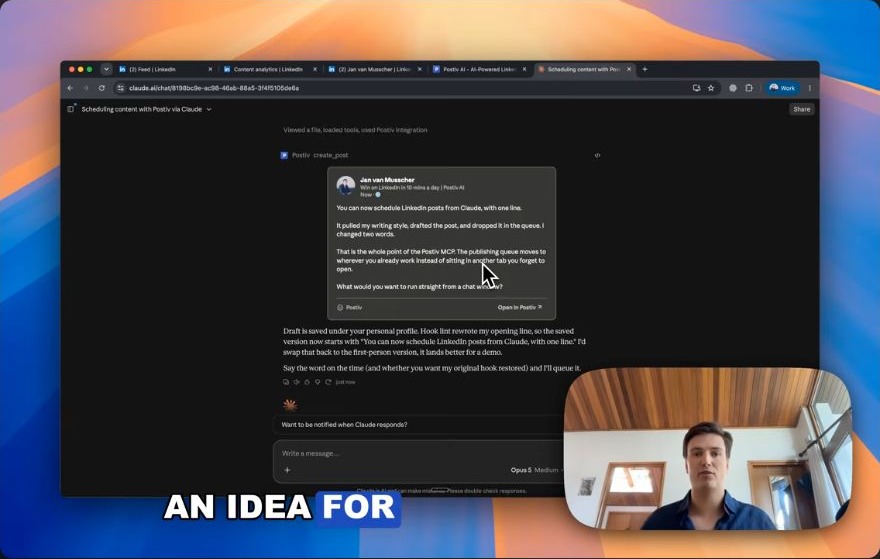
Take one idea into Postiv and draft it in your voice
Once you have chosen the angle, give Postiv the material that makes the draft yours: the audience, the real observation, the evidence you can share, and a sample of how you normally explain things.
Postiv combines an inspiration library, a knowledge library, AI-assisted drafting, carousel creation, and LinkedIn scheduling. Use the inspiration library to study approaches. Use your own knowledge and voice to supply the actual content.
For the onboarding idea above, a useful original drafting brief would be:
Help me draft a LinkedIn post for B2B founders deciding whether to send another setup reminder.
My angle: first check whether the next step and completion state are clear.
Use the checklist and notes I provide. Ask for an example if those notes aren't specific enough. I have no measured activation result, so don't invent one.
Give me three opening options, then draft one practical answer with a clear next step. Use my writing sample for tone. Keep it direct and explain any jargon.
You can add relevant source documents to Postiv's knowledge library, work through the angle with Bob, and revise the draft before scheduling. Read it aloud: replace language you would not use, verify every claim, and keep the detail that only you could provide.
Build a repeatable plan, then learn from the response
Start with a manageable mix: one useful answer, one explanation from your work, and one update or reflection when you have something to share. This is a planning suggestion, not an algorithm rule. Put the ideas and their source material into a LinkedIn content calendar; adjust the cadence to the evidence and time you have. See how often to post on LinkedIn for more on planning frequency.
Review each post against its purpose. Did someone from the intended audience ask a substantive question? Did a prospect mention the explanation? Did readers take the offered next step? Track those signals alongside reach and engagement rather than treating likes as proof of pipeline. Our guide to generating leads on LinkedIn covers the broader process.
Keep the questions that come back. A reader asking “What if our situation is different?” may have just given you the next useful post.
Frequently asked questions
What should I post on LinkedIn when I have nothing to say?
Start with the last useful question you answered at work. Explain the situation, your answer, and the conditions that would change it. If you lack experience with the topic, share what you are learning or ask a specific question instead of inventing expertise.
What are good LinkedIn post ideas for business owners?
Customer questions, product decisions, practical lessons, and documented cases are useful starting points. Choose the one that helps a prospective customer understand a problem, assess your approach, or take a relevant next step.
What should digital marketers post on LinkedIn?
Explain a campaign decision, show a creative revision, walk through an audit, or share a measured finding. State the audience, timeframe, and limits of the evidence. A small, well-explained observation is more useful than an unsupported claim about what always works.
What type of LinkedIn post gets the most engagement?
There is no guaranteed winner for your audience. These examples were selected to illustrate useful approaches, not to prove one format outperforms another. Choose the format that explains your idea clearly, then compare your own posts against their intended purpose.
Can I use AI to generate LinkedIn post ideas?
Yes. Give it real notes, a specific audience, your point of view, and evidence. Ask for angles and drafts, then review the output. AI should not invent personal experiences, client results, quotations, or research to fill gaps in the brief.
Do I need a personal story or a call to action in every post?
No. A clear answer or useful demonstration can stand on its own. Include a story when it explains the point. Include a question or next step when it gives an interested reader something worthwhile to do.
Free weekly newsletter
Join 15,000+ LinkedIn professionals
Weekly insights on what's working on LinkedIn right now. Strategy, examples, and trends straight to your inbox.