
A solid LinkedIn marketing strategy for B2B isn't about just posting updates and hoping for the best. It's a deliberate plan that uses the world's largest professional network to build real authority, generate leads that actually close, and connect you directly with the people who make buying decisions.
This means moving from random acts of marketing to a focused approach built on deep audience knowledge, strategic content, and clear, measurable goals.
Why LinkedIn Is Your B2B Marketing Powerhouse
In the B2B space, getting in front of the right person at the right time is everything. Other social platforms are great for connecting with friends, but LinkedIn is built from the ground up for professional networking. This is where your ideal customers—from VPs to C-suite executives—are actively talking about industry pain points and looking for solutions.
This professional context is key. It creates a level of trust and credibility that’s nearly impossible to find anywhere else. Instead of a cold email that feels intrusive, a smart LinkedIn strategy lets you warm up potential buyers by consistently delivering value long before you ever ask for a meeting.
The Data Behind the Dominance
The statistics speak for themselves. An incredible 80% of all B2B social media leads come from LinkedIn, blowing other networks out of the water.
It's not just about leads, either. LinkedIn generates three times more conversions than Facebook and X, with a lead conversion rate that's nearly three times higher at 2.74%. If you want a deeper dive, check out these powerful LinkedIn B2B marketing statistics. And once your strategy is set, our complete playbook on LinkedIn for B2B lead generation shows you how to turn that audience into qualified, inbound pipeline.
This isn't an accident. LinkedIn’s power comes from its unique blend of precise targeting and a professional user mindset. You're not just targeting a demographic; you're reaching a specific job title, at a specific company, in a specific industry.
The Big Takeaway: LinkedIn isn't just another social media channel; it's a dedicated B2B ecosystem. People are there with a business-first mindset, actively looking for ways to solve professional challenges. That's your opening.
To put this all into perspective, here's a quick look at the essential components we'll be breaking down.
Core Pillars of a High-Impact B2B LinkedIn Strategy
| Pillar | Objective | Key Activities |
|---|---|---|
| Audience Definition | Identify and understand your ideal customer profile (ICP). | Persona development, competitor analysis, audience segmentation. |
| Brand Positioning | Establish your unique value proposition and brand voice. | Messaging framework, company page optimization, employee advocacy. |
| Content Strategy | Create valuable, relevant content that attracts and engages. | Content pillars, format selection (posts, video, carousels), editorial calendar. |
| Execution & Engagement | Consistently publish content and build a community. | Scheduling, proactive engagement, comment moderation, outreach. |
| Paid Amplification | Reach a wider, targeted audience with paid campaigns. | Ad formats, audience targeting, budget allocation, A/B testing. |
| Measurement & ROI | Track performance and prove the business impact of your efforts. | KPI selection, reporting dashboards, lead tracking, optimization. |
Each pillar builds on the last, creating a comprehensive system for predictable growth on the platform.
The visual below maps out the fundamental workflow of any successful B2B LinkedIn strategy. It's a continuous loop of learning and improving.
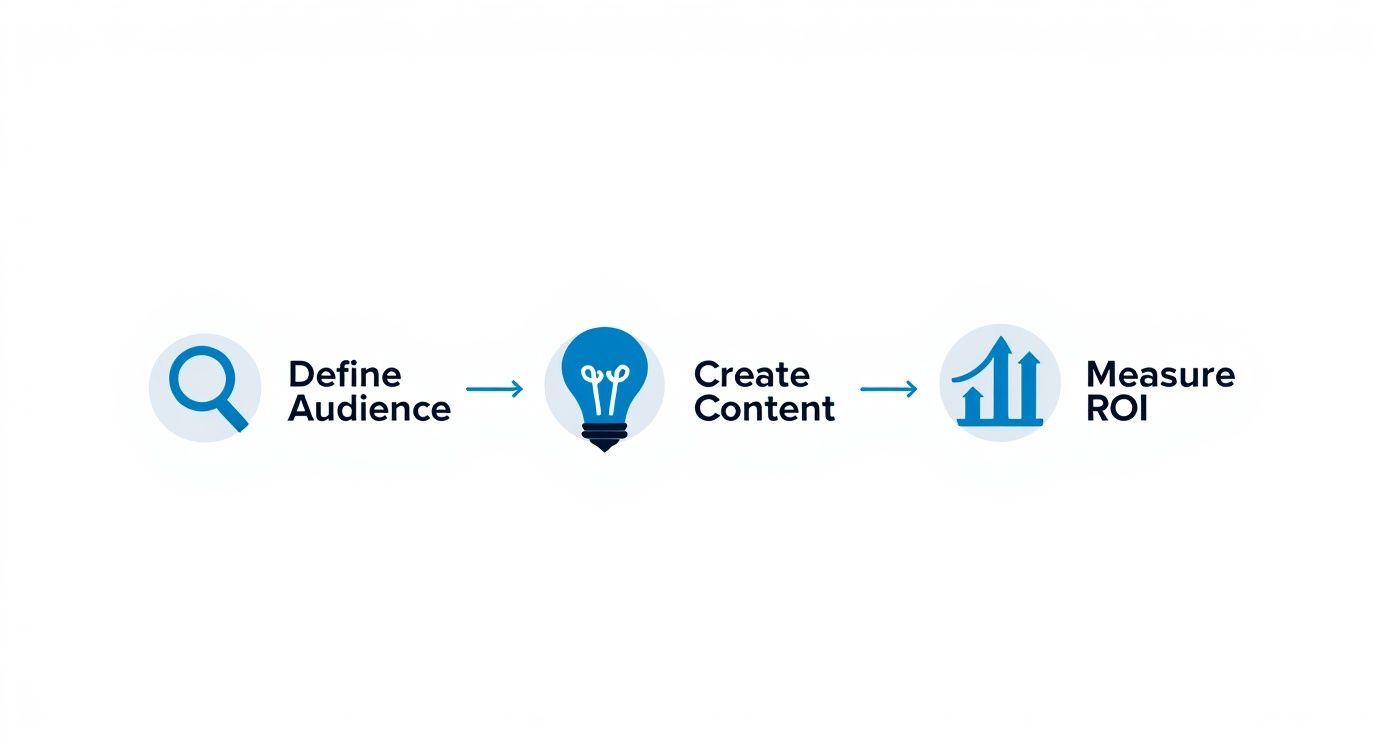
As you can see, it's a cycle. Who you're talking to (your audience) dictates what you create (your content). How that content performs (your metrics) then tells you how to refine both your audience targeting and your creative approach.
In the next sections, we'll walk through a step-by-step framework to master every piece of this powerful process.
Laying the Groundwork: Your Strategic Foundation on LinkedIn
Any B2B marketing strategy worth its salt starts with an almost obsessive focus on the audience. Before you even think about writing a post or designing a graphic, you need to know exactly who you're talking to. What keeps them up at night? What content do they actually find valuable? Where do they hang out on the platform?
This goes way beyond basic demographics. We're talking about building a crystal-clear Ideal Customer Profile (ICP). The goal is to shift your thinking from a broad statement like, "We sell to CTOs at SaaS companies," to something much sharper: "Our ideal customer is a CTO at a Series B SaaS company, somewhere between 50-200 employees. They're grappling with scaling their data infrastructure and look up to industry leaders like..."
See the difference? One is a guess; the other is a strategy.
Nailing Down Your Ideal Customer Profile
First things first, let's get granular. While LinkedIn's standard search is okay for a quick look, serious B2B marketers live and breathe in tools like Sales Navigator. It offers the kind of deep filtering you need to pinpoint your perfect prospects with surgical precision.
Here's how you can use a tool like Sales Navigator to build out that ICP:
- Company Vitals: Don't just look at industry. Filter by company headcount, annual revenue, and even recent growth signals. Are you after the fast-moving startups or the established enterprise players?
- Role-Specifics: "Manager" can mean a thousand different things. Dig deeper. Filter by seniority (VP, Director, C-Suite), specific function (Operations, IT, Marketing), and even years of experience.
- Behavioral Tells: My favorite trick? Find people who have posted on LinkedIn in the last 30 days. This is a dead giveaway that they're active and far more likely to see and engage with your stuff. A recent job change is another golden nugget—it's often a prime buying signal.
This screenshot from Sales Navigator gives you a sense of just how specific you can get when building a targeted lead list.
Just look at the filters for "Company headcount" and "Seniority level." This is how you isolate the actual decision-makers at the right-sized companies, which is the entire ballgame in B2B.
Polishing Your Digital Real Estate
Okay, so you know who you're talking to. Now, does your digital storefront—your Company Page and key employee profiles—actually speak their language? So many businesses treat their LinkedIn Company Page like a dusty, static brochure. Big mistake. It needs to be a living, breathing resource hub that constantly reinforces why you matter.
Your Company Page isn't for you; it's for your ideal customer. Every single element, from the banner to the 'About' section, has to answer their silent question: "What's in it for me?"
Let's start with your tagline. Ditch the generic fluff like "Innovative Software Solutions." That tells a prospect absolutely nothing. A much better approach would be, "We help B2B finance teams close their books in half the time." It’s specific, it’s benefit-driven, and it speaks directly to a real-world pain point.
Next up, give your 'About' section a complete overhaul. This is your chance to tell a story. Here's a simple flow that works wonders:
- The Hook: Kick things off with a sentence that nails your ICP's biggest challenge.
- The Solution: Briefly explain how you solve it. No jargon.
- The Proof: Back it up with a powerful stat, a quick customer quote, or a major company milestone.
- The Ask: Tell them what to do next. Should they visit your site, follow you for weekly tips, or check out a new case study?
This isn't just for your Company Page. The same logic applies to the personal profiles of your CEO, your sales leaders, and your subject matter experts. Their profiles need to be perfectly aligned with the company's message, turning them from random employees into trusted advisors. When a prospect clicks from your page to your CEO's profile, the story should feel seamless. That's how you build trust. For a full checklist covering banners, specialties, and hashtags, see our LinkedIn company page best practices guide.
Building a B2B Content Engine That Actually Converts
Once you’ve nailed down who you’re talking to, it’s time to build the machine that talks to them consistently. Your content is the fuel for your entire LinkedIn strategy. Just randomly posting product updates or sharing the occasional company press release isn't going to cut it. That's just noise. You need a structured approach that delivers real value, every single time.

This is where content pillars save the day. Think of them as the main channels of your brand's broadcast station. Instead of waking up and thinking, "What on earth do I post today?", you'll operate within a smart framework designed to hit your audience's core challenges from multiple angles.
For instance, a cybersecurity firm isn't just selling software; they're selling peace of mind. Their pillars might look like this:
- Emerging Threat Analysis: Breaking down the latest scary-sounding industry threats into plain English.
- Customer Security Wins: Sharing stories of how clients successfully used their tools to dodge a bullet.
- Behind the Code: Giving a human face to the tech by showcasing the brilliant people who build it.
These pillars guarantee every post has a purpose and ladders up to a bigger story about why your brand is the expert in the room.
Mastering the Most Effective B2B Content Formats
On LinkedIn, how you say something can be just as important as what you say. The real trick is matching your message to the right format. A complex idea that gets ignored as a text post might become your most-shared piece of content when turned into a carousel.
Let’s break down the workhorses of a solid B2B content plan.
- Text-Only Posts: These are your go-to for sparking conversations and sharing a strong point of view. Their raw simplicity makes them incredibly easy to read in a busy feed. The secret? Use plenty of white space—think short, punchy sentences and single-line paragraphs—and always end with a sharp question to get the comments flowing.
- Carousels (Document Posts): This is your format for teaching. Use carousels to unpack a complex process step-by-step, visualize data from a new report, or chop up a long webinar into digestible slides. A well-designed carousel keeps people on your post longer, which is a massive signal to the LinkedIn algorithm that you're posting quality stuff.
- Short-Form Video: Nothing humanizes a brand faster than video. And I don't mean slick, overproduced corporate ads. I'm talking about authentic, shot-on-a-phone clips. A quick tip from your CEO, a behind-the-scenes peek at a team event, or a genuine client testimonial builds trust in a way that text just can't.
- Articles: Think of LinkedIn Articles as your long-term thought leadership assets. While they might not get the same immediate pop in the feed as a short post, they are indexable by Google and serve as a permanent home for your most important ideas.
My Take: The best in the business mix and match these formats constantly. A text post can drop a controversial idea that you unpack in a detailed carousel the next day. A quick video can introduce a person or concept that you later flesh out in a full-length article. This variety is what keeps your feed feeling fresh and unpredictable.
Choosing the Right LinkedIn Format for Your B2B Goals
To make it even clearer, here’s a quick-glance table to help you align your content format with your marketing objectives.
| Content Format | Primary Goal | Best For | Pro Tip |
|---|---|---|---|
| Text-Only Post | Sparking Conversation | Sharing strong opinions, asking questions, telling quick stories. | Break up text with single-line paragraphs. The more white space, the better. |
| Carousel/PDF | Educating & Instructing | Step-by-step guides, data visualization, repurposing presentations. | End with a strong call-to-action on the final slide. Tell them what to do next. |
| Short-Form Video | Building Trust & Authenticity | Behind-the-scenes content, executive insights, quick tips, event clips. | Captions are non-negotiable. 85% of social media videos are watched on mute. |
| Article | Establishing Authority | Deep dives on core topics, industry analysis, publishing original research. | Embed other posts and videos within the article to boost engagement. |
Ultimately, a multi-format approach ensures you’re hitting different audience segments who prefer to consume content in different ways.
Finding a Posting Rhythm You Can Actually Stick To
Let me be clear: consistency trumps frequency. Going hard with three posts a day for a week and then ghosting your audience for a month is a surefire way to kill your momentum. The goal is to establish a cadence that your team can realistically manage for the long haul.
For most B2B companies, posting 2-3 high-quality pieces per week is the sweet spot. It's often enough to stay on your audience's radar without burning out your content team or spamming your followers' feeds. The right LinkedIn automation tools can make this cadence sustainable by handling scheduling, content generation, and cross-posting so your team focuses on strategy instead of manual publishing.
When should you post? That depends entirely on when your target audience is scrolling LinkedIn. This is often during morning and evening commutes or over their lunch break. Start by testing different days and times, and pay close attention to your LinkedIn Analytics—the data will tell you what's working. For a more detailed look at this, our guide on building a winning LinkedIn content strategy for 2025 provides some great frameworks.
Here’s what this might look like in a simple, actionable content calendar.
Sample B2B Content Calendar
| Day | Content Pillar | Format | Post Concept |
|---|---|---|---|
| Tuesday | Emerging Threat Analysis | Carousel | "5 Simple Steps to Spot a Phishing Email: A Visual Guide for Your Team" |
| Thursday | Behind the Code | Short-Form Video | A 60-second interview with an engineer explaining our newest feature. |
| Friday | Customer Security Wins | Text-Only Post | Sharing a quick, powerful story about how a client avoided a major data breach. |
This simple structure creates a predictable flow. Your audience starts to learn what to expect from you, and more importantly, your team has a clear roadmap. This turns your LinkedIn marketing from a chaotic, reactive chore into a smooth-running engine that drives real business conversations.
Powering Up Your Reach with LinkedIn Ads
Relying on organic content alone for your B2B LinkedIn strategy is like trying to cross the ocean in a rowboat. You'll get there eventually, but it’s going to be a long, slow journey. A smart, targeted paid advertising strategy is the outboard motor you need to accelerate your growth and get your best content in front of the exact people who sign the checks.
This isn’t about randomly "boosting" posts and hoping for the best. We're talking about running surgical campaigns using LinkedIn’s powerful advertising tools to generate high-quality leads, build brand awareness with key accounts, and drive real business outcomes. There's a reason it has become a non-negotiable part of the paid B2B playbook.
The proof is in the numbers. A whopping three-fourths of B2B marketers are already running LinkedIn ads, and a third of businesses see a 33% increase in purchase intent from their campaigns. It's clear that these ads directly influence buyer behavior. You can dive deeper into these numbers and other key LinkedIn statistics for marketers.
Choosing the Right Ad Formats for the Job
LinkedIn gives you a whole menu of ad formats, but honestly, you can ignore most of them when you're starting out. For most B2B goals, a few heavy hitters consistently deliver the best results.
- Sponsored Content: These are your workhorses. They look like native posts right in the feed and are perfect for getting your best organic content—that killer carousel or compelling case study—in front of a much larger, more specific audience.
- Lead Gen Forms: This is where the magic happens for lead capture. Instead of sending someone to a clunky landing page, a form pre-filled with their LinkedIn info pops up right in the app. The experience is seamless, which is why it dramatically boosts conversion rates for things like webinar sign-ups or gated content.
- Sponsored Messaging: Think of this as a highly targeted, personalized message sent directly to a user's inbox. This format works wonders when you have a truly valuable offer that feels more like a one-on-one recommendation than a blast advertisement.
My Two Cents: Don't try to reinvent the wheel. Start by sponsoring the organic content that's already getting traction. Once you find a winner, attach a Lead Gen Form to it and put some budget behind it. It's the fastest path I've found from engagement to qualified leads.
Precision Targeting: Don't Waste a Dime
The real power of LinkedIn Ads isn’t just reach; it’s who you can reach. The targeting capabilities are second to none, and this is where all that deep audience research you did earlier pays off big time.
Let's say you sell project management software to construction companies. Forget basic demographics. You can build an audience of:
- Job Seniority: VPs and Directors
- Job Function: Operations and Program Management
- Company Size: 201-1,000 employees
- Company Industry: Construction
Even better, you can upload a list of your dream accounts and run an account-based marketing (ABM) campaign that only shows your ads to decision-makers at those specific companies. This is what makes a strong LinkedIn marketing strategy for B2B so incredibly effective.
How to Structure Your Campaigns for Real Results
One of the most common mistakes I see is people cramming all their goals into one big, messy campaign. A far better approach is to structure your campaigns around a single, clear objective. This lets you manage your budget better and actually measure what's working.
Try separating your campaigns this way:
- Brand Awareness Campaign: The goal here is simple: impressions and reach. You're using top-of-funnel content to introduce your brand to a broad but highly relevant audience.
- Lead Generation Campaign: Here, you live and die by your Cost Per Lead (CPL). These campaigns almost always promote a gated asset (like a whitepaper) and use Lead Gen Forms to capture info.
- Retargeting Campaign: This is for warming up leads. You're targeting people who have already visited your site or engaged with your content, so your messaging can be more direct and focused on conversion.
Organizing your campaigns this way gives you a crystal-clear view of your performance, allowing you to cut what's failing and pour more fuel on what's firing. Of course, budgeting can feel like a guessing game at first. To get a better handle on what to expect, check out our complete breakdown of how much LinkedIn advertising costs. If you're hiring, our LinkedIn job ad pricing guide covers promoted job budgets and cost per applicant. Both will help you set a realistic budget and get the most bang for your buck.
Engaging Your Audience and Building Community
Look, hitting "publish" on a post is just the starting line. A successful LinkedIn marketing strategy for B2B isn't about shouting into the void; it's about starting conversations. If you're just broadcasting your message without listening or jumping into the discussion, you're missing the whole point of the platform.
Success on LinkedIn isn't about vanity metrics. It's measured by how many people actually interact with what you're putting out there. This is your chance to shift from being a simple content publisher to a genuine community builder, turning followers into real advocates.
Sparking Genuine Conversations
Every single post should have one underlying goal: to start a discussion. The easiest way to do this is to stop making statements and start asking questions. Instead of just dropping a fact, end your posts with a thoughtful, open-ended question that actually invites people to share their own stories.
Ditch the simple yes/no questions. "Do you agree?" is a dead end. Instead, try something like, "What's one challenge you've run into with this that I haven't mentioned?" This small change is huge—it encourages detailed responses and transforms your comments section into a goldmine of insights.
Another fantastic tactic is to strategically tag relevant experts or companies. But there’s a right way and a wrong way to do this. Don't just spam tags to get attention. Do it when you’re genuinely building on their work or need their specific take. For example, "Loved the framework that @JaneDoe shared last week. It got me thinking about how this could apply to the manufacturing sector..." This adds value, shows you're paying attention to the ecosystem, and often pulls influential voices into your orbit.
The LinkedIn algorithm absolutely loves posts that generate real back-and-forth conversations. When people start discussing things in your comments, it's a massive signal to LinkedIn that your content is valuable, and they'll show it to more people.
The Power Commenting Strategy
Your brand’s voice isn't just on your Company Page. In fact, one of the most powerful, under-the-radar tactics is what I call "power commenting." This is all about having your team—especially your subject matter experts and sales leaders—proactively engage on posts from influencers, prospects, and partners.
The goal isn't to leave a sales pitch. It's to add real insight to a conversation already in progress. A great power comment always does one of these three things:
- Adds a new perspective: "Great point. Another angle to consider is how this impacts smaller businesses without a dedicated IT team."
- Asks a smart question: "Fascinating data. I'm curious if you saw any regional differences in the survey responses?"
- Shares a genuinely helpful resource: "Fantastic breakdown. For anyone looking to go deeper, a report we published last month really complements these findings."
When your team consistently leaves thoughtful comments across the platform, you're not just engaging. You're demonstrating expertise right where your ideal customers are already looking.
Finding Your People in LinkedIn Groups
While the main feed gives you broad reach, LinkedIn Groups are where you find your niche. These are ready-made communities where your ideal customers are actively talking about their biggest headaches and looking for answers.
Don't be that person who joins a group and immediately starts spamming links. You'll get kicked out, and fast. Instead, treat it like a real-world networking event. Listen first. Answer questions where you can be truly helpful. Become a trusted member of the community. Trust me, when you build that credibility, people will naturally become curious about who you are and what you do.
Turn Your Team into an Army of Advocates
Finally, the most powerful and authentic voice you have is your own team. Employee advocacy is simply the act of encouraging your employees to share company news and their own industry insights from their personal profiles.
Think about it: a post shared by an employee just feels more authentic and trustworthy. It also gets far more reach than the exact same content coming from a faceless Company Page.
To get this going, you just need a simple playbook:
- Make it easy: Give them pre-written copy they can easily tweak to sound like themselves.
- Provide guidance: Offer simple tips on how to personalize posts and what to do when people comment.
- Celebrate the wins: Give a shout-out to employees who are crushing it and driving great conversations.
When your whole team is part of the conversation, your reach doesn't just grow—it multiplies, backed by a layer of human trust a brand can never achieve on its own. Want to see what this looks like at real companies? Our LinkedIn team strategy breakdowns map out exactly how B2B teams like beehiiv and Deel run LinkedIn as a team sport, down to who posts and how often.
Measuring What Matters and Optimizing Your Strategy
Let's be honest: a great strategy is just a document if you can't tell whether it's actually working. Flying blind on LinkedIn is a classic mistake. It feels productive—you're posting, you're getting likes—but you're often just wasting time and money on activities that don't move the needle. To build a truly effective linkedin marketing strategy for b2b, you have to stop chasing vanity metrics and start measuring what actually impacts the business.

This means we need to look past simple follower counts and post likes. Sure, seeing those numbers go up feels good, but they don't pay the bills. The real questions you need to be asking are: Is our content attracting the right people? Are our paid ads bringing in qualified leads? And can we trace any of this back to actual revenue?
Separating Signal from Noise in Your Metrics
The secret is focusing on Key Performance Indicators (KPIs) that draw a straight line from your LinkedIn activity to your business goals. A good place to start is by treating your organic and paid efforts separately—they have different jobs and need to be measured differently.
When it comes to your organic content, you want to prioritize metrics that show genuine interest and intent:
- Engagement Rate: Look beyond the likes. A high number of thoughtful comments and shares is a much better sign that your content is actually sparking conversations and resonating with your audience.
- Follower Quality: Dive into LinkedIn Analytics. Are your new followers matching your Ideal Customer Profile (ICP)? Check their job titles, industries, and seniority levels. This tells you if you're building the right kind of audience.
- Website Referral Traffic: This one is huge. How many people are actually clicking through from your LinkedIn content to your website? That click is a clear signal of intent to learn more.
Measuring the ROI of Paid Campaigns
When you're putting ad dollars to work, the stakes get a lot higher. Your paid campaign KPIs need to be tied directly to lead generation and, ultimately, your sales pipeline. It's time to stop guessing and start tracking what really counts.
Your paid LinkedIn strategy lives and dies by its ability to generate a positive return on investment. If you can't prove that your ad spend is creating more value than it costs, you're just lighting money on fire.
For paid campaigns, you need to be relentless about these bottom-line metrics:
- Cost Per Lead (CPL): Simple but powerful. How much does it cost you to get one person to fill out a form? This is your core efficiency metric.
- Conversion Rate: Of all the people who clicked your ad and filled out a Lead Gen Form, what percentage actually became a qualified lead for your sales team?
- Pipeline Influence: This is where the magic happens. Use LinkedIn’s conversion tracking to connect the dots and see which campaigns are directly contributing to sales opportunities in your CRM.
Get into a rhythm of checking these numbers in LinkedIn Analytics. Pinpoint your best-performing posts and ads—what topics, formats, and opening hooks are getting the most traction? Do more of what works and ruthlessly cut what doesn't. This constant cycle of measuring, learning, and optimizing is what turns a static plan into a dynamic, results-driven engine.
If you want to dig deeper into the numbers, our guide on understanding LinkedIn costs and ROI can help you set the right financial benchmarks from the start.
Turning Your LinkedIn Strategy into a B2B Lead Generation Engine
All of the strategy pillars above—audience, content, ads, engagement, measurement—ultimately serve one purpose: filling your pipeline with qualified leads. But there's a difference between having a general presence and running a machine that predictably generates LinkedIn B2B lead generation results. Here's how to connect the dots.
How to Use LinkedIn for B2B Lead Generation Step by Step
- Nail your ICP first. Use Sales Navigator filters (company size, seniority, industry, recent activity) to build a target account list. Without a tight ICP, every downstream effort is diluted.
- Optimize profiles for conversion, not vanity. Your headline, About section, and Featured content should answer one question for the prospect: "What's in it for me?" Frame everything around their pain points, not your achievements. If your About section still reads like a resume, a free LinkedIn bio generator is a fast way to rewrite it around what your buyers actually care about.
- Publish content that moves prospects through the funnel. Map your content pillars to buyer stages—awareness posts that highlight a pain point, consideration carousels that teach a framework, and decision-stage case studies that prove ROI.
- Layer in LinkedIn Ads with Lead Gen Forms. Sponsor your highest-performing organic posts and attach Lead Gen Forms. The pre-filled experience slashes friction and dramatically boosts conversion rates.
- Activate employee advocacy. Personal profiles consistently outperform Company Pages in organic reach. Equip your team with shareable content and simple guidelines so they amplify your brand voice authentically.
- Measure pipeline, not impressions. Track Cost Per Lead, lead-to-opportunity rate, and pipeline influence in your CRM. Cut campaigns that generate clicks but no revenue.
For a deeper dive into each tactic, our guide on LinkedIn for B2B lead generation walks through profile optimization, outreach sequences, and advanced targeting in detail. And if you want more tactical frameworks, check out our roundup of proven LinkedIn lead generation strategies.
Why LinkedIn Outperforms Other Channels for B2B Leads
LinkedIn isn't just "another social channel" for B2B teams. It's the only platform where professional intent is baked into every interaction. Decision-makers log in to solve business problems, evaluate vendors, and stay ahead of industry trends—not to scroll cat videos. That context means your content and ads hit prospects in a buying mindset.
Combine that with unmatched targeting—filter by job function, seniority, company revenue, and even technologies used—and you get a lead quality that email lists and display ads can't match. It's why 40% of B2B marketers rate LinkedIn as the single most effective channel for high-quality leads.
A Few Common B2B LinkedIn Questions Answered
Even with the best strategy in place, you're bound to run into a few specific questions as you get going. Here are some of the most frequent ones I get asked, along with some straight-to-the-point answers.
How Often Should I Post on LinkedIn?
Look, consistency beats frequency every single time. For most B2B brands, aiming for 2-4 high-quality posts per week is the sweet spot.
This cadence is frequent enough to keep your brand on your audience's radar but not so much that you'll exhaust your content team or annoy your followers. The goal is to find a rhythm you can actually stick with for the long haul.
Should We Focus on the Company Page or Personal Profiles?
The real answer? You need both. Your Company Page acts as your brand's official home base. It’s where you run ads, showcase your team, and build a central community. It’s non-negotiable.
But the real magic often happens on personal profiles. Posts from your executives, sales leaders, and subject matter experts will almost always get more organic reach and feel more authentic. The best strategies weave them together—have your team share company content, but with their own spin on it.
A quick tip: When employees share a company post, they shouldn't just hit "repost." Encourage them to add their own two cents—a personal story, a key takeaway, or a question for their network. That personal touch is what sparks real conversation and builds trust.
Are Hashtags Still Worth Using?
Absolutely, but you have to be smart about it. Stick to 3-5 super-relevant hashtags for each post.
Think of them less as a magic wand and more like signposts that help LinkedIn understand your content and show it to the right people. I recommend mixing one or two broad industry tags (like #B2BMarketing) with a few niche, specific ones (#DemandGeneration or #SaaSMetrics). Just don't stuff your posts with irrelevant tags; it looks spammy and can actually hurt your reach.
How Do You Use LinkedIn for B2B Lead Generation?
Start with a fully optimized profile that speaks to your ideal buyer, not a generic resume. Then build a content engine around their biggest challenges—publish 2-4 posts per week mixing educational carousels, strong-opinion text posts, and social-proof stories. Use LinkedIn Ads with Lead Gen Forms to capture high-intent prospects at scale, and run a thoughtful outreach sequence that warms leads before asking for a meeting. The full playbook is covered in our dedicated guide to LinkedIn for B2B lead generation.
What Is the Best LinkedIn B2B Marketing Strategy?
The most effective LinkedIn B2B marketing strategy in 2026 follows a clear framework: define your ICP with surgical precision, create content pillars tied to your buyer's pain points, amplify top-performing posts with targeted ads, and measure everything against pipeline revenue—not vanity metrics. The brands winning right now are the ones treating LinkedIn as a full-funnel revenue channel, not just a brand-awareness play. Our LinkedIn content strategy guide covers the content piece in much more depth.
Does LinkedIn Actually Work for B2B Lead Generation?
The data is unambiguous. LinkedIn generates 80% of all B2B social media leads and converts at nearly three times the rate of other major platforms. Its combination of professional user intent and precise targeting by job title, seniority, industry, and company size is unmatched. The key is treating it as a system—profile, content, ads, engagement, and measurement all working together—rather than relying on any single tactic in isolation.
What Is the Difference Between LinkedIn Marketing and LinkedIn Lead Generation?
A LinkedIn marketing strategy is the full picture: brand positioning, content creation, community building, paid amplification, and performance measurement. Lead generation is one specific outcome of that strategy—the act of capturing prospect information and moving them into your sales pipeline. Think of marketing as the engine and lead generation as the fuel it produces. You can't generate quality leads without a solid marketing foundation, and your marketing strategy isn't complete until it's actually driving pipeline.
Ready to turn your B2B LinkedIn strategy into high-quality content without the grind? Postiv AI helps you create authority-building posts and carousels in minutes. Streamline your entire workflow from drafting with a brand-trained AI to designing and scheduling, all in one place. Start your free trial at Postiv.ai and see the difference.
More Questions
What is the best LinkedIn B2B marketing strategy for 2026?
The best LinkedIn B2B marketing strategy for 2026 combines a sharp Ideal Customer Profile, 2-4 high-quality posts per week using carousels and text formats, employee advocacy, precision-targeted LinkedIn Ads, and an always-on measurement loop that ties activity to revenue. Focus on generating meaningful conversations rather than vanity metrics.
Does LinkedIn work for B2B lead generation?
Yes. LinkedIn drives 80% of all B2B social media leads and converts at nearly 3x the rate of Facebook and X. Its professional audience and granular targeting by job title, seniority, company size, and industry make it the most effective platform for reaching B2B decision-makers.
What is the difference between a LinkedIn marketing strategy and LinkedIn lead generation?
A LinkedIn marketing strategy is the full plan covering brand positioning, content, ads, community building, and measurement. LinkedIn lead generation is one outcome of that strategy, focused specifically on capturing prospect information and moving them into your sales pipeline. A strong marketing strategy naturally fuels lead generation.