LinkedIn has evolved beyond a digital resume into the most powerful B2B lead generation engine on the planet. For businesses aiming to connect with decision-makers, it's not just an option, it's essential. Yet many professionals either rely on outdated tactics or feel overwhelmed by the sheer number of possibilities. The difference between a thriving lead pipeline and a stagnant one usually comes down to a clear, actionable strategy.
This guide cuts through the noise. We've compiled nine proven LinkedIn lead generation strategies, each designed to help you attract, engage, and convert high-value clients. From optimizing your digital storefront to launching targeted campaigns, these methods provide a roadmap for turning connections into customers.
What Changed on LinkedIn Going Into 2026
Several tactics that circulated freely in 2024 and 2025 no longer work the way older guides describe. Before you build a plan, three platform changes are worth knowing:
- Personalized connection notes are now rationed. Free accounts get roughly five personalized invitation notes per month. The old advice to "always add a note" is only fully available on Premium, Sales Navigator, or Recruiter.
- Spontaneous LinkedIn Live is gone. As of June 22, 2026, every live broadcast must be scheduled in advance rather than started on the spot, per LinkedIn's own Live overview.
- Creator mode no longer exists as a toggle. LinkedIn retired the switch in March 2024 and folded its features, including newsletters, live video, and deeper post analytics, into every eligible profile by default. There is nothing left to turn on.
Together these push the platform in one direction: away from volume outreach and toward earning attention with content first. The strategies below are ordered accordingly.
Forget generic advice and vague tips. This is a practical playbook for B2B founders, sales teams, and marketers ready to build a consistent pipeline. Each strategy is broken down into actionable steps, complete with real-world examples and the key metrics you need to track. We will cover:
- Foundation & Optimization: Mastering your personal profile and company page for maximum visibility.
- Content & Authority: Building influence through strategic content marketing and thought leadership.
- Warm Conversations: Turning engagement signals into direct messages people actually welcome.
- Paid Amplification: Leveraging LinkedIn Ads and sponsored content to reach ideal customer profiles at scale.
- Community & Engagement: Tapping into LinkedIn Groups and events to build genuine relationships.
These strategies are designed to work together, creating a repeatable system for generating qualified leads. If you want a single end-to-end walkthrough rather than individual tactics, start with our complete guide on how to generate leads from LinkedIn. Now let's dive into the specific tactics that will help you find and connect with your next high-value client.
1. LinkedIn Profile Optimization & SEO
Your LinkedIn profile is more than a digital resume; it's a dynamic landing page and a powerful asset in your arsenal of LinkedIn lead generation strategies. By strategically optimizing your profile with relevant keywords, you transform it from a passive document into an active lead magnet. This process, known as LinkedIn SEO, helps you rank higher in both LinkedIn and Google search results, attracting inbound interest from your ideal prospects.
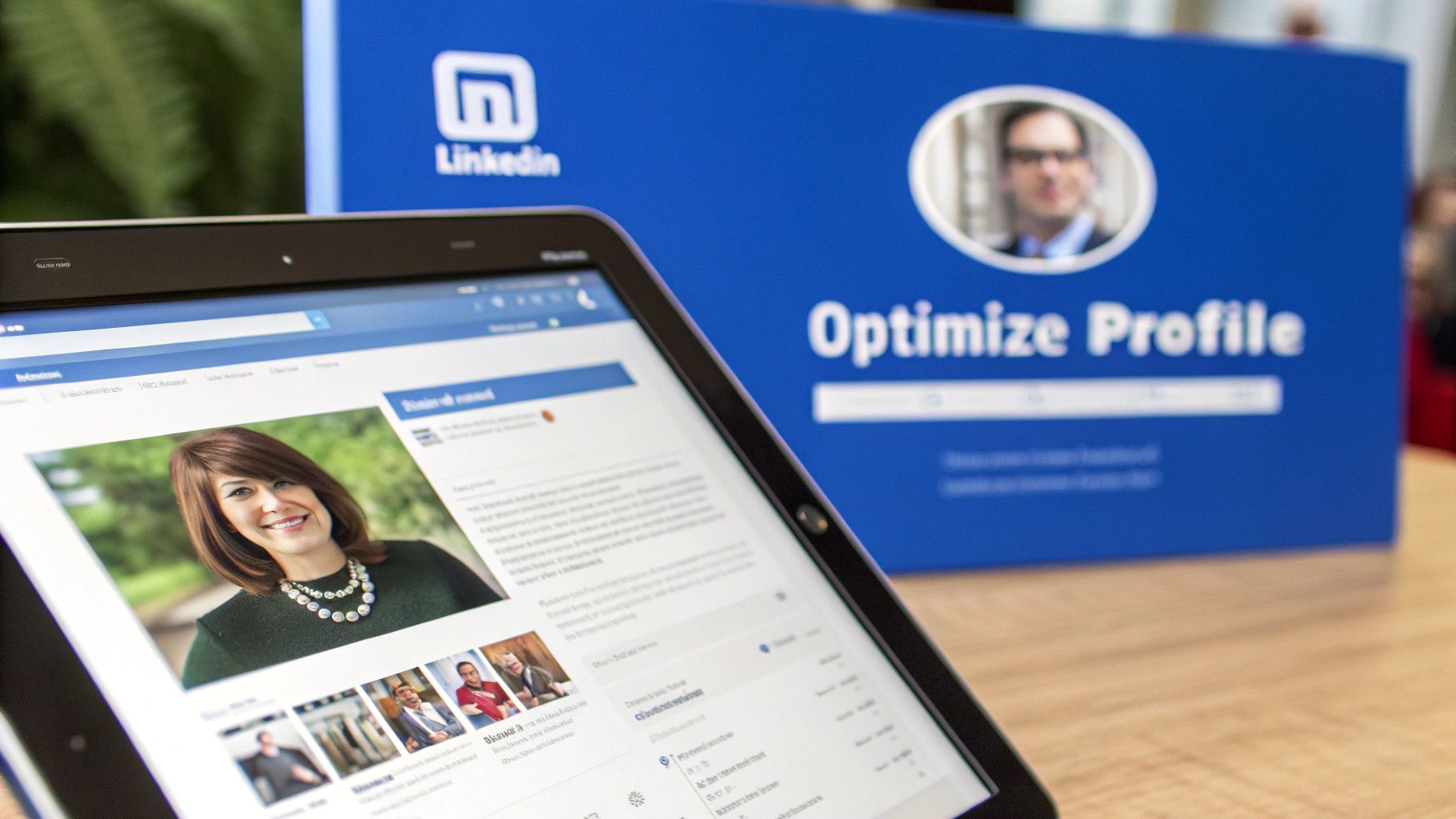
When a potential client searches for a "B2B marketing consultant" or a "SaaS sales leader," an optimized profile ensures you appear at the top of their results. This positions you as an immediate authority and funnels high-intent leads directly to you, often before you even begin your outbound efforts. It’s the foundation upon which all other outreach and content strategies are built.
How to Implement Profile SEO
To turn your profile into a lead-generating machine, focus on infusing keywords throughout key sections. This creates a cohesive and discoverable personal brand.
- Headline: Go beyond your job title. Incorporate 3-5 keywords that describe what you do, who you help, and the results you deliver. For example: "Helping B2B SaaS Startups Scale with Demand Generation | Content Marketing | LinkedIn Ads."
- Summary (About Section): Use the 2,600-character limit to tell a compelling story. Weave in your primary and secondary keywords naturally while outlining your value proposition. End with a clear call-to-action (CTA), like inviting prospects to book a call or download a resource.
- Experience & Skills: Describe your achievements in each role using relevant keywords. LinkedIn allows a maximum of 100 skills on a profile, not the 50 that older guides cite, and skills attached to roles in your Experience section do not count against that total. Fill the list with terms your ideal clients would actually search for, then seek endorsements on the handful that matter most.
- Featured Section & URL: Showcase case studies, testimonials, or lead magnets in your Featured section. Since creator mode was retired, Featured and Activity placement is available to every profile by default, so there is no setting to enable first. Also customize your profile URL to
linkedin.com/in/yourname-keywordfor a professional and searchable touch.
2. LinkedIn Content Marketing & Thought Leadership
Effective LinkedIn lead generation strategies go beyond outreach; they involve pulling prospects toward you through value-driven content. By consistently sharing industry-relevant insights, you establish yourself as a thought leader. This shifts the dynamic from chasing leads to attracting them, as potential clients begin to see you as the go-to expert in your field.

When prospects see your content in their feed, they build familiarity and trust with your brand over time. Instead of receiving a cold message from a stranger, they receive a connection request from an authority figure whose perspective they already value. This content-first approach warms up your audience, making them significantly more receptive to your eventual outreach and inbound offers.
How to Implement a Content & Thought Leadership Strategy
Building authority requires a consistent and strategic approach to content creation. Focus on providing value and sparking conversations that position you as a credible resource.
- Develop Content Pillars: Identify 3-5 core topics where you have deep expertise and that resonate with your ideal customer profile. This ensures your content remains focused, relevant, and builds a cohesive brand identity.
- Post Consistently: Aim for 3-5 high-quality posts per week. Consistency is more important than frequency; a regular cadence keeps you top-of-mind with your network and signals to the LinkedIn algorithm that you are an active creator.
- Vary Your Formats: Mix text-only posts with images, carousels (documents), polls, and native video. Different formats appeal to different audience segments and help keep your feed engaging.
- Start a Newsletter: This is the most underused inbound asset on the platform. Unlike a normal post, every newsletter edition triggers push, in-app, and email notifications to your subscribers, which means you own a distribution channel the algorithm cannot throttle. Members and Pages with more than 150 followers or connections are eligible to be evaluated for access, per LinkedIn's newsletter access criteria. Subscribers are a far better leading indicator of pipeline than followers.
- Engage Authentically: Don't just post and ghost. Dedicate time to respond to comments on your posts and engage with content from other leaders in your industry. This shows you are an active community member, not just a broadcaster. For more insights, you can explore a complete B2B LinkedIn marketing strategy.
3. Turning Engagement Signals Into Warm Conversations
Profile optimization and content bring people to you. This strategy is about what you do with the signal they leave behind. Rather than working a cold list, you message the people who have already read your post, viewed your profile, or subscribed to your newsletter. This is the highest-yield form of direct messaging on LinkedIn in 2026, and it sidesteps the platform's tightening limits on cold volume.
That tightening is real. Free accounts now get roughly five personalized invitation notes per month. You can still send unlimited connection requests without a note, but the "always personalize every invite" advice from older guides assumes a Premium, Sales Navigator, or Recruiter seat. Plan around your actual allowance instead of burning it on strangers.
The alternative is better anyway. When someone comments on your post about data breach response and you reply in their inbox referencing that exact comment, the conversation starts from a place of shared context. You are not interrupting them. You are continuing a conversation they started.
How to Work Your Engagement Signals
The goal is to start a conversation, not to close a deal in the first message.
- Mine Your Own Post Engagement: Every post's viewer and reaction list is a warm lead list you generated for free. Once a week, pull the people who engaged with your last few posts and cross-check them against your ideal customer profile. These are the invites worth spending a personalized note on.
- Reference the Specific Signal: Your opening should make clear why you are reaching out to this person now. For example: "You mentioned in the comments that your team is rebuilding onboarding docs. We wrote up how we solved that. Want it?" Specificity is what separates this from spam.
- Lead with Value, Not a Pitch: After they accept, wait 24 to 48 hours before your first direct message, and offer something without asking for anything. Keep it under 200 characters and end with an open question so there is something easy to reply to.
- Follow Up Sparingly: Two or three follow-ups over several weeks is plenty, and each one should carry new value such as a relevant case study or an event invitation. If someone has not responded after that, put them back into your content audience rather than your inbox. Consistent posting will reach them again on their own timeline.
4. LinkedIn Advertising (Sponsored Content & Lead Gen Ads)
While organic strategies build a strong foundation, LinkedIn advertising provides a direct, scalable, and highly targeted path to generate qualified leads. Paid campaigns allow you to bypass the algorithm's organic reach limitations and place your message directly in front of your ideal customer profile (ICP). This is one of the most powerful LinkedIn lead generation strategies for accelerating pipeline growth with precision.
Unlike other social platforms, LinkedIn’s advertising engine lets you target users based on professional data like job title, company size, industry, and seniority. This means you can run an account-based marketing (ABM) campaign for a specific list of target companies or promote a whitepaper exclusively to CFOs in the tech sector, ensuring your budget is spent on reaching high-intent prospects. For current CPC, CPM, and CPL benchmarks by industry, see our full LinkedIn advertising costs breakdown.
How to Implement LinkedIn Ads
To launch a successful campaign, you need a clear objective, a defined audience, and compelling creative that speaks directly to their pain points.
- Choose Your Objective: Start with "Lead Generation" as your objective to use LinkedIn's native Lead Gen Forms, which remain available in 2026 for Sponsored Content and Message Ads. The forms arrive pre-filled with the member's own profile data, including name, contact details, company, seniority, job title, and location, so the prospect never leaves the feed. LinkedIn reports that 90% of pilot customers beat their cost-per-lead goals using them versus standard Sponsored Content. Treat that as a vendor figure rather than a guarantee, but the friction argument holds.
- Define Your Audience: Use a combination of targeting options. Upload a list of target companies for an ABM approach or build a lookalike audience from your existing customer data to find similar professionals. Test separate campaigns for different audience segments, like one for "Marketing Managers" and another for "VPs of Marketing."
- Create Compelling Ad Creative: Your ad copy and visuals must be tailored to the audience. Create industry-specific ad variations with headlines like "The Ultimate Guide to SEO for SaaS Companies." Use video ads for higher engagement and A/B test different calls-to-action (CTAs).
- Track and Optimize: Install the LinkedIn Insight Tag on your website to track conversions and build retargeting audiences. Monitor your campaign's cost-per-lead (CPL) and lead quality, and continuously refine your audience targeting and ad creative for better results. A swift follow-up, ideally within 24 hours, is crucial for converting these leads.
5. LinkedIn Groups & Community Engagement
Beyond direct outreach, LinkedIn Groups offer a powerful semi-enclosed environment for building authority and nurturing leads. They are digital hubs where professionals with shared interests, industries, or roles gather to discuss challenges and share insights. Active, value-driven participation in these communities is one of the most effective long-term LinkedIn lead generation strategies, allowing you to build trust at scale.
When you consistently provide helpful answers and start insightful conversations in a relevant group, you move from being a stranger to a recognized expert. This positions you as the go-to resource, so when members need a solution you offer, they think of you first. This approach attracts high-quality, inbound leads who are already familiar with your expertise and value your contributions.
Groups are still fully supported in 2026, and LinkedIn has been rebuilding them with dedicated event spaces, resource libraries, and stronger moderation. What did get shut down is the adjacent practice of engagement pods, the private groups people used to trade guaranteed likes and comments. LinkedIn removed a wave of them in early 2026 and warned the creators involved. Treat groups as a place to be genuinely useful, not as a reciprocity scheme.
How to Implement Community Engagement
The key is to give more than you take. Focus on establishing genuine connections and showcasing your expertise without a hard sell. This transforms passive group members into warm prospects.
- Strategic Selection: Identify and join 3-5 highly active groups where your ideal clients congregate. Look for communities like "SaaS Growth Hacks" for software marketers or "Financial Services Professionals" for fintech experts. Quality over quantity is crucial.
- Consistent Value-Add: Dedicate time each week to engage. Answer questions thoughtfully, offer unique perspectives on trending topics, and share non-promotional resources. Your goal is to become a top contributor known for genuine help.
- Spark Discussions: Don't just comment; initiate conversations. Pose open-ended questions about industry challenges or share a compelling statistic to prompt dialogue. This elevates your visibility and establishes you as a thought leader.
- Transition to Private Conversations: After building rapport with an engaged member in the group, send a personalized connection request. Reference your shared group and a specific comment they made to smoothly transition the relationship to a one-on-one conversation.
6. LinkedIn Webinar & Virtual Event Strategy
Hosting webinars and virtual events on LinkedIn positions you as an industry authority, allowing you to deliver immense value to a captive audience in real-time. This is one of the most effective LinkedIn lead generation strategies for engaging prospects at scale. Using native LinkedIn Events and LinkedIn Live, you can build a community, interact directly with potential customers, and capture high-intent leads through a simple registration process.
Unlike static content, live events create a sense of urgency and exclusivity, encouraging immediate sign-ups. Companies like HubSpot and Salesforce use this strategy to attract thousands of professionals to their events, presenting solutions to common industry pain points. This approach generates a list of qualified leads who have explicitly raised their hands to learn from you, making the follow-up sales conversation much warmer and more effective.
One important 2026 change: spontaneous broadcasts are no longer possible. As of June 22, 2026, LinkedIn requires every Live to be attached to a scheduled event, as documented in LinkedIn's Live overview. You can still schedule one a few minutes before you start, so short-notice streams remain workable, but the "go live right now" button that older playbooks reference is gone. Build the scheduling step into your process. Every Live is also recorded and stays publicly visible afterwards, which makes each broadcast a durable content asset rather than a one-off.
How to Implement a Virtual Event Strategy
A successful virtual event requires a combination of valuable content, strategic promotion, and diligent follow-up to convert attendees into customers.
- Choose a High-Value Topic: Focus on a specific pain point your target audience faces. Instead of a generic product demo, host a training session, an executive roundtable, or a panel discussion that promises a tangible learning outcome.
- Promote Strategically: Begin promoting your event at least 2-3 weeks in advance. Use a mix of company page posts, personal profile updates, direct outreach to key accounts, and LinkedIn Event Ads to drive registrations. Partnering with a co-presenter can dramatically expand your promotional reach.
- Engage and Convert: During the event, include clear calls-to-action (CTAs) that guide attendees to the next step, such as booking a demo or downloading a resource. Engage with the audience through polls and a live Q&A session to maintain high energy.
- Follow Up & Repurpose: Create separate follow-up sequences for those who attended and those who registered but didn't attend. Send attendees the recording and a special offer, and send non-attendees the recording to re-engage them. Repurpose the event content into smaller video clips, blog posts, and carousels to extend its value. To get the most out of your video assets, you can learn more about how to post a video to LinkedIn for maximum impact.
7. LinkedIn Employee Advocacy Program
Your employees are your most authentic and powerful brand ambassadors. A LinkedIn employee advocacy program mobilizes your team to share company content, industry insights, and their own expertise, dramatically amplifying your reach and credibility. This approach transforms your collective workforce into a trusted, human-centric marketing channel, making it one of the most effective LinkedIn lead generation strategies available.
When employees share content, it receives significantly higher engagement and is perceived as more trustworthy than posts coming directly from a company page. This peer-to-peer validation builds social proof and extends your brand’s reach into networks you couldn't access otherwise. For instance, companies like Salesforce and Microsoft leverage their vast employee networks to generate millions in pipeline by positioning their team as helpful industry experts.
How to Implement an Employee Advocacy Program
Building a successful program requires making it simple, rewarding, and valuable for employees to participate. The goal is to empower them, not mandate them.
- Provide Quality Content & Tools: Curate a library of pre-approved content, including blog posts, case studies, and industry news. Use platforms that offer one-click sharing to make the process effortless for your team.
- Train and Empower: Offer brief training sessions on LinkedIn best practices. Teach them how to personalize posts to add their own voice, which makes the content more authentic and engaging. Don't just ask them to share; ask them to add their perspective.
- Start with Leadership: Gain buy-in and active participation from the executive team first. When leaders model the desired behavior, employees are far more likely to follow suit, creating a culture of advocacy.
- Recognize and Reward: Create a system to acknowledge top advocates. This can be as simple as a shout-out in a company-wide email or as structured as a gamified leaderboard with small rewards. Sharing metrics that show the program's impact helps maintain momentum.
8. LinkedIn Referral & Network Expansion Strategy
Cold outreach has its place, but the highest-converting leads often come from a warmer source: referrals. A referral-based approach leverages your existing network's trust and social proof, transforming a cold introduction into a warm conversation. This powerful LinkedIn lead generation strategy bypasses initial skepticism and dramatically shortens the sales cycle.
When a satisfied client or trusted connection introduces you to a prospect, they are essentially vouching for your credibility and value. This transfer of trust means your new lead is significantly more receptive to hearing what you have to say. By systemizing how you ask for and manage introductions, you can create a reliable, high-quality lead flow directly from your established relationships.
How to Implement a Referral Strategy
Building a referral engine on LinkedIn requires a proactive and organized approach. It’s about making it effortless for your network to advocate for you.
- Be Specific with Your Ask: Don't just ask for "any referrals." Instead, identify the specific person you want to meet in their network and ask for a direct introduction. For example: "I see you're connected with Jane Doe at Acme Corp. Would you be open to introducing us? I believe our solutions could really help their team with X."
- Provide a Forwardable Template: Make it easy for your connection to say yes. Write a short, clear message they can copy, paste, and send to the target prospect. This removes all the friction and work on their end.
- Establish a Reciprocal Mindset: Actively look for opportunities to provide introductions for others in your network. The principle of reciprocity is powerful; people are far more likely to help you if you have helped them first.
- Track and Follow Up: Use your CRM or a simple spreadsheet to track who you've asked for referrals and the outcomes. Always thank your referrer and keep them updated on the progress, whether the introduction leads to business or not. This encourages future referrals.
9. LinkedIn Account-Based Marketing (ABM)
Instead of casting a wide net, Account-Based Marketing (ABM) focuses your resources on a select group of high-value target accounts. This highly strategic approach treats individual companies as unique markets, delivering hyper-personalized messaging and content. LinkedIn is the ideal platform for ABM, as it allows you to identify, surround, and engage the entire buying committee within your dream accounts.
When an enterprise software company wants to land a Fortune 500 client, they can't rely on generic outreach. ABM allows them to coordinate efforts across sales and marketing, serving tailored ads to the C-suite, sharing relevant case studies with department heads, and sending personalized connection requests to key decision-makers. This orchestrated approach is one of the most effective LinkedIn lead generation strategies for closing large, complex deals.
How to Implement a LinkedIn ABM Campaign
Executing a successful ABM strategy requires deep research, personalization, and cross-functional coordination. Focus on delivering value at every touchpoint.
- Identify & Map Accounts: Start small with 10-20 high-value accounts. Use Sales Navigator to build detailed account maps, identifying every influencer, champion, and decision-maker involved in the buying process. Budget accordingly: LinkedIn currently lists Sales Navigator Core at $119.99 per month ($1,079.88 billed annually) and Advanced at $159.99 per month ($1,799.88 annually), with Advanced Plus quoted individually. Older articles still cite a $65 to $99 entry price, which has not been accurate for some time.
- Create Custom Content: Develop content that addresses the specific pain points, industry trends, and strategic goals of a single target account. This could be a custom report, a personalized video, or a case study featuring a similar company.
- Coordinate Multi-Channel Outreach: Align your team's efforts. While marketing uses Matched Audiences to run targeted ads, your sales team can engage key contacts with personalized messages referencing the same content and value propositions.
- Track Account-Level Engagement: Shift your focus from individual lead metrics (like form fills) to account-level metrics. Track the overall engagement score of a target account, measuring how many key contacts are interacting with your brand across multiple touchpoints.
The 9 Strategies Compared
| Strategy | 🔄 Implementation Complexity | ⚡ Resource Requirements & Cost | 📊 Expected Outcomes & Timeframe | 💡 Ideal Use Cases | ⭐ Key Advantages |
|---|---|---|---|---|---|
| 1. Profile Optimization & SEO | Low to medium; one-time setup plus light maintenance 🔄 | Minimal cost; a few hours to optimize and revisit quarterly ⚡ | Improved search visibility and steady inbound interest; gradual, then continuous 📊 | Consultants, founders, recruiters, executives 💡 | Cheapest strategy on the list; works 24/7; highest ROI per hour spent ⭐ |
| 2. Content Marketing & Thought Leadership | Medium to high; the hard part is consistency 🔄 | Time-intensive (writing, editing); low direct spend ⚡ | Builds authority and organic inbound leads; 3 to 6+ months to compound 📊 | Brand building, demand generation, long sales cycles 💡 | Low cost over time; SEO lift; every post is a durable asset ⭐ |
| 3. Warm Conversations from Engagement | Medium; requires a weekly review habit 🔄 | High time per prospect; free accounts capped near 5 personalized notes/month ⚡ | Faster replies than cold outreach; variable conversion; immediate to weeks 📊 | Sales prospecting, freelancers, solo founders 💡 | Direct access to decision-makers who already know you; quick feedback loop ⭐ |
| 4. LinkedIn Advertising & Lead Gen Forms | High; campaign setup and ongoing optimization 🔄 | High budget ($5k to $20k+/mo for meaningful scale); creative and analytics resources ⚡ | Rapid lead volume; measurable ROI; lead quality varies; weeks 📊 | Time-sensitive campaigns, ABM support, demand-gen pushes 💡 | Precise professional targeting; pre-filled Lead Gen Forms; fully measurable ⭐ |
| 5. Groups & Community Engagement | Medium; ongoing contribution required 🔄 | Time for participation; no monetary cost ⚡ | Niche trust-building; slow and lower-volume; long-term 📊 | Niche industries, local networking, peer communities 💡 | Builds credibility; surfaces real customer language; costs nothing ⭐ |
| 6. Webinar & Virtual Event Strategy | High; planning, promotion, and scheduling required 🔄 | Significant time, speakers, promotion budget ⚡ | High-quality, self-qualified leads; strong B2B ROI; weeks to months 📊 | Product training, executive roundtables, lead capture campaigns 💡 | Direct engagement; recordings become evergreen content; strong qualification ⭐ |
| 7. Employee Advocacy Program | Medium; needs training and light governance 🔄 | Platform costs, content curation, employee time ⚡ | Amplified reach and trust; better engagement and lead quality; medium-term 📊 | Enterprise brands, recruitment, scaling thought leadership 💡 | Multiplies reach without ad spend; authentic; boosts employer brand ⭐ |
| 8. Referral & Network Expansion | Low to medium; entirely relationship-dependent 🔄 | Time to nurture relationships; CRM tracking ⚡ | Highest conversion rates of any channel; lower CAC; builds over time 📊 | High-touch sales, consulting, professional services 💡 | Warm intros close at higher rates; shorter cycles; strong LTV ⭐ |
| 9. Account-Based Marketing (ABM) | Very high; needs cross-team coordination 🔄 | Resource-intensive: Sales Navigator from $119.99/mo, content, sales and marketing alignment ⚡ | Very high ROI on targeted accounts; larger deals; longer cycles 📊 | Enterprise deals, strategic accounts, multi-stakeholder sales 💡 | Coordinated personalization; higher deal size and win rates ⭐ |
Common Questions About LinkedIn Lead Generation
Which LinkedIn strategy is most effective for lead generation?
Consistent, value-driven content paired with an optimized profile outperforms every other single tactic for most B2B teams. Content warms buyers before they ever speak to you, and it keeps working after you stop posting. Outreach converts faster in the short term, but LinkedIn caps free accounts at roughly five personalized connection notes per month, so it does not scale on its own. Content plus profile is the compounding layer everything else sits on.
What is the 4-1-1 rule on LinkedIn?
The 4-1-1 rule is a posting mix borrowed from content marketing. For every six posts you publish, four share useful third-party or educational content, one is a soft promotion such as a case study, and one is a hard promotion such as a demo offer. The point is that roughly two thirds of your feed presence should give something away before you ask for anything. It keeps a lead generation feed from reading like an ad channel.
What is the 3-2-1 rule on LinkedIn?
The 3-2-1 rule is a weekly cadence rather than a content mix. You publish three posts, leave two meaningful comments on other people's content each day, and send one thoughtful direct message to someone who engaged with you. It works because it front-loads visibility and treats outreach as follow-through on an existing signal instead of a cold approach, which is what LinkedIn's current messaging limits reward.
How do you do lead generation through LinkedIn without paid tools?
Start with the free layer. Optimize your headline, About section and Featured section for the terms buyers search, then publish two to three posts a week against three to five content pillars. Reply to every comment within the first hour. Track who engages repeatedly and message only those people. This produces qualified conversations without Sales Navigator or ad spend, though it takes roughly three to six months to compound.
How much does LinkedIn Sales Navigator cost in 2026?
LinkedIn lists Sales Navigator Core at $119.99 per month, or $1,079.88 billed annually. Advanced is $159.99 per month, or $1,799.88 billed annually. Advanced Plus is quoted individually based on team size and CRM integration needs. Prices exclude VAT and GST and vary by region, so check LinkedIn's own compare-plans page before budgeting.
Turning LinkedIn Strategy Into Sustainable Revenue
We’ve journeyed through a comprehensive playbook of the most effective LinkedIn lead generation strategies, from optimizing your digital storefront with a stellar profile to deploying sophisticated Account-Based Marketing campaigns. The path from a passive presence to a proactive pipeline is not paved with a single "hack" or secret tactic. Instead, it’s built upon a consistent, multi-faceted approach that integrates profile authority, value-driven content, intelligent outreach, and targeted advertising.
Each strategy we've detailed, whether it's harnessing the precision of Sales Navigator or fostering community in LinkedIn Groups, represents a powerful lever you can pull. The true mastery, however, lies in understanding how these levers work in unison. Your optimized profile acts as the foundation, making your content and outreach more credible. Your thought leadership content warms up cold connections, making them receptive to your direct messages. Your ad campaigns can then retarget those who engaged with your content, creating a cohesive and powerful conversion funnel.
From Knowledge to Action: Your Next Steps
Merely knowing these strategies is not enough. The difference between a stagnant LinkedIn account and a revenue-generating machine is consistent, intelligent execution. The most common point of failure isn't a lack of knowledge; it's a lack of a sustainable workflow. Many professionals get trapped in a cycle of manual, time-consuming tasks that lead to burnout and inconsistent results.
To avoid this trap and build a truly scalable system, here are your immediate, actionable next steps:
- Conduct a Self-Audit: Before you dive in, take stock. Review your current LinkedIn profile, content performance, and outreach efforts against the best practices outlined in this article. Where are the biggest gaps and the most significant opportunities for improvement?
- Select Your "Power-Plays": Don't try to implement all nine strategies at once. Choose two or three that align most closely with your immediate business goals and resources. For a consultant, this might be Profile Optimization and Content Marketing. For a sales team, it could be Sales Navigator and warm follow-up on post engagement. Master these first.
- Establish a "Minimum Viable" Consistency: Define a realistic, non-negotiable schedule for your chosen strategies. Something like "publish two value-driven posts per week and review my engagement list every Friday" is enough to start. Set the number against your actual account limits rather than a figure from an older guide, since personalized invitation notes are capped on free accounts. Consistency builds momentum and creates the data you need to make informed decisions.
- Remove the Content Bottleneck: For almost every team that stalls, the thing that breaks first is publishing cadence, not strategy. Drafting, designing, and scheduling posts by hand is what turns a three-post-a-week commitment into one post a month. Compare the LinkedIn automation tools that handle creation and scheduling so the human hours go into conversations instead of formatting.
The True Value of a Systemized Approach
Ultimately, mastering these LinkedIn lead generation strategies is about more than just filling your sales pipeline. It’s about building a predictable and scalable engine for business growth. It’s about establishing your personal brand or company as a go-to authority in your niche, attracting inbound opportunities, and shortening sales cycles.
By systemizing your approach, you transform LinkedIn from a social network into a core business asset. You move from sporadic, unpredictable "wins" to a reliable stream of qualified leads. This shift doesn’t happen by accident; it happens by combining proven strategies with the right operational framework and technological support. Embrace this integrated mindset, commit to consistent action, and you will unlock the immense potential LinkedIn holds for driving sustainable revenue.
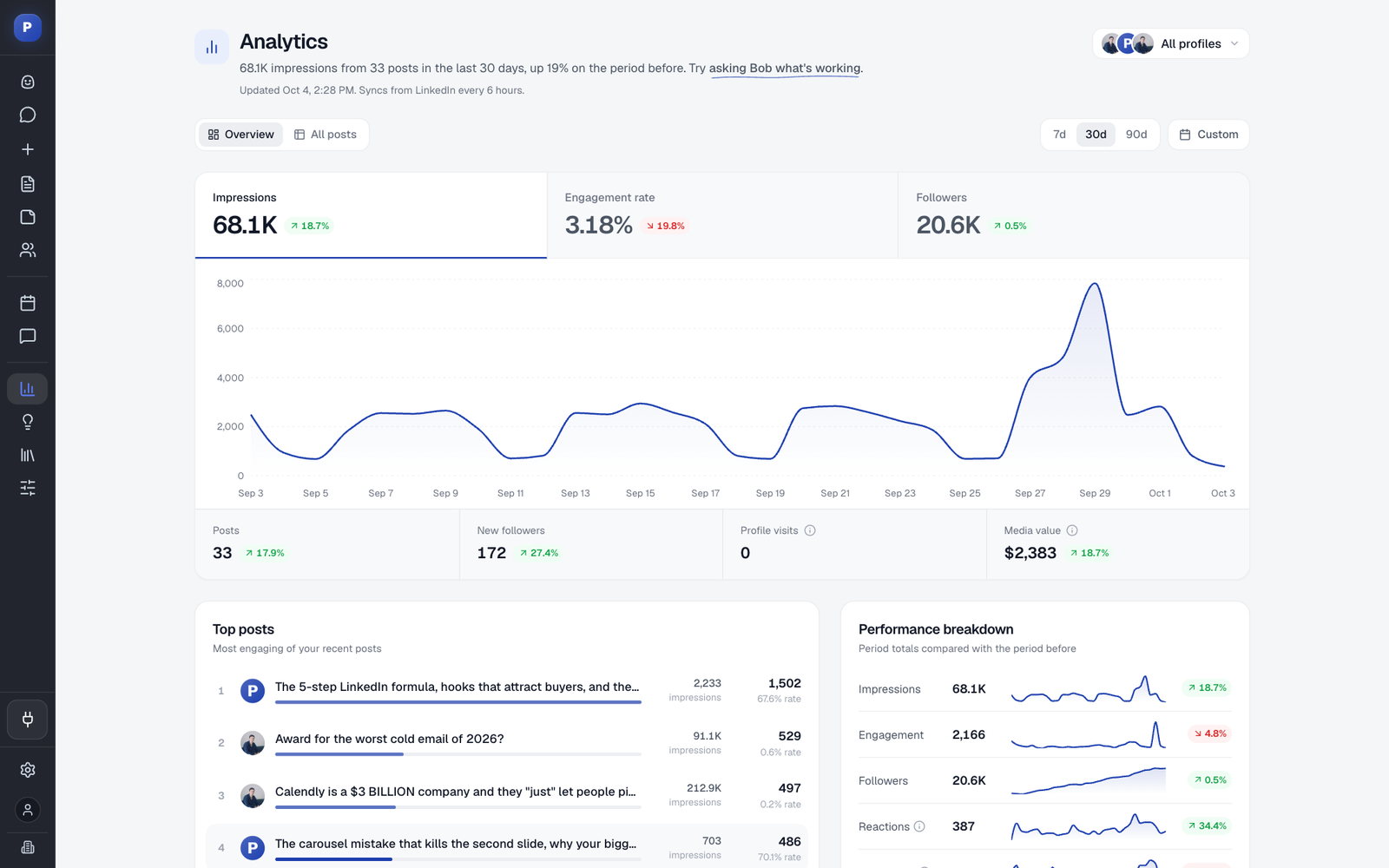
Of the nine strategies above, the two that compound fastest are the two that depend on publishing consistently: profile authority and content. That is the part Postiv AI is built for. It drafts posts and carousels in your voice, keeps a schedule running without you babysitting it, and shows you which topics actually pull qualified attention, so the inbound side of your pipeline keeps working while you spend your hours on conversations. Start a 7-day free trial of Postiv AI and get your first week of content live.