
Think of your LinkedIn SSI Score as a sort of credit score, but for your professional influence. It’s a number from 1 to 100 that LinkedIn uses to measure how well you're establishing your professional brand, finding the right people, sharing valuable insights, and building strong relationships.
A higher score doesn't just look good; it actively helps you. It’s a direct signal to the LinkedIn algorithm that you’re a credible, active member, which means more visibility for you and your content.
What Is the LinkedIn SSI Score and Why It Matters
Your SSI score is much more than a vanity metric. It’s a real-time report card on how effectively you’re using the platform for professional growth. A low score might leave you shouting into the void, while a high one can put a megaphone in your hands.
At its core, LinkedIn created the SSI to encourage a specific kind of behavior: building genuine, value-driven connections instead of just hoarding contacts. The score is their way of measuring and rewarding the activities that lead to meaningful professional relationships and conversations.
The Real-World Impact of a High SSI
Focusing on your SSI isn't about chasing a number—it's about building habits that get you real results. The data here is pretty compelling and shows a clear link between a solid SSI and actual professional wins.
According to LinkedIn, professionals with an SSI score above 70 create 45% more sales opportunities than those with scores under 30. And their InMail response rates can hit 30%, a massive leap from the 10% average for low scorers. You can dig into more LinkedIn marketing stats on brentonway.com.
What this means is simple: by working on the four pillars of your SSI, you are directly increasing your odds of starting valuable conversations that can lead to new business.
More Than Just Sales
Don't let the "Social Selling" name fool you. The benefits of a strong SSI reach far beyond traditional sales roles.
For a founder, a high score can build the kind of authority that attracts investors and top talent. For a marketer, it means your content and brand messages get seen by more of the right people. It's really a universal benchmark for professional influence.
Of course, a huge part of this is consistently sharing great content, which can feel like a full-time job. This is where smart tools can help you keep the momentum going without burning out. A strong personal brand also organically pulls in a bigger, more interested audience. For more on that, check out our guide on how to grow LinkedIn followers.
Ultimately, a good SSI score is the natural result of a smart, well-rounded strategy for using LinkedIn to grow your career or business.
Breaking Down the 4 Pillars of Your LinkedIn SSI Score
Your total SSI score isn't some arbitrary number LinkedIn assigns you. Think of it as a final grade calculated from four distinct report cards, with each "subject" contributing 25 points toward your total of 100.
Getting a handle on these four pillars is the secret to moving the needle. It lets you stop guessing and start building a focused strategy, turning your weakest areas into your biggest strengths.
This infographic lays out how the four pillars come together to build your score and, more importantly, open up new professional doors.
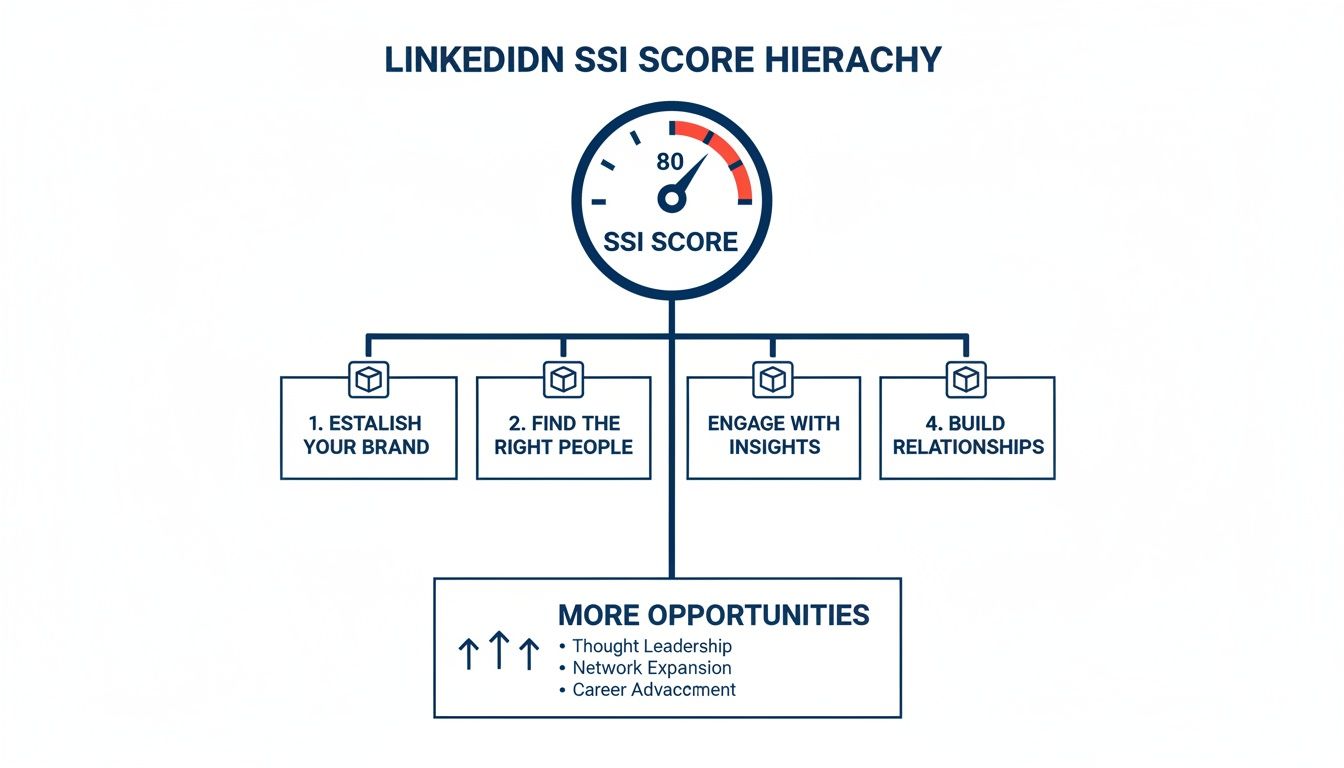
The message here is simple: master each component, and you'll not only raise your score but also unlock real, tangible success on the platform.
A Deeper Look at the Four Pillars
So, what exactly are these four pillars? Each one measures a specific set of activities that LinkedIn has identified as critical for effective social selling. Understanding them is the first step toward improving them.
Let's break down each component, looking at what it measures and the key actions you can take to boost your score in that area.
The Four Pillars of LinkedIn SSI Explained
| SSI Pillar | What It Measures | Key Action Items |
|---|---|---|
| Establish Your Professional Brand | How complete and customer-focused your profile is. It's about creating a resource, not just a resume. | Complete all profile sections (especially "Featured"), publish long-form articles, and get endorsements for your skills. |
| Find the Right People | Your ability to efficiently identify and connect with relevant prospects and decision-makers using LinkedIn's tools. | Use advanced search filters or Sales Navigator, view profiles of key prospects, and send personalized connection requests. |
| Engage with Insights | Your activity level. It measures how often you share valuable content and participate in conversations. | Share relevant industry news, leave thoughtful comments on others' posts, and get likes, shares, and comments on your own content. |
| Build Relationships | How effectively you nurture your network to build trust with key decision-makers over the long term. | Connect with senior-level members, engage with their content consistently, and maintain relationships beyond the initial connection. |
By focusing on these specific actions, you’re giving the LinkedIn algorithm exactly what it wants to see, which directly translates into a higher SSI score and greater visibility.
Pillar 1: Establish Your Professional Brand
This first pillar is all about building a profile that does the heavy lifting for you, even when you're offline. LinkedIn is looking at how complete your profile is and, more importantly, whether it's geared toward helping your target audience.
This isn't just about ticking boxes. It’s about transforming your profile from a static resume into a dynamic, compelling hub that positions you as an expert.
Key activities that boost this score include:
- Completing every profile section: Don't skip the "Featured" section: add valuable content, case studies, or links. Be sure to add relevant skills and gather endorsements, and use these recommendation templates you can adapt when you ask for a written recommendation.
- Publishing high-quality content: This means sharing insightful posts and publishing longer-form articles that showcase your expertise.
- Gaining followers from your content: When your writing is good enough to make people hit that "follow" button, LinkedIn sees you as a valuable voice.
Pillar 2: Find the Right People
LinkedIn wants to see that you're building your network with intention, not just mindlessly clicking "connect." This pillar scores your efficiency in using the platform's tools to find the right prospects and industry leaders. It’s a classic case of quality over quantity.
Think of it as your professional GPS. A high score here tells LinkedIn you know how to use its search and prospecting features to find the most direct route to valuable connections.
LinkedIn's own data reveals that 78% of social sellers outsell peers who aren’t using social media. A big part of that success comes from their ability to pinpoint and connect with high-value prospects—a core skill this pillar measures.
Actions to improve this pillar include:
- Using advanced search features: Regularly use LinkedIn's search filters or Sales Navigator to zero in on people who fit your ideal customer profile.
- Viewing profiles of target prospects: Actively browsing the profiles of people you want to connect with signals clear intent to the algorithm.
- Maintaining a high connection acceptance rate: Generic requests get ignored. Sending personalized, relevant connection requests is essential, as a low acceptance rate will drag your score down.
Pillar 3: Engage with Insights
This is where your activity comes into play. Just logging in and scrolling doesn't cut it; LinkedIn rewards active, meaningful participation. This pillar is all about sharing valuable content and engaging in conversations to build your reputation.
Being a passive consumer won't do much for your score. LinkedIn wants you to be a creator and a conversationalist. Every like, thoughtful comment, and share acts as a signal that you're an engaged member of the community.
Meaningful engagement is the currency of LinkedIn. When you share a relevant article or offer a unique perspective in the comments, you're building social capital that directly improves your SSI score.
Pillar 4: Build Relationships
The final pillar ties everything together. It measures how well you're nurturing your network for the long haul. It's about turning a list of digital connections into a web of trusted professional relationships, especially with decision-makers.
This component isn't about the initial outreach; it's all about the follow-through. LinkedIn tracks how you connect with senior-level people and how well you maintain those relationships over time. The goal is to build genuine rapport that can lead to real opportunities.
Effective strategies here involve moving beyond the "thanks for connecting" message. Acknowledge your connections' work anniversaries, share resources you think they'd find helpful, and consistently offer value without asking for anything in return.
How to Find and Interpret Your SSI Score
Alright, now that we’ve broken down the four pillars of the LinkedIn SSI score, let's get to the good stuff: finding out where you actually stand. Getting your score is the easy part. The real value comes from the context the dashboard provides, which turns that single number into a launchpad for your strategy.
First things first, your SSI score is your business. It's completely private, so you don't have to worry about anyone else seeing it. The only exception is if your company uses LinkedIn Sales Navigator for its sales team—in that case, an admin might see a team-wide leaderboard.
Accessing Your SSI Dashboard
LinkedIn makes it incredibly simple to check your score, and you don't even need a premium account to see it. That is worth knowing before you upgrade for it: our breakdown of whether LinkedIn Premium is worth it covers which SSI-adjacent features actually sit behind the paywall and which ones are free.
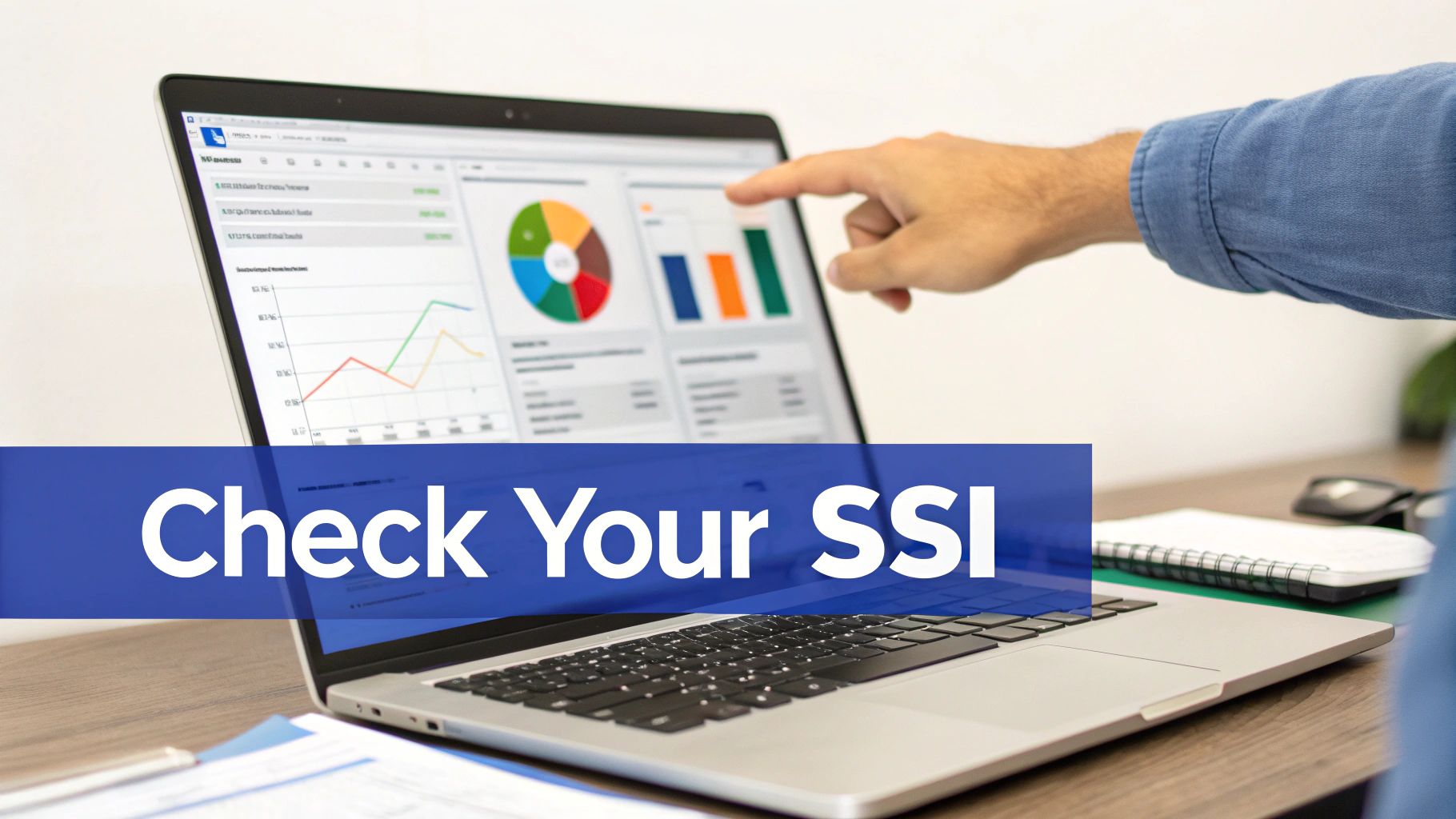
Here’s how to pull it up:
- Log into your LinkedIn account on a computer.
- Head straight to the Social Selling Index page: https://www.linkedin.com/sales/ssi.
- I'd recommend bookmarking that page. Your score updates daily, so it's worth checking in on it regularly.
Once you land on the page, you'll see your personal dashboard. This is where LinkedIn lays out your performance across several key areas. It instantly shows your total SSI score out of 100, along with your individual scores for each of the four components we discussed.
Making Sense of the Numbers
This dashboard is more than just a report card; it gives you the benchmarks you need to set meaningful goals.
Your SSI score isn't a "set it and forget it" number. It’s a dynamic score reflecting your last 90 days of activity. That means consistent effort is the only way to not just raise your score, but keep it high.
On your dashboard, you'll find a few crucial pieces of information:
- Your Overall SSI Score: This is your main grade, a number from 1 to 100 that sums up your social selling game.
- The Four Pillar Scores: Here’s the breakdown. You’ll see how many points you've earned (out of 25) for establishing your brand, finding people, engaging, and building relationships.
- Industry Comparison: This metric shows you how your score stacks up against the average SSI for others in your industry, giving you a percentile rank.
- Network Comparison: This does the same thing but compares your score to the average of the people in your professional network.
These numbers tell a story. They pinpoint exactly where you’re winning and where you have room to grow. For example, if your "Engage with Insights" score is lagging, that’s your cue to start sharing more valuable content and joining conversations.
Reviewing this data consistently is just as important as learning how to analyze content performance for any other marketing effort. It gives you the feedback you need to make small, targeted changes that lead to big results. SSI tells you how you are doing overall; post-level LinkedIn analytics show which posts actually moved your reach and engagement.
Understanding What a Good SSI Score Looks Like
So you've found your LinkedIn SSI score. The immediate question is, "What does this number actually mean?" It’s not just an arbitrary metric; it’s a direct reflection of how well you're playing the game on LinkedIn.
Think of it this way: a low score means you're still on the tutorial level, while a high score suggests you're a seasoned player who knows all the right moves. LinkedIn breaks this down into three main performance tiers, each telling a different story about your networking impact.
The Developing Stage: Scores 0-40
If your score is anywhere from 0-40, you’re in the "Developing" stage. This is a clear signal that there are some big holes in your LinkedIn strategy. Maybe your profile is a bit bare, your network is small, or you just aren't posting or engaging much.
A score in this zone is a bit of a handicap. LinkedIn’s algorithm isn't likely to favor your profile in search results or suggest your content to others, making it tough to gain any real traction. It’s your cue to start building a stronger foundation.
The Effective Range: Scores 41-70
Landing between 41-70 puts you in the "Effective" category. This is where most reasonably active LinkedIn users find themselves. You’re doing a lot of the right things—your profile is filled out, you’re making connections, and you're interacting with posts.
Being "Effective" is a solid starting point, but it also means there’s a lot of untapped potential. You've got the basics down, but you haven't quite unlocked the platform's full power. A few strategic tweaks to your weakest areas can be all it takes to jump into the top tier.
Don't mistake a high SSI for a simple vanity metric. LinkedIn's own research shows that social selling leaders create 45% more opportunities than their peers with lower scores. This is proof that a top-tier score translates directly to real business outcomes.
The Leading Tier: Scores 71-100
A score of 71 or higher means you're a "Leader." This is where you want to be. Hitting this level tells the LinkedIn algorithm that you're a top performer and a credible voice in your field.
People in this bracket are consistently active and strategic. They’ve fully optimized their profiles, they engage in meaningful conversations, and they excel at building genuine relationships. In return, LinkedIn gives them a major visibility boost, amplifying their content and ranking their profiles higher in searches.
Here’s a simple way to think about the tiers:
| Score Range | Tier | What It Means for You |
|---|---|---|
| 0 - 40 | Developing | Your LinkedIn activity is spotty or unoptimized. You’re flying under the radar and likely missing out. |
| 41 - 70 | Effective | You’ve built a decent foundation and are active, but there are clear opportunities to level up your impact. |
| 71 - 100 | Leading | You're a power user. LinkedIn sees you as an authority, rewarding you with greater reach and credibility. |
Knowing where you stand is the first step to getting where you want to go. If you’re in the developing stage, focus on becoming effective. If you’re already effective, it's time to pinpoint the specific actions that will make you a true leader on the platform.
Proven Strategies to Elevate Your SSI Score

Knowing your SSI score is one thing. Actually improving it is where the magic happens. Think of it less like trying to game an algorithm and more like building the right habits to become a more effective and visible professional on LinkedIn. The secret is to turn the four pillars of SSI into consistent, daily actions.
This all comes down to a simple shift: stop scrolling and start contributing. Move from passive consumption to active participation by creating, commenting, and connecting with a clear purpose.
The strategies below are broken down by role, giving you specific tactics you can start using today. Whether you’re a founder building a brand from scratch or a sales pro warming up leads, these methods will help you systematically raise each component of your SSI.
Strategies for Founders and Solopreneurs
When you're a founder, your personal brand is the company brand. A high SSI score isn't just a vanity metric; it's a magnet for talent, investors, and those critical first customers. Your goal is to cement your reputation as a credible, forward-thinking voice in your industry.
You'll want to pour most of your energy into the "Establish Your Professional Brand" and "Engage with Insights" pillars. You do this by consistently sharing high-quality content that offers a unique perspective only you can provide.
Your LinkedIn profile essentially becomes your digital headquarters. Every single post, article, and comment you make reinforces your company's mission and your vision.
Key Insight: A founder with a strong LinkedIn presence builds social proof and de-risks the venture for potential partners and investors—long before they ever see a pitch deck.
Here’s how to get started:
- Nail Down Your Core Content Themes: Pick three to five topics where your expertise, your industry, and your personal passion intersect. This makes it way easier to create content and helps you build an authoritative voice people can count on.
- Share the Founder Journey: Don’t just post the wins. Talk about the roadblocks, the lessons learned, and the messy behind-the-scenes stuff. Authentic storytelling is what builds real connections and gets people talking.
- Publish Weekly Long-Form Content: Use LinkedIn Articles to go deep on one of your core themes. This is a fantastic way to flex your expertise and give the "professional brand" part of your SSI score a serious boost.
Strategies for Marketers
Marketers are natural storytellers, which makes LinkedIn the perfect playground. For you, a high SSI score is proof you can practice what you preach: building an engaged community. Your strategy should be a smart mix of building your personal brand while aligning your activity with your company’s goals.
You’ll want to crush the "Engage with Insights" and "Find the Right People" pillars by sparking conversations and connecting with industry peers, partners, and potential customers.
A marketer with a high SSI becomes a powerful distribution channel. You amplify the company's message with a layer of personal credibility that a corporate page just can't match.
Example Post Idea for Marketers
A carousel post breaking down a recent successful campaign is a guaranteed winner.
- Slide 1: The big, splashy result (e.g., "How we drove a 150% increase in MQLs last quarter").
- Slides 2-4: Briefly explain the problem, your strategy, and the specific tactics you used.
- Slide 5: End with a key takeaway or a question to get the comments flowing (e.g., "What's the most underrated marketing channel you're using right now?").
This kind of post delivers huge value and positions you as someone who knows their stuff, inviting the comments and shares that fuel your SSI. Understanding the nuts and bolts of what makes content work is key, and you can dive deeper in our guide to content creation best practices.
Strategies for Sales and SDR Teams
If you're in sales, your SSI score is a direct reflection of your social selling muscle. A higher score means you’re doing a better job of finding prospects, connecting with them, and building real relationships. The focus here is all on "Find the Right People" and "Build Relationships."
Your mission is to use LinkedIn as a listening device, not a megaphone. It's about gathering intelligence and building rapport before you ever make an ask. By the time you reach out, you’re a familiar face, not a cold prospector.
The data doesn't lie: social selling leaders are 51% more likely to hit their sales quota. This isn’t luck; it's the result of disciplined, value-first engagement. To keep a steady drumbeat of activity, it's a good idea to learn how to schedule your LinkedIn posts effectively.
Tactical Sales Plays
- The "Insightful" Comment: Don't just "like" a prospect's post. Leave a thoughtful comment (15+ words) that actually adds to the conversation. Ask a smart question or share a related stat. This makes you a contributor, not just a lurker.
- The "Shared Interest" Connection: Before sending a request, find some common ground. Mention a mutual connection, a group you're both in, or a recent post they engaged with. A personalized request dramatically increases your acceptance rate, which feeds directly into your "Build Relationships" score.
- The "Value-First" Follow-Up: Once you've connected, fight the urge to pitch. Instead, share a relevant article or case study you think they'd find genuinely useful. This builds trust and positions you as a helpful resource, not just another salesperson.
Strategies for Agencies
For agencies juggling multiple client accounts, a high team-wide SSI score is a massive selling point. It proves your team truly gets the platform. The real challenge is keeping the quality and consistency high across different client voices and brand strategies.
Your focus should be on building scalable workflows that boost all four pillars for every client. This means efficient content creation, strategic engagement, and clear reporting to show your value.
A smooth process frees you up for high-impact activities like personalized engagement—the kind of thing that’s tough to automate but is absolutely essential for building genuine relationships and a higher ssi score linkedin.
Agency Workflow Optimization
- Batch Your Content: Block out time to create a week or two's worth of content for each client at once. Using tools to brainstorm ideas and design posts can make this process incredibly efficient.
- Internal Engagement Pods: Have team members actively engage with each other's (and clients') posts right after they go live. That initial traction can help the content get favored by the LinkedIn algorithm.
- Report on Performance: Track key SSI metrics for each client every month. Pinpoint which activities delivered the biggest score increases to refine your strategy and show a clear return on investment.
Your Top LinkedIn SSI Questions, Answered
Once you start digging into LinkedIn's Social Selling Index, a few questions always seem to surface. It's only natural. Let's tackle the big ones head-on so you can move forward with a clear strategy.
Think of this as your quick-start guide to understanding the nuts and bolts of your SSI score.
How Often Does the LinkedIn SSI Score Update?
This is easily the most common question. Your ssi score linkedin isn't set in stone; it's a living number that reflects what you’re doing on the platform right now.
Technically, your score updates daily. So, that profile you checked out, the thoughtful comment you left, or the new connection you made today can nudge your score up tomorrow.
But here's the key: the score is calculated over a rolling period, typically your activity from the last 90 days. This setup means that consistent, daily habits are what really move the needle. A few days of inactivity won't crush your score, but you can't just cram a month's worth of activity into one afternoon and expect it to stick.
Can Other People See My SSI Score?
Let's put this worry to rest: No, your SSI score is completely private.
Your score is for your eyes only. It’s a personal diagnostic tool, not a public grade for your connections or competitors to see.
The only exception is if your company uses LinkedIn Sales Navigator for its teams. In that specific environment, a team administrator can view a leaderboard showing the SSI scores of everyone on their team. This is purely for internal coaching and performance tracking within a private company setting.
For almost everyone, your LinkedIn SSI score is a confidential benchmark. It’s for you to measure your own progress, without any outside pressure.
Is a High SSI Score a Guarantee of Sales Success?
Ah, the million-dollar question. A high SSI score is a fantastic indicator of strong social selling habits, but it's not a magic bullet for sales.
Think of it like this: your SSI score is a finely-tuned engine in a race car. It gives you incredible potential and a serious competitive edge, but you still need a skilled driver behind the wheel to navigate the track, read the competition, and actually win the race.
A high score means you're excelling at the activities that lead to sales:
- You’ve built a compelling, customer-centric profile.
- You’re a pro at finding and connecting with the right people.
- You consistently share valuable insights that start real conversations.
- You’re building a network founded on trust.
These actions give you a massive advantage. In fact, sales pros with high SSI scores are 45% more likely to create new opportunities and 51% more likely to hit their quota. The score reflects the behaviors that drive success.
But the score itself doesn't close the deal. You still have to bring your sales acumen, product knowledge, and human touch to turn a LinkedIn conversation into a real business partnership.
Why Did My SSI Score Go Down?
It’s always a little frustrating to see your score drop, but don't panic. Since your SSI is based on recent activity, a dip usually points to one of a few simple causes.
- You Eased Off the Gas: Were you on fire last week—posting, commenting, connecting—but quieter this week? As those high-activity days fall outside the 90-day window, your score can dip.
- Low Connection Acceptance Rate: If you sent a wave of connection requests and a lot of them were ignored, your "Build Relationships" pillar might take a small hit.
- Less Engagement: The "Engage with Insights" pillar isn't just about posting; it's about interacting. If you've been scrolling more than you've been commenting or sharing, this score will likely slide.
A small dip here and there is perfectly normal. The real thing to watch is the trend over a few weeks. A steady downward slide is your cue to revisit your daily LinkedIn routine and get back to the core activities that fuel all four pillars. Your ssi score linkedin is incredibly responsive; it'll bounce back as soon as you do.
Ready to turn these insights into consistent, high-quality content? Postiv AI helps you create authority-building LinkedIn posts and carousels in minutes, not hours. Stop staring at a blank screen and start building the professional brand that elevates your SSI score and opens new doors. Discover how at Postiv.ai.