If you're tired of unpredictable revenue and deals that seem to fall through at the last minute, it's a familiar pain point. Many sales teams run on a reactive, almost chaotic, approach where success feels more like a lucky break than a repeatable strategy. This leads to those frustrating boom-and-bust cycles that make forecasting feel like guesswork.
The problem isn't a lack of effort. It's the absence of a system.
A sales pipeline is that system. It's far more than just a list of potential deals; it's a visual roadmap that lays out the entire customer journey, from the first "hello" to a signed contract. By putting a structured pipeline in place, you give your sales team a clear path to follow, letting them focus on the high-impact activities that actually close deals.
The Power of Predictable Growth
A well-defined pipeline turns random sales activities into a deliberate, repeatable process. This structure is the engine of sustainable growth. In fact, companies that formalize their sales process grow their revenue 18% faster than those that don't. That’s a massive competitive advantage built on nothing more than clarity and efficiency.
Having a structured pipeline brings several key advantages that can fundamentally change how your business operates.
Core Benefits of a Structured Sales Pipeline
| Benefit | Impact on Your Business |
|---|---|
| Accurate Revenue Forecasting | Stop guessing. With clear stages and conversion data, you can predict future income with surprising accuracy. |
| Improved Team Performance | Reps know exactly what to do at each stage to move a deal forward, which eliminates confusion and boosts productivity. |
| Enhanced Customer Experience | A consistent process means timely follow-ups and a more professional buying journey, which builds trust with your prospects. |
| Strategic Decision-Making | Instantly spot bottlenecks. Are deals getting stuck after the demo? The data tells you exactly where to focus your coaching and resources. |
Ultimately, a solid pipeline gives you control and visibility, turning reactive scrambling into proactive strategy.
A pipeline isn’t just about tracking what’s happening; it’s about making things happen. It gives you control over your sales motion, allowing you to proactively manage deals instead of just reacting to them.
To truly leave inconsistency behind, you need a solid foundation. For a step-by-step guide on putting this into practice, this strategic blueprint for building your sales pipeline is an excellent starting point. It's the first critical step toward creating a reliable revenue engine for your business.
Mapping Your Pipeline Stages from Contact to Close
A sales pipeline is more than just a list of deals; it's a living map of your customer's journey. To build one that actually works, you have to define clear, distinct stages that mirror the real-world steps a prospect takes from the first "hello" to signing on the dotted line. Forget generic templates—they almost never account for the unique quirks of your sales cycle.
Let's walk through a realistic B2B scenario to see how this looks in practice. For each stage, we’ll set specific entry and exit criteria. This gives you a rock-solid framework you can tweak for your own business.
Ultimately, a well-defined pipeline is what turns a chaotic, unpredictable sales motion into a clear, reliable path toward growth.
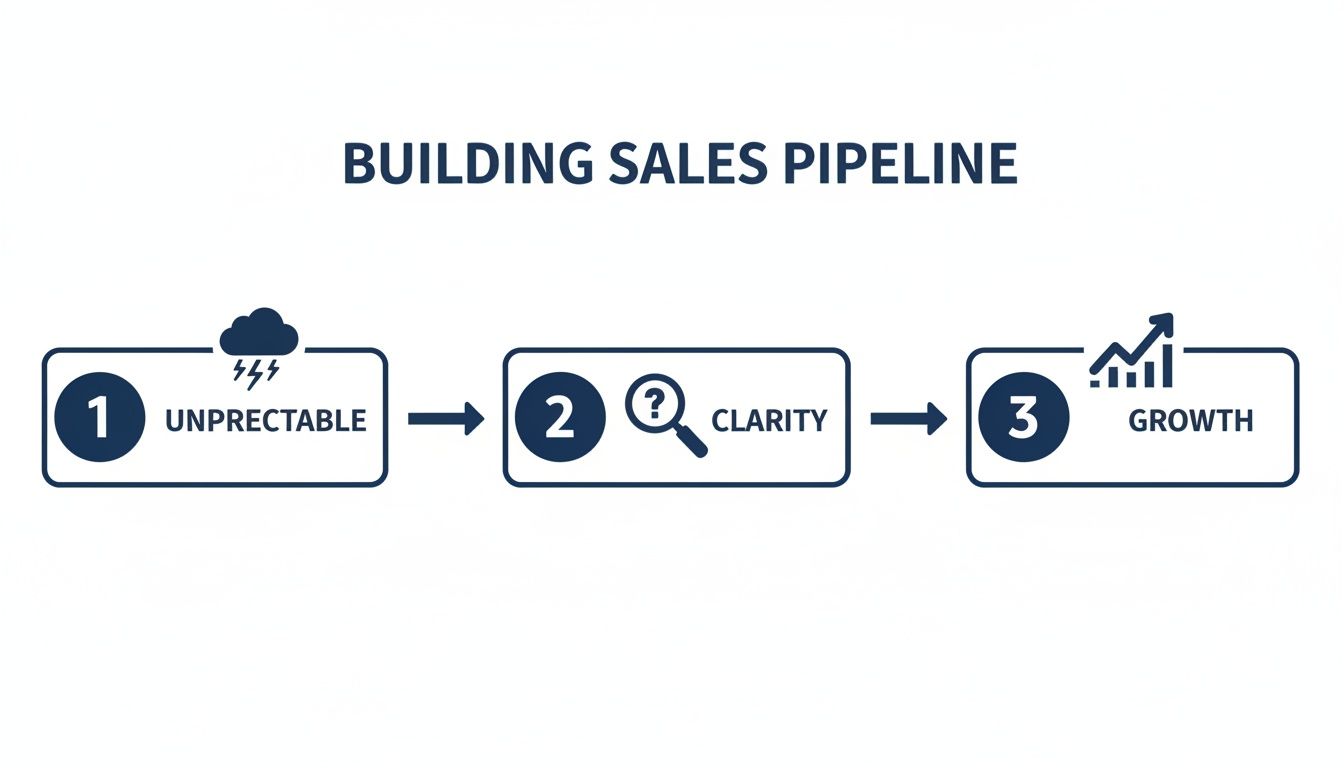
This journey from total uncertainty to predictable growth is exactly what a structured pipeline provides.
Stage 1: Prospecting and Lead Generation
This is the very top of your funnel. Think of it as your hunting ground, where you're identifying potential opportunities that haven't been contacted yet. The whole point here is to build a high-quality list of contacts who actually fit your ideal customer profile.
- Entry Criteria: A company or contact is flagged through research (like on LinkedIn Sales Navigator), inbound marketing (a content download, for example), or a warm referral. They must meet your basic firmographic criteria—things like industry, company size, and location.
- Key Activities: Cold outreach, social selling, content marketing, and good old-fashioned networking.
- Exit Criteria: The prospect replies to your outreach and agrees to have an initial conversation. That’s it.
Stage 2: Qualification
Okay, they've shown a flicker of interest. Now what? Your job is to verify they have a real need and are a legitimate potential customer. This is the crucial handoff from a Marketing Qualified Lead (MQL) to a Sales Qualified Lead (SQL), and it’s where so many sales processes break down.
The average B2B buyer's journey now stretches to a whopping 211 days, and for big enterprise deals, it's even longer—their customers take 49% more time on average. According to a 2025 benchmark report from Dreamdata, a major bottleneck happens right here, with leads sometimes taking over three months just to move from MQL to SQL.
Think of this stage as your pipeline’s bouncer. Be ruthless about disqualifying poor-fit leads here. It will save you countless wasted hours down the road and keep your forecast from becoming a work of fiction. A pipeline clogged with unqualified leads is a recipe for missed quotas.
Stage 3: Discovery and Needs Analysis
You've confirmed a basic fit. It’s time to go deep. This stage is all about understanding the prospect's world—their specific challenges, their goals, and who holds the purse strings. It requires asking sharp questions, but more importantly, it requires you to shut up and listen.
- Entry Criteria: The lead is officially an SQL and has agreed to a proper discovery call.
- Key Activities: You’ll run a thorough discovery call, map out the key stakeholders, and uncover the specific pain points your solution can solve. To nail this, it’s vital to understand how to identify your target audience so your questions hit the mark.
- Exit Criteria: You have a crystal-clear picture of their problem, their budget, the decision-makers, and their timeline (often called BANT).
Stage 4: Demonstration or Proposal
Armed with a deep understanding of their needs, you can finally show them what you've got. This isn't a one-size-fits-all product tour. It could be a highly personalized software demo, a formal proposal, or a strategic presentation that shows exactly how you'll make their problems disappear.
- Entry Criteria: Their needs and buying criteria are clearly defined and documented in your CRM.
- Key Activities: Presenting that tailored demo, sending over a detailed proposal, and handling their first round of objections.
- Exit Criteria: The prospect gives you a clear signal that your solution checks their boxes and they’re ready to talk specifics.
Stage 5: Negotiation and Closing
This is where the deal gets real. The prospect is serious about buying, but there will be back-and-forth on pricing, contract terms, or implementation details. Sharp negotiation skills and crystal-clear communication are non-negotiable here.
- Entry Criteria: The prospect has given a verbal "yes" or has otherwise expressed strong intent to buy.
- Key Activities: You're negotiating price and terms, sending the final contract for legal review, and chasing down all the necessary signatures.
- Exit Criteria: The contract is signed. The deal is won.
Stage 6: Closed-Won or Closed-Lost
Every single opportunity has to end here. There's no in-between. It’s just as critical to track and analyze why you lose deals as it is to celebrate the wins. That "Closed-Lost" data is pure gold for refining your sales process and making sure you win more next quarter.
Using LinkedIn to Fuel Your Sales Pipeline
Once your pipeline stages are mapped out, the real work begins: keeping them full. You've got plenty of channels to pull from, but for B2B sellers, LinkedIn has become the undisputed champion. It’s far more than a digital resume; it's a living, breathing ecosystem where you can find, connect with, and ultimately convert high-value prospects.
But just "being active" on LinkedIn isn't going to move the needle. You need a deliberate strategy to turn the platform into a predictable lead-generation machine. This means getting past random connection requests and generic, self-serving posts.

Hyper-Targeted Prospecting with Sales Navigator
The free version of LinkedIn is a decent starting point, but for anyone serious about building a pipeline, LinkedIn Sales Navigator is a must-have. It unlocks advanced search filters that let you pinpoint your ideal customers with stunning precision. Before committing, review the full Sales Navigator pricing breakdown to compare Core, Advanced and Advanced Plus plans.
You can zero in on prospects by their seniority level, company size, industry, and even specific keywords they’ve used in their profiles.
Let’s say you sell project management software to marketing agencies with 20-50 employees. With Sales Navigator, you can create a saved search that instantly alerts you when a new marketing manager or director joins a company matching that exact profile. Suddenly, your cold prospecting becomes a highly targeted, warm outreach opportunity.
Establishing Authority Through Strategic Content
Prospecting is only half the battle. You also need to attract inbound leads by positioning yourself as a credible expert in your field. This is where consistent, high-value content makes all the difference. Your goal isn't just to sell; it's to educate, inform, and solve real problems for your audience.
Instead of a lazy post saying, "Buy our software!", try creating a carousel detailing the "5 Common Workflow Bottlenecks in Marketing Agencies and How to Fix Them." This simple shift frames you as a helpful expert, not just another salesperson pushing a product.
Tools like Postiv AI are built to make this whole process easier. You can create high-quality, on-brand content—including those eye-catching carousels—without spending hours staring at a blank document. Consistency is key to staying top-of-mind, and this helps you deliver.
People buy from those they know, like, and trust. Consistent, valuable content on LinkedIn builds all three. It’s the long-term play that ensures your sales pipeline is never empty, as prospects will start coming to you when the time is right.
When planning your content, focus on these pillars:
- Pain Points: Speak directly to the challenges your ideal customers wrestle with every day.
- Industry Insights: Share your unique perspective on market trends and shifts.
- Success Stories: Show, don't just tell, how you've helped similar clients get real results.
- Educational Tips: Provide actionable advice they can use right away, whether they buy from you or not.
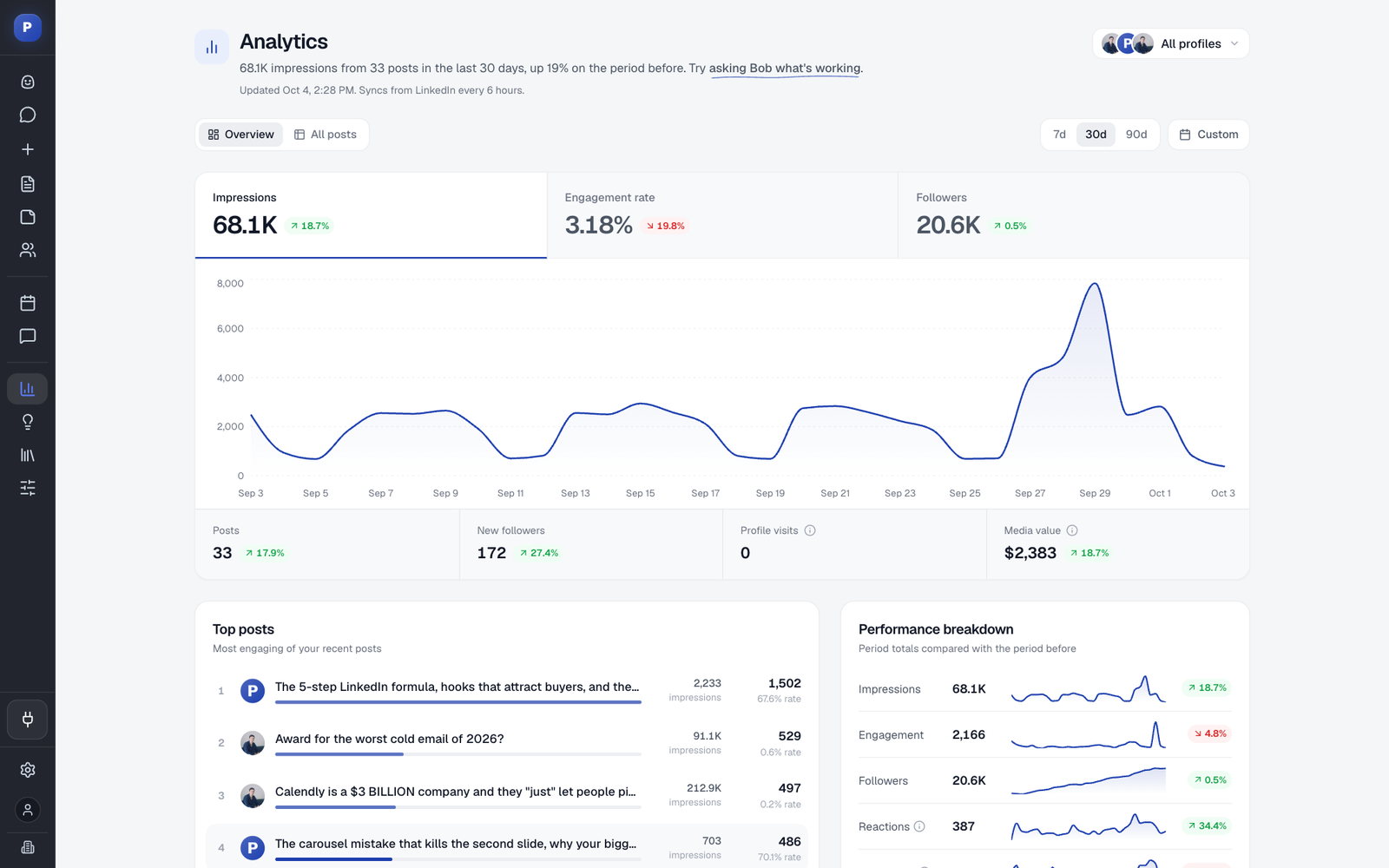
Using a tool like Postiv AI to consistently hit these pillars can transform your LinkedIn presence from a passive profile into an active lead-generation asset. Here’s a quick look at how specific activities translate into pipeline growth.
LinkedIn Pipeline Building Activities and Their Impact
| Activity (Using Postiv AI) | Purpose | Example Metric to Track |
|---|---|---|
| Carousel & Text Post Creation | To establish thought leadership and attract inbound interest. | Engagement Rate, Profile Views |
| AI-Assisted Commenting | To build rapport and enter relevant conversations with prospects. | Number of Meaningful Replies |
| Personalized Connection Requests | To turn cold outreach into warm conversations. | Connection Acceptance Rate |
| Scheduling & Consistency | To stay top-of-mind and build brand recall with your network. | Inbound DMs/Meeting Requests |
Ultimately, each of these actions works together to create a steady flow of conversations that can be moved into your formal sales pipeline.
Engaging in Meaningful Conversations
Your content will spark some conversations, but you also need to go out and find them. That means getting active in the comments—not just on your own posts, but more importantly, on posts from other industry leaders and potential buyers.
When a prospect posts about a challenge they're facing, a thoughtful comment offering a helpful perspective can be far more powerful than a cold DM. You're showing your expertise and building rapport in a public space, which adds a ton of credibility. It's a surprisingly effective way to find active buyers and start warm conversations.
The numbers don't lie. LinkedIn's visitor-to-lead conversion rate is 2.74%, which crushes other platforms. A solid 40% of B2B marketers see LinkedIn as their top channel for high-quality leads, and it's been shown to be 277% more effective for lead generation than Facebook and X combined.
Crafting Non-Pushy Outreach Messages
When you do decide to send a direct message, personalization is non-negotiable. Generic, copy-paste connection requests are an instant turn-off. Your message has to prove you’ve done at least a minute of homework.
Here’s a simple structure that works:
- The Hook: Start with a specific, genuine point of connection. "I saw your recent post on AI in marketing..."
- The Value Prop: Briefly explain how you can help, tied directly to their world. "...and it reminded me of how we helped a similar agency cut their content approval time by 50%."
- The Call-to-Action: Make the next step easy and low-friction. "Would you be open to a brief 15-minute chat next week to see if this could be relevant for you?"
This approach shows you respect their time and frames your outreach as a relevant, potentially valuable conversation. For a deeper dive, our guide to LinkedIn lead generation strategies breaks down nine ways to fill the top of this pipeline, from profile SEO through to account-based marketing.
And while you're mastering LinkedIn, it's also worth exploring how AI-Powered Lead Generation can further automate your efforts. Integrating modern tools like these gives you a serious edge, letting you spend more time selling and less on the manual grind of prospecting.
Measuring Pipeline Health with the Right Metrics
A sales pipeline without data is like driving blind. You might be moving, but you have no idea if you're heading in the right direction, how fast you're going, or what obstacles lie ahead. To really get a grip on your sales process, you need to focus on a handful of metrics that tell the true story of your pipeline's health.
This isn't about getting lost in spreadsheets or chasing vanity numbers. The goal is to build a clear, real-time dashboard that paints a picture of your revenue engine. When you track the right KPIs, you can spot leaks, find coaching opportunities, and forecast revenue with confidence, not guesswork.

Unlocking Your Pipeline Velocity
If there's one "master metric" for pipeline health, it’s Pipeline Velocity. This KPI is all about how quickly deals move through your pipeline and how much revenue they're generating each day. Think of it as the ultimate indicator of your sales machine's efficiency.
Mastering this metric is fundamental to building a sales pipeline that performs consistently. Recent data shows that teams who keep their sales cycles between 30-45 days achieve 38% higher velocity, pulling in an average of $2,134 per day in pipeline value.
The formula is: (Number of Opportunities × Average Deal Size × Win Rate) ÷ Sales Cycle Length. Given that the average B2B win rate for qualified opportunities is just 21%, every single part of this equation needs your attention. You can discover more insights about sales pipeline statistics to see how you stack up.
Pipeline Velocity is the speedometer for your revenue. A high number means you're closing good-sized deals quickly. A low number is a red flag that something's causing friction—deals are too small, they're taking too long, or you just aren't winning enough of them.
Diagnosing Leaks with Conversion Rates
While velocity gives you the 30,000-foot view, Conversion Rate by Stage lets you zoom in on specific problems. This metric shows the percentage of deals that successfully advance from one stage to the next. It’s your pipeline’s diagnostic tool, pinpointing exactly where deals are stalling or falling through the cracks.
For instance, you might see a fantastic 80% conversion rate from "Discovery" to "Demonstration," but a dismal 25% from "Demonstration" to "Negotiation." That immediately tells you something is wrong with your demos. Are they not hitting the mark? Is your team failing to establish value? It gives you a clear starting point for investigation.
Tracking this KPI helps you ask the right questions:
- Where are the bottlenecks? Find out exactly where deals are getting stuck.
- Is our qualification solid? A steep drop-off early in the process suggests your initial criteria are too loose.
- Is our value prop landing? If deals stall right before the proposal stage, you might have a messaging problem.
Understanding the Impact of Average Deal Size
Average Deal Size is a simple but surprisingly powerful metric. You just divide your total revenue from closed-won deals by the number of deals won in that period. It seems basic, but tracking it over time reveals critical trends.
Is your average deal size on the rise? Fantastic. It’s a strong sign you're successfully moving upmarket or your reps are getting better at cross-selling. If it’s shrinking, that could be a red flag. Maybe you're attracting smaller clients, or your team is handing out discounts too freely just to get deals over the line. Just like with marketing, measuring these sales metrics is crucial for growth. For a related perspective, check out our guide on measuring content marketing ROI.
Shortening Your Sales Cycle Length
Finally, there's Sales Cycle Length—the average time it takes to get from first contact to a closed-won deal. A long sales cycle is a massive drain on your resources and kills momentum. In fact, nearly one in three sales reps say a lengthy cycle is the single biggest barrier to hitting their quota.
Even a small improvement here can have a huge impact on revenue. Let's say your current sales cycle is 60 days. By finding and removing friction—maybe by simplifying your proposal process or creating better sales collateral—you might knock it down to 50 days.
That 17% reduction means your reps can handle more deals in the same amount of time, which directly boosts your pipeline velocity and overall revenue. You don't even need to generate a single extra lead. It's one of the most effective levers you can pull to make your entire sales operation more profitable.
Common Sales Pipeline Pitfalls to Avoid
Building a sales pipeline is one thing; keeping it healthy is another game entirely. You can design the most beautiful, logical sales process on paper, but if you're not careful, it can quickly get clogged up and become a source of frustration rather than revenue.
Think of it like tending a garden. It needs constant weeding and attention. If you let it go, a few common problems can take root and choke out the good deals you’ve worked so hard to find. Let's walk through the mistakes I see most often and, more importantly, how to sidestep them.
The Clogged Pipeline Problem
One of the biggest traps is a pipeline that’s jam-packed with unqualified leads. On the surface, it looks great—lots of activity! But it's a vanity metric, and a dangerous one at that. When your reps are busy chasing prospects who were never a good fit, they're not spending time on the deals that could actually close.
This usually happens when there's a huge push to fill the top of the funnel, but not enough discipline around qualification. The result? A bloated pipeline that gives you a false sense of security while your win rate silently tanks.
A pipeline full of unqualified leads is like trying to run a marathon with rocks in your pockets. You’re working twice as hard for half the result. The only fix is to be ruthless about qualification right from the start.
Inconsistent and Untimely Follow-Up
Deals rarely close themselves. And yet, an astonishing 44% of salespeople give up after just a single follow-up. That’s a huge problem when you consider it takes an average of eight touches to actually get a deal across the finish line. When follow-up is random or half-hearted, promising leads go cold and all that initial momentum just evaporates.
This isn’t always about reps being lazy. Often, it's a system failure. Without a clear follow-up cadence tracked in a CRM, it’s nearly impossible to remember who needs a call, an email, or a gentle nudge. Deals that should have been won end up slipping through the cracks, all for the lack of a simple, persistent touchpoint.
Letting Dead Deals Linger
I get it. It’s hard to let go of a deal you’ve poured hours into. But clinging to dead-end opportunities is one of the fastest ways to kill your pipeline’s velocity. Those stalled deals that haven't moved in weeks (or months) aren't just clutter—they're actively hurting you.
Here’s why these "zombie deals" are so damaging:
- They wreck your forecast: Including them in your projections leads to wildly optimistic revenue numbers that never materialize.
- They waste mental energy: Your reps keep thinking about them, occasionally poking them to see if they’re alive, instead of focusing on fresh opportunities.
- They hide bigger problems: A pipeline full of stalled deals can mask a real issue, like a lack of new, healthy leads coming in.
You need to set clear rules for when a deal is officially moved to "Closed-Lost." Maybe it's after 30 days of no meaningful two-way communication, or as soon as you get a definitive "no." Regular pipeline hygiene is just as critical as prospecting.
Relying on a Single Lead Source
Picture this: your number one source of leads suddenly vanishes. What happens to your business? Too many companies put all their eggs in one basket, whether it’s paid ads, LinkedIn outreach, or referrals. This creates a massive single point of failure.
Maybe an algorithm change kills your best ad campaign, or your top referral partner retires. If you haven't built out other lead channels, your entire sales engine could grind to a halt overnight. Before committing budget to any paid channel, understand the real LinkedIn advertising costs so you can diversify with clear cost expectations.
A much safer approach is to diversify. You need a healthy mix of strategies working for you.
- Inbound: Pulling people in with content, SEO, and building a presence on social platforms with tools like Postiv AI.
- Outbound: Pushing your message out with strategic cold calls, emails, and targeted prospecting.
- Partnerships: Building a network through referral programs and channel sales.
When you have a multi-channel strategy, you create stability. If one stream slows down, the others can pick up the slack, keeping your pipeline full and your revenue predictable.
Common Sales Pipeline Questions
Even with a solid plan, you're bound to run into questions as you build or fine-tune your sales pipeline. Let's tackle some of the most common ones I hear from sales leaders and reps.
How Many Stages Should My Sales Pipeline Have?
There's no magic number here. Most B2B companies find their sweet spot with five to seven stages. The real goal is to find a balance. You need enough detail to see how a deal is really progressing, but not so many stages that your team gets bogged down in administrative work.
A solid starting point usually includes the core milestones: Prospecting, Qualification, Discovery, Proposal, and Closing.
The most important rule? Each stage must represent a real, verifiable step forward in the buyer's journey. Don't just copy a generic template. Map your stages to how your customers actually buy. A simple, transactional sale might only need four stages, while a complex enterprise deal could easily need eight or more.
What’s the Difference Between a Sales Pipeline and a Sales Funnel?
People mix these up all the time, but they represent two distinct and equally important views of your customer's journey.
A sales funnel is really a marketing concept. It visualizes the entire path from someone first hearing about you all the way to becoming a customer. It's a numbers game—you can see the quantity of leads dropping off at each step, from broad awareness down to a final purchase. Think of it as tracking volume and conversion rates from the very top.
A sales pipeline, on the other hand, is a pure sales management tool. It's all about the specific, defined stages a salesperson is actively guiding a qualified lead through. Simply put: the funnel is about generating leads, while the pipeline is about managing the deals your team is actively working to close right now.
How Often Should I Review My Sales Pipeline?
Consistent reviews are non-negotiable if you want a healthy pipeline. The right rhythm really depends on who you are.
- For individual sales reps: A quick daily check-in is a game-changer. It helps you prioritize your day and ensures no hot opportunities fall through the cracks.
- For sales teams and managers: The weekly pipeline review meeting should be sacred.
This weekly meeting isn't just about reading off numbers. It needs to be a strategic session dedicated to solving problems. Use that time to figure out why deals are stuck, clear out bottlenecks, share what's working, and build a more accurate forecast. Regular reviews keep your pipeline clean and predictive.
What Is the Best CRM for Managing a Sales Pipeline?
The "best" CRM is the one that actually fits your business—your size, budget, and how your team works. While there's no one-size-fits-all answer, a few players consistently deliver.
For small and medium-sized businesses, HubSpot is often a fantastic choice, especially with its powerful free tools. Salesforce is the undisputed giant for larger enterprises needing deep customization, and Zoho CRM offers incredible all-around value.
When you're evaluating options, look for these non-negotiables:
- Fully customizable pipeline stages
- Dead-simple contact and deal management
- Automation for follow-ups and task reminders
- Clear reporting and analytics dashboards
But honestly, the most critical factor is adoption. The most feature-packed CRM on the planet is worthless if your team hates using it. A clean, user-friendly interface should be your top priority.
Ready to turn your LinkedIn activity into a predictable stream of high-quality leads? With Postiv AI, you can create content that builds authority and attracts your ideal customers, without the writer's block. See how to consistently fill the top of your pipeline by visiting https://postiv.ai.