Before you send a single connection request, stop and look at your own LinkedIn profile. Seriously. Think of it as your digital storefront—if a high-value prospect walked by, would they be intrigued enough to come inside? Or would they just keep walking?
This isn't just about tidying up; it's the absolute bedrock of any successful networking strategy on the platform. Get this right, and everything that follows becomes ten times easier.
Build a Profile That Pulls People In
Your LinkedIn profile is working for you 24/7, whether you’re online or not. The moment you send a request, what’s the first thing that person does? They click on your name and make a split-second judgment.
They’re asking themselves: "Who is this person? Do they seem credible? What do they do?" A sparse, outdated, or unprofessional profile screams "no" to all those questions, and your request goes straight to the ignore pile.
But a sharp, well-crafted profile flips the script. It pre-sells you. It builds instant credibility and tells a compelling story, making the other person’s decision to click “Accept” a no-brainer.
The Three Pillars of a Magnetic Profile
Let's cut through the noise. To make an immediate impact, you need to nail three specific areas of your profile. These are the first things anyone sees.
-
Your Headshot: This is non-negotiable. You need a crisp, professional photo where you're looking at the camera and look approachable. No wedding photos, no cropped vacation pics. Just a clear shot of your face with good lighting. It's the first step in building trust.
-
Your Headline: Ditch your generic job title. Your headline is your billboard. Instead of "Account Executive," try something like, "Helping Fintech Startups Scale Customer Acquisition | Account Executive at XYZ Corp." See the difference? One is a label; the other is a solution. Not sure where to start? Our free LinkedIn headline generator reads your existing profile and drafts three ranked options like this one for you.
-
Your About Section: This is where you connect the dots. Write in the first person and tell your story. What are you passionate about? Who do you serve? What problems do you solve? It’s your chance to move beyond a list of jobs and show some personality. You can dive deeper into crafting this narrative by exploring strategies for how to build a personal brand.
Once you've drafted these three sections, it helps to see them the way a stranger would. Run your profile through the LinkedIn profile optimizer to get a section-by-section score, spot keyword gaps, and get paste-ready rewrites for whichever part is holding your connection rate back.
Before you move on, take a quick look at this checklist. It’s a simple way to audit your own profile and spot any easy wins.
Your Profile Optimization Checklist
| Profile Element | Key Action | Why It Matters |
|---|---|---|
| Profile Photo | Use a high-resolution, professional headshot. | Builds immediate trust and shows you're a real, credible person. |
| Banner Image | Create a custom banner that reflects your brand or company. | Reinforces your value proposition and makes your profile stand out visually. |
| Headline | Write a value-driven statement, not just a job title. | Quickly tells visitors who you help and how, grabbing their attention. |
| About Section | Tell your professional story in the first person; include keywords. | Connects with readers on a human level and improves your search visibility. |
| Featured Section | Showcase top posts, articles, or links to your work. | Provides social proof and directs traffic to your most valuable content. |
| Experience | Detail your accomplishments with bullet points and metrics. | Demonstrates tangible results and proves your expertise. |
| Skills & Endorsements | Add at least 5 relevant skills and get them endorsed. | Validates your capabilities and helps you rank in searches for those skills. |
Running through these points is a quick, high-impact exercise. An optimized profile doesn't just look good—it’s a strategic tool that actively turns profile views into meaningful conversations.
So many people treat their LinkedIn profile like a dusty, forgotten resume. That's a huge mistake. Think of it as a dynamic landing page for your career. Every time you complete a big project or learn a new skill, add it. This simple habit keeps your profile fresh and ensures it’s always working to attract the right people.
Find the Right People to Connect With
Now that your profile is polished and ready to make a great first impression, it's time to find the right people. Sending connection requests to anyone and everyone is like shouting into a void—it’s just noise, and you won’t get the results you’re looking for. The real secret to building a powerful network is precision. You need to know exactly who you want to connect with and, more importantly, why.
This all starts with a crystal-clear picture of your target. Before you even think about hitting that "Connect" button, you have to define who you're after. A great starting point is to create an Ideal Customer Profile to really nail down who your high-value clients are. This simple step turns your search from a wild goose chase into a focused, strategic mission.
Think of it this way: your profile is the foundation. Without it, your outreach will crumble.
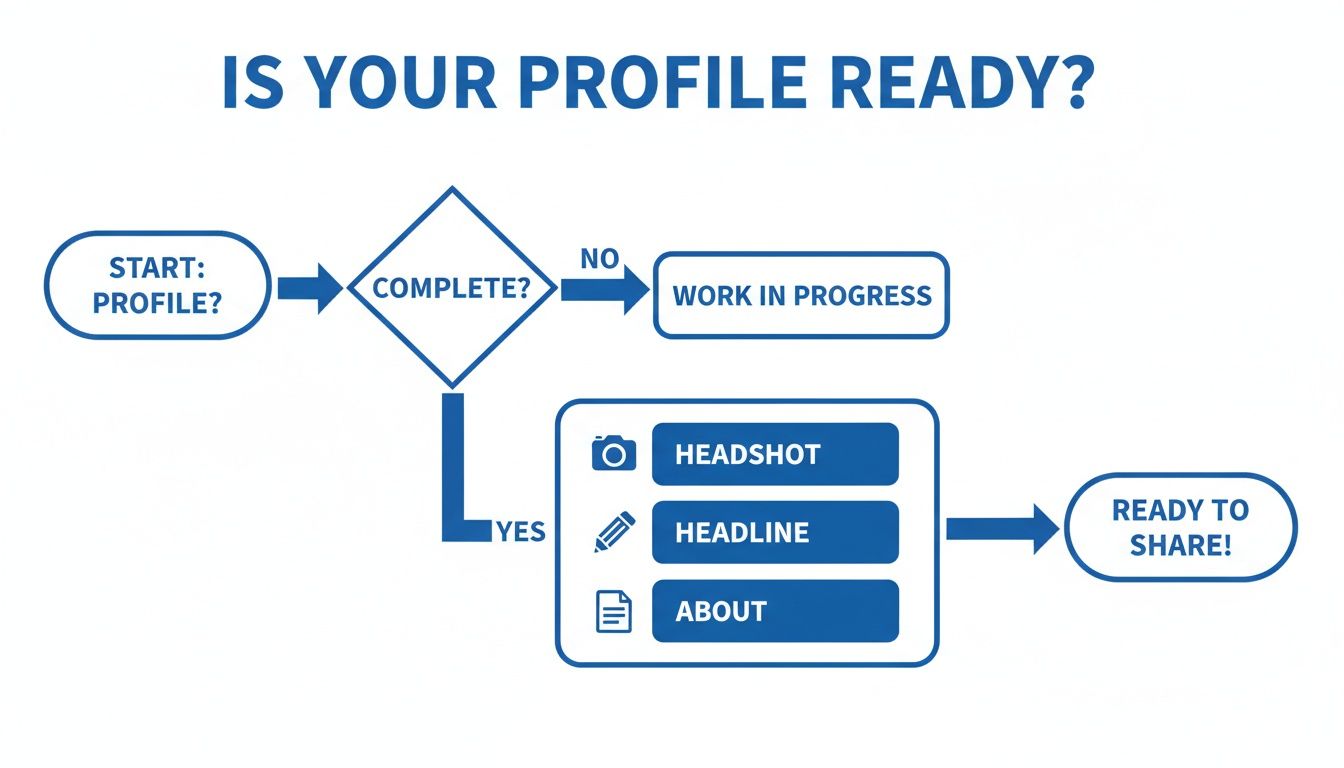
As the flowchart shows, getting the basics right—a professional headshot, a magnetic headline, and a well-written 'About' section—is non-negotiable. It’s the prerequisite for any successful networking on LinkedIn.
Mastering LinkedIn Search with Boolean Logic
That standard search bar on LinkedIn? It’s way more powerful than most people realize. You can move far beyond just typing in job titles by using Boolean search operators. These are simple commands that let you tell LinkedIn’s search engine exactly what you want.
Think of it as giving LinkedIn a very specific set of instructions. Here are the core operators I use all the time:
-
Quotes (""): Use quotes to lock in an exact phrase. For example, "content marketing manager" will pull up people with that exact title, filtering out anyone who's just a "Content Manager" or a "Marketing Manager." It’s a small trick with a big impact.
-
AND: This operator is for narrowing your search. A search for "sales" AND "SaaS" will only show you profiles that contain both keywords somewhere in them. Simple, but effective.
-
OR: This one broadens your search to include multiple options. If you're targeting the C-suite, you could search for "founder" OR "CEO". This brings back people with either title, which is perfect for reaching top decision-makers.
-
NOT: Use this to exclude things you don't want. Let's say you're looking for marketing professionals but want to avoid the real estate industry. You'd search for "marketing" NOT "real estate."
By mixing and matching these, you can build incredibly targeted search queries. A B2B consultant looking for startup leaders in the finance tech space could search: ("founder" OR "CEO") AND "fintech" NOT "intern". Boom. Your list of prospects just got a whole lot more relevant.
Using Boolean search is the difference between fishing with a single line and fishing with a targeted net. You'll spend way less time sifting through irrelevant profiles and get your ideal connections right in front of you, fast.
Go Deeper with Sales Navigator and Engagement Signals
While Boolean search is a game-changer on the free version of LinkedIn, if you’re really serious about lead generation, Sales Navigator is where the magic happens. It gives you another level of precision with advanced filters like company size, years in a role, and even recent job changes.
For instance, a SaaS founder could use it to find VPs of Marketing at companies with 50-200 employees who have been in their job for less than a year. Why is that so powerful? Because new leaders are almost always looking to shake things up with new tools and strategies.
Beyond search filters, you need to start paying attention to engagement signals. This is all about finding people who are already active in conversations that matter to your industry.
- Who is commenting on your competitors' posts? These folks are actively researching solutions and are clearly in the market.
- Who is RSVP'd to relevant LinkedIn Events? Events are a goldmine, gathering a concentrated group of people all interested in one specific topic.
- Who is active in niche LinkedIn Groups? Joining and participating in these groups puts you directly in touch with a pre-qualified audience.
When you find people who are already engaged, your outreach feels less like a cold interruption and more like a natural continuation of a conversation they're already having. It's a subtle shift, but it will dramatically improve your connection acceptance rate.
Write Connection Requests That Get Accepted
You've done the hard work. Your profile is polished, and you’ve pinpointed the exact people you want in your network. Now comes the moment of truth: the outreach.
This is where so many B2B professionals drop the ball. They fire off that generic, default "I'd like to add you to my professional network" message. Let’s be honest, that’s the digital equivalent of a limp handshake. It’s forgettable and screams low effort.
To build a network that actually means something, your connection request has to be a masterclass in personalization. It needs to feel real, give a clear reason for reaching out, and come across as the start of a genuine conversation, not a thinly veiled sales pitch. We put together 10 ready-to-use templates in our LinkedIn message for connecting guide if you want copy-paste examples for every scenario.

Think of it this way: your profile earned their attention, but your message has to earn their acceptance.
The goal is simple: make the recipient feel seen. A quick, personalized note can boost your acceptance rate by over 50%. It shows you've done your homework and respect their time.
The Anatomy of a Perfect Request
Every successful connection request I've sent (or accepted) comes down to three key ingredients. Nail these, and you’ll stand out in any inbox.
-
Establish Context (The Why): Immediately answer the question swirling in their head: "Why are you contacting me?" Maybe you have a shared connection, belong to the same industry group, or genuinely admire something they’ve posted. Leading with context instantly removes that "stranger danger" feeling.
-
Provide Value (The What): Briefly hint at what’s in it for them. This isn't about pitching. It's about suggesting a shared interest or a potential for collaboration down the road. Frame it as a mutually beneficial relationship.
-
Gentle Call-to-Action (The How): Keep it simple. End with a low-pressure invitation to connect. Do not ask for a call or 15 minutes of their time. The only goal here is to get them to click "Accept."
Let’s look at how this plays out in the real world.
Proven Templates for Different Scenarios
A word of warning: never just copy and paste. Use these as a launchpad, not a script. The magic is in the specific details you add.
Scenario 1: The Content Admirer
This is my go-to for connecting with thought leaders or people whose work I actually follow.
- Hi [Name], I just finished your article on [Topic], and your point about [Specific Insight] really hit home. Your perspective is something I'd love to follow more closely. Would be great to connect.
Scenario 2: The Shared Connection
This is one of the most powerful warm-ins you can have.
- Hi [Name], I see we're both connected with [Mutual Connection's Name]. I’ve always been impressed with their work in [Industry/Field], and I noticed you have a similar background. I'm building my network with sharp people in the [Industry] space and would love to connect.
Scenario 3: The Event Attendee
Perfect for turning a fleeting interaction at a webinar or conference into a solid connection.
- Hi [Name], I really enjoyed your question about [Topic] during the [Event Name] webinar today. It’s a challenge my team is also tackling. Hope you found the session as valuable as I did—would be great to connect.
A well-crafted connection request is the start, not the end, of the conversation. The initial message is just the opening line. Once they accept, your follow-up is what builds the actual relationship.
Navigating LinkedIn's Limits
It’s crucial to remember that LinkedIn has guardrails to prevent spam. While it’s not an official, published number, the platform generally caps you at around 100 connection requests per week.
But this isn't a target to hit; it's a ceiling to be aware of.
A much smarter—and safer—strategy is to focus on sending 15-20 highly personalized requests each day. This keeps your acceptance rate high, which signals to LinkedIn that you're a valuable member of the community, not a spammer. A high acceptance rate is your best friend for maintaining good account standing.
The opportunity here is massive. In 2017, LinkedIn had 18 million companies listed; by 2025, that number has shot up by 283% to 69 million. That’s a goldmine for anyone in B2B. It’s no surprise that 96% of B2B marketers use the platform for content and 77% say it delivers their best organic results. You can dig deeper into these LinkedIn lead generation statistics on sopro.io. Your personalized approach is how you stake your claim.
Use Content to Attract Inbound Connections
What if your ideal connections started coming to you? While sending outbound requests is a solid tactic, the real endgame is to become a magnet for your ideal network. This is where a content-driven strategy comes in, transforming your profile from a static resume into a dynamic hub that people genuinely want to follow.
Instead of always being the one reaching out, you create content that pulls the right people in. You start positioning yourself as a go-to expert, making others eager to join your network. It's amazing how a single, well-crafted post can bring in dozens of connection requests from the very prospects you were trying to find.
This strategy isn’t about going viral. It's about being consistently valuable and building a reputation that precedes any connection request you might send.
Shift From Hunter to Farmer
Think of your LinkedIn activity in two modes. Outbound networking is like hunting—you're actively seeking specific targets. Inbound networking, on the other hand, is like farming—you're cultivating an environment where opportunities naturally grow and come to you.
The key is to publish authority-building posts that solve real problems, offer a unique perspective, or just spark a meaningful conversation in your niche. When someone consistently sees you sharing insights that help them do their job better, connecting with you feels like a no-brainer.
Your content is your digital body language. It tells people who you are, what you care about, and how you think. Every post is a chance to build trust at scale with people you haven't even met yet.
Master Content Formats That Work
Not all content gets the same love on LinkedIn. To get a steady stream of inbound connections, you need to use formats that the platform's algorithm favors and that your audience actually finds engaging. My advice? Stop just sharing links to outside articles. Native content is what truly drives results.
Here are a few high-impact formats I always recommend focusing on:
- Insightful Text Posts: A simple, well-structured text post can be incredibly powerful. Share a personal story, a contrarian take on an industry trend, or a quick tactical tip. Just be sure to use short paragraphs and good spacing to make it easy on the eyes.
- Data-Driven Carousels: Carousels (which are really just PDF documents) are fantastic for breaking down complex topics into digestible slides. Use them to share checklists, frameworks, or key stats from a recent report.
- Engaging Short-Form Videos: Nothing builds a personal connection faster than a quick, 1-2 minute video of you talking directly to the camera. Share a quick thought, answer a common question, or react to industry news. Authenticity is what wins here, not high production value.
To really dig into creating posts that get noticed, check out our detailed guide on content creation best practices.
Consistency Is Your Superpower
Posting sporadically just doesn't cut it; your content will get lost in the feed. To build real momentum and attract those inbound connections, consistency is everything. The algorithm rewards it, and your audience will come to expect it.
Just how much of a difference does it make? Fresh 2025 data from Metricool's LinkedIn statistics report shows that posting weekly can boost your follower growth by 5.6 times and speed up following expansion by 7 times compared to only posting monthly. That's a massive impact, especially on a platform with over 1.2 billion members.
Of course, maintaining a steady flow of 3-5 high-quality posts per week can feel overwhelming. This is where having the right tools in your corner becomes essential for turning a major time-sink into a manageable workflow.
Engage Beyond Your Own Posts
Creating content is only half the battle. The other half is getting involved in the community. Your activity in the comments section of other people's posts is often just as visible as your own content, if not more so.
Make it a daily habit to leave thoughtful, insightful comments on posts from key people in your target network. Don't just drop a "Great post!" Add to the conversation. Ask a smart question, offer a different perspective, or share a related experience.
This two-pronged approach—creating your own valuable content and contributing to others' conversations—is how you become a recognized name in your field. You're showing you're not just broadcasting, but are an active, engaged member of the community. Before you know it, you'll see connection requests rolling in with notes like, "I've been following your comments and love your insights." That's when you know it's working.
Grow Your Network Without Getting Flagged
So, you've figured out a system that works. Your connection requests are landing, and conversations are starting. The first instinct is to floor it, right? Pump up the volume and get more results, faster.
Hold on. Scaling your LinkedIn networking is a delicate dance. If you go too hard, too fast, you risk tripping LinkedIn's safety alarms. That can get your account restricted, bringing your entire lead generation engine to a screeching halt.
The real goal is to grow efficiently while flying under the radar. It's about turning your manual, one-off actions into a structured, repeatable workflow that you can stick with day in and day out without looking like a bot. Think strategic, not just busy.
Craft a Sustainable Daily Workflow
Consistency beats intensity every single time. Firing off 100 connection requests on a Monday and then ghosting the platform for a week is a surefire way to get poor results and maybe even a suspension. What you really need is a manageable daily routine.
Think of it as a simple, high-impact checklist:
- Send Targeted Requests: Aim for 15-20 highly personalized connection requests. These should go to prospects you've already researched and qualified. It’s all about quality over quantity.
- Engage with Your Network: Block out 15 minutes to leave thoughtful comments on posts from key people in your industry. This isn't just about being seen; it's about building genuine rapport.
- Plant Content Seeds: Draft or schedule one piece of content. This doesn’t have to be a daily grind, but a consistent flow of valuable content is what draws inbound connections to you.
This rhythm keeps your activity looking natural to the algorithm and, just as importantly, prevents you from burning out.
Sustainable growth on LinkedIn isn't about finding secret hacks. It's about building a professional habit. A simple, repeatable process, done consistently, will always outperform frantic, aggressive campaigns in the long run.
Using Automation the Smart Way
Let's be clear: automation can be your best friend or your worst enemy. Used wisely, it saves you time and streamlines your work. Used recklessly, it's a one-way ticket to getting your account restricted.
Safe automation is all about making your existing workflow more efficient, not about faking human interaction. It's crucial to know the difference.
Here’s a quick rundown of what’s safe and what’s risky:
| Safe Automation (What to Do) | Risky Automation (What to Avoid) |
|---|---|
| Scheduling your own content ahead of time | Auto-commenting on other people's posts |
| Using tools for performance analytics | Sending automated, generic follow-up messages |
| Managing team approvals and workflows | Auto-endorsing skills or auto-visiting profiles |
| Finding contact information for outreach | Using tools that aggressively scrape data |
The right way to do this is with compliant tools that play by LinkedIn’s rules. If you're looking for guidance, we've put together a breakdown of the best LinkedIn automation tools that are built with account safety in mind.
Scaling for Teams and Measuring What Matters
When you’re working with a sales team or an agency, scaling outreach means everyone needs to be on the same page. Modern platforms help with this, offering features like content approval workflows and multi-profile scheduling. This keeps your brand messaging tight and consistent, even with multiple people posting.
This is the point where your outreach graduates from guesswork to a predictable system. You stop hoping and start knowing by tracking a few key numbers:
- Connection Acceptance Rate: Are you hitting 30% or higher? If not, it’s a strong signal that you need to refine your targeting or tweak your messaging.
- Reply Rate: How many of your new connections actually reply to your first message? This tells you if you're successfully starting real conversations.
- Inbound Connection Requests: Are people starting to reach out to you? This is the ultimate sign that your content and profile are hitting the mark.
Keeping an eye on these metrics allows you to fine-tune your process and build a scalable growth engine. And the opportunity is massive. LinkedIn is projected to hit 1.2 billion members in 2025, with over 75% living outside the US. This isn't just about vanity metrics; according to recent data from ReachSense on 2025's LinkedIn landscape, 53% of B2B marketers actively use the platform to source prospects. A smart, sustainable approach is your key to tapping into this global network.
Answering Your Top LinkedIn Connection Questions
Even with a great game plan, you're going to have questions as you start building out your network on LinkedIn. How many invites is too many? What’s the right thing to say after someone accepts? Let's tackle some of the most common hurdles I see professionals run into.
How Many Connection Requests Should I Send Per Day?
This one is all about finding the sweet spot between being proactive and looking like a spam bot. While LinkedIn has an unofficial weekly limit floating around 100 connection requests, your goal should never be to max it out. Hitting that ceiling over and over is a great way to get your account flagged.
A much smarter—and frankly, more effective—approach is to focus on quality, not quantity. I always advise people to aim for 15-20 highly personalized requests a day. This keeps your activity looking natural to LinkedIn's algorithm and, more importantly, it skyrockets your acceptance rate. A high acceptance rate tells the platform you're a valuable member of the community, not just someone blasting out generic invites.
To stay in LinkedIn's good graces:
- Keep an eye on your pending invites. If you pop into your "Sent" invitations and see hundreds of them just sitting there, it's a huge red flag that your approach isn't resonating. It can also hurt your account's standing over time.
- Clean up old requests. I make it a habit to go in every few weeks and withdraw any requests that are more than a month old. It shows you’re actively managing your networking efforts.
This measured pace is sustainable and builds a network that's actually engaged, not just bloated with numbers.
What Should I Do After Someone Accepts My Request?
That moment someone hits "Accept" is huge. It’s also where most people drop the ball. They either do nothing and let a warm opportunity go cold, or they immediately pounce with a sales pitch, which is a guaranteed way to get ignored.
Think of the acceptance as the start of the conversation, not the finish line.
The best first move is a simple, non-salesy thank you that opens the door for a real chat. Don't ask for a meeting. Don't pitch your product. Just be a human being.
Here’s a simple message I’ve used countless times that you can adapt:
"Thanks for connecting, [Name]. I saw your post the other day about [Topic] and thought your take on [Specific Point] was spot on. Looking forward to following your work."
This little message does so much. It acknowledges them, proves you're actually paying attention by referencing their work, and sets a positive tone for whatever comes next. The name of the game is to provide value and show genuine interest long before you ever ask for anything.
Is It Better to Have More Connections or Followers?
This is a classic question, and the real answer is: it completely depends on what you're trying to achieve. Connections and followers are two different tools in your toolkit, and knowing when to use each is crucial.
A connection is a two-way street. You can message each other directly, and you both see each other's content in your feeds. This is the bedrock of any real relationship-building or direct outreach.
A follower, on the other hand, is a one-way relationship. Someone can follow you to see your public posts without you connecting back. They get your updates, but you don't see theirs, and you can't slide into their DMs.
Here’s how I think about it:
| Goal | Primary Focus | Why It Matters |
|---|---|---|
| Lead Generation & Sales | Connections | You need to be able to start one-on-one conversations to explore opportunities. |
| Partnerships & Networking | Connections | Building real professional relationships requires that mutual access and communication. |
| Brand Awareness | Followers | This is about getting your message out to the widest possible audience to build your reputation. |
| Content Distribution | Followers | A bigger follower count simply means more eyeballs on your articles, videos, and posts. |
For most B2B pros I work with—people in sales, marketing, or business development—a targeted network of connections is far more valuable. These are the folks you can actually talk to.
That said, the ultimate strategy is a hybrid. You actively connect with your ideal prospects while also creating great content that naturally attracts a wider following. It’s truly the best of both worlds.
Ready to turn these strategies into a consistent, authority-building presence on LinkedIn? Postiv AI helps you create high-quality posts and carousels in minutes, combining a brand-trained AI writer with powerful design and scheduling tools. Stop the content grind and start building connections that matter. Discover how at https://postiv.ai.