Before you can even think about a content strategy, you need to turn your LinkedIn profile into a destination. It's the difference between a static, dusty resume and a dynamic, engaging hub that people actually want to follow.
Think of it this way: your profile is your digital storefront. If it’s messy or unclear, even the best content won't convince people to stick around. We're going to fix that by focusing on three critical areas: your headline, 'About' section, and 'Featured' section.
How to Optimize Your LinkedIn Profile for Follower Growth
People don't follow profiles; they follow people who provide consistent value, insight, and a clear point of view. A fully optimized profile is the first signal you send that you’re a creator worth following.
This isn’t just about filling in the blanks. It’s a strategic exercise. Every single element—from your banner image down to your skills—needs to work together to tell a cohesive story. Who are you? Who do you help? And what makes you uniquely qualified to do so? Nail this, and you’ve built the foundation for everything else.
Craft a Headline That Communicates Value
Your headline is the single most visible piece of real estate on your profile. It follows you everywhere—in search results, in comments, and on every post you make. It absolutely has to do more than just state your job title. A great headline instantly tells a visitor what you do, who you serve, and why they should care.
It's your personal elevator pitch, condensed into a single line.
- Weak Headline: "Content Strategist"
- Strong Headline: "B2B Content Strategist | Helping SaaS Startups Drive Leads with SEO-Focused Content | Ex-HubSpot"
See the difference? One is a generic label; the other is a specific solution. It immediately attracts the right kind of person. To skip the blank-page struggle, run your profile through our free LinkedIn headline generator and get three ranked options in seconds. To make certain phrases stand out, you can use a LinkedIn bold text generator to add some punch.
Write an 'About' Section That Tells a Story
This is your chance to move beyond a dry, third-person career summary. The 'About' section is where you connect with people on a human level. Use a conversational, first-person voice to share your professional story, what drives you, and the expertise you bring to the table.
A simple structure I’ve found effective is:
- Start with a strong hook: Open with a direct statement about who you help and what problems you solve.
- Share your "why": Briefly explain what gets you excited about your work.
- Provide social proof: Mention key results, accomplishments, or notable clients to build credibility.
- End with a call to action: Tell people what to do next. "Follow me for daily marketing tips" works perfectly.
Showcase Your Best Work in the 'Featured' Section
The 'Featured' section is your portfolio, front and center. It's prime real estate to show, not just tell, what you can do. Letting this space sit empty is a huge missed opportunity.
Use it to pin your most popular posts, link to articles you've published, or showcase compelling case studies. A short introductory video also works wonders here. It provides immediate, tangible value to anyone who lands on your profile.
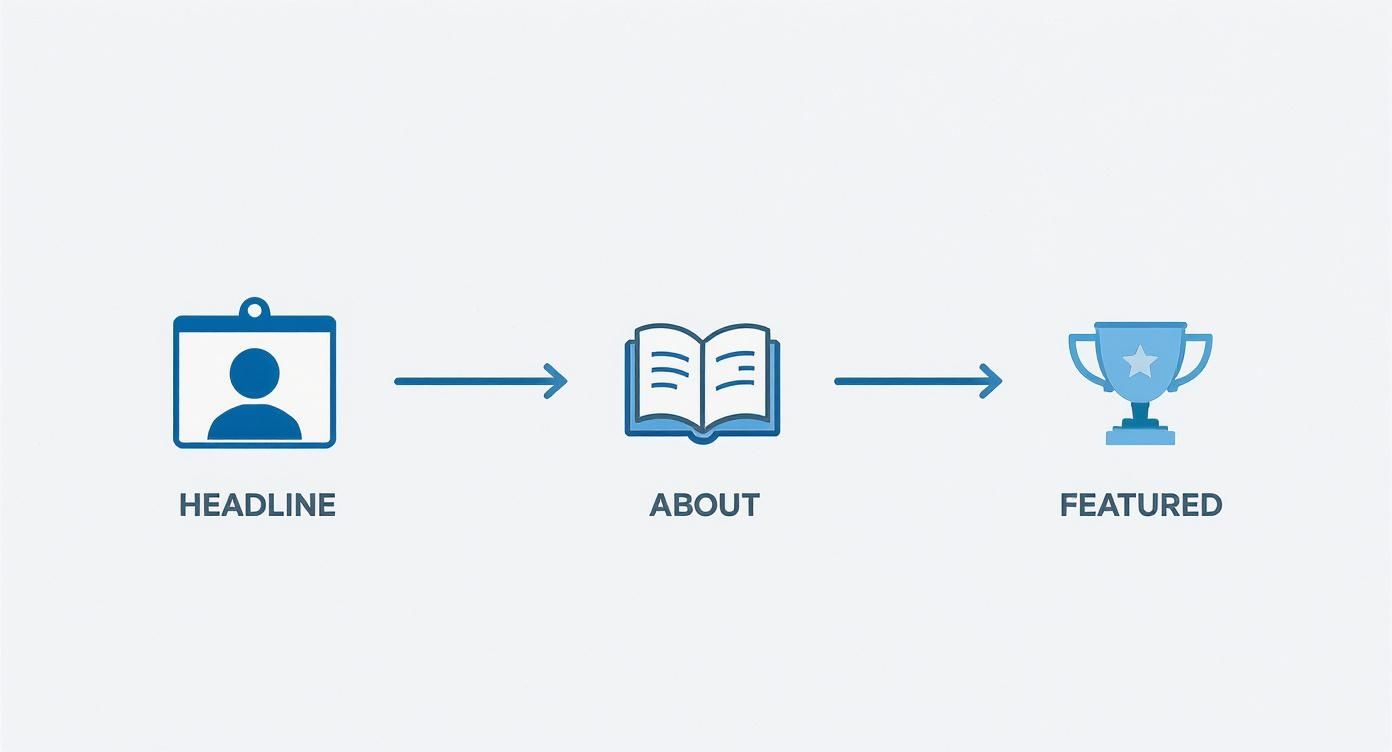
This workflow shows how these three elements work together. You grab attention with the headline, build a connection with your 'About' story, and then provide concrete proof in the 'Featured' section.
To help you get started, here's a quick-reference table breaking down the most important profile elements and how to optimize them for follower growth.
Key Profile Elements for Attracting Followers
| Profile Element | Optimization Goal | Actionable Tip |
|---|---|---|
| Headline | Grab attention & clarify value | Go beyond your job title. Use the formula: "I help [Target Audience] achieve [Result] through [My Method]." |
| Profile Photo | Build trust & appear professional | Use a high-quality, professional headshot where you're looking at the camera and smiling. No logos or group photos. |
| Banner Image | Reinforce your brand or mission | Design a custom banner that includes a tagline, your website, or a value proposition. Keep it clean and simple. |
| About Section | Tell a compelling story | Write in the first person. Start with a hook, share your "why," include social proof, and end with a call to action. |
| Featured Section | Showcase expertise & provide value | Pin your best content: a high-performing post, a link to a valuable resource, or a client case study. |
| Experience | Add credibility with results | For your current and recent roles, use 2-3 bullet points focused on quantifiable achievements, not just responsibilities. |
By methodically working through these key areas, you'll transform your profile from a passive resume into an active, compelling destination for your ideal audience.
Your LinkedIn profile should answer a visitor's unspoken question: "Why should I listen to you?" Each optimized section builds a stronger, more convincing answer.
With a platform that adds 2-3 new users per second and now has over 1 billion members, standing out is non-negotiable. For anyone in the B2B space, this is the main event: 97% of B2B marketers use it for content marketing, and it's where 80% of high-quality B2B leads from social media originate. This massive, engaged audience is actively looking for experts to follow, which is exactly why a polished profile is the first and most critical step.
What Content Strategy Grows LinkedIn Followers Fastest?
If your optimized profile is the stage, your content strategy is the main event. You can have the best-looking profile in the world, but without a steady stream of valuable, engaging content, you’ll be performing to an empty room. This is where you stop just having a presence and start building a real community.
The goal? Become the go-to resource for your ideal audience. You get there by creating a reliable flow of content that teaches, inspires, and gets people talking. That’s how you turn casual profile visitors into loyal followers who can't wait to see your next post.

Establish Your Core Content Pillars
You can't be everything to everyone, and trying is the fastest way to get ignored. The most successful creators on LinkedIn build their authority around a few core topics. We call these content pillars. Think of them as the 3-5 key themes you’ll own—the intersection of your expertise and your audience’s biggest needs.
For example, if you're a B2B marketing consultant, your pillars might look something like this:
- Lead Generation Strategies
- SEO for SaaS Companies
- Content Marketing ROI
- Marketing Team Leadership
Defining your pillars brings incredible focus. It makes content creation way less daunting and signals to potential followers exactly what they'll get by hitting that "Follow" button. Every single post should tie back to one of these themes, reinforcing your expertise and building a cohesive personal brand.
Mix Up Your Content Formats for Maximum Engagement
Posting the same type of content over and over is a recipe for a stale feed. To keep your audience hooked and pull in new followers, you need to vary your content formats. Each one serves a different purpose, from delivering a quick hit of insight to offering a detailed breakdown of a complex topic.
-
Text-Only Posts: Perfect for telling a personal story, sharing a contrarian take, or dropping a quick, actionable tip. Their simplicity is their superpower—they're easy to scan and fantastic for sparking conversation.
-
Image Posts: A single, powerful image or a clean graphic can literally stop the scroll. Use them to visualize a key piece of data, share an inspiring quote, or give a behind-the-scenes look at your work.
-
Carousels (PDFs): These are absolute powerhouses for teaching. You can break down complicated ideas into simple, swipeable slides. They’re brilliant for creating how-to guides, checklists, and mini-presentations that pack a ton of value.
-
Native Video: There's a reason video is blowing up on LinkedIn. Short, authentic videos where you share a quick thought or a tip build a powerful personal connection and often drive massive engagement.
And the data backs this up. Recent studies show LinkedIn pages with 1,000 to 5,000 followers grew their audiences by over 40% year-over-year, outpacing even much larger accounts. This growth is being driven by dynamic content strategies, with video posts seeing an average engagement rate of 5.60%. If you're a data geek, you can explore the full social media benchmark report for more trends.
Key Takeaway: Your content strategy isn't a monologue. It's a conversation. Mix up your formats to keep your audience on their toes, showcase the full range of your expertise, and appeal to different learning styles.
Structure Your Posts for Scannability
Let's be real: people on LinkedIn are busy. They're scrolling fast, and you’ve got maybe two seconds to grab their attention. This means how you write your post is just as important as what you write. Big walls of text are the enemy.
Your writing needs to be "thumb-stopping." Here's how:
- Start with a Killer Hook: The first line is everything. It has to be compelling enough to make someone stop scrolling and click "...see more." Ask a provocative question, state a bold opinion, or tease a valuable takeaway.
- Use Short Paragraphs: Seriously. One or two sentences max. This creates precious white space, making your content infinitely easier to read on a phone.
- Break It Up with Lists: Use bullet points or numbered lists to make key points pop. It makes your advice feel structured and easy to digest.
- End with a Clear Call to Action (CTA): Don't just end your post. Tell people what to do next. A simple "What are your thoughts?" or "Share your experience below" can make a huge difference in your engagement.
This simple structure ensures your message lands clearly and quickly. You're respecting your audience's time, which makes them far more likely to engage and follow you for more. For a deeper dive, our guide on building a winning LinkedIn content strategy covers even more advanced tactics.
Create Content That Screams Authority and Authenticity
Ultimately, your goal is to build a content engine that consistently produces posts that are both authoritative and authentic. Finding that sweet spot is what turns a simple professional profile into a must-follow personal brand.
- Authoritative Content is where you prove your expertise. This is your industry analysis, your data-backed insights, your detailed how-to guides, and your case studies. This is the content that says, "I know my stuff."
- Authentic Content is where you show the person behind the expertise. This is where you share personal career stories, lessons from your failures, a glimpse behind the curtain of your work, and your real opinions. This is the content that says, "I'm a human you can trust."
When you weave these two threads together, you create a narrative that’s impossible to ignore. You'll attract followers for your knowledge, but they'll stay for your personality.
How Often Should You Post on LinkedIn to Gain Followers?
Having a brilliant content strategy is one thing, but executing it consistently is where most people fall off. If you only post sporadically, you're sending mixed signals to the LinkedIn algorithm and anyone who might want to follow you. A steady, reliable rhythm, on the other hand, shows you're a serious voice in your space and worth listening to.
The goal isn't to post yourself into burnout. It's about building a sustainable system that lets you show up regularly, so your audience starts to expect—and even look forward to—your content. This kind of predictability is one of the biggest factors in growing your follower count for the long haul.
What Is the Best Posting Frequency to Grow LinkedIn Followers?
So, what's the magic number for posting? While it varies, the data points to a clear sweet spot. For most professionals trying to build real momentum, 3-5 high-quality posts per week is the ideal target.
Sure, you can post daily if you have a team or a massive content engine, but it’s a quick path to creative fatigue for most. On the flip side, posting less than twice a week makes it nearly impossible to stay top-of-mind. That 3-5 range strikes the perfect balance—it keeps your feed active and gives each post enough time to get traction.
This consistency matters more now than ever. Recent shifts in LinkedIn's algorithm have led to a 50% decrease in views and a 59% drop in follower growth for many creators as the platform favors quality. But here's the good news: pages that post at least weekly still see 5.6 times more follower growth. This proves that a regular cadence is your best bet for navigating these changes. You can dive deeper into the latest LinkedIn statistics and trends to see the full picture.
Build a Smart Content Workflow
Consistency isn't about willpower; it’s about having a system. Stop waking up and asking, "What should I post today?" The best way to get ahead is with content batching.
This just means you set aside a dedicated block of time to create all your content at once. Maybe you block off two hours on a Friday afternoon to write, design, and schedule every post for the following week. Simple as that.
This method is a game-changer for a few reasons:
- Keeps You Focused: It lets you get into a creative groove without constantly switching between tasks.
- Saves You Time: It's way more efficient than trying to create something from scratch every single day.
- Ensures Cohesion: You can make sure your content for the week flows together and supports your core themes.
A planned content calendar is your best defense against inconsistency. It transforms content creation from a daily chore into a strategic, manageable task.
Use Scheduling Tools and Post at the Right Times
Once you've batched your content, the next step is scheduling it. Using a tool like Postiv AI or another scheduler isn't a "nice-to-have"—it's a must for a sustainable workflow. Scheduling frees you from the pressure of having to be online at the perfect moment to hit "publish."
It also lets you take advantage of the best times to post on LinkedIn, which is when your audience is most active. General trends point to high engagement during these windows:
- Mid-mornings (8-11 AM) on Tuesdays, Wednesdays, and Thursdays.
- Commuting hours when professionals are scrolling through their feeds.
Ultimately, your own analytics are your best guide. Experiment with different time slots and see which ones get you the most engagement in the first couple of hours. Scheduling your posts for these peak windows gives your content the initial boost it needs to reach a wider audience and, you guessed it, attract more followers.
How to Quickly Gain LinkedIn Followers Through Engagement
Look, posting great content is fantastic, but it's only half the story on LinkedIn. If you just post and ghost, you're missing the entire point. Growth on this platform isn't a one-way broadcast; it's a conversation. Proactive, smart engagement is the fuel that will actually pull new, relevant followers to your profile. It's how you break out of your bubble and get discovered.
You have to give to get. Plain and simple. When you consistently engage with other people's content, you're not just being nice—you're positioning yourself as a thoughtful expert, building real relationships, and creating a feedback loop where the platform starts rewarding you with more visibility. This is the secret to shifting from just another content creator to a genuine presence in your industry.

The LinkedIn feed is where the magic happens. It’s a dynamic, conversation-driven space, and your insightful comments can be the perfect introduction to your future followers.
Master the "Comment to Connect" Strategy
One of the most powerful and criminally underused methods for growth is what I call the "Comment to Connect" strategy. The concept is brilliantly simple: find posts from influential people in your niche and leave comments that actually add value. This isn't about dropping a lazy "Great post!" and moving on.
Your goal is to become part of the conversation. I've seen a single high-value comment get more eyeballs than one of my own posts. When you leave a comment that offers a unique perspective, asks a smart question, or shares a relevant story, you're doing two critical things at once:
- You get noticed by the original poster and their entire audience.
- You showcase your expertise without coming across as self-promotional.
People who see your insight will get curious. They'll click on your name, and if your profile is dialed in (like we talked about earlier), they'll hit "Follow." I highly recommend dedicating 15-20 minutes every single day to this. It’s one of the highest-ROI activities you can possibly do.
Send Connection Requests That People Actually Accept
While followers are the main goal, strategic connections are your secret weapon for expanding your network's reach. But let's be real—a generic, empty connection request is practically a guaranteed "ignore." To make this work, you have to personalize every single one.
Never, ever send a request without a note. Your note should be short, sweet, and give them a reason why. Mentioning a shared connection, a piece of their content you genuinely enjoyed, or a common industry interest makes your request feel human, not like you're just trying to rack up numbers.
Here’s a personalized request that works:
"Hi [Name], I really enjoyed your recent post on the future of B2B content marketing. Your point about interactive content resonated with me. I'm also passionate about this space and would love to connect and follow your work."
This approach shows you've done your homework and actually value what they have to say. It dramatically increases the odds they’ll accept and check out your profile.
Treat Your Own Comment Section Like Gold
Growth isn't just about what you do on other people's posts; it’s about fostering a community on your own. When someone takes the time to comment on your content, that's a golden opportunity. Responding to every single one isn't just polite—it's non-negotiable for growth.
This does more than just make the commenter feel seen. It gives your post a massive algorithmic boost. The LinkedIn algorithm absolutely loves seeing active conversations. Posts with lively, back-and-forth comment threads get pushed out to a much wider audience.
Here’s how to make your responses really count:
- Acknowledge their point. Show you've actually read and considered what they said.
- Ask a follow-up question. This is key. Keep the conversation going and invite more replies.
- Tag them in your reply. This sends them a notification and makes it easy for them to jump back in.
A thriving comment section is a huge social signal. It tells both the algorithm and new visitors that your content is valuable and that you’re an engaged, approachable expert worth following.
By getting into the trenches and actively participating in conversations across the platform, you build a reputation as a contributor, not just a broadcaster. This strategic approach to engagement is the most organic and effective way to expand your network, attract your ideal audience, and steadily grow your following on LinkedIn.
Grow LinkedIn Followers Organically Through Collaboration
One of the most overlooked LinkedIn follower growth strategies is collaboration. Instead of trying to build an audience entirely on your own, partner with other creators and professionals in your niche. This lets you tap into established audiences that are already interested in your topic.
Collaborate with Other LinkedIn Creators
Joint content is a shortcut to faster organic growth. Consider these approaches:
- Co-authored posts or carousels: Partner with a complementary creator to produce a piece that you both share. Each of you exposes the other to your respective audiences.
- Shoutouts and recommendations: Genuine public endorsements from respected voices in your industry carry immense weight. Tag collaborators when celebrating shared wins or milestones.
- Cross-platform promotion: Share your best LinkedIn content on newsletters, podcasts, or other social channels. Every touchpoint is an opportunity to drive new followers back to your profile.
The principle here is simple: choose collaboration over competition. Two creators with 2,000 followers each can both reach 4,000 people through a single joint post. That kind of leverage is hard to replicate alone.
Earn a Top Voice Badge with LinkedIn Collaborative Articles
LinkedIn's Collaborative Articles feature is one of the most underused tools for growing followers organically. When you contribute expert answers to AI-generated article prompts, LinkedIn may award you a "Top Voice" or "Community Top Voice" badge in your topic area.
This badge appears next to your name across the platform, instantly boosting your credibility. More importantly, your contributions appear on high-authority LinkedIn pages that get significant search traffic, sending a steady stream of new profile visitors your way.
To get started, search for collaborative articles in your area of expertise and add genuinely insightful contributions. Focus on topics aligned with your content pillars. Consistency matters here too—regular contributions signal to LinkedIn that you're a subject matter expert worth highlighting. Your LinkedIn SSI score also benefits from this kind of activity, which further amplifies your visibility.
Best Tools and Analytics for LinkedIn Follower Growth
To really grow your following on LinkedIn, you need more than just good ideas. You need a system. If you're just waiting for inspiration to strike each morning, you're setting yourself up for burnout and inconsistent results. The real secret to scaling your presence is to work smarter, not harder. That means using the right tools to build an efficient workflow and letting data guide your strategy.
This is all about shifting from a reactive approach—scrambling to write a post every day—to a proactive one. You’ll be creating, scheduling, and analyzing with a clear purpose. A well-oiled machine doesn't just save you hours; it makes sure every single piece of content is a calculated step toward your growth goals.
Build Your Modern LinkedIn Tech Stack
Building an effective LinkedIn workflow doesn't mean you need a dozen complex subscriptions. It's actually about finding a few key tools that do the heavy lifting for you: content creation, scheduling, and analysis. This smart combination is what I see separating the accounts that are stuck from those with steady, predictable growth.
Here's what a simple but powerful stack looks like:
- A Content Creation Assistant: This is your secret weapon against the blank page. I've found tools like Postiv AI are built for this exact problem. They can help you brainstorm ideas, draft posts in your own voice, and even design professional-looking carousels in minutes.
- A Reliable Scheduler: Consistency is everything on LinkedIn. A scheduling platform ensures your content goes live at the best times, even when you’re busy with other things. It's fundamental for maintaining a constant presence.
- LinkedIn’s Native Analytics: Your best feedback loop is already built right into the platform. This is where you find the unfiltered truth about what your audience loves and what they're ignoring.
By integrating these tools, you turn content creation from a daily chore into a strategic process. You can batch a week's worth of content in an afternoon, schedule it for maximum impact, and then spend your valuable time actually engaging with people.
Before we dive into what metrics to track, let's look at how these tools fit together. A solid workflow is your foundation for growth.
LinkedIn Growth Tool Comparison
Here’s a quick comparison of the essential tools that can help you build an efficient and scalable LinkedIn workflow, from initial idea to final analysis.
| Tool Category | Example Tool (e.g., Postiv AI) | Primary Function | Impact on Follower Growth |
|---|---|---|---|
| Content Ideation & Creation | Postiv AI | Generates post ideas, drafts text, and designs carousels based on your voice and expertise. | Helps you consistently produce high-quality, relevant content that attracts your target audience. |
| Content Scheduling | Buffer or Hootsuite | Automates posting at optimal times to maintain a consistent presence. | Ensures your content reaches your audience when they're most active, increasing visibility and engagement. |
| Visual Design | Canva | Creates custom graphics, carousels, and video thumbnails to make posts stand out. | Visually appealing content stops the scroll and often gets higher engagement, leading to more profile views. |
| Performance Analytics | LinkedIn Native Analytics | Tracks impressions, engagement, and follower demographics directly on the platform. | Provides direct feedback on what's working, so you can double down on content that attracts new followers. |
Choosing the right combination of tools allows you to focus less on the manual work and more on the strategy behind your growth.
Which Metrics Actually Drive LinkedIn Follower Growth?
LinkedIn gives you a ton of data, but honestly, not all of it matters for growing your follower count. It’s way too easy to get caught up in vanity metrics that feel good but don't actually move the needle. To focus your energy, you need to track the numbers that have a direct link to audience growth.
Here’s what I keep a close eye on:
- Impressions: This is your reach. Are more people seeing your posts this month than last month? A steady climb in impressions is the first sign that the algorithm is showing your content to a wider audience, which creates more opportunities to earn followers.
- Engagement Rate: This number tells you if your content is actually interesting. It's calculated by adding up your likes, comments, and reposts, and then dividing by your impressions. A high engagement rate signals to LinkedIn that your content is valuable, and the platform will reward you with even more reach.
- New Follower Demographics: Dive into the "Followers" tab in your analytics. Here, you can see the job titles, industries, and locations of your newest followers. Does this match the audience you're trying to attract? If there's a disconnect, it’s a sign to tweak your content pillars.
Your analytics dashboard is your roadmap. It tells you exactly what your audience wants more of. Ignoring it is like driving with your eyes closed—you might be moving, but you probably aren't heading in the right direction.
The Analyze and Iterate Loop
Data is useless if you don't act on it. The final, and most important, step is creating a feedback loop. You analyze your performance and use those insights to make your next batch of content even better. This is how you get that compounding growth everyone talks about.
Set aside a little time each month to review your analytics and ask yourself these questions:
- What was my top-performing post? Look at everything—the format (text-only, carousel, video), the topic, and the hook. What was the magic ingredient?
- What was my worst-performing post? Be honest here. What fell flat? Was the topic too niche, or was the opening line just not compelling enough?
- Which posts drove the most followers? LinkedIn Analytics will show you follower gains from specific posts. These are pure gold. Double down on these topics and formats.
For example, if you see that a carousel breaking down a complex industry trend brought in a wave of new followers, that's a huge clue. It's time to create more in-depth, educational carousels. If a text-only post about a personal lesson learned got massive engagement, it shows your audience connects with authenticity. You're no longer guessing; you're making data-driven decisions that speed up your growth.
This continuous cycle of creating, measuring, and refining is the real engine of sustainable growth. As you scale, you might even start thinking about upgrading your account. If you get to that point, our guide on whether LinkedIn Premium is worth it can help you decide if it's the right time to invest.
Frequently Asked Questions About Growing LinkedIn Followers
Even with the best playbook, you're bound to have questions as you start putting these strategies into action. Growing a following on LinkedIn isn't always straightforward. Let's dig into some of the most common questions I hear from people trying to build their presence.
How Long Does It Take to Grow LinkedIn Followers?
I get this one a lot. Everyone wants to know when the hard work pays off, and the honest answer is: it's a marathon, not a sprint.
If you're truly committed—posting high-quality content 3-5 times a week and actively engaging every day—you'll likely start to feel real momentum within 3 to 6 months. The first couple of months can feel like you're shouting into the void, but stick with it. Your efforts build on each other, and once the algorithm starts to see you as a consistent voice in your niche, your visibility snowballs.
Should You Accept Every LinkedIn Connection Request?
It's so tempting to hit "accept" on every request to watch that connection count climb, right? But this is a classic quality-over-quality mistake. A smaller, focused network will do more for your growth in the long run.
Think about it this way: a network of 1,000 engaged connections who actually care about what you post is far more valuable than 10,000 random connections who scroll right past your content.
Focus on connecting with:
- People who are actually in your industry or target audience.
- Professionals in related fields where you can share insights.
- Anyone who takes the time to send a personalized note.
A curated network is a growth multiplier. Each relevant connection is a signal to LinkedIn's algorithm, telling it exactly who else needs to see your content.
What Type of LinkedIn Content Gets the Most Followers?
The secret is to use both. They play different, equally important roles in building an audience that sticks around.
Your professional advice—the industry deep dives, the how-to guides, the trend analyses—is what builds your authority. It's the reason people follow you in the first place; they want your expertise.
But your personal stories are what build authenticity and connection. Sharing a bit of the behind-the-scenes journey makes your professional advice land with more impact because people feel like they know you. A good rule of thumb is the 80/20 mix: 80% professional value, 20% personal stories.
Do Hashtags Help You Get More LinkedIn Followers?
Absolutely. Hashtags are still one of the most direct ways to get your content in front of a new audience. Think of them as signposts that tell LinkedIn what your post is about and who might be interested in it.
The key is to be strategic, not spammy. Aim for 3-5 highly relevant hashtags per post. I usually recommend a simple mix:
- Broad industry tags: (e.g., #Marketing, #SaaS)
- Niche-specific tags: (e.g., #B2BContentStrategy, #ProductLedGrowth)
- A branded or personal tag: (e.g., #YourCompanyName, #MarketingWithMaria)
This approach helps people who are already looking for your expertise find you, which is the most natural way to grow your LinkedIn followers.
Can You Grow LinkedIn Followers Organically Without Paying for Ads?
Yes. Focus on three fundamentals: optimize your profile so it clearly communicates what value you offer, post consistently useful content 3-5 times per week around defined content pillars, and spend 15-20 minutes daily engaging on other creators' posts. Organic growth takes 3-6 months to build momentum, but it compounds over time and attracts higher-quality followers than paid methods. If you need help staying consistent, building a personal brand on LinkedIn is the single best long-term investment you can make.
How Do You Grow Followers on a LinkedIn Company Page?
Most LinkedIn follower growth strategies work for both personal profiles and company pages. The biggest difference is that company pages should activate employee advocacy, because when team members share and engage with page content it dramatically expands organic reach. Also make sure to add a Follow button to your website and email signatures, and cross-promote your page on other social channels. Post a mix of thought leadership, behind-the-scenes content, and industry insights to keep the page feeling human and worth following. Pages have their own setup rules and reach mechanics, so it is worth working through the LinkedIn company page best practices that apply specifically to brand accounts.
How Does the LinkedIn Algorithm Affect Follower Growth?
The LinkedIn algorithm in 2026 rewards content that sparks meaningful conversation in your niche. Posts that generate thoughtful comments (not just likes) get shown to a wider audience. The algorithm also favors creators who consistently post on a focused set of topics, which helps LinkedIn understand who should see your content. Engaging with others' posts before and after you publish also signals to the algorithm that you are an active, valuable community member.
What Is the Fastest Way to Get More LinkedIn Followers?
The fastest organic methods include the Comment to Connect strategy (leaving insightful comments on high-visibility posts in your niche), collaborating with other LinkedIn creators through joint content or shoutouts, and contributing to LinkedIn collaborative articles to earn a Top Voice badge. Creators who combine these tactics with consistent 3-5x weekly posting often see the strongest follower growth within the first 90 days. For specific post structures that drive engagement, check out our guide on how to write LinkedIn posts that stop the scroll.
Ready to stop guessing and start creating high-impact LinkedIn content that attracts followers? With Postiv AI, you can generate on-brand posts, design stunning carousels, and schedule everything in minutes, not hours. See how it works at https://postiv.ai.